


To sing better, build a few core skills and practice them regularly: warm up before you sing, breathe low and steadily, release tension in your jaw, tongue and neck, sing in a range and key that suit you, and train your pitch. For a quick improvement today, warm up, stand tall, choose an easier key and lighten your high notes. For lasting progress, record yourself, practice with a plan on most days, and get feedback from a teacher who can hear what you can’t.
Key takeaways
- Quick fixes such as warming up, posture and the right key can help your singing today.
- Lasting improvement comes from breath, tone, pitch, range and musicianship working together.
- Short, focused practice on most days beats occasional long sessions.
- Record yourself and get feedback, because you can’t fully hear yourself as you sing.
How to sing better instantly: eight quick fixes
Real progress takes practice, but these changes can make a noticeable difference the next time you sing.
- Warm up first. Even a short warm-up of lip trills, humming and easy scales makes your voice more responsive. Try our vocal warm-up routine.
- Stand tall and loose. Balance your head over your shoulders, soften your knees and let your shoulders drop. See alignment.
- Breathe low. Let the breath drop in so your ribs and sides expand, without lifting your shoulders. See how to breathe when singing.
- Choose the right key. If a song strains at the top or disappears at the bottom, change the key. It’s the single fastest fix for many singers.
- Lighten your high notes. Sing a little softer as you go up instead of pushing. High notes often get easier and sound better.
- Relax your jaw and tongue. Let the jaw hang loosely and the tongue rest forward. Tension there makes the sound tight.
- Sing the words, not just the notes. Think about what the song means and who you’re singing to. Expression changes your sound.
- Hear it before you sing it. Imagine each phrase clearly in your head first. You’ll land pitches more cleanly.
Seven skills that make you a better singer
Over time, better singing comes from developing a handful of core skills. Each one supports the others, so working on any of them helps your whole voice.
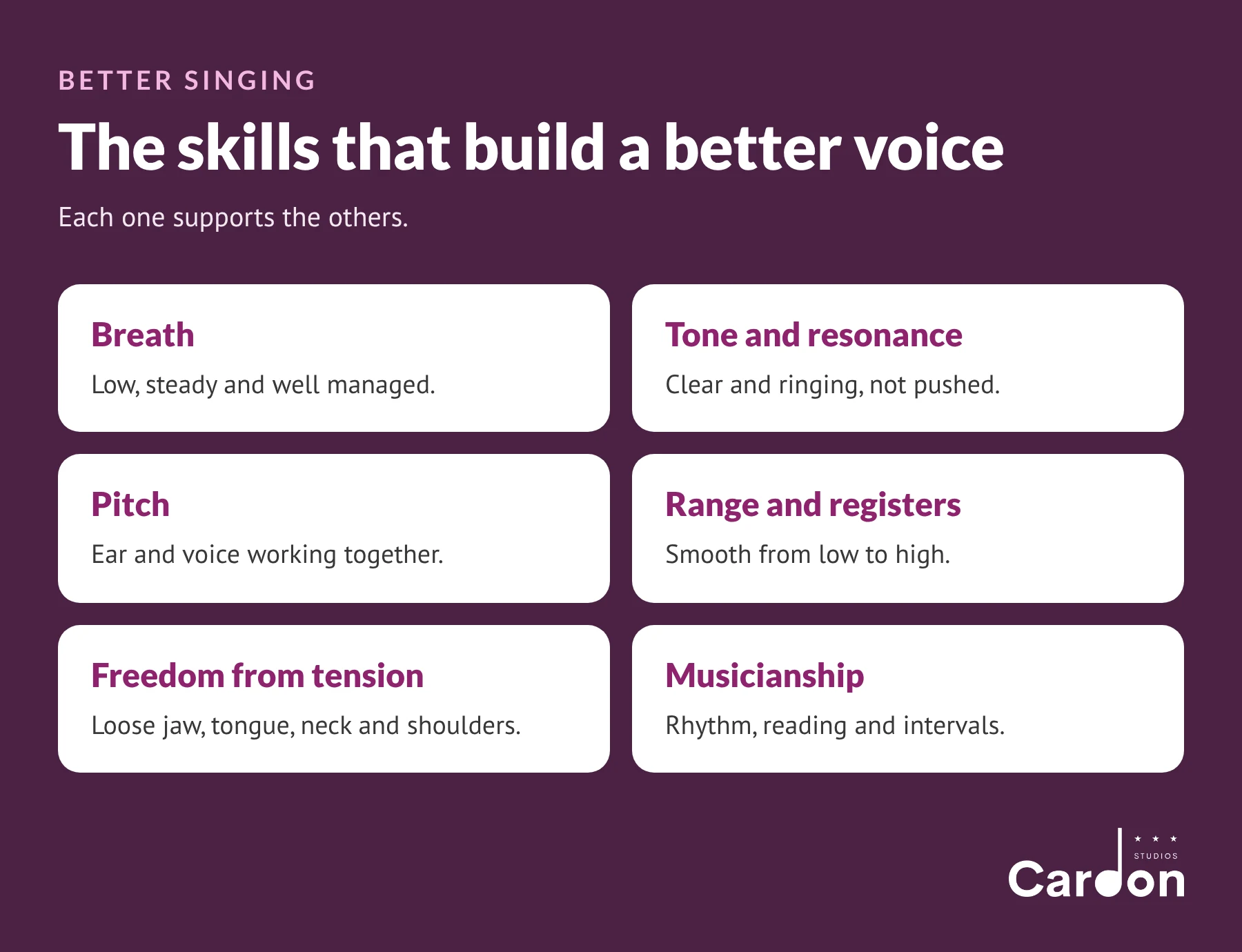
1. Breath and support
Steady, well-managed breath underlies everything else. Learn to breathe low and release air evenly. Read our breathing primer and what breath support really is.
2. Tone and resonance
A clear, resonant sound carries without pushing. Humming, lip trills and bright vowels help you find it. See vocal projection.
3. Pitch
Singing in tune is a trainable coordination between your ear and your voice. Our guide to how to sing in tune has exercises to build it.
4. Range and registers
A better singer moves smoothly from low to high. Learn your chest voice and head voice, then blend them with a mixed voice. For low notes, see how to sing low notes.
5. Freedom from tension
Tension in the jaw, tongue, neck or shoulders limits everything. See releasing tension when singing.
6. Musicianship
Rhythm, reading music and hearing intervals help you learn songs faster and sing them more accurately. See musicianship for singers and sight singing.
7. Expression and performance
Great singing tells a story. Work on meaning, dynamics and stage presence, and get comfortable being heard. See how to prepare for a singing performance and conquering stage fright.
Practice that makes a difference
How you practice matters more than how long. A short, focused session on most days builds good habits faster than an occasional marathon, and it’s easier on your voice. A simple session looks like this: warm up, do one exercise from your lesson, work on one tricky phrase, sing the song through, and note one thing to ask your teacher.
Our guide to how to practice singing has a full routine and a sample practice week. If you’re just getting started, read singing tips for beginners.
How to get better at singing: a four-week plan
To get better at singing, focus on one skill at a time for a week while keeping a short routine on most days. This plan puts the seven skills above in order, starting with the ones the others depend on.
| Week | Focus | On each practice day |
|---|---|---|
| 1 | Breath and warm-up | Warm up with lip trills and humming. Then take five slow breaths: let the air drop in low, and hiss it out evenly on “sss.” Sing one easy song through. |
| 2 | Tone and tension | Hum into “ah” (mm-ah) on five-note scales, four repetitions, checking your jaw, tongue and shoulders between each one. |
| 3 | Pitch | Play or hear a note, hum it, then sing it on “oo,” for five different notes. Sing a slow song and record it. |
| 4 | Range and the song | Glide on “oo” or a lip trill from low to high and back, three times. Work the hardest phrase of your song slowly, then sing it through and record it. |
Keep each session short enough that your voice feels as good at the end as it did at the start, and repeat a week if it still feels new. Stay comfortable, and stop if anything hurts.
At the end of week four, compare your two recordings. Choose your next focus from the skill that still sounds weakest, and plan another four weeks around it. Our guide to the benefits of recording yourself explains what to listen for, and if one problem keeps coming back, our guide to common vocal problems can help you find the cause.
Habits that hold singers back
Six habits slow most singers down. Here they are side by side with what to do instead, followed by why each one matters.
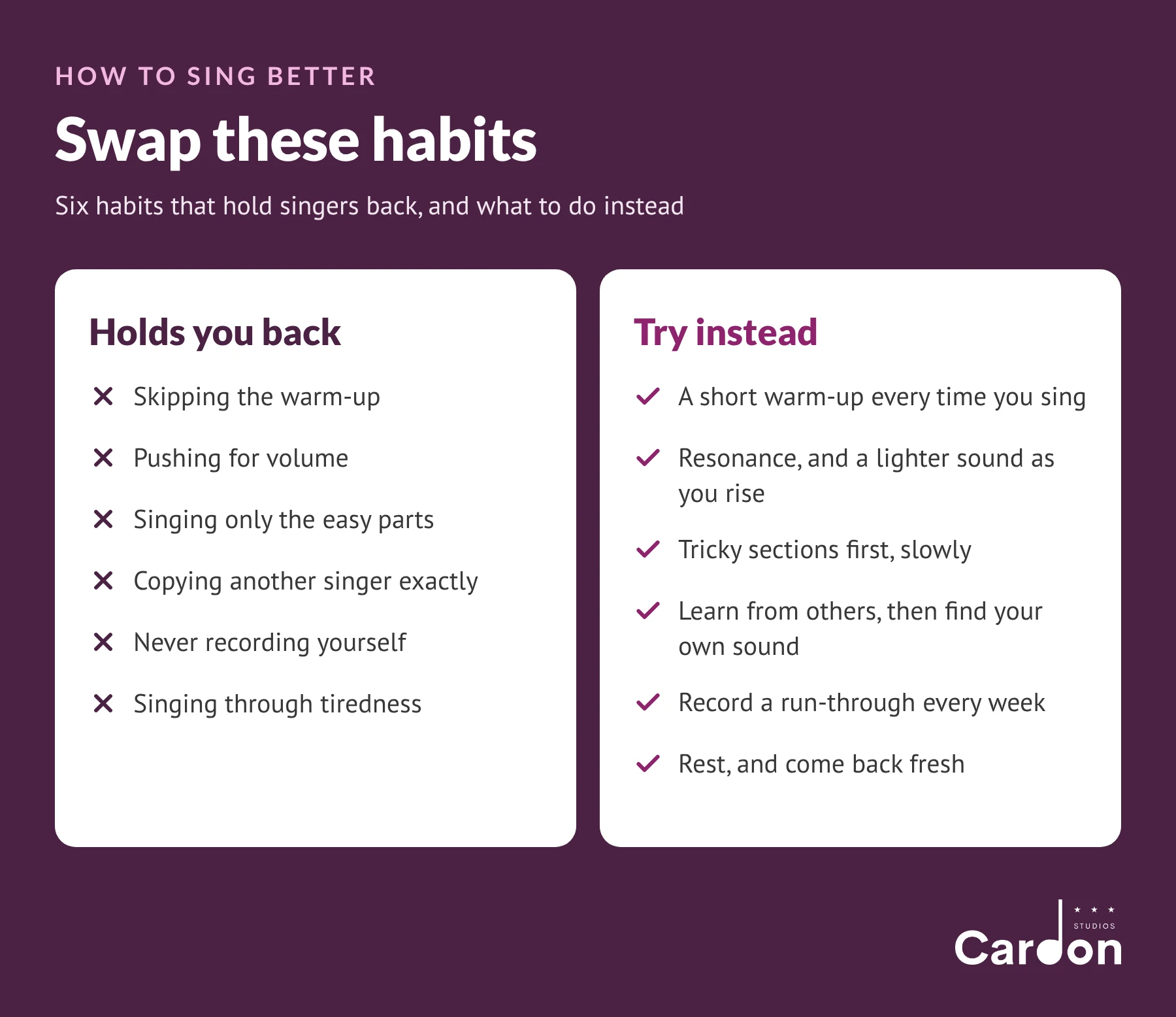
| Habit | Why it holds you back | Try instead |
|---|---|---|
| Skipping the warm-up | Your voice starts stiff and less reliable | A short warm-up every time you sing |
| Pushing for volume | Strain, a harsh tone and a tired voice | Resonance and a lighter approach as you rise |
| Singing only the easy parts | The hard phrases never improve | Practice the tricky sections first, slowly |
| Copying another singer exactly | You strain to make a sound that isn’t yours | Learn from others, then find your own best sound |
| Never recording yourself | You can’t hear what listeners hear | Record a run-through every week |
| Singing through tiredness | Habits of strain and possible hoarseness | Rest, and come back fresh |
How to measure your progress
You can’t fully hear yourself as you sing, so a few simple checks show you how far you’ve come.
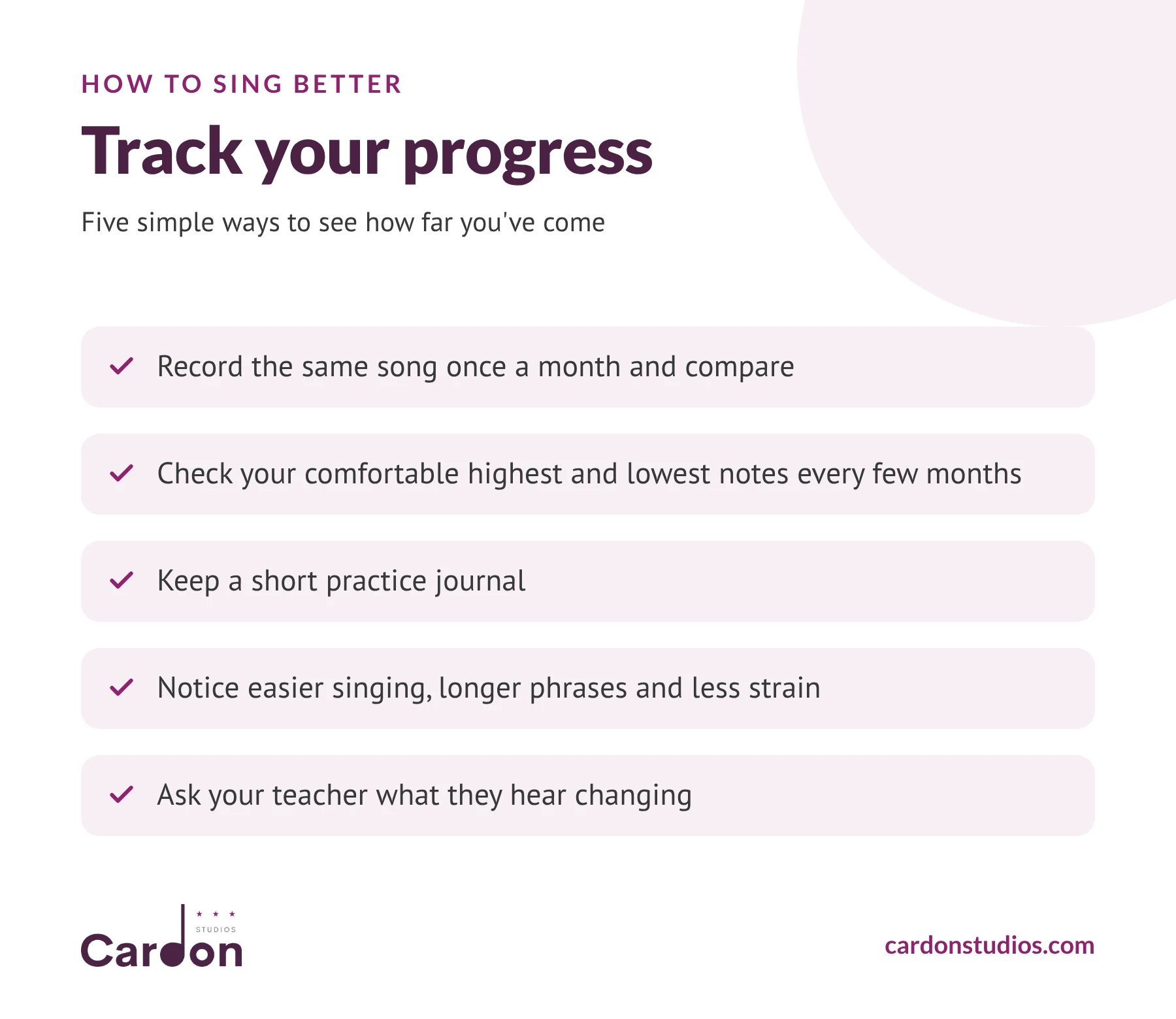
- Record the same song once a month and compare the recordings.
- Note your comfortable highest and lowest notes, and check them every few months.
- Keep a short practice journal of what you worked on and what improved.
- Notice how singing feels: easier, longer phrases and less strain are real signs of progress.
- Ask your teacher what they’re hearing change.
Progress in singing is rarely a straight line. You may feel stuck for a while and then notice a sudden leap. Consistency is what gets you there. If you’re wondering whether lessons are worth it, read the benefits of voice lessons.
Look after your voice
A healthy voice is easier to improve. The National Institute on Deafness and Other Communication Disorders recommends drinking plenty of water, resting your voice throughout the day, avoiding extremes such as screaming or whispering, and not speaking or singing when your voice is hoarse or tired. Our guide to vocal health for singers covers more.
Listen to your voice
Singing better should never mean singing through pain. If your voice stays hoarse, rest it, and according to NIDCD, see a doctor if hoarseness lasts more than three weeks.
From the studio
The fastest way to sing better is feedback from someone who can hear what you can’t. In a live online lesson, your teacher can pinpoint what will make the biggest difference for your voice right now. Lessons are recorded so you can rewatch them, and between lessons you can send a video and get a personalized response within 72 hours.
Online voice lessons
Start singing better with expert feedback
One monthly membership includes four private online voice lessons, one video coaching submission, the Learning Library, and member online events, with a teacher matched to your style, goals, age, and schedule.
Common questions about singing better
How can I improve my singing voice?
Warm up before you sing, breathe low and steadily, release tension, sing in a comfortable key, train your pitch, practice briefly on most days, and record yourself. A teacher can tell you which of these matters most for your voice.
How can I sing better instantly?
Warm up, stand tall and loose, breathe low, choose a key that suits you, sing high notes a little lighter and think about the meaning of the words. These won’t replace practice, but they often help right away.
Can a bad singer become a good singer?
Yes. Singing is a skill, and most people improve significantly with good guidance and regular practice. Many people who think they can’t sing simply haven’t learned the coordination yet.
How long does it take to sing better?
It depends on your starting point, your goals and how regularly you practice. Many singers notice that singing feels easier within weeks of consistent practice, while bigger changes in range and tone build over months and years.
Does drinking water help your singing?
Staying well hydrated is part of everyday voice care; NIDCD recommends drinking plenty of water. It won’t fix technique, but it helps keep your voice in good condition.
How can a beginner sing better?
Start with the basics in order: a short warm-up, low and steady breathing, a comfortable key and simple pitch exercises. Practice briefly on most days, record yourself once a week, and follow a plan like the four weeks above. Our singing tips for beginners cover your first steps.
How do I make my voice better for singing?
Train it and look after it. Regular exercises for breath, tone, pitch and range build the coordination, while everyday care keeps it in good condition: NIDCD recommends drinking plenty of water, resting your voice and not singing when it’s hoarse or tired.