


Becoming a singer can feel like a big goal. And it is! But like any challenge, breaking it into smaller steps makes it manageable. Here’s a five-step roadmap for beginners, from picturing the singer you want to be to choosing your first songs and finding the right help along the way.
Key takeaways
- Start by picturing the kind of singer you want to be; your style shapes the path.
- Your voice is part of your body, so rest, hydration, and relaxed breathing come first.
- Explore your range with easy sirens and scales before diving into hard songs.
- Work on one comfortable song and one reach song, and get outside ears early.
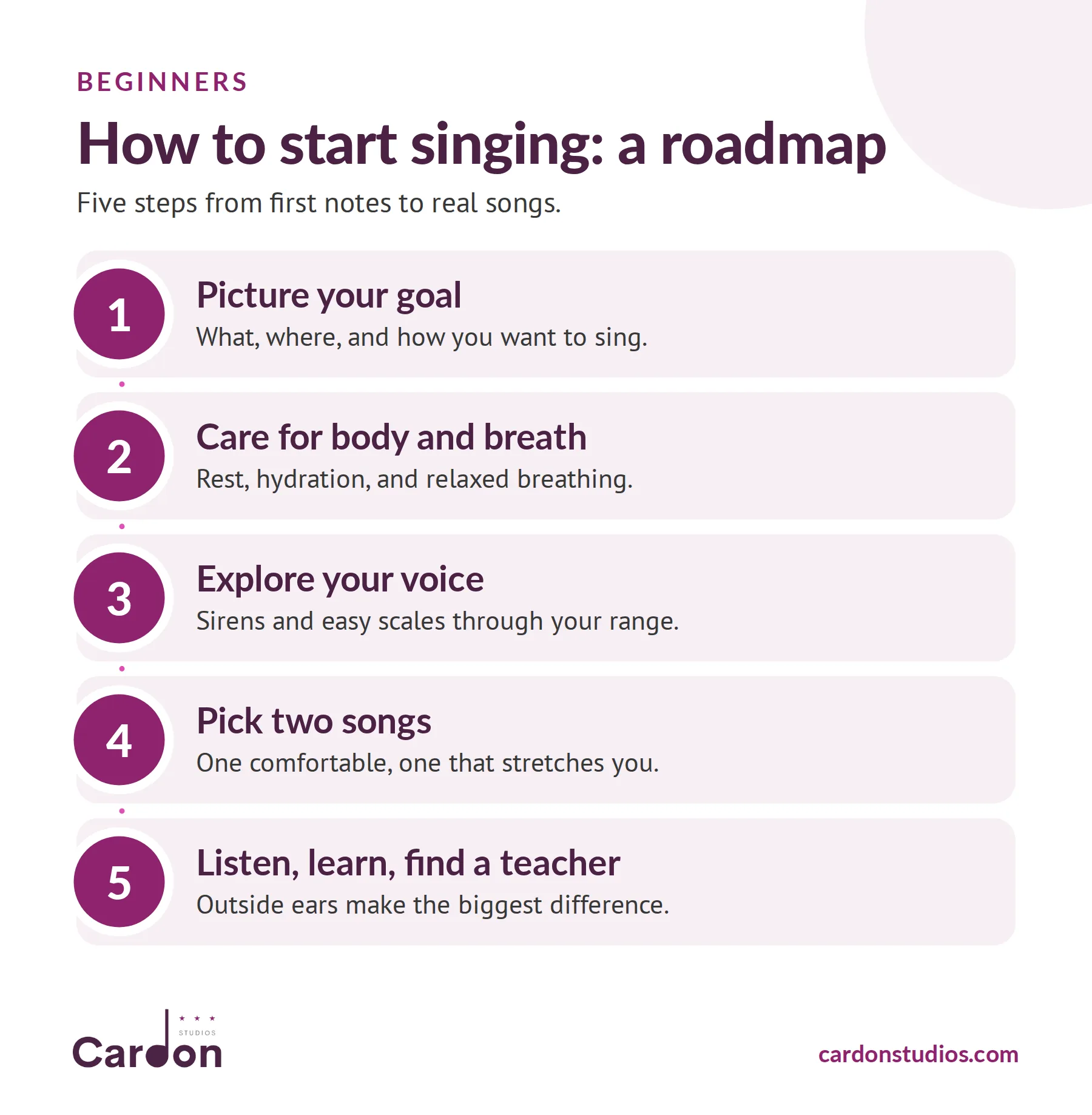
1. Picture your goal
Visualize the singer you want to be in as much detail as you can. What style of music will you sing? Where will you perform? Do you dream of singing at a coffeehouse, in a church or community choir, in a musical, or on a big stage? These questions help you choose the right songs for future auditions, recordings, or set lists.
At this stage, set goals for your performing, not your voice. Those goals will help you, and your teacher, define the steps to get there. Each style of singing has its own vocal priorities, just as each has its own path, so setting your direction early helps you follow the right one.
2. Care for your body and breath
Singing is uniquely personal. Your voice is part of your body and closely tied to your sense of self, so your physical and mental well-being matter. Pursuing your goals will bring physical challenges, and probably some criticism and rejection along the way, too. Take care of yourself: stay hydrated, get enough sleep, eat well, and practice kind self-talk. Our guide to vocal health for singers covers the everyday habits that help.
3. Explore your voice
Before you dive into full songs, get to know your instrument. You sing with your whole body, and your voice depends heavily on your breathing, so notice how your breath works and what it feels like when you’re relaxed. Our primer on breathing for singers is a good starting point.
Then experiment with easy, unsung sounds. Try loose siren slides from the top of your voice to the bottom and back. Aim for an even flow of breath across your range, and watch for habits that interrupt your airflow or let tension creep in. Build a short routine of scales across your comfortable range, as high and as low as you can sing easily. Never force your way through a register change; a teacher can help you understand terms like chest voice, head voice, and mixed voice as you go.
4. Pick a starter song and a reach song
Once you’re comfortable with your breathing and your range, it’s time for songs. Keep it simple at first: choose something you love that doesn’t feel hard. Even easy songs have small hiccups to smooth out, and solving those tiny challenges teaches you how to solve bigger ones later.
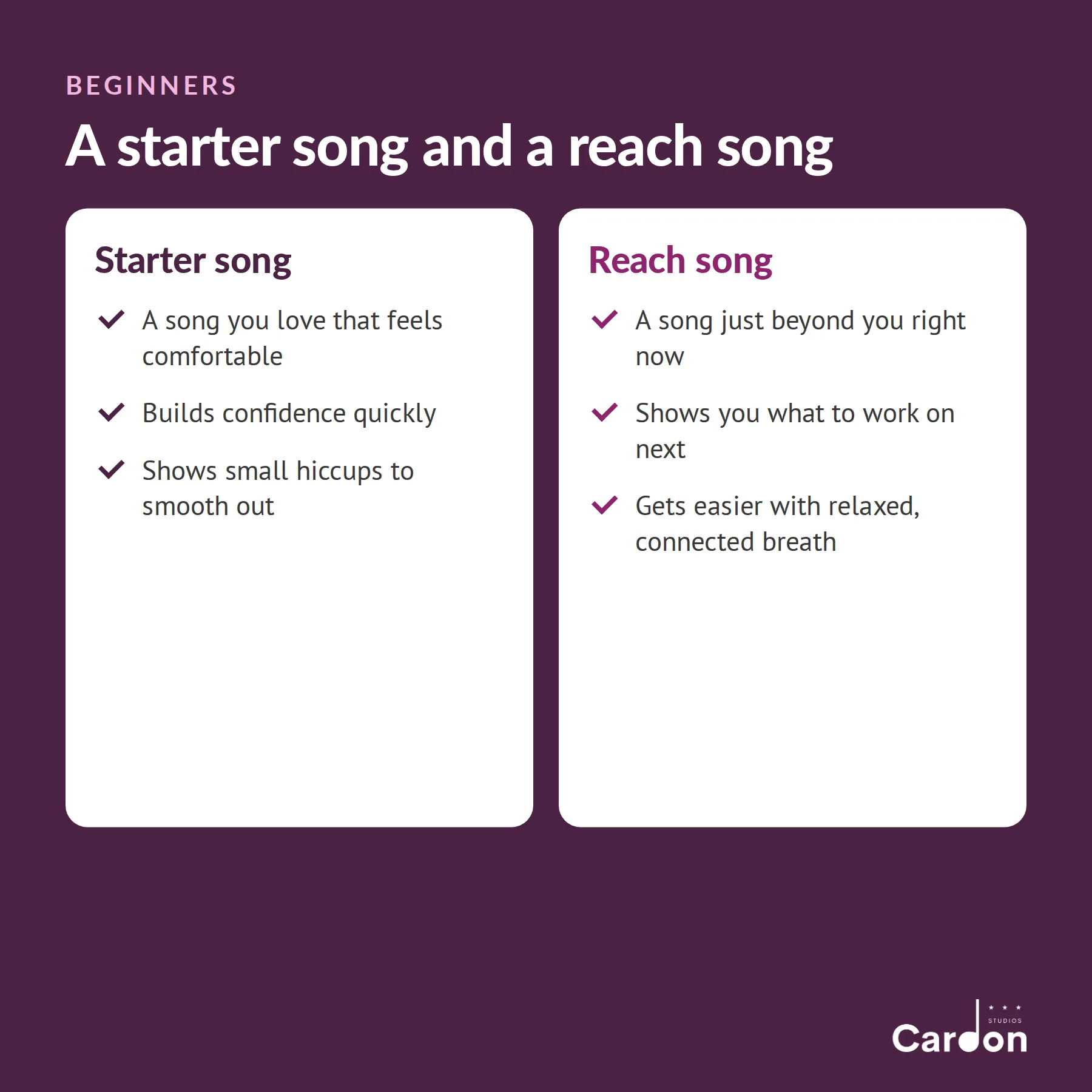
It’s a good idea to work on one starter song and one reach song at a time. Spend a couple of weeks on just those two and see what you discover. If your reach song doesn’t start to feel more comfortable with relaxed, connected breathing, that’s a good moment to call in a qualified teacher.
5. Listen, learn, and find a teacher
Listening to other singers is a wonderful source of inspiration and know-how, if you know what to listen for. Try to name the vocal effects you hear, and watch videos to see how singers breathe. Don’t copy everything they do with their mouths, though; some of that is personal, because everyone is built differently.
Self-study has limits. If you’ve ever been surprised by your voice on a voicemail or video, you know that you don’t hear yourself the way others do. The spaces inside your head shape what you hear differently from the room your listeners are in. Recording yourself helps, but it can still be hard to make adjustments in the moment without guidance.
That’s where a qualified voice teacher comes in. Look for someone supportive and compassionate who will be more than a cheerleader, whose students sing well, and who has an up-to-date understanding of how voices work. Our guide to choosing a voice teacher walks you through it.
Common beginner mistakes
A few habits trip up many new singers. Watch for these as you start:
- Pushing for high or loud notes too soon. Build easy coordination first; power comes later.
- Skipping the warmup. A few minutes of gentle sirens and scales makes everything after feel easier.
- Practicing only the hard song. Your starter song builds the confidence and habits your reach song needs.
- Judging every note. Curiosity helps you learn faster than criticism does.
Your first few weeks
- Write down your performing goal in a sentence or two.
- Practice a short, gentle routine of sirens and scales on most days.
- Choose your starter song and your reach song.
- Record yourself once a week and listen back with an open mind.
- Book a lesson so someone experienced can hear where you’re starting.
From the studio
Wherever you are on your vocal journey, Cardon Studios is designed to meet you there. You’re matched with a teacher by your style, goals, age, and schedule, and every lesson is recorded so you can review it while you practice. Meet Kate and her team of teachers.
Online voice lessons
Start singing with a teacher behind you
One monthly membership includes four private online voice lessons, one video coaching submission, the Learning Library, and member online events, with a teacher matched to your style, goals, age, and schedule.
Common questions from new singers
How do I start singing as a complete beginner?
Picture your goal, care for your body and breath, explore your range with easy sirens and scales, then choose one comfortable song and one reach song. A teacher can help you build good habits from the start.
Can anyone learn to sing?
Yes. Singing is a skill, and nearly everyone can improve with good guidance and regular practice. Read more in our article on going from tone deaf to talented.
What should my first song be?
Something you love that feels comfortable to sing. Pair it with one slightly harder song so you always have something to grow into.