


Head voice is the lighter, higher register of your voice, where the sound feels like it rings in your face and head rather than your chest. To sing in head voice, start light: use gentle sirens, “oo” vowels and descending scales that begin high, keep the breath steady, and let the sound stay easy rather than loud. Every voice type has a head voice, and building it makes your whole range more flexible, from soft high phrases to a smoother mix.
Key takeaways
- Head voice is a register with thinner, stretched vocal folds and less contact than chest voice.
- Find it with light, playful sounds: sirens, a gentle “hoo,” or a quiet whimper on “ng.”
- Work from the top down. Descending patterns help head voice carry into your middle range.
- Keep it easy. Head voice gets stronger through consistency, not pushing.
What is head voice?
Head voice is the upper register of the voice. In head voice the vocal folds are stretched longer and thinner, and they touch for a smaller part of each vibration than in chest voice. Voice scientists call this the second laryngeal mechanism, or M2.
Research describes the difference clearly. In a 2014 study in The Journal of the Acoustical Society of America, the vocal folds were in contact for generally less than half of each vibration in the second mechanism, compared with up to about 70 percent in chest voice, and less of the folds’ mass was moving. That lighter, thinner vibration is why head voice sounds and feels lighter. Our guide to chest voice covers the other side of the picture.
How head voice feels and sounds
- Light and high. It feels easier and less weighty than chest voice, especially on higher notes.
- Felt in the face and head. Many singers feel buzzing behind the nose, in the cheekbones or at the top of the head.
- Rounder and softer. Head voice tends to sound pure and floaty. With training it can become strong and ringing too.
- Different from speech. Most people rarely speak in head voice, which is why it can feel unfamiliar at first.
Head voice vs. falsetto
These two terms are used differently by different teachers, and that causes a lot of confusion. Both use the same lighter laryngeal mechanism. In practice, many teachers use falsetto for a breathier, airier version, especially in lower voices, and head voice for a fuller, more connected version with a clearer tone.
| Head voice | Falsetto | |
|---|---|---|
| Sound | Clear, ringing, more connected | Airy, breathy, often softer |
| Feels like | Light but focused | Light and loose, sometimes with escaping air |
| Blends with chest voice? | More easily, which helps build a mix | Less easily; the shift can sound like a flip |
| Used for | Classical singing, high phrases, the top of a mix | Style effects, soft high moments in pop and R&B |
Both are useful. If your high notes feel breathy and disconnected, the exercises below help you move from a falsetto-like sound toward a clearer head voice.
How to find your head voice
- Make a light, playful sound. Say “whoo!” like an owl, or “hoo” as if gently surprised, in a high, easy voice.
- Siren on “oo.” Slide smoothly from a comfortable low note up into that light sound and back down, like a quiet siren.
- Try a whimper. With lips closed, make a soft, high “mm” or “ng” like a puppy’s whimper. It’s a gentle way to find the coordination.
- Keep it quiet at first. Head voice usually starts soft. Volume comes later with practice.
If you can’t find it right away, that’s normal, especially for singers who have mostly used chest voice. Give it a few sessions.
Head voice exercises
Do these at a soft to moderate volume, a few repetitions each, after a gentle warm-up. Stop if anything feels tight or hurts.
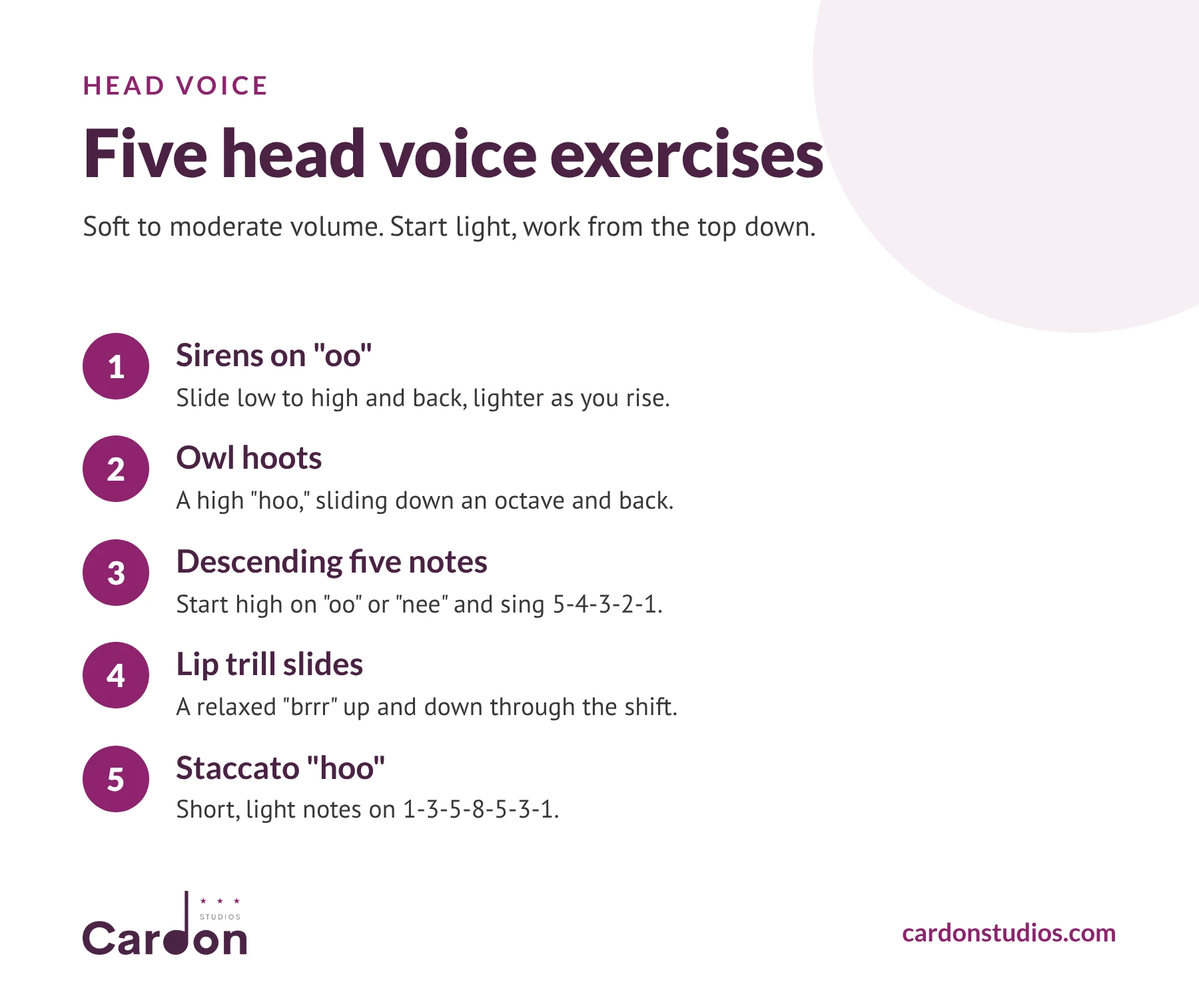
1. Sirens on “oo”
Slide from low to high and back on “oo,” letting the sound get lighter as you rise. Don’t aim for a note; aim for a smooth, unbroken line. If it flips, make the whole siren softer.
2. Owl hoots
Sing “hoo” on a high, comfortable note, then slide down an octave and back up. The “h” keeps the onset gentle and the “oo” keeps the throat open.
3. Descending five-note scales
Start in your head voice and sing “oo” or “nee” down five notes (5-4-3-2-1). Starting high and coming down helps the lighter coordination carry into your middle range instead of the heavier chest sound carrying up. Move the pattern down by half steps.
4. Lip trill slides
Slide up and down on a relaxed lip trill (“brrr”). The trill balances breath and vocal fold closure automatically, which makes it easier to move through the register shift.
5. Staccato “hoo”
Sing short, bouncy “hoo” notes on 1-3-5-8-5-3-1, light and clean. Short notes build clear, efficient closure in head voice without strain.
How to strengthen your head voice
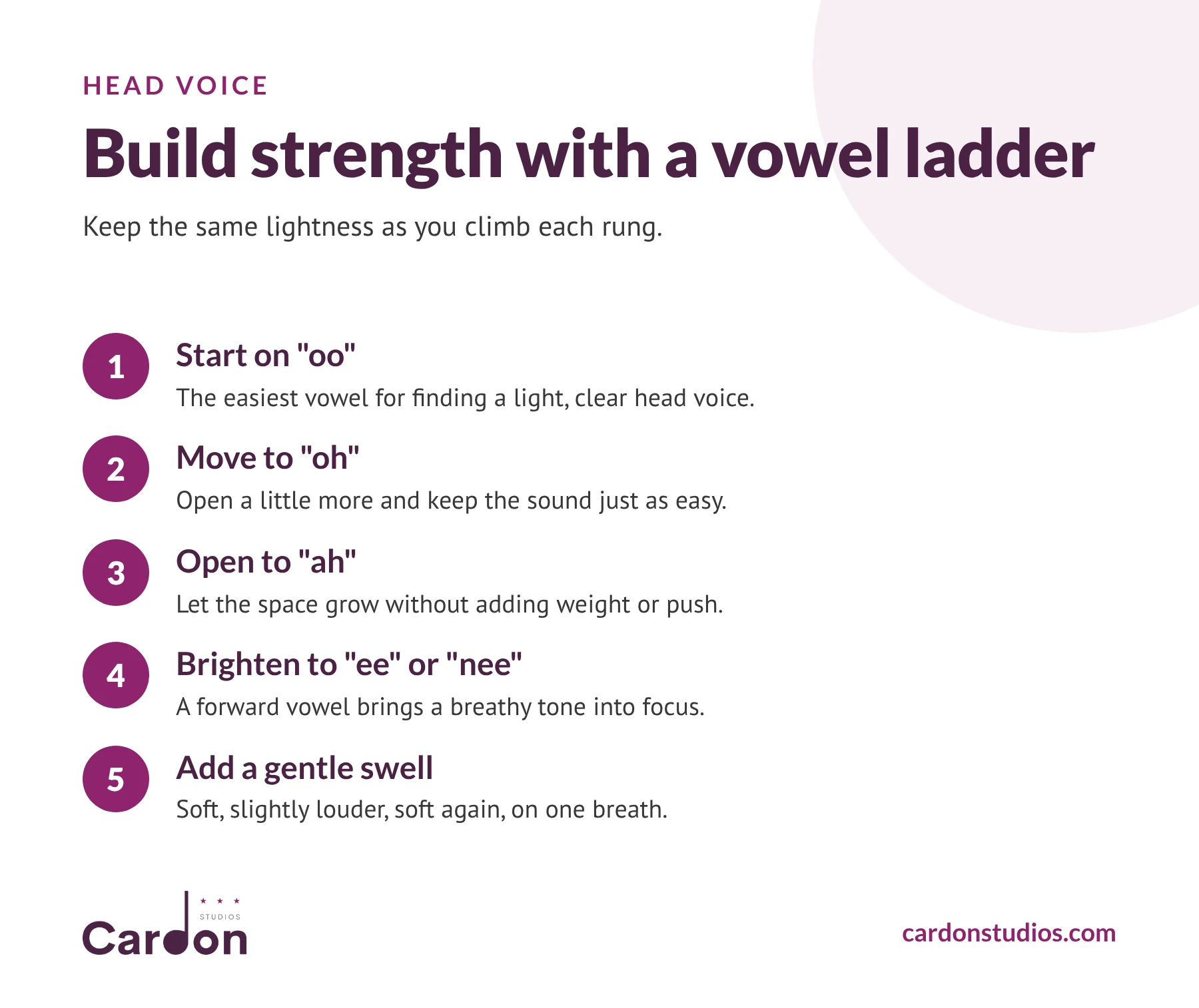
Head voice gets stronger through light, regular practice. Climb the vowel ladder one rung at a time, and move up only when the current vowel feels easy.
- Practice a little every day. Head voice responds to regular, gentle use more than to long sessions.
- Move from “oo” to brighter vowels. Once “oo” feels easy, try “oh,” then “ah,” then “ee,” keeping the same lightness.
- Add clarity, not force. If it’s breathy, try a slightly brighter, more forward “nee” or “ng” to bring the sound into focus.
- Swell gently. On one comfortable head voice note, grow slightly louder and back to soft on one breath. This builds control.
- Connect it to your mix. A strong head voice makes a balanced mix possible. Our guides to finding your mix for higher voices and lower voices take the next step.
- Support with steady breath. Head voice needs less air than you might think, but it needs it steadily. See Breathe: A Primer for Singers.
Head voice in different styles
Head voice shows up in almost every style, used in different ways:
- Classical singing relies on a strong, ringing head voice for much of the upper range, blended smoothly with the lower voice.
- Musical theater uses it for “legit” songs, which call for a classical-leaning sound, and as the light end of a mix in contemporary shows.
- Pop, R&B and gospel singers often switch into a light head voice or falsetto for contrast, runs and soft high moments.
- Choirs lean on head voice for blend and tuning, especially in the upper parts and in soft passages.
Whatever you sing, a reliable head voice gives you more choices. It lets you sing high phrases softly, change color for expression and stop relying on force for every high note. If you sing in a choir, our choir singing tips show how it helps blend.
Common head voice mistakes
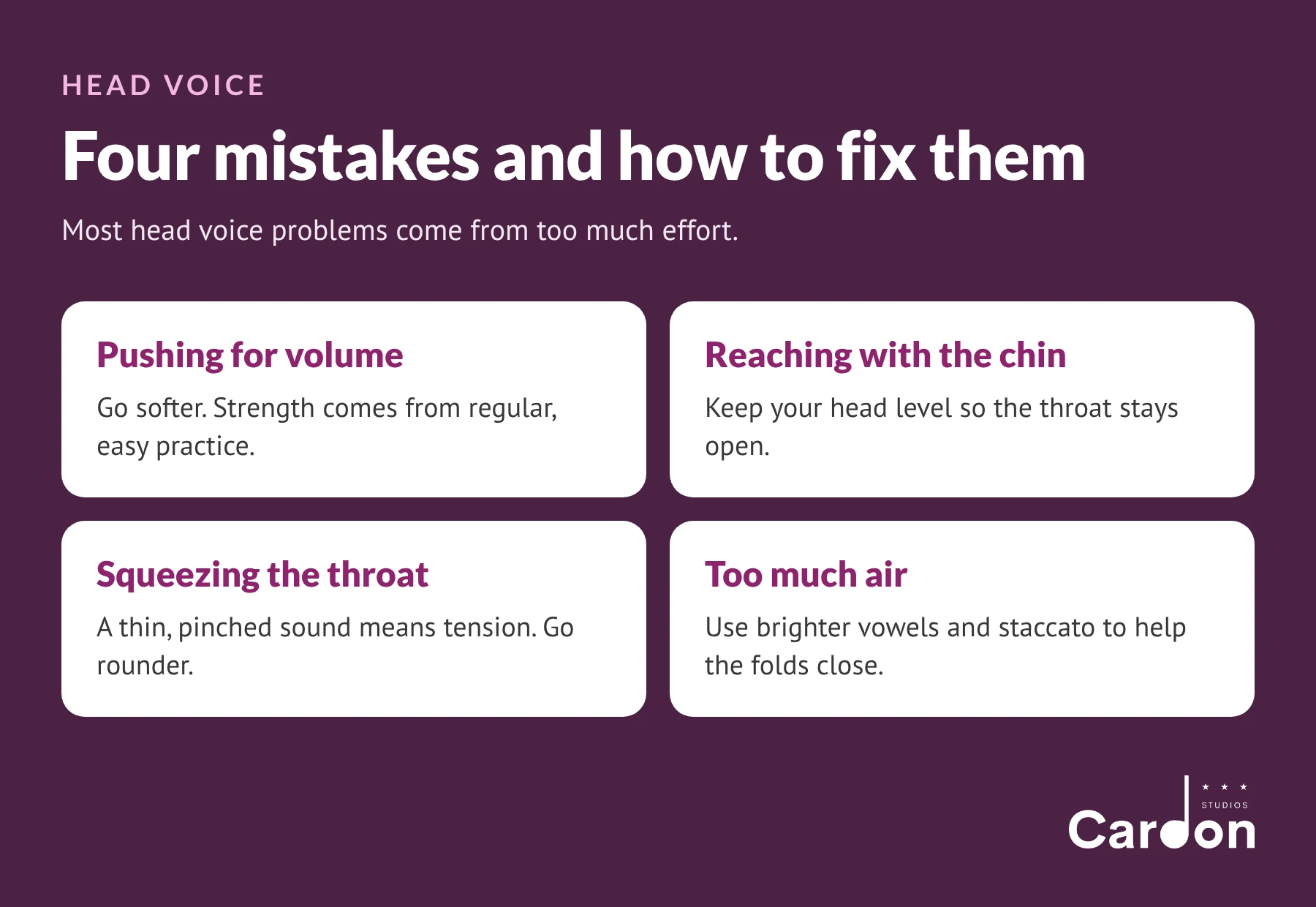
- Pushing for volume. Trying to make head voice as loud as chest voice too early leads to strain or a flip back into chest.
- Reaching up with the chin. Keep your head level; lifting the chin tightens the throat.
- Squeezing the throat. A pinched, thin sound usually means tension. Go softer and rounder.
- Too much air. Some breathiness is normal at first, but a lot of escaping air means the folds aren’t closing efficiently. Brighter vowels and staccato help.
- Avoiding it. Singers who never use head voice often struggle with high notes and a rough break. Regular, gentle practice changes that.
If your voice cracks between registers, see common vocal problems, and for powerful high notes in contemporary styles, read how to belt safely.
From the studio
Head voice can feel strange at first, and it’s hard to tell from the inside whether a sound is connected or breathy. In a live online lesson, your teacher can hear the difference and adjust your exercises in the moment. Between lessons, you can send a video of a scale or a high phrase and get a personalized response within 72 hours.
Online voice lessons
Find your head voice with a teacher
One monthly membership includes four private online voice lessons, one video coaching submission, the Learning Library, and member online events, with a teacher matched to your style, goals, age, and schedule.
Common questions about head voice
Do men have a head voice?
Yes. Every voice type has a head voice. Lower voices often find it first as falsetto and develop a fuller, more connected head voice with practice.
Is head voice the same as falsetto?
They use the same lighter mechanism, and teachers use the terms differently. Many describe falsetto as the breathier version and head voice as the clearer, more connected version.
Why does my head voice sound weak or breathy?
That’s common when head voice is new. Practice brighter vowels like “nee,” staccato exercises and gentle swells. Clarity and strength build over weeks of regular practice.
How do I switch from chest voice to head voice smoothly?
Lighten the sound as you go up instead of carrying chest weight higher, and practice slides and descending scales across the shift. Over time, many singers develop a mix that smooths the transition.
Can singing in head voice hurt my voice?
Not when it’s light and easy. Problems come from pushing or squeezing. If singing ever hurts or leaves you hoarse, rest, and see a doctor if hoarseness lasts more than three weeks.
How do I use head voice in a song?
Look for high, soft or floating phrases and long high notes that don’t need much volume. Sing the phrase on “oo” in head voice first, then add the words while keeping the same lightness, and decide whether to stay light or blend toward your mix as the phrase climbs. Our guide to how to practice singing shows how to learn a new song in layers.
How can I improve my head voice?
Practice it a little on most days at a soft to moderate volume. Sirens on “oo,” descending five-note scales and staccato “hoo” build clarity, and brighter vowels and gentle swells add strength. Record yourself every week or so to hear the change; see how to record yourself singing.