

To warm up your voice, spend 10 to 15 minutes moving step by step from your body and breath to gentle humming, lip trills or straw singing, then to vowels across your range, and finally to clear consonants and a phrase of the song you’re about to sing. A good warm-up eases your voice into the demands of practice, helps you spot tension before it gets into your songs, and makes your singing more reliable. Here’s a complete vocal warm-up routine you can follow every day.
Key takeaways
- Warm up in order: body, breath, gentle “semi-occluded” exercises, vowels through your range, then diction.
- Lip trills, humming and straw singing are among the best first exercises for most singers.
- Start quiet and in the middle of your range. Volume and range extremes come last.
- Use your warm-up to notice and release tension, especially in the jaw and tongue.
Why warm up your voice
Because the anatomy of the voice is invisible to us, it’s easy to think of singing as something mysterious that sometimes works and sometimes doesn’t. In reality, the voice is a set of small muscles and tissues, and like any part of the body, it responds better when it’s eased into hard work. Spending a few minutes priming those muscles improves flexibility and stamina before you tackle more demanding singing.
A warm-up also gives you a moment to check in. It’s your chance to notice tension, breath habits or a tired voice before you start your songs, when it’s much easier to adjust. Vocal injuries can happen to any singer, and they can be slow and costly to recover from. A short, consistent warm-up is one of the simplest ways to reduce unnecessary risk.
A complete vocal warm-up routine
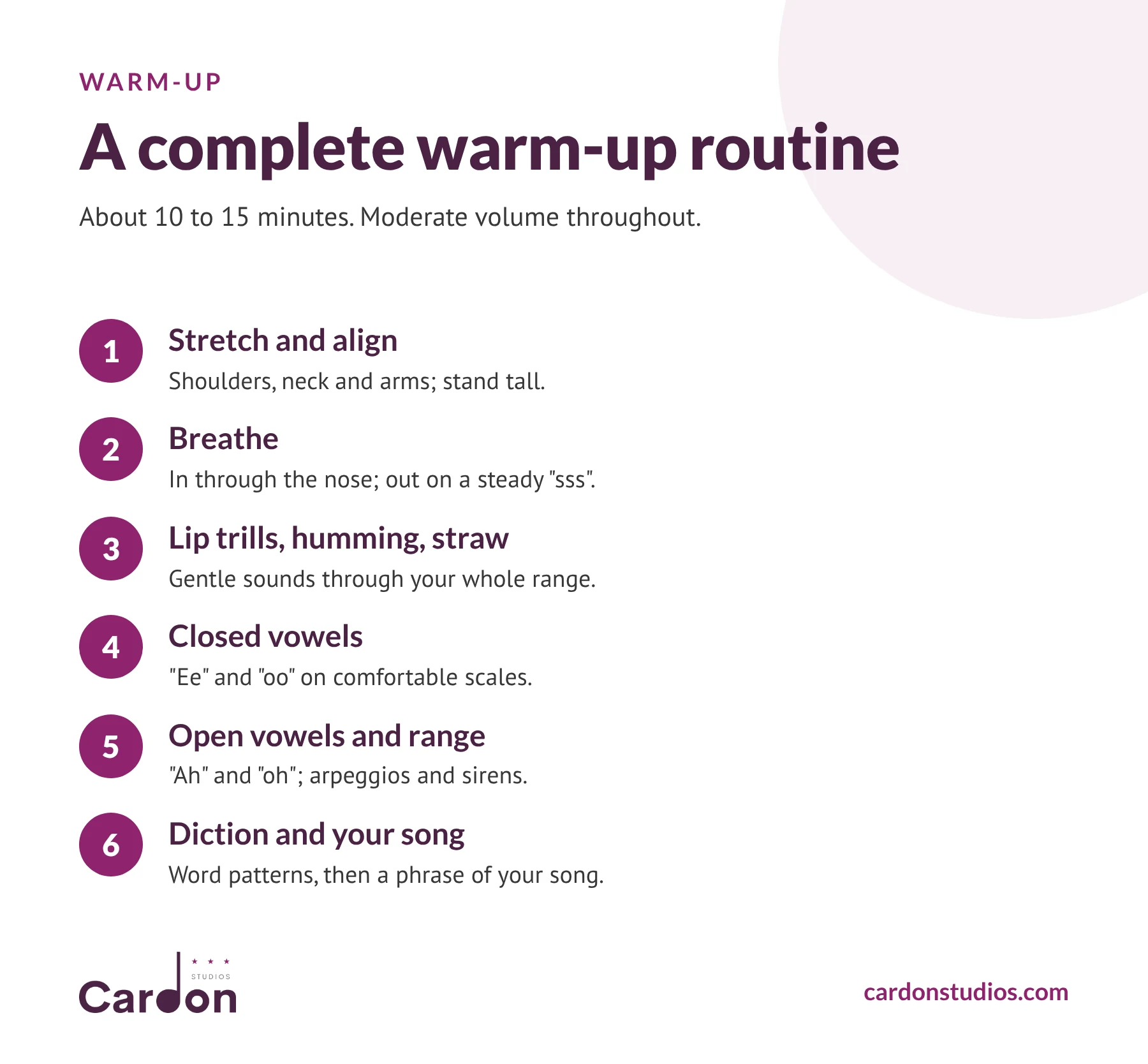
This routine takes about 10 to 15 minutes. Keep the volume moderate throughout, and move patterns up and down by half steps through a comfortable part of your range.
Steps 1 and 2: body and breath
Stretch and align (2 minutes)
Roll your shoulders back and down, gently tilt your head side to side, stretch your arms overhead and let them float down. Then stand with your feet hip-width apart, knees soft, and your head balanced over your shoulders. Full-body stretching helps your attention tune into your body before you make a sound. See singing posture and alignment for more.
Breathe (2 minutes)
Breathe in slowly through your nose, letting your ribs and belly expand, then breathe out on a steady “sss” for eight counts. Repeat a few times, extending the hiss as it gets easier. Then try a few pulsed “sh, sh, sh, sh” sounds to wake up the muscles that support the breath. Our primer on breathing for singers explains why steady breath matters.
Step 3: lip trills, humming and straw singing
Next, get the voice moving gently with semi-occluded vocal tract exercises, often shortened to SOVT exercises. They partly close the mouth at or near the lips: humming, lip trills, tongue trills, singing on voiced consonants such as “v,” “z,” “m,” “n” or “ng,” and singing through a straw. A 2021 review in the Journal of Singing describes an important warm-up effect for developed singers. The partial closure creates back pressure in the mouth that helps the vocal folds vibrate efficiently, with less effort.
- Lip trills. Relax your lips and blow through them to make a “brrr,” then add voice. Slide up and down a five-note scale, then through your whole range on a gentle siren.
- Humming. Hum a five-note scale on “mm” with your lips lightly closed and your teeth apart. Feel the buzz around your lips and nose.
- Straw singing. Sing through a drinking straw, sliding up and down. The same review suggests starting with a medium-resistance option and moving to lower resistance, since a very narrow straw can make some singers squeeze.
These exercises may seem odd preparation for singing, but they’re among the most efficient ways to get the voice ready. Take one of them through your whole range before moving on. If your lips won’t trill, gently press your cheeks with your fingertips or try a tongue trill or straw instead.
Steps 4 and 5: vowels and range
Closed vowels (2 to 3 minutes)
Move to a small, “closed” vowel such as “ee” or “oo.” Sing it on any scale that feels comfortable, even the same one you used for your lip trills, staying relaxed and connected to your breath through your whole range. Watch for extra effort creeping in at the top and bottom.
Open vowels and range (2 to 3 minutes)
Then open to “ah” and “oh” on scales and arpeggios (1-3-5-8-5-3-1). Finish with a few sirens on “oo” from low to high and back, staying light at the top. If you’re working on your mix or high notes, this is the place for one or two exercises that target them, at moderate volume.
Step 6: diction and your song
Wake up your articulators, the lips, teeth and tongue, with patterns that use words. Sing “la, le, li, lo, lu” on a scale, or try a tongue twister like “red leather, yellow leather” spoken and then sung on one pitch. Finally, sing a tricky phrase from the song you’re about to practice, first on a lip trill and then on the words. That bridges the warm-up straight into your music.
Short warm-ups for busy days
- Five-minute version: a few breaths, lip trills through your range, “ee” and “ah” on a five-note scale, and one phrase of your song.
- On the way to rehearsal: quiet humming as you walk or ride is an easy head start. Finish the rest of the routine when you arrive.
- Before a performance: keep it light and short. Gentle humming, sirens and a phrase of your opening song are enough; you want a fresh voice, not a tired one. Our guide to preparing for a singing performance has more.
- Quiet practice spaces: straw singing and humming are some of the quietest warm-ups. See how to practice singing in an apartment.
Warm-ups by goal
| If you’re working on… | Add this to your warm-up |
|---|---|
| High notes | Sirens on “oo” and descending scales that start in head voice |
| Low notes | Descending five-note scales on “uh,” gently, without pressing down |
| Agility and runs | Fast five-note scales on “ah” or a lip trill, slowly at first |
| Belting | Calls on “hey” and a bratty “nyeh,” after the full routine; see how to belt safely |
| Breath control | A longer hiss and sustained notes on “oo” with a steady tone |
| A tired or morning voice | Extra humming and straw singing before any open vowels |
Releasing tension while you warm up
As you sing through your warm-up, notice any tension in your body. When you find it, let your attention go to that spot and encourage it to release. Common places are the jaw, the tongue, the back of the neck and the shoulders. A tight tongue or jaw often feels like a generally “tight throat.”
Some tensions need a more targeted approach, such as gentle jaw massage or an exercise that interrupts the habit. Talk with your teacher about any tension that keeps coming back. A mindful warm-up often makes tight spots in songs feel easier, and when a phrase still feels hard, check the line before it for small tensions you may have overlooked. Those small habits are often the roots of bigger problems.
Cooling down after you sing
After a long rehearsal or performance, a minute or two of gentle humming, lip trills or straw singing at a low volume helps your voice settle back toward speaking. The Journal of Singing review notes that semi-occluded exercises at low intensity make good cool-downs. Then rest your voice and drink some water.
Listen to your voice
A warm-up should leave your voice feeling ready, not tired. If warming up hurts, or your voice stays hoarse, rest it. According to the National Institute on Deafness and Other Communication Disorders, see a doctor if your voice has been hoarse for more than three weeks. Our guide to vocal health for singers covers everyday care.
From the studio
Every voice warms up a little differently. In a live online lesson, your teacher can build a warm-up around your voice and your goals, and adjust it as you progress. Between lessons, you can send a video of your singing and get a personalized response within 72 hours.
Online voice lessons
Build a warm-up that fits your voice
One monthly membership includes four private online voice lessons, one video coaching submission, the Learning Library, and member online events, with a teacher matched to your style, goals, age, and schedule.
Common questions about vocal warm-ups
How long should a vocal warm-up be?
About 10 to 15 minutes works for most practice sessions. A five-minute version is fine on busy days, and a longer, gentler warm-up helps early in the morning or when your voice feels tired.
What are the best vocal warm-ups?
For most singers, lip trills, humming and straw singing are the best place to start, followed by vowels on scales through the range and a few diction patterns. The best warm-up is one you do consistently.
Should I warm up before every practice?
Yes. Even a short warm-up before each practice session makes your singing more reliable and helps you notice tension early.
How can I warm up my voice quickly?
Try a few breaths, lip trills through your whole range, “ee” and “ah” on a five-note scale, and one phrase of your song. That takes about five minutes.
Do singers need to cool down?
It helps after long or demanding singing. A minute or two of quiet humming, lip trills or straw singing eases the voice back toward speaking.