

The most common vocal problems for new singers are voice cracks, a lack of power, vocal fatigue and pitch trouble. The good news is that most of them come from coordination, not from a flaw in your voice, so they respond well to training. Voice cracking when singing, for example, usually happens when your voice switches suddenly from its heavier, chest-dominant setting to its lighter, head-dominant one, often because you’re pushing too much weight or breath into the notes around that shift. Here’s what causes each problem and how to start fixing it.
Key takeaways
- Voice cracks are a normal part of every voice. They smooth out when you lighten up and strengthen the weaker part of your range.
- A lack of power is usually a coordination problem, not a lack of strength.
- Tiredness, strain or pain are signs to stop and rest, and to get checked if they persist.
- Many pitch problems improve once breath and registers are balanced.
Why problems can feel worse before they get better
Whether you come to singing lessons for fun and self-expression or to fix something that bothers you about your voice, the process is similar. With the support of a knowledgeable teacher, you learn to assess yourself and make small adjustments that help your voice work more efficiently.
New singers are often surprised by how quickly they start to notice small details that are out of balance. That new awareness can even make it feel like you’re getting worse before you get better. Rest assured, it’s part of the process: you can’t fix something you haven’t noticed. When you separate your ego from your voice, it becomes much easier to treat the voice as an instrument and yourself as its engineer.
Performing well means singing with artistic honesty and expression. Technical problems, though, are best solved before you layer in emotion and vocal effects. Your teacher will help you build a comfortable, reliable sound throughout your range. From there, you can add the expression you want without your voice letting you down.
Voice cracking when singing
Every voice has registers: different ways the vocal folds vibrate that give your low and high notes their different colors. Voice scientists describe two main laryngeal mechanisms. A 2014 study in The Journal of the Acoustical Society of America calls them M1, which produces chest or “modal” registers, and M2, which produces lighter, falsetto-type registers, and it notes an overlap region of notes that a singer can produce in either one.
A voice crack is usually an abrupt, unplanned switch between those two settings, most often as you sing up through the middle of your range. The fact that you can hear a break doesn’t mean anything is wrong. It means you haven’t yet learned to manage the shift. Common causes include:
- Carrying too much weight up. Pushing your heavier, speech-like sound higher until it gives way.
- Too much breath pressure. Blowing harder to reach a note overloads the folds at the shift.
- An underused upper range. Most of us use our lower, speech range all day and our head voice hardly at all, so the lighter setting is weaker and less reliable.
- Tension. A tight jaw, tongue or neck, or a larynx that rises sharply on high notes, makes the switch harder to control.
- Tiredness. A tired voice cracks more easily, which is a cue to rest.
- A changing voice. Teens whose voices are changing often crack more for a while. Gentle, regular singing through that phase helps.
How to stop your voice cracking
The aim isn’t to hide the shift. It’s to make it smooth, so you control which setting you use. Practice these at a moderate volume, a little every day.
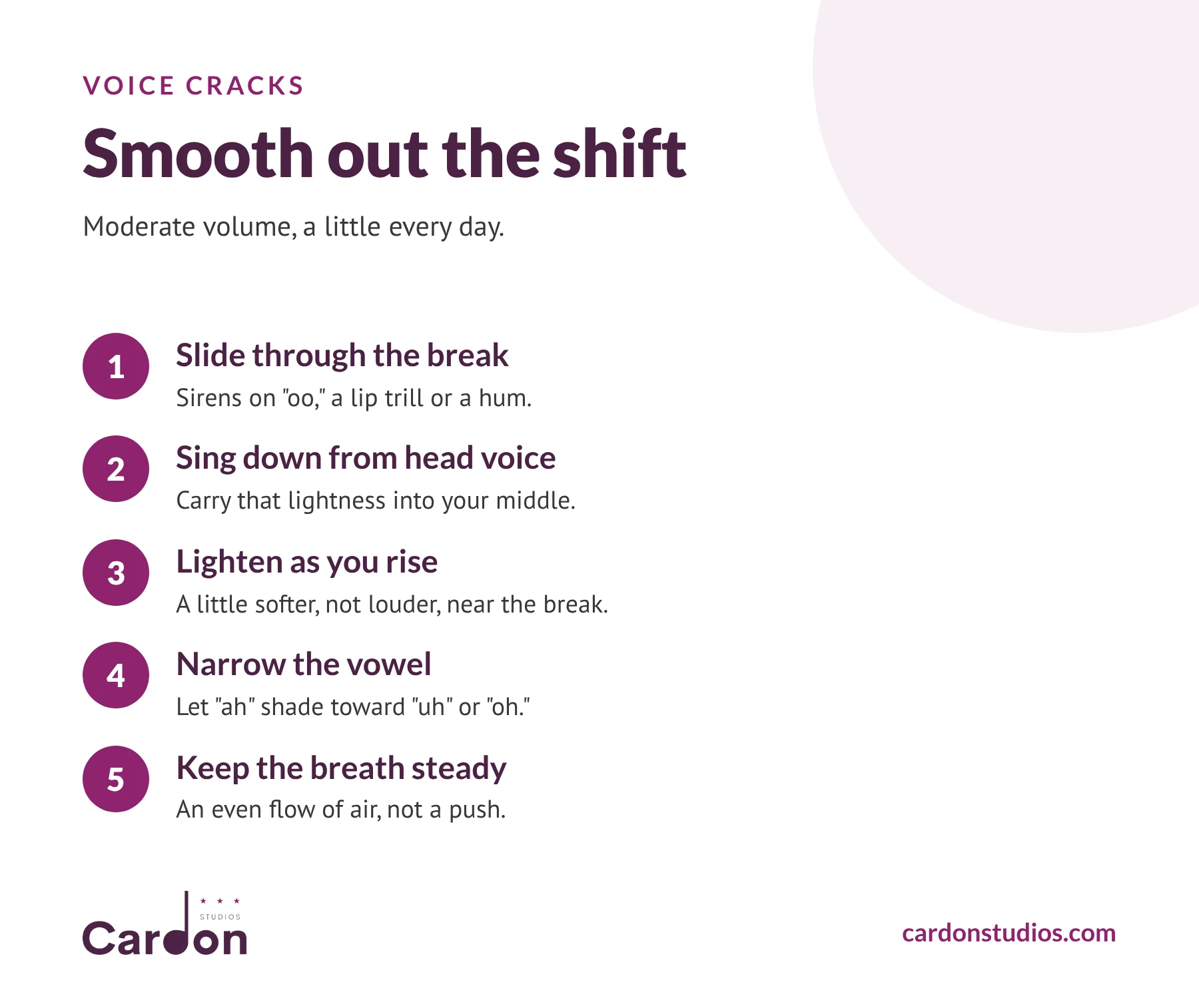
- Slide through the break. Sing slow sirens on “oo,” a lip trill or a hum from low to high and back. Semi-closed sounds like these make the shift easier to feel without fear of cracking.
- Sing down from head voice. Start descending five-note scales in your light upper range and carry that lightness down into your middle. This strengthens the weaker setting.
- Lighten as you rise. As you approach the break, sing a little softer rather than louder. Less weight and pressure lets the folds shift gradually.
- Narrow the vowel. Near the break, let wide vowels such as “ah” shade toward “uh” or “oh.” A slightly narrower vowel often keeps the sound steadier through the shift.
- Keep the breath steady. Aim for an even, steady flow of air rather than a push. Our guide to breath support explains how.
Over time, many singers develop a mixed voice that blends the two settings across the middle of the range. Our guides to finding your mix for higher voices and lower voices walk you through it.
Lack of power
When singers complain of a lack of power, the same imbalance between registers is often to blame. If your lighter setting is weak, your voice has nowhere comfortable to go as you rise, so you either push or back off. Spending time on the weaker part of your range, even though it may feel awkward at first, strengthens your whole voice and helps it work smoothly from bottom to top.
Breath support plays a big part too, along with resonance: a voice carries further when it’s bright and clear rather than pushed. For more, read how to sing louder without straining, and for contemporary power, see how to belt safely.
Vocal fatigue and discomfort
Feelings of tiredness, strain or pain should never be ignored. Don’t wait for pain before you act: a voice that tires quickly, feels scratchy or stays hoarse is a reason to stop, rest and, if it doesn’t clear up, get checked. A laryngologist, an ear, nose and throat doctor who specializes in the voice, is the best person to see.
Listen to your voice
According to the National Institute on Deafness and Other Communication Disorders, see a doctor if your voice has been hoarse for more than three weeks. Our guide to vocal health for singers covers everyday care.
Once a doctor has ruled out a problem and you’ve rested, it’s time to rethink how you sing. Healthy singing can be every bit as loud, powerful and expressive as the habits you relied on before, but it can take time to unlearn old patterns. A few principles help:
- Warm up gradually, and cool down after intense sessions. See our complete vocal warm-up routine.
- Breathe low and easily, and let your larger trunk muscles manage the breath instead of pushing with your neck, tongue or jaw.
- Keep practice sessions short and focused, and rest between them.
- Work with a trained teacher, who can spot misalignment and misuse that are hard to notice yourself.
Pitch problems
Pitch trouble is common, and it’s often a simpler fix than singers fear. Many pitch problems come from general imbalance in the voice: breath that isn’t supporting the vocal folds well, or tension in the throat and mouth that pulls notes flat or sharp. You may even notice your pitch slip temporarily whenever you change something about your technique.
So work on breath and registers first, and you may find your pitch improves along with them. If you think you have trouble hearing the difference between pitches, ear training helps, and so does recording yourself so you can listen back. Our article from “tone deaf” to talented explains why most people can learn to sing in tune, and how to record yourself singing covers the basics of listening back.
Other common problems
| Problem | Often caused by | Try first |
|---|---|---|
| Breathy tone | Air escaping without being turned into sound | Gentle hums and a clean, balanced start to each note |
| Tight throat | Tension in the jaw, tongue or neck | Lip trills and straw singing, plus a jaw and tongue check |
| Running out of breath | High, shallow breaths or pushing too much air | Low, wide breaths and planned breath points; see how to breathe when singing |
| Hoarseness after singing | Pushing, overuse or singing while tired | Rest, and see a doctor if it lasts more than three weeks |
| Stage nerves | Adrenaline that tightens breath and body | Preparation and calming routines; see conquering stage fright |
From the studio
These are the complaints we hear most from new singers, and we love solving them. In a live online lesson, your teacher can hear exactly where your voice cracks or tires and give you exercises that fit your voice. Lessons are recorded so you can rewatch them, and between lessons you can send a video of your singing and get a personalized response within 72 hours.
Online voice lessons
Smooth out the problem spots in your voice
One monthly membership includes four private online voice lessons, one video coaching submission, the Learning Library, and member online events, with a teacher matched to your style, goals, age, and schedule.
Common questions about vocal problems
Why does my voice crack when I sing high notes?
Usually because your voice is switching suddenly from its heavier setting to its lighter one. Pushing more weight or breath into the notes around that shift makes the switch abrupt. Lighten as you go up, and strengthen your head voice with slides and descending scales.
Is it normal for your voice to crack when singing?
Yes. Every voice has a shift between registers, and cracks are common while you learn to manage it. They’re also common in teens whose voices are changing.
Can you fix voice cracks?
Yes. With regular practice on the shift, a lighter approach to high notes and steady breath, most singers learn to move through their range smoothly. A teacher can speed that up considerably.
Why does my voice get tired when I sing?
Common reasons include pushing, singing for too long without breaks, skipping your warm-up, or singing while you’re unwell. Rest, and if hoarseness lasts more than three weeks, see a doctor.
Why do I sing off-key?
Often because of imbalance in breath or tension rather than your ear. Recording yourself and working on breath and registers usually helps. If you have trouble hearing pitch differences, add ear training.