

Breath support in singing is the coordinated work of the muscles around your ribs and middle that lets you release air steadily, at the pressure each phrase needs, without squeezing your throat. It isn’t about having strong abs. It’s about coordination: breathing in low and wide, keeping your front belly soft, and letting the deep muscles that wrap your trunk manage the air as you sing. If breath support has always felt like a mystery, you’re not alone. Here’s what’s really going on, and how to practice it.
Key takeaways
- Breath support is about coordination and flexibility, not core strength.
- The diaphragm does the main work of breathing in; the abdominal muscles help manage the breath out.
- Keep the “six-pack” muscle soft, and think of support as 360 degrees around your trunk.
- Too much effort is as common as too little. Aim for steady, not forceful.
Why breath support feels so confusing
Breath support is crucial to singing well and healthfully, but it’s at once very specific and hard to pin down. Part of the problem is how we usually think about the core. Most of us picture core muscles through an athletic or aesthetic lens: we take for granted that they hold us up all day, and we tend to think about them only when we want them to look more defined.
Singing asks for something different. It needs long, controlled exhales, steady air pressure and quick, easy breaths in, all without tension creeping into the throat. That’s a skill of timing and balance more than power, which is why “support from your diaphragm” can be such confusing advice. For the basics of a singing breath, start with our primer on how to breathe when singing; this article goes deeper into the core.
The muscles behind breath support
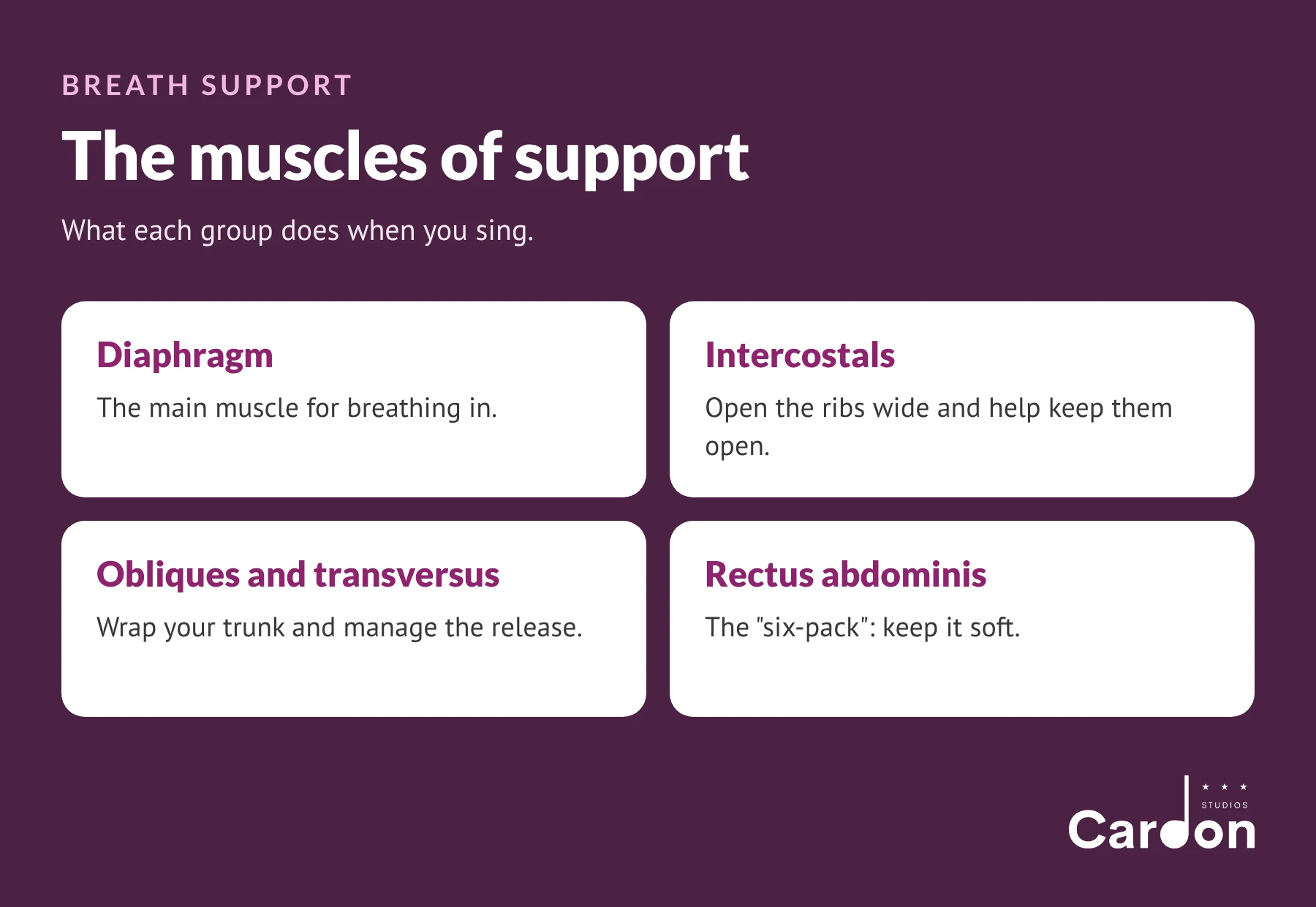
Two groups of muscles do most of the work. The diaphragm, a dome-shaped muscle beneath your lungs, is the primary muscle for breathing in. The abdominal muscles are the primary muscles for active breathing out, according to the Queensland Spinal Cord Injuries Service. Singing uses both: the diaphragm to take the breath in, and the abdominal muscles, along with the muscles between your ribs, to manage how the air leaves.
The front and sides of your abdomen are made of five muscles, as TeachMeAnatomy describes: two vertical muscles near the midline, the rectus abdominis and the small pyramidalis, and three flat muscles on each side, the external oblique, the internal oblique and the transversus abdominis. The transversus abdominis is the deepest of the flat muscles, and its fibers run horizontally around your trunk.
Keep the “six-pack” soft
When the fitness world talks about the core, it’s usually talking about the rectus abdominis: the “six-pack” muscle. For singing, the main job of those front muscles is to stay relaxed.
Especially in very fit singers (looking at you, musical theater triple threats), the rectus abdominis is often too tight. The abs want to pull in too fast, which makes an even, slow release of air difficult. Keeping your belly soft helps resist that tightness. On the other hand, singers who worry their abs are weak often overcompensate with a heavy, athletic squeeze. Wherever you fall on the spectrum, the work your core needs to do for singing is about coordination, not strength.
Think 360 degrees
Instead of focusing on the front abs, think of all the muscles that wrap the trunk of your body, especially the deep transversus abdominis. Breathe into your full sense of self, as though inflating yourself from the inside out: front, sides and back.
Just as your breath in should feel like expansion all the way around, your awareness of your core should include your whole 360-degree self. We are not paper dolls! For good breath support, stay open and flexible, and keep the muscles of your core moving smoothly rather than locking them in place.
Coordination, not strength
Too much effort is just as common as too little. Use this table to spot which way you lean, then adjust.
| Signs | Try this | |
|---|---|---|
| Over-working | Hard belly, pushed or pressed tone, tight throat, holding your breath before phrases | Soften your belly, take a smaller breath, and think “steady” instead of “strong” |
| Under-working | Running out of air early, breathy tone, ribs collapsing at the start of phrases | Breathe low and wide, and keep your ribs open longer as you sing |
| Balanced | Even tone, easy breaths in, phrases that finish without strain | Keep it up, and bring the same feeling into harder songs |
Once your core moves flexibly and under your control, you can distribute effort more evenly across your body. That avoids strain and creates a supportive environment for your voice, so power comes with less effort.
Breath support exercises
Practice these slowly. If you feel lightheaded at any point, stop and breathe normally for a moment.
- Hands on your ribs. Place your hands on the sides of your lower ribs, thumbs toward your back. Breathe in and feel your ribs widen into your hands, front, sides and back. Breathe out slowly and notice how long you can keep them open without forcing.
- The laugh check. Laugh “ha-ha-ha” or give a gentle cough, and notice the flex at your sides and just below your ribs. That’s the area of engagement you want for support, not a squeeze at the front of your belly.
- Pulsed “sh.” Breathe in low, then say “sh, sh, sh, sh” in short, energetic pulses, letting your belly release between each one. This trains quick, flexible engagement.
- Sustained “v.” On a comfortable pitch, sustain a buzzy “vvvv” for eight counts with an even sound from start to finish. The partly closed lips give you gentle resistance to balance against. Work up to longer counts.
- Swell on one note. On a comfortable note, start softly, grow to a moderate volume and fade back down, all on one breath. Keep your throat easy and let your middle do the managing.
Should singers train their core?
Core training is a great practice for singers, not because singing needs athletic power, but because it builds the mind-body connection. Activities that build awareness of your trunk, such as yoga or Pilates, can help you notice and control your core muscles. Bring that awareness to your singing, and keep checking that the work feels flexible rather than braced. If you have an injury or health condition, check with your doctor before starting a new exercise program.
Breath support also depends on posture. A collapsed or rigid body makes coordination much harder, so read our guide to singing posture and alignment next. To use your support to be heard, see how to sing louder without straining.
From the studio
Breath support is hard to judge from the inside. In a live online lesson, your teacher can see and hear whether you’re over-working or under-working and give you exercises that fit your body. Between lessons, you can send a video of your singing and get a personalized response within 72 hours.
Online voice lessons
Find breath support that works for you
One monthly membership includes four private online voice lessons, one video coaching submission, the Learning Library, and member online events, with a teacher matched to your style, goals, age, and schedule.
Common questions about breath support
What is breath support in singing?
It’s the coordination of your breathing muscles that lets you release air steadily, at the pressure each phrase needs, without squeezing your throat. The work happens low in your body, around your ribs and middle.
Does “singing from the diaphragm” mean pushing from my stomach?
No. The diaphragm is the main muscle for breathing in, and you can’t feel it directly. “Singing from the diaphragm” is a way of saying to breathe low and keep the work out of your throat and shoulders, not to push from your belly.
Do I need strong abs to sing well?
No. Singing needs flexible, well-coordinated core muscles more than strong ones. Very tight abs can actually make a steady release of air harder.
How do I know if my breath support is working?
Your tone stays even, your breaths in feel easy, and you finish phrases without strain or a tight throat. If you’re running out of air or pushing, adjust using the table above, or ask your voice teacher.
How is breath support different for different styles?
Classical singers often use more sustained support for unamplified singing, while singers who use a microphone may need less. The principle is the same: steady, flexible support with the work low in the body.