


Good singing posture is a tall, balanced, relaxed alignment: feet under your hips, knees soft, ribs open, shoulders easy, and your head balanced so your ears sit over your shoulders. It isn’t a stiff, military stance. The goal is a body that lets your breath and voice move freely, so singing feels easier, not harder.
Singing well is not about trying harder. After watching great performers give everything emotionally on stage, many singers mistake that emotional intensity for physical effort. A healthy, open sound should feel easy and open, never forced. That ease starts with how you stand, and this guide shows you how to find your alignment, check it while you sing, and practice it until it becomes habit.
Key takeaways
- Good singing posture is balanced and tall, but never rigid: stack your ears over your shoulders over your hips, with soft knees.
- Tension travels. A tight jaw, neck, or shoulders can pull on the muscles around your voice box.
- An open, lifted rib cage gives your breath room to expand into your back and sides.
- Check your alignment during songs, especially on hard phrases and high notes, and let tight spots release.
What singing posture is (and isn’t)
Singing posture, sometimes called vocal posture or alignment, is the way you organize your body so it supports your voice instead of getting in its way. Think of it as stacking: your head balanced on top of your spine, your shoulders resting over your rib cage, your rib cage over your pelvis, and your pelvis over your feet. When the parts are stacked, your muscles don’t have to work hard just to hold you up, and more of your energy goes into breathing and singing.
It’s just as important to know what good singing posture is not. It isn’t standing at attention with your chest puffed out, your shoulders pinned back, and your knees locked. That kind of posture looks tall, but it’s full of held tension, and held tension is exactly what makes singing feel effortful. Good alignment is closer to the way an athlete stands before moving: upright, balanced, and ready, with nothing locked.
Posture is also not one perfect position you have to freeze in. You’ll move on stage, sit in choir, hold a microphone, and act out a song. What carries across all of those is the balance underneath: a long spine, a relaxed neck, and room to breathe.
Why alignment matters for your voice
Your voice is made by breath moving through your vocal folds, and the sound is shaped by the spaces of your throat and mouth. If you’d like a quick tour of the parts involved, read how your voice works. Posture affects this system in a few practical ways.
Muscles are connected. No muscle in your face, jaw, or neck works alone. They’re layered and intertwined, so tension in one area can easily spread to its neighbors. That’s why singers talk so much about jaw release: the muscles of the jaw and throat sit very close to your voice box. A jaw that juts forward, a neck that strains, or shoulders that creep up can add tension right where your voice needs freedom. Our guide to releasing tension when singing goes deeper into where it hides.
Breath needs room. When your rib cage is open and lifted, your breath can expand low and wide, into your back and sides as well as your front. When you slump, the ribs have less room to move, and many singers end up taking shallow, high breaths. Good alignment sets up the coordinated breath support that steady singing relies on.
Balance beats force. It’s tempting to think there’s one magic position that unlocks your voice, but research suggests the picture is more subtle. In a small pilot study of eight trained singers published in the Journal of Voice, changing between several standing postures did not produce significant differences in neck and trunk muscle activity or in the airflow measures of the voice, although singing on an unstable surface did change pitch. The authors called for larger studies. The practical lesson for singers is that posture is less about hitting an exact shape and more about staying balanced and clear of unnecessary tension, so your body can respond to what the music asks for.
How to stand when you sing, step by step
Use this sequence to find a balanced singing posture from the ground up. Go slowly the first few times, and notice how each change feels before you move on.
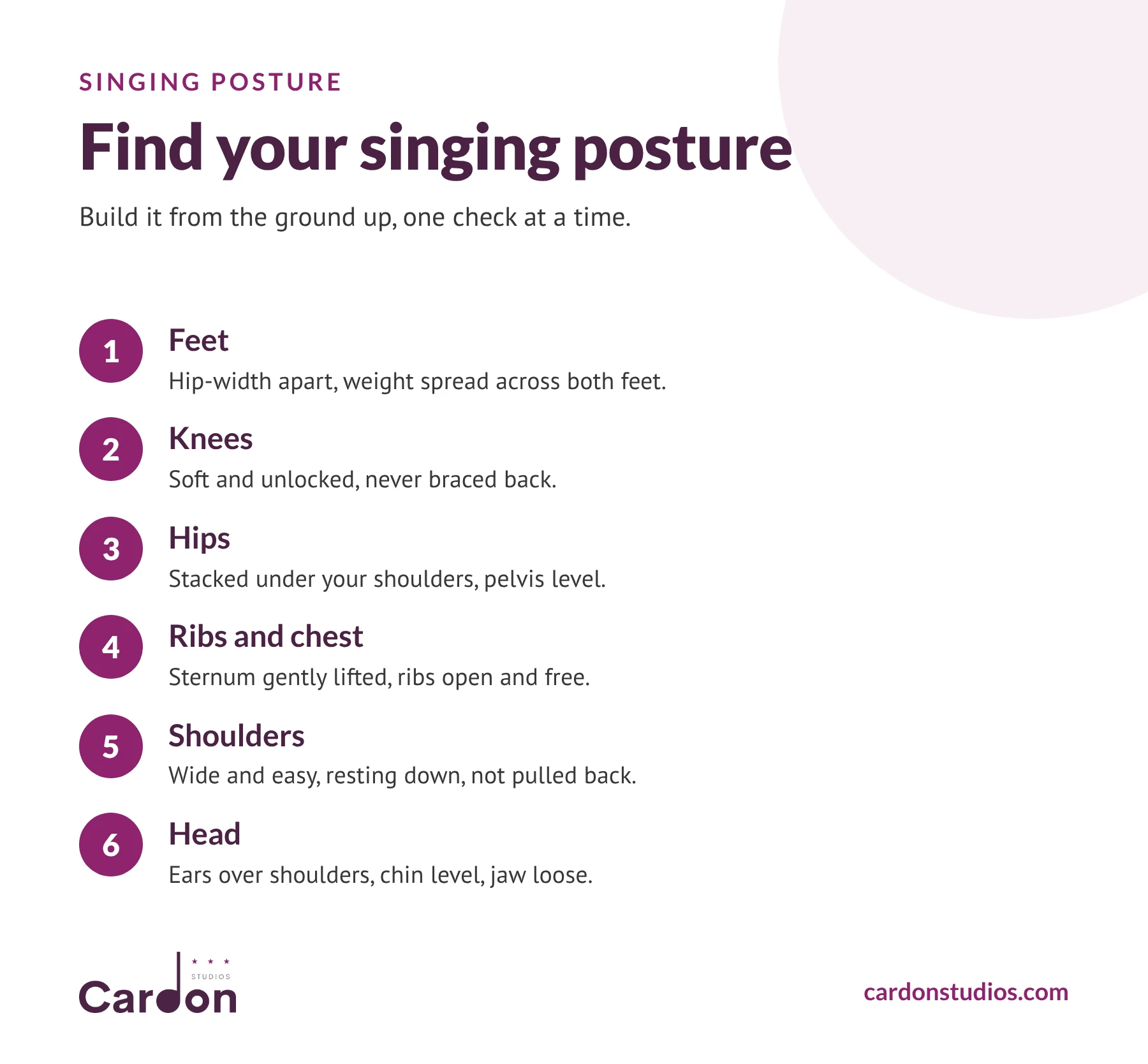
- Set your feet. Stand with your feet about hip-width apart, or with one foot slightly ahead of the other if that feels more stable. Let your weight spread evenly across both feet, between the heels and the balls of the feet.
- Unlock your knees. Let your knees be soft, neither bent nor braced back. Locked knees tighten the legs and lower back and can even make you lightheaded during a long song.
- Stack your hips. Let your pelvis rest level, without tucking it under or arching your lower back. Your hips should sit under your shoulders, not pushed forward or back.
- Open your ribs. Let your sternum (breastbone) float gently upward so your rib cage feels open and buoyant. This is a lift, not a puff: your chest shouldn’t feel pushed out or held.
- Release your shoulders. Let your shoulders rest wide and easy, hanging from your frame rather than pulled back or hunched forward. Your arms should hang loosely at your sides.
- Balance your head. Let your head sit on top of your spine so your ears line up over your shoulders. Keep your chin level, your jaw loose, and your neck long, without tucking or jutting the chin.
Once you’ve stacked everything, take a breath and notice how deeply you can breathe. Many singers feel their breath reach their back and sides for the first time in this position.
Tall, not stiff: finding an open, lifted chest
The most common mistake singers make with posture is overdoing it. They hear “stand up straight” and lock everything into place. The result looks tall but sounds tight. Good alignment should feel easy enough to hold for a whole song.
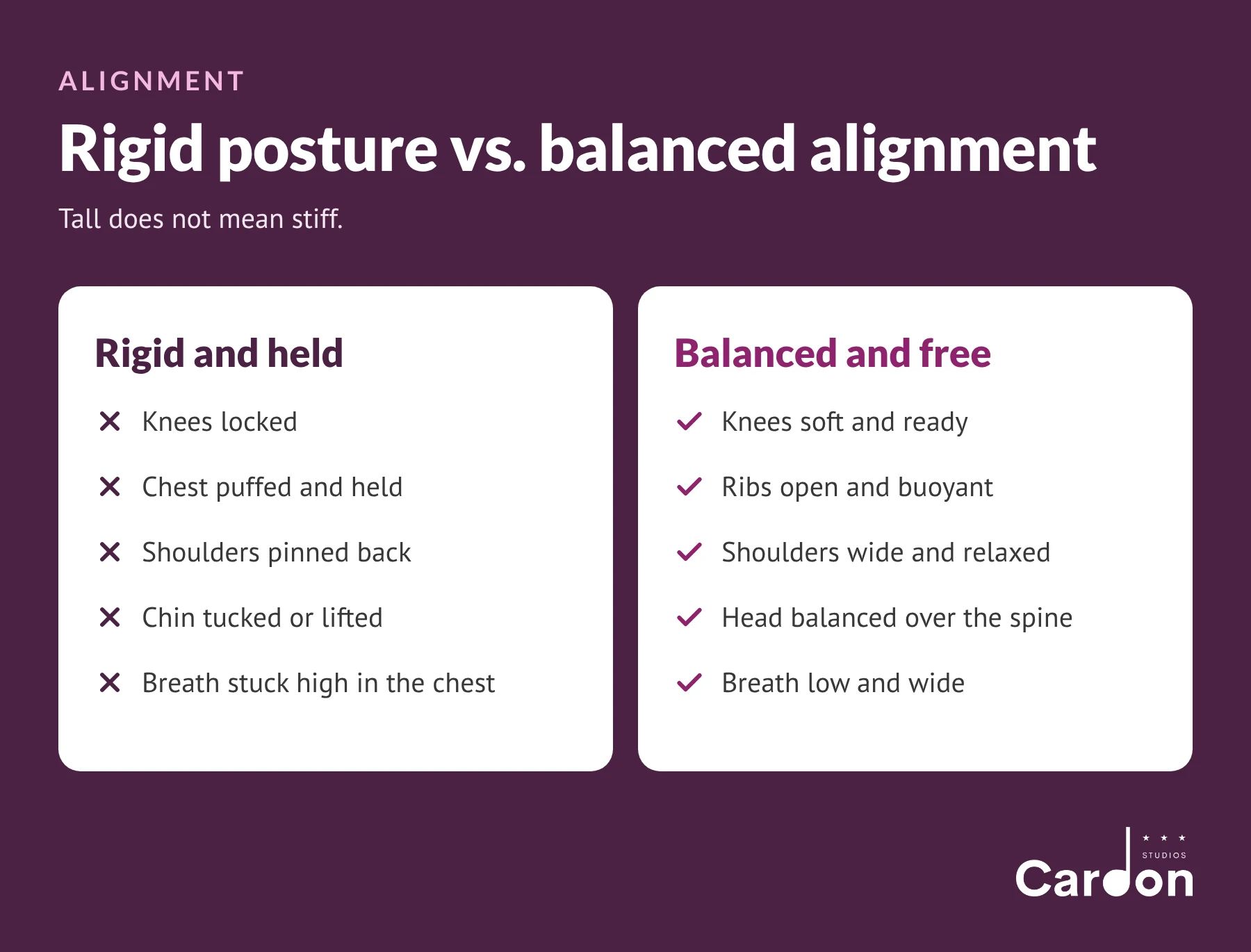
Here’s a simple way to find an open, lifted chest without forcing it:
- Reach up. Raise both arms straight up over your head, next to your ears, and feel your rib cage lift and widen.
- Lower slowly. Bring your arms back down to your sides slowly, letting your shoulders settle.
- Keep the lift. Notice the height of your chest at that moment, and aim to keep your ribs that lifted and open while you sing, without holding your breath or bracing.
Repeat this two or three times at the start of practice. Over time, your body learns where an open chest lives, and you won’t need the arm lift to find it.
Singing posture when sitting
Choir rehearsals, practice at a desk, and online lessons often happen sitting down. The same stacking idea applies: you just build it from the chair instead of your feet.
- Sit toward the front of the chair. Leaning back into the chair tends to collapse your ribs. Sitting forward lets your spine stay long.
- Feet flat on the floor. Plant both feet, about hip-width apart, so your legs support you.
- Balance on your sit bones. Rock gently forward and back until you feel balanced on the two bony points under your pelvis, then stop in the middle.
- Keep the top half the same. Open ribs, easy shoulders, and your head balanced over your spine, just as when you stand.
- Hold music at eye level. If you read from a folder or screen, lift it so you don’t drop your head to see it. Our guide to vocal warm-ups for choir includes body warm-ups that help before a seated rehearsal.
If you find that you sing better sitting down, it may be because sitting takes your legs and lower back out of the picture, so there’s less to lock. That’s a useful clue. When you stand again, check whether you’ve been locking your knees or gripping your lower back.
Singing posture exercises
These exercises build awareness of your alignment and help you release tension before you sing. Do them gently, stay comfortable, and stop if anything hurts.
1. The wall check
Stand with your back against a wall, heels a few inches away from it. Let your lower back, upper back, and the back of your head lightly touch the wall without straining. Notice where your head and shoulders sit. Then step away and keep that sense of length. Repeat three times.
2. Shoulder rolls and drops
Slowly roll your shoulders up, back, and down five times. Then lift them toward your ears on an inhale and let them drop on a sigh. Repeat three times. Finish by singing a comfortable five-note scale on “ah,” keeping the shoulders where they landed.
3. Head balance nods
Nod your head very slightly, as if saying a tiny “yes,” and feel where it balances on top of your spine. Then let it come to rest at the balance point, chin level. Hum a few comfortable notes and notice whether your neck feels longer and easier.
4. Jaw release
Place your fingertips on your cheeks just in front of your ears and gently massage the jaw muscles in small circles. Let your jaw hang open slightly. Then sing “yah, yah, yah” on one comfortable note five times, letting the jaw drop loosely on each “ah” without pushing it.
5. Low, wide breath
Place your hands on the sides of your lower ribs. Breathe in slowly through your nose and feel your ribs widen into your hands, then breathe out on a gentle “sss” for as long as is comfortable. Repeat four times. Keep your shoulders still and your chest open. For more on breathing, read how to breathe when singing.
You can add these to the start of your usual vocal warm-up. A few rounds before each practice session is enough to make a difference over time.
Checking your alignment while you sing
Finding good posture before a song is the easy part. Keeping it while you sing, especially when a phrase gets hard, is where the real work happens. Start by taking stock of how loose your jaw and neck feel at rest, then notice the exact moment that changes. Is it during your inhale? At the start of the sound? On the highest note? That kind of self-awareness tells you where to focus.
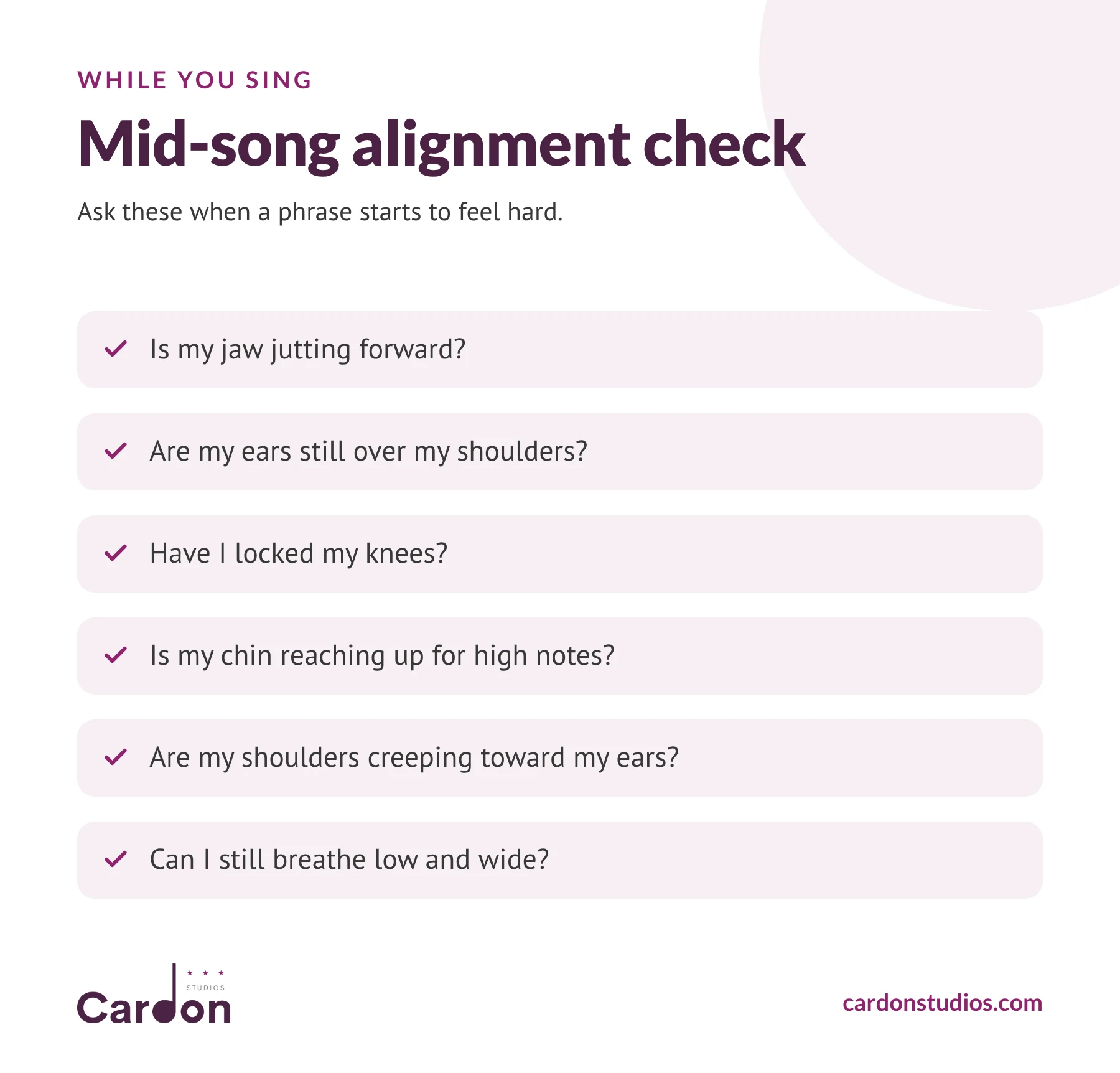
As you sing, check in with your body. Is your jaw beginning to jut forward? Have you pushed your head out so your ears are no longer over your shoulders? Have you locked your knees? Is your lower body staying loose but energized, helping your upper body support the sound? Singing well is a full-body experience.
When you reach a problem spot in a song, come back to this open, flexible alignment. Notice where you’ve locked up and let that area melt back into release. It can help to picture your voice as what it really is, vibration and air, and imagine your breath and sound flowing freely. Locking the body interrupts that flow, or at least makes it less efficient and more tiring, which no performer wants during a show or a run of shows. Ideas from visualization for singers can make this imagery more vivid.
A mirror or a video helps a lot here. Record yourself singing a hard phrase and watch it back with the sound off. Habits like a lifted chin or rising shoulders are much easier to see than to feel.
Common posture problems and how to fix them
Most posture problems come from a handful of habits. Use this table to spot yours and try a fix.
| Habit | What you might notice | Try this |
|---|---|---|
| Chin lifts on high notes | A tight, thin sound at the top of a phrase; tension in the front of the neck | Keep your eyes level and let the note come to you. Practice the phrase while looking at a spot straight ahead. |
| Head juts forward | Strain in the back of the neck; ears in front of the shoulders | Use the head balance nod, then think of your head floating up and back over your spine. |
| Shoulders creep up | Shallow, noisy breaths; tight upper chest | Drop your shoulders on a sigh before each phrase, and breathe into the sides of your ribs. |
| Chest collapses as you run out of air | The end of each phrase goes flat or breathy | Keep the ribs open as you sing, and take a breath sooner rather than squeezing out the last of your air. |
| Knees lock | Stiff legs and lower back; feeling unsteady in long songs | Soften your knees and shift your weight slightly from foot to foot between phrases. |
| Overcorrected, military posture | Looks tall but feels held; breath feels stuck | Let go about a third of the effort you’re using to stand straight, and keep only the length. |
Posture also affects how well your voice carries. Once your alignment is balanced, our guide to vocal projection shows how to fill a room without pushing.
Listen to your voice
Your body tells you when something isn’t right through pain or discomfort. If singing hurts, or your throat feels tight or scratchy, don’t push through: stop, rest, and notice what you were doing. Posture work should feel easy and comfortable, never painful. According to the National Institute on Deafness and Other Communication Disorders, you should see a doctor if your voice has been hoarse for more than three weeks. For everyday care, see our guide to vocal health for singers.
From the studio
Posture habits are hard to see in yourself, and that’s where a teacher helps. In a live online voice lesson, your teacher watches and listens at the same time, so they can spot a lifted chin or rising shoulders and help you translate what you’re feeling into small adjustments. Between lessons, you can send a video of a song for a personalized response from your teacher within two business days.
Online voice lessons
Find an easier, freer voice with a teacher
One monthly membership includes four private online voice lessons, one video coaching submission, the Learning Library, and member online events, with a teacher matched to your style, goals, age, and schedule.
Common questions about singing posture
What is the correct posture for singing?
Stand tall and balanced with your feet about hip-width apart, knees soft, ribs open, shoulders relaxed, and your head balanced so your ears are over your shoulders. It should feel easy to hold. If it feels stiff or held, you’re working too hard.
Why do I sing better sitting down?
Sitting takes your legs and lower back out of the picture, so there’s less to lock. If you sing better seated, check whether you lock your knees or grip your lower back when you stand, and bring that same ease into your standing posture.
Does posture really affect your singing voice?
Yes, mainly by adding or removing tension. Tension in the jaw, neck, and shoulders can spread to the muscles around your voice box, and a slumped chest leaves less room to breathe. There isn’t one perfect position, but a balanced, relaxed alignment makes singing easier for most people.
Should I lift my chin to sing high notes?
No. Reaching up with the chin tightens the front of the neck and usually makes high notes harder. Keep your head level, your neck long, and let the vowel open a little instead. Our guide on how to belt covers high notes in more detail.
What are good singing posture exercises?
Try a wall check to feel a long spine, shoulder rolls and drops, gentle head balance nods, jaw release, and slow, wide breathing with your hands on your ribs. A few rounds at the start of practice build the habit over time.