

Releasing tension when singing starts with noticing where it lives. For most singers, it hides in the jaw, the tongue, the neck, the shoulders or a held breath. Once you can spot it, gentle movement while you sing, simple release exercises and greater body awareness let your voice work with less effort. Here’s where to look, how to let go, and the bodywork methods many singers explore to keep moving freely.
Key takeaways
- Tension usually collects in the jaw, tongue, neck, shoulders and breath.
- Mirrors, recordings and slow practice help you notice tension you can’t feel.
- Moving while you sing is one of the easiest ways to catch and release locking.
- Methods such as the Alexander Technique and Body Mapping build lasting body awareness.
Why tension matters for singers
As a singer, you probably already know how important body awareness is. Perhaps you’ve noticed what jaw or tongue tension does to your sound, or you know you tend to slump in a way that keeps you from taking a full, comfortable breath. Your voice is part of your body, so tension anywhere in the system tends to show up in your sound: a tighter tone, a shorter breath, a high note that won’t come out easily.
The tricky part is that much of this tension is habitual. We don’t feel it because we’ve always done it. As actors and singers the world over will tell you, the hardest part is often not doing something: letting go of an effort you didn’t know you were making.
Where tension hides
| Area | Signs | Try this |
|---|---|---|
| Jaw | Clenched teeth, a jaw that juts forward on high notes, a “tight throat” feeling | Let the jaw hang loosely and gently massage the muscles in front of your ears |
| Tongue | A tongue that pulls back or bunches up, a swallowed or muffled sound | Rest the tip behind your lower front teeth and sing a scale on “yah” |
| Neck | Chin lifting on high notes, visible straining in the neck | Keep your head balanced and slowly nod “yes” while you sing |
| Shoulders | Shoulders rising when you breathe in or creeping toward your ears | Raise your arms overhead and float them down, letting the shoulders settle |
| Breath | Holding your breath before a phrase, gasping between phrases | Let the breath turn around without a pause; see how to breathe when singing |
| Legs and feet | Locked knees, gripping toes, rising onto your toes for high notes | Soften your knees and feel your weight spread through your feet |
How to spot tension
Because habitual tension is hard to feel, use other senses to catch it:
- Use a mirror. Watch your jaw, neck and shoulders as you sing a phrase, especially on high or loud notes.
- Record video. A phone video shows habits you won’t notice in the moment. See how to record yourself singing.
- Use your hands. Rest your fingertips lightly on your jaw hinge or under your chin while you sing, and notice what tightens.
- Slow it down. Sing a tricky phrase at half speed and scan your body as you go.
- Check the line before. When a phrase feels hard, the tension often started in the line leading into it.
Release exercises
Use these as part of your warm-up, or any time singing starts to feel tight. Keep everything gentle; release can’t be forced.
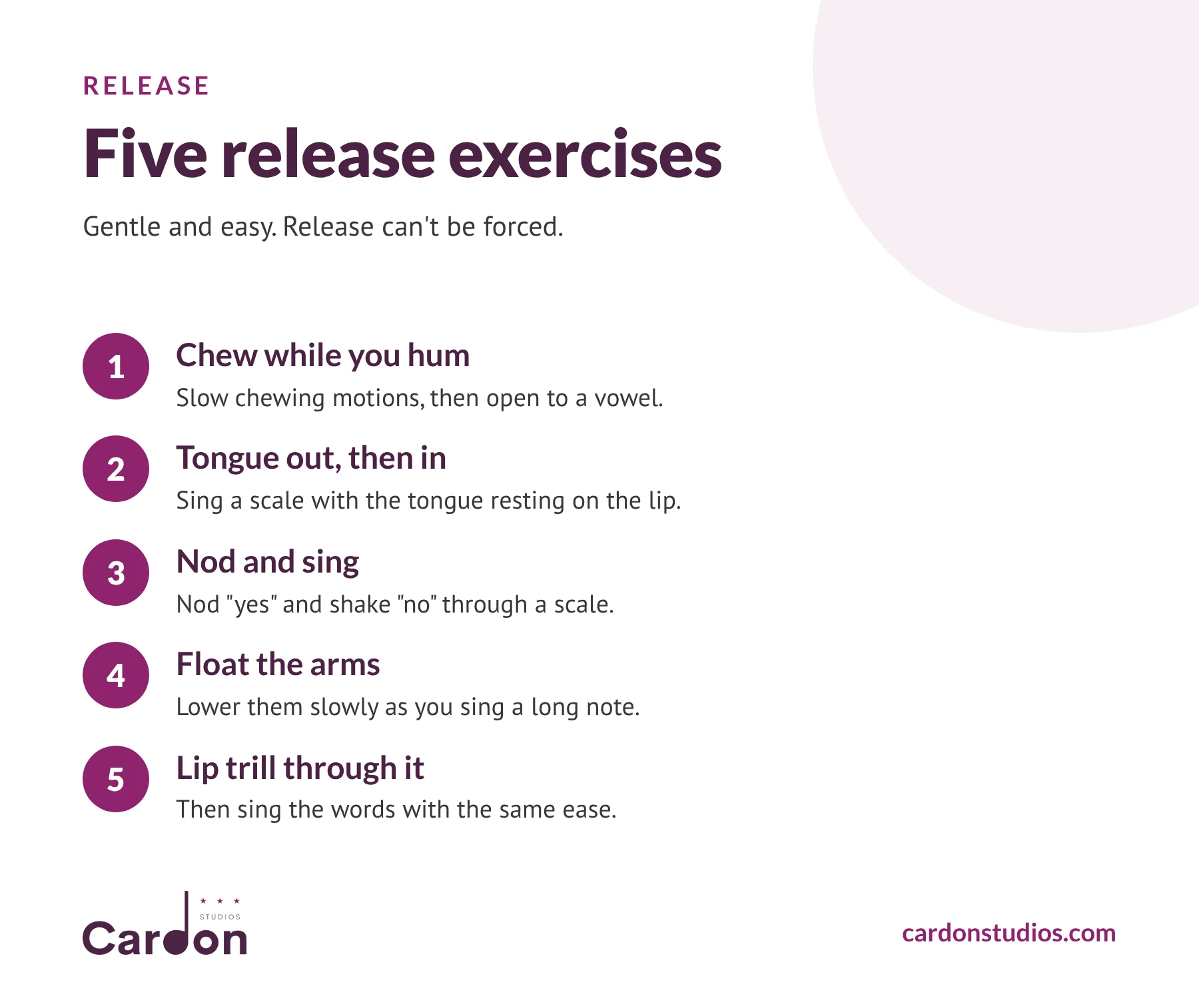
- Chew while you hum. Hum a comfortable pitch and make slow, exaggerated chewing motions. Then open into a vowel while keeping the jaw loose.
- Tongue out, then in. Let the tip of your tongue rest gently on your lower lip and sing a five-note scale on “ah.” Then sing it again with your tongue back in place, keeping the same freedom.
- Nod and sing. Sing a scale while slowly nodding “yes,” then shaking “no.” If a note only works with your head held still, there’s tension to release.
- Float the arms. Raise your arms up beside your ears, then slowly lower them out to the sides as you sing a long note. Let your shoulders settle as the arms come down.
- Lip trill through it. Sing a tricky phrase on a lip trill. The gentle back pressure makes it hard to squeeze, so you feel what the phrase is like without pushing. Then sing the words with the same ease.
For a full routine that builds these in, see our complete vocal warm-up, and for posture, read alignment.
Move while you sing
Many singers lock up when they stand still to sing. A simple fix is to keep moving. Gently sway, shift your weight from foot to foot, walk around the room or make easy gestures as you sing a phrase. If the movement suddenly stops when a high note arrives, your body is bracing, and that’s the moment to look at.
Freedom of movement also matters on stage. A body that can move easily is a body that can act, and that makes your performance more expressive as well as easier on your voice. For staying present and aware as you practice, read mastery through mindfulness, and for using mental images to release tension, see visualization for singers.
Bodywork methods singers explore
The further you go in singing, the more often you’ll hear about bodywork disciplines that build awareness and ease. Here’s a brief overview of a few that are popular with singers and other performers. Each is best learned from a qualified teacher.
Alexander Technique
The Alexander Technique is named for Frederick Matthias Alexander, a Shakespearean actor. According to Harvard Health Publishing, he wanted to understand why he kept losing his voice during performances in the 1890s, and by watching himself in mirrors he noticed that he tightened his neck and upper body before speaking. The technique he developed teaches people how to let go of tension and unlearn unhelpful habits. Much of it comes down to paying attention to the process rather than the end result. The American Society for the Alexander Technique can help you find a teacher. For singers, Jane Heirich’s book Voice and the Alexander Technique is a good place to start.
Feldenkrais Method
The Feldenkrais Method is a form of somatic education developed by Moshe Feldenkrais, who founded the Feldenkrais Guild of North America in 1977. It’s offered as Awareness Through Movement classes and Functional Integration sessions, which use small, gentle movements to build awareness and efficiency. To explore it for singing, read Singing with Your Whole Self: The Feldenkrais Method and Voice by Samuel H. Nelson and Elizabeth L. Blades.
Body Mapping
Body Mapping, as an article from the Eastman School of Music’s Institute for Music Leadership describes it, is the conscious correction and refinement of your body map: the representation of your own body in your brain. Barbara and William Conable developed its concepts from the mid-1970s, building on ideas implicit in Alexander’s writing. When your internal map of where your joints and muscles are doesn’t match reality, your movements tend to use more effort than they need. Barbara Conable’s What Every Musician Needs to Know About the Body is the classic introduction.
Yoga and Pilates
Yoga and Pilates are the best-known options on this list. Many singers find that they build awareness of the breath and trunk, along with flexibility and balance. If you try them, bring the same mindset to singing: notice what you’re doing, and look for ease rather than effort.
Cardon Studios teachers often draw on principles from methods like these to help singers find greater body awareness and freer movement, all in service of a more flexible, reliable voice.
Listen to your body
Release work should feel good. If singing causes pain, or your voice stays hoarse, rest and get checked. According to the National Institute on Deafness and Other Communication Disorders, see a doctor if your voice has been hoarse for more than three weeks. If you have an injury or health condition, check with your doctor before starting a new movement practice.
From the studio
Tension is often easier for someone else to see. In a live online lesson, your teacher can watch for habits you can’t feel and give you exercises to release them. Lessons are recorded so you can rewatch them, and between lessons you can send a video and get a personalized response within 72 hours.
Online voice lessons
Let go of the tension in your singing
One monthly membership includes four private online voice lessons, one video coaching submission, the Learning Library, and member online events, with a teacher matched to your style, goals, age, and schedule.
Common questions about tension when singing
Why does my throat feel tight when I sing?
Often the tightness isn’t in the throat itself but in the muscles around it: the jaw, the tongue and the neck. Pushing too much air or reaching for high notes adds to it. Release exercises and a lighter approach usually help.
How do I relax my jaw when singing?
Let the jaw hang loosely rather than holding it open, and try humming while making slow chewing motions. Gently massaging the muscles in front of your ears before you sing also helps.
How do I stop tensing up on high notes?
Keep your head balanced instead of lifting your chin, lighten the sound as you rise, and try moving gently while you sing. If your body freezes as the high note arrives, that’s the tension to work on.
Is the Alexander Technique good for singers?
Many singers and actors use it to build awareness of habits such as tightening the neck, and its origins are in one actor’s voice problems. It works best alongside voice training, with a qualified teacher.
Can tension cause voice problems?
Excess tension makes singing harder and can tire your voice. If you notice pain or ongoing hoarseness, rest and see a doctor.