

Visualization for singers means using mental images to guide how your body sings. Because we call notes “high” and “low,” many of us picture high notes as somewhere above our heads, and our bodies respond by reaching and straining. Changing the picture, for example imagining a big leap as a step straight ahead, can release that tension. Pair it with audiation, hearing the music clearly in your head before you sing, and visualization becomes one of the simplest tools for more ease and expression.
Key takeaways
- How you picture a note changes how your body sings it.
- Nothing in your body needs to move up to sing a higher note.
- Audiation, hearing music in your mind’s ear, makes pitches easier to find.
- Visualize the energy and meaning of a line, not just the shape of the melody.
Why singing gets complicated
In one sense, singing is simple. Zoom out, and there isn’t much to it: air, vibration, pitch and rhythm. But add a human being to the equation, with habits, expectations and nerves, and things get complicated. Have you ever wondered why a particular song, or even one particular line, is so hard? Often the problem isn’t your voice. It’s that you’re getting caught up in your own head.
The good news is that the same mind that creates the problem can help solve it. Visualization uses your imagination on purpose, to steer your body toward ease rather than effort.
Audiation: hear it first
Try this. Without singing out loud, imagine the opening of a song you know well. If you can hear the melody clearly in your head, you’re using a skill called audiation: hearing with your “mind’s ear.” It’s the musical equivalent of reading silently.
Audiation matters because your voice follows what you hear inside. When you can hear a pitch clearly before you sing it, you’re far more likely to land it cleanly. Practice it by audiating a phrase before you sing it, or by hearing the next note in your head during a rest. Building musicianship skills strengthens audiation over time.
Why high notes make us reach
Pitch is simply the frequency of the sound waves your voice produces. But because we describe pitches as high or low, most of us have a mental picture of where a note “lives.” Think of the opening octave leap of “Over the Rainbow,” and notice what shape you picture as you hear it in your head. For most people, a big upward jump looks like a giant leap uphill.
Picture a musical interval that way, and your body tends to respond in kind. You start reaching for the “high” note somewhere above your head: lifting your chin, stretching your neck, tightening the root of your tongue, sometimes even rising onto your toes. None of that helps. Nothing in your body needs to go up to produce a higher pitch; the change happens inside your voice box, as our guide to how your voice works explains. Those extra movements are your body trying to help, prompted by the picture in your head.
Visualization exercises to try
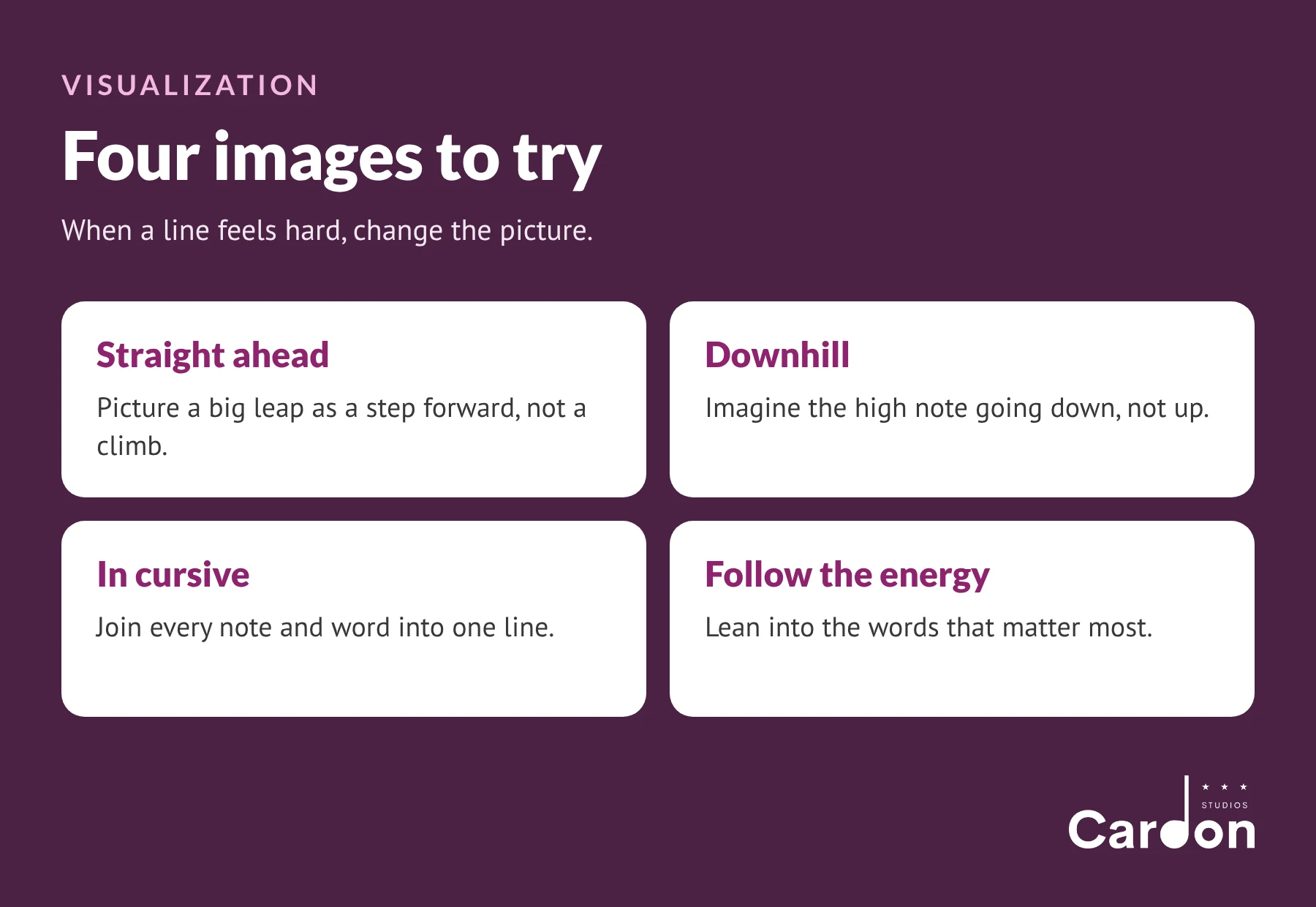
- The leap straight ahead. Sing a large upward interval, such as an octave, and picture the path between the notes as a step straight ahead of you rather than a climb. Notice whether your neck and jaw stay quieter.
- The downhill high note. Sing the same interval while imagining it going downhill. It may feel strange, but many singers find the high note suddenly feels lighter and more grounded.
- Draw the line. Sketch the shape you want a phrase to feel like, even if it doesn’t match the melody’s contour on the page. A long, smooth curve for a legato phrase is a good start.
- Hear, then sing. Audiate the phrase once in your head, then sing it. Compare how it feels with singing it cold.
- Rehearse in your mind. Run through a song entirely in your head, hearing every note and picturing yourself singing with ease. This is useful when your voice needs rest.
Visualizing wordy and rhythmic lines
The same reframing helps with rhythmic or very wordy passages. Instead of singing word. by. word. or note. by. note., sing “in cursive,” joining everything into one connected line.
For wordy passages, visualize the energy of the line rather than the melody. Which words actually matter? Where does the energy swell? Let the in-between words fade into the background, and lean into the important words with a little more energy. One caution: the highest note isn’t necessarily the most important one. Following the meaning of the text, rather than the shape of the melody, creates an easy, natural ebb and flow.
Images teachers use
Voice teachers use imagery all the time, because it can communicate a coordination faster than an explanation. Not every image works for every singer, so experiment and keep the ones that click.
| Image | Often used for |
|---|---|
| Breath dropping down to your hips | A low, relaxed breath; see how to breathe when singing |
| Spacers between your vertebrae | A tall, open posture without stiffness |
| Sending your voice to the back wall | Projection without pushing; see vocal projection |
| Singing in cursive | Smooth, connected phrases |
| Shoulder blades melting down your back | Releasing shoulder tension |
| A high note straight ahead, not above | Avoiding reaching on high notes |
Building visualization into your practice
Visualization works best as a regular habit rather than a last-minute fix. Try these ways to fit it into your practice:
- Before you start a new song, audiate the melody all the way through before you sing a note.
- When a phrase feels hard, change the picture before you change anything else.
- Write the images that work in your music, so you can come back to them.
- Record a phrase with and without the image, and listen for the difference.
- On rest days, rehearse your songs in your head instead of skipping practice altogether.
Our guide to how to practice singing has a simple session plan to build these into.
Visualization for performance
Visualization isn’t only for technique. Before a performance, picture the space, the audience and yourself singing with ease from your first note to your last. Imagine how you’ll walk on, where you’ll focus, and how you’ll recover calmly if something unexpected happens. Rehearsing the experience in your mind makes the real thing feel more familiar.
If nerves are a big part of your experience, pair visualization with the techniques in conquering stage fright and our guide to preparing for a singing performance. For staying present while you practice, read mastery through mindfulness.
From the studio
As with all art, it’s easy to get caught up in the details, and visualization is a great way to step back and rethink your approach. In a live online lesson, your teacher can help you find the images that work for your voice. Lessons are recorded so you can rewatch them, and between lessons you can send a video and get a personalized response within 72 hours.
Online voice lessons
Find more ease in every line
One monthly membership includes four private online voice lessons, one video coaching submission, the Learning Library, and member online events, with a teacher matched to your style, goals, age, and schedule.
Common questions about visualization for singers
What is visualization in singing?
It’s using mental images to guide how your body sings, for example picturing a high note straight ahead of you instead of above your head, so you don’t reach and strain for it.
What is audiation?
Audiation is hearing music clearly in your head without singing it out loud. It helps you find pitches more accurately and learn music faster.
Why do I strain on high notes?
Often because you’re reaching up physically, with your chin, neck or tongue, as if the note were above you. Nothing needs to move up to sing higher. Try picturing the note straight ahead and lightening the sound as you rise.
Does visualization really work for singing?
Many singers find that changing a mental image changes how a phrase feels and sounds, often right away. It doesn’t replace technique, but it’s a quick way to release habits like reaching or pushing. Test it yourself: record a phrase with and without the image and compare.
Can I practice singing in my head?
Yes. Mentally rehearsing a song, hearing every note and picturing yourself singing with ease, is a useful practice tool, especially when your voice needs rest. It works best alongside regular practice out loud.