

The best musical theater audition song is one that sits comfortably in your voice, matches the style of the show you’re auditioning for, and fits the kind of role you want. Look for a song by the same writers or from the same era as the show, sung by a character similar to the one you’re after, that you can sing with total ease. Below is a checklist for choosing, then song ideas sorted by voice type, each with the show, the writers, the character and the role’s published range.
Key takeaways
- Match the show’s style: choose a song by the same writers or from the same period, not from the show itself.
- Pick a character close to the role you want in age, type and place in the story.
- Sing something you can own. Ease beats difficulty in the audition room.
- Prepare a clean, clearly marked cut, usually 16 or 32 bars, in your own key.
How to choose a musical theater audition song
You want to put your best foot forward vocally, but an audition song also shows your sense of musical style, your ability to become a character, and your understanding of the show. This checklist helps you narrow your options.
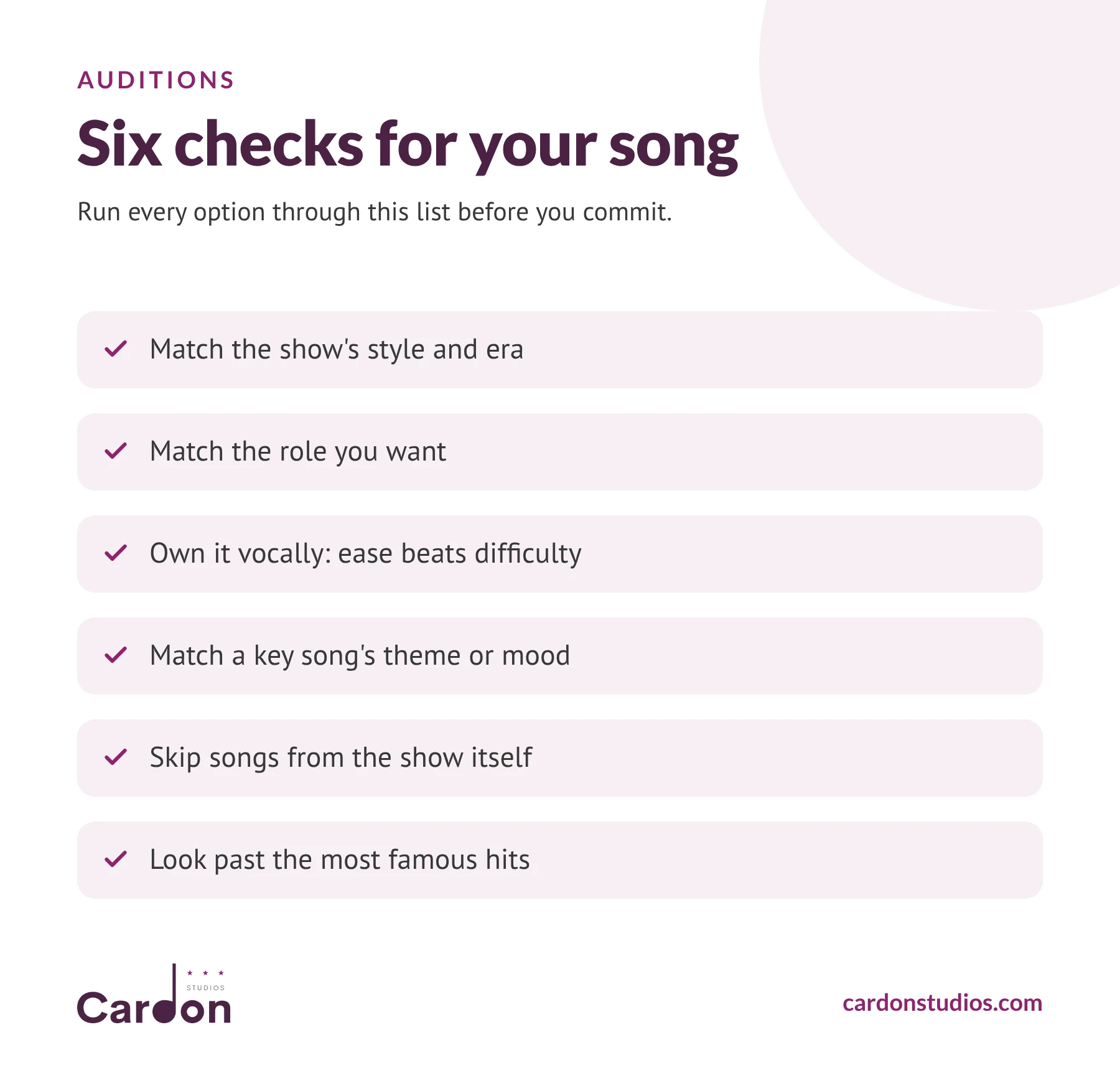
- Match the show’s style. Look at songs by the same composer, or by writers working in the same style and period. A song from the same musical world tells the creative team you understand what the show needs.
- Match the role. Choose a song sung by a character with similar traits to the role you want: age, background, time period, and where they sit in the story, such as a romantic lead or a comic supporting role. Choose wisely. The role you want most may not be the one you’re best suited for, so consider every option.
- Own it vocally. Don’t overextend yourself. Creative teams hear plenty of hard songs sung at an underwhelming level. A singer completely at ease in a simpler song is far more memorable than one who just makes it through a showpiece.
- Match the theme or mood. If you can, pick a song about a similar idea to a key song for your target role. If you can’t find a close theme, look for a similar mood.
- Skip the show itself. It’s generally considered bad form to sing a song from the show you’re auditioning for, and many auditions forbid it. Follow the audition notice; if it asks for material from the show, sing from the show.
- Look past the hits. Directors hear a lot of singers. The most famous songs can make you blend into the crowd, while a strong, less familiar song by the same writers helps you stand out.
Not sure where your voice sits? Start with our guide to voice types and vocal range.
Musical theater audition song ideas by voice type
The songs below are starting points, chosen to cover a range of styles and periods. For each one, we’ve listed the show, its writers, the character who sings it, and the full role range that the show’s licensor, Music Theatre International, publishes in its character breakdowns. Writers listed are the songwriters, and ranges use the system in which C4 is middle C. A role’s range covers the whole part, so a single song may sit in a narrower band.
Use the list to find writers and characters that suit you, then explore their other songs. Before you choose a song, listen to it in full, read the whole show, and check the song’s range against your own.
Soprano
| Song | Show and writers | Character | Role range |
|---|---|---|---|
| “Much More” | The Fantasticks (Harvey Schmidt and Tom Jones) | Luisa | B3 to B5 |
| “Vanilla Ice Cream” | She Loves Me (Jerry Bock and Sheldon Harnick) | Amalia | C4 to B5 |
| “Goodnight, My Someone” | The Music Man (Meredith Willson) | Marian | G3 to A5 |
All three suit a light, classically shaped “legit” sound, and they show sustained high notes and an honest, youthful character. “Vanilla Ice Cream” is the most demanding at the top.
Mezzo-soprano and belt
| Song | Show and writers | Character | Role range |
|---|---|---|---|
| “Astonishing” | Little Women (Jason Howland and Mindi Dickstein) | Jo | E3 to A5 |
| “Gimme Gimme” | Thoroughly Modern Millie (Jeanine Tesori and Dick Scanlan) | Millie | G#3 to E5 |
| “Watch What Happens” | Newsies (Alan Menken and Jack Feldman) | Katherine | A3 to F5 |
| “I Speak Six Languages” | The 25th Annual Putnam County Spelling Bee (William Finn) | Marcy | A3 to Eb5 |
| “Home” | Beauty and the Beast (Alan Menken and Tim Rice) | Belle | E3 to F5 |
“Astonishing,” “Gimme Gimme” and “Watch What Happens” are big, contemporary belt songs; the licensor’s breakdown for Katherine calls for a contemporary pop voice with a high belt. “I Speak Six Languages” is a comic character song, and “Home” is a gentler, story-driven ballad. If belting is new to you, read how to belt safely before you take on the first three.
Tenor
| Song | Show and writers | Character | Role range |
|---|---|---|---|
| “Santa Fe” | Newsies (Alan Menken and Jack Feldman) | Jack | Bb2 to A4 |
| “Take a Chance on Me” | Little Women (Jason Howland and Mindi Dickstein) | Laurie | Bb2 to Bb4 |
| “What Do I Need with Love?” | Thoroughly Modern Millie (Jeanine Tesori and Dick Scanlan) | Jimmy | C3 to A4 |
| “Moving Too Fast” | The Last Five Years (Jason Robert Brown) | Jamie | A2 to Bb4 |
The licensor’s breakdown for Jack asks for a great pop tenor voice. “Take a Chance on Me” and “What Do I Need with Love?” both show charm and a light, bright top, while “Moving Too Fast” is a fast, high, contemporary song that rewards strong diction and stamina.
Baritone
| Song | Show and writers | Character | Role range |
|---|---|---|---|
| “If I Can’t Love Her” | Beauty and the Beast (Alan Menken and Tim Rice) | Beast | A2 to F4 |
| “She Loves Me” | She Loves Me (Jerry Bock and Sheldon Harnick) | Georg | B2 to F4 |
| “How I Am” | Little Women (Jason Howland and Mindi Dickstein) | Professor Bhaer | G2 to F#4 |
| “Marian the Librarian” | The Music Man (Meredith Willson) | Harold Hill | Ab2 to F4 |
“If I Can’t Love Her” and “How I Am” are dramatic ballads; “She Loves Me” is joyful and comic; and “Marian the Librarian” shows a charming, persuasive leading man. Song details are drawn from the licensor’s character breakdowns and the shows’ published song lists.
Cutting your song: 16 and 32 bars
Most auditions ask for a short excerpt rather than a full song. The notice usually names a length, most often 16 or 32 bars. Choose a section that has a clear beginning and a satisfying end, shows your voice at its best, and lets your character make a choice or discovery. The climax of a song is often the strongest choice.
- Count bars carefully, and keep the cut close to the length requested.
- Start and end on a complete musical phrase, not mid-thought.
- Add a short introduction, such as a bell tone or one measure, so you can find your starting pitch.
- Prepare the full song too, in case the panel asks to hear more.
Preparing your sheet music
The accompanist in the room is a key partner. Bring clean, legible sheet music in the key you’ll sing, with the start and end of your cut clearly marked. Put the pages in a binder or tape them together so they’re easy to turn, and mark any repeats, cuts or tempo changes. When you hand over your music, point out the start and end of the cut and indicate the tempo, ideally by quietly singing a phrase. A short, polite conversation goes a long way.
If the audition is virtual or uses a recorded track, practice with that track ahead of time, and test your sound setup. Our guide to recording yourself singing covers the basics.
Performing your song
An audition song is a scene. Before you sing, decide who you’re singing to, what you want from them, and what changes by the end of the cut. Plant your focus just above the panel’s heads rather than singing directly to them, unless they invite you to.
Your body language and clothing are part of the audition, too. Even before you sing, the creative team is noticing your professionalism and your flexibility to play a role that may be different from you. Be confidently yourself as you greet them, then make a clear but subtle change in posture and attitude to signal the start of your performance. Never wear a costume, but a small nod to the character or the period in your outfit is a nice touch. Less is more.
Nerves are normal. Our guide to conquering stage fright has techniques that help, and our step-by-step guide to community theater and school musical auditions walks you through the whole day.
Building an audition book
Over time, collect a small book of songs you can sing at any audition. A useful book includes contrasting choices, so you’re ready for whatever a notice requests:
- A ballad that shows your tone and sustained singing.
- An up-tempo song that shows energy, diction and personality.
- A classic song from the earlier musical theater repertoire.
- A contemporary song from a recent show.
- A comic or character song that shows your acting and timing.
Keep each song performance-ready, with its cut marked, and revisit the book as your voice grows. Applying to college programs? See preparing for college auditions.
Common audition song mistakes
- Choosing for difficulty. A showpiece you can barely sing works against you.
- Ignoring the show’s style. A pop ballad for a classic golden-age musical can signal a poor fit.
- A messy cut. Unclear markings or the wrong length unsettle the accompanist and you.
- Singing in the wrong key. Bring music in the key you’ve practiced.
- Treating it like a concert. Panels are casting characters, so act the song.
From the studio
Choosing an audition song is easier with a second set of ears. In a live online lesson, your teacher can help you find songs that fit your voice and the roles you want, set a strong cut, and coach the acting. Between lessons, you can send a video of your audition song and get a personalized response within 72 hours.
Online voice lessons
Walk into your audition ready
One monthly membership includes four private online voice lessons, one video coaching submission, the Learning Library, and member online events, with a teacher matched to your style, goals, age, and schedule.
Common questions about audition songs
Can I sing a song from the show I’m auditioning for?
Usually not. It’s generally considered bad form, and many auditions forbid it. Follow the audition notice: if it asks for a song from the show, sing one.
What does “16 bars” mean?
It means a short excerpt of a song, about 16 measures long. Choose a section with a clear beginning and end that shows your voice and character well, and mark it clearly in your sheet music.
Should my audition song be hard to show off my range?
No. A song you can sing with complete ease is more memorable than one that stretches you to the limit. Show your best singing, not your hardest.
How do I know if a song fits my voice?
Compare the song’s highest and lowest notes with your comfortable range, and sing through the whole song, not just the cut. If you strain anywhere, choose a different song or a different key, or ask your voice teacher.
Can I change the key of an audition song?
Yes, as long as you bring sheet music printed in your key. Don’t ask the accompanist to transpose at sight.