


Experienced singers wake up on performance day with a plan. They’ve done their homework, they know how their bodies respond to nerves, and they’ve taken steps to set themselves up for success. If you’re newer to performing, you may be surprised by how much changes once you leave the practice room. Here’s what to prepare for, how to rehearse, what to ask the venue, and how to connect with your audience once you’re on stage.
Key takeaways
- Performance conditions, from stage lights to acoustics to adrenaline, change how singing feels.
- The best preparation is performing often, so you learn how your body responds.
- Ask the venue practical questions before you say yes to a gig.
- Connect with your audience from the first moment, and sing music that means something to you.
What changes on performance day
No matter how carefully you’ve practiced, performance conditions can change how singing feels. Here’s what the pros plan for.
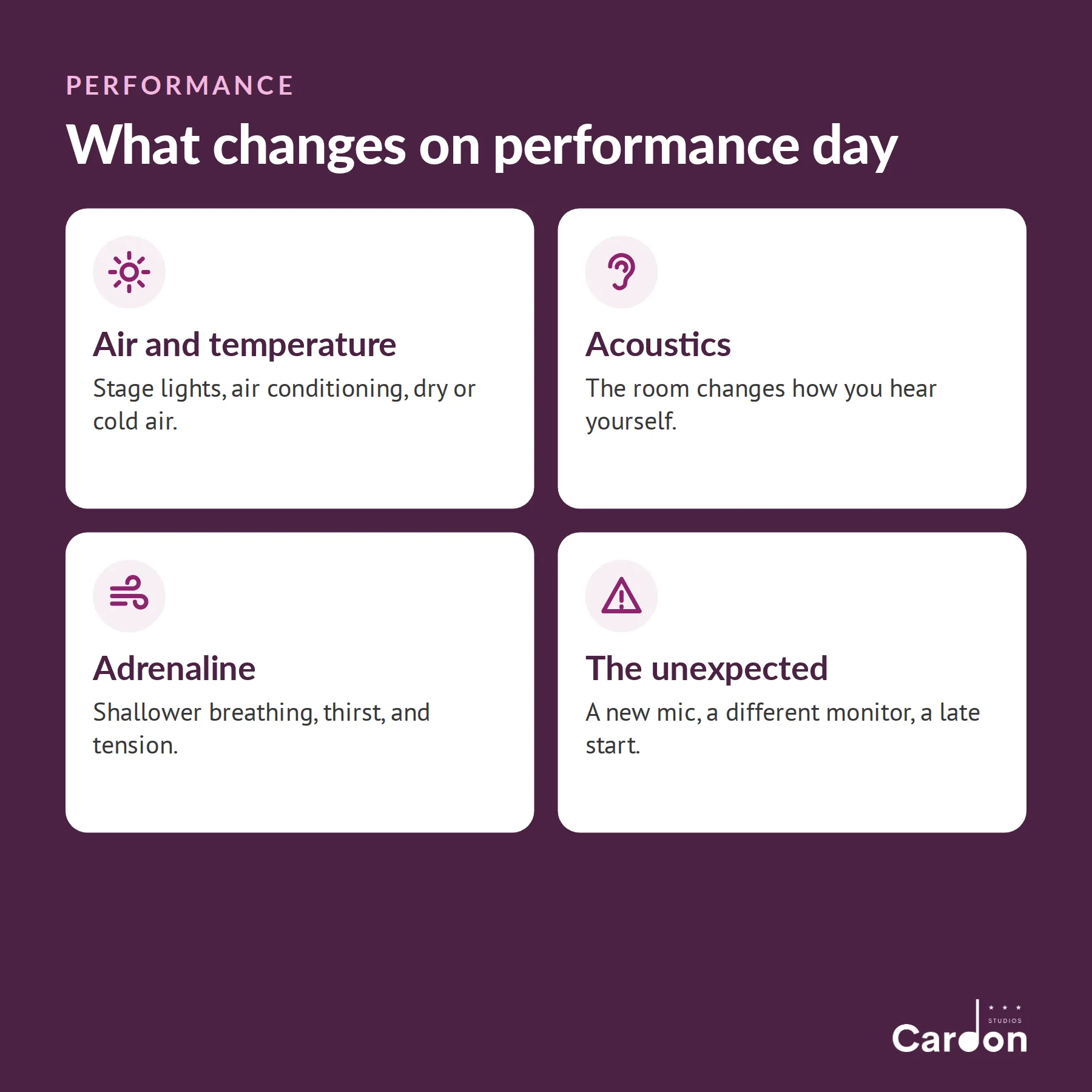
- Air and temperature. Stage lights or sunshine can be hot, and air conditioning or cold outdoor air can feel drying. Dust and other irritants can bother some singers too.
- Acoustics. The size and shape of the space change how you hear yourself and your bandmates. Monitors help, and so does learning to sing by sensation rather than sound, a skill voice lessons develop.
- Adrenaline. Even polished performers feel a rush before going on. Whether it comes from nerves or excitement, you may notice shallower breathing, more thirst, muscle tension, or cold hands.
- The unexpected. A different microphone, a monitor that doesn’t work, or a late start can all throw you if you haven’t thought about them.
Rehearse for real conditions
Every body is different, so the only reliable way to learn how you respond to performing is to perform as often as you can. Over time you’ll know what to expect and how to adapt on the fly. Low-pressure performances, like singing for friends or at an online open mic, count.
In the weeks before, use muscle memory to your advantage. Practice each phrase on its own until it goes the way you want, then put the song back together. Reinforce the exact coordination you want, so your body remembers it under pressure. Then run the whole set the way you’ll perform it: standing, in order, without stopping. Our guide to practicing between lessons has a simple session plan.
Questions to ask before you take a gig
Knowing what to ask is part of planning. If something matters to your voice and your performance, ask about it, and ask for it.
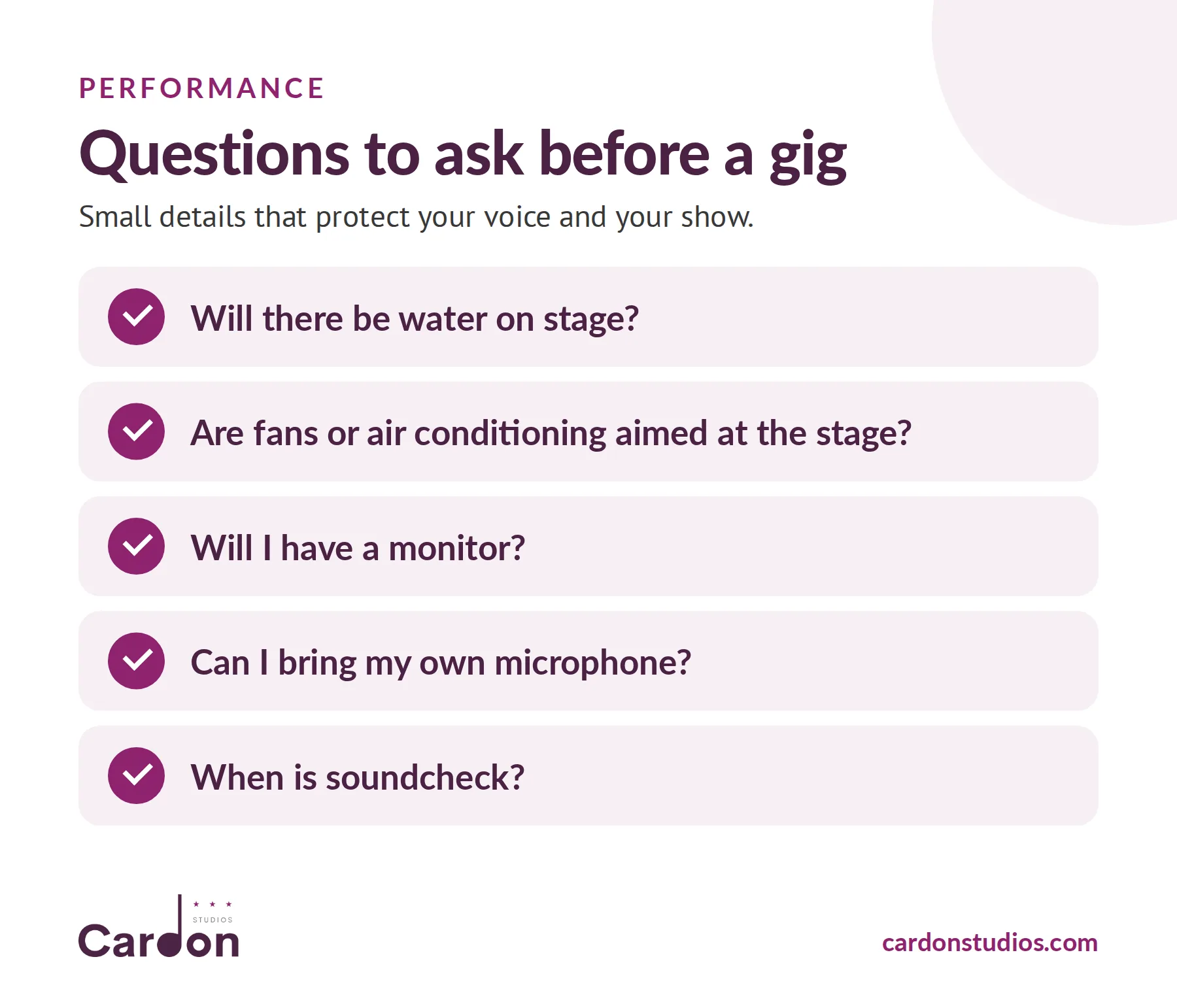
- Will there be water on stage?
- Are fans or air conditioning aimed at the stage?
- Will I have a monitor so I can hear myself?
- Can I bring my own microphone?
- When is soundcheck, and how long will it be?
It’s not unusual for singers to bring their own microphone to remove one more variable. If you’re performing professionally, protecting your voice and your performance is part of the job.
A simple performance-day routine
A steady routine keeps performance day calm and your voice ready.
- Keep your schedule light and give yourself extra time.
- Hydrate steadily and eat something you know agrees with you.
- Warm up gently, then run your opening phrase.
- Arrive early enough to settle and, if possible, soundcheck.
- Take a few slow breaths before you walk on.
Afterward, jot down what went well and what you’d change. Those notes make your next performance easier, and they’re great material to bring to your next lesson.
Connecting with your audience
A well-rounded performance is about more than the notes. Expression, body language, and stage presence all shape how your audience experiences your singing.
Start with your introduction. Engage your audience from the moment you walk on. Before you begin, smile and make eye contact with a few friendly faces. If you introduce yourself or your song, use a relaxed, warm voice. That openness sets the tone for everything that follows.
Let your body language feel natural. Some singers move freely and use their hands; others prefer to stand still. Either can work. Do what feels natural, and avoid closed-off habits like crossed arms or avoiding eye contact. Good posture helps your breathing as well as your presence.
Know what the song means to you. Audiences can see, hear, and feel whether a song matters to you. Before you rehearse, ask yourself what this piece means to you and who you’re singing it to. Whenever you can, choose music you genuinely connect with.
Projecting confidence
It takes courage to share your voice with an audience, and that alone is something to be proud of. Even a new performer can move an audience. Remind yourself that the people listening want you to do well, and perform for them the way you’d want someone to perform for you. If nerves are a big part of your experience, our guide to conquering stage fright has a breathing tool and a simple pre-performance routine.
From the studio
Cardon Studios members can practice performing at online open mic nights, group classes, and recorded showcases, and you’re welcome to watch first. Before a big performance, you can send your teacher a video of your run-through and get a personalized response within 72 hours.
Online voice lessons
Prepare your next performance with a teacher
One monthly membership includes four private online voice lessons, one video coaching submission, the Learning Library, and member online events, with a teacher matched to your style, goals, age, and schedule.
Common questions about performance preparation
How should a singer prepare the day of a performance?
Keep your schedule calm, hydrate, eat something you know agrees with you, warm up, and do a short run of your opening. Arrive early enough to settle and, if possible, soundcheck.
Why does my voice feel different on stage?
Adrenaline, temperature, dry air, and the acoustics of the room all change how singing feels and sounds to you. Performing often helps you learn to adapt.
Should I bring my own microphone to a gig?
Many singers do, because it removes one variable. Ask the venue first, and make sure your mic works with their sound system.