

Lessons are where you learn something new. Practice is where it becomes yours. What you do in the days between lessons decides how much of that new coordination sticks, and it doesn’t take hours a day. It takes a little direction.
Key takeaways
- Short, focused sessions on most days usually do more than one long session the night before your lesson.
- A five-step session works for most singers: warm up, revisit one exercise, work one section, run it, and write down one question.
- Rewatch your lesson recording before you practice, and record your own run-through.
- When practice stalls, send your teacher a video instead of drilling the problem for a week.
Short and regular beats long and rare
Your voice learns through repetition of good habits. A focused session on most days usually does more than one long session the night before your next lesson, and it’s easier on your voice. How much is right depends on your age, experience, and what you’re working on, so ask your teacher what to aim for. For the thinking behind this, read Practicing: How vs. How Much and our primer on deliberate practice.
A simple practice session
Use this five-step plan as your default. It fits into a short session and keeps you working on what your teacher gave you, not only on what you already enjoy singing.
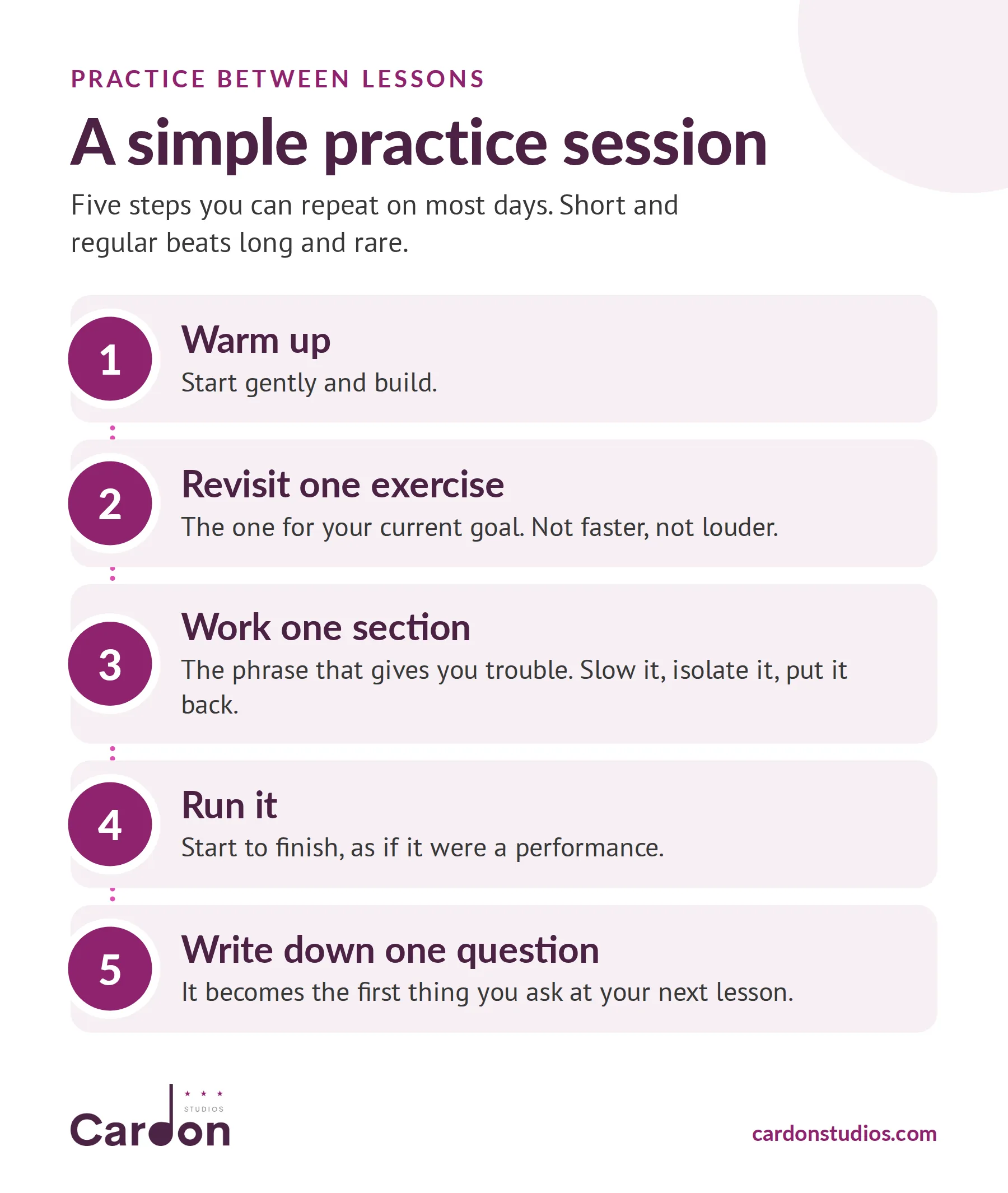
- Warm up. Start gently and build. Our guide to warming up explains why it matters.
- Revisit one exercise from your lesson. Choose the one your teacher gave you for your current goal, and do it the way you did it in the lesson: not faster, not louder.
- Work one section of a song. Pick the phrase that’s giving you trouble, not the part you already love singing. Slow it down, isolate it, then put it back in context.
- Run it. Sing the song, your audition cut, or your choir part from start to finish, as if it were a performance.
- Write down one question. Anything that felt unclear becomes the first thing you ask at your next lesson.
Set up a place to practice
A consistent spot makes it easier to start. Choose a room away from distractions, with good light and enough space to stand the way you would to perform. Keep what you need within reach: water, your music or lyrics, and a phone or computer for recordings.
If you have a mirror, use it as a quick posture check. You can see whether your shoulders creep up when you breathe or your jaw tightens on high notes, which are hard to feel while you sing. Our article on alignment covers what to look for.
Make it a routine
Pick a practice time that works for you and the people you live with, and keep it. Practicing at the same time and in the same place turns practice into a habit rather than a decision you have to make every day. If your schedule changes from week to week, put your sessions on your calendar the way you would a lesson.
Keep each session’s goal small and specific: one exercise, one phrase. Mindful repetition builds good habits, while repetition on autopilot can reinforce the very habits you’re trying to change. Practice makes permanent, so pay attention to how each repetition feels and sounds.
Use your lesson recordings
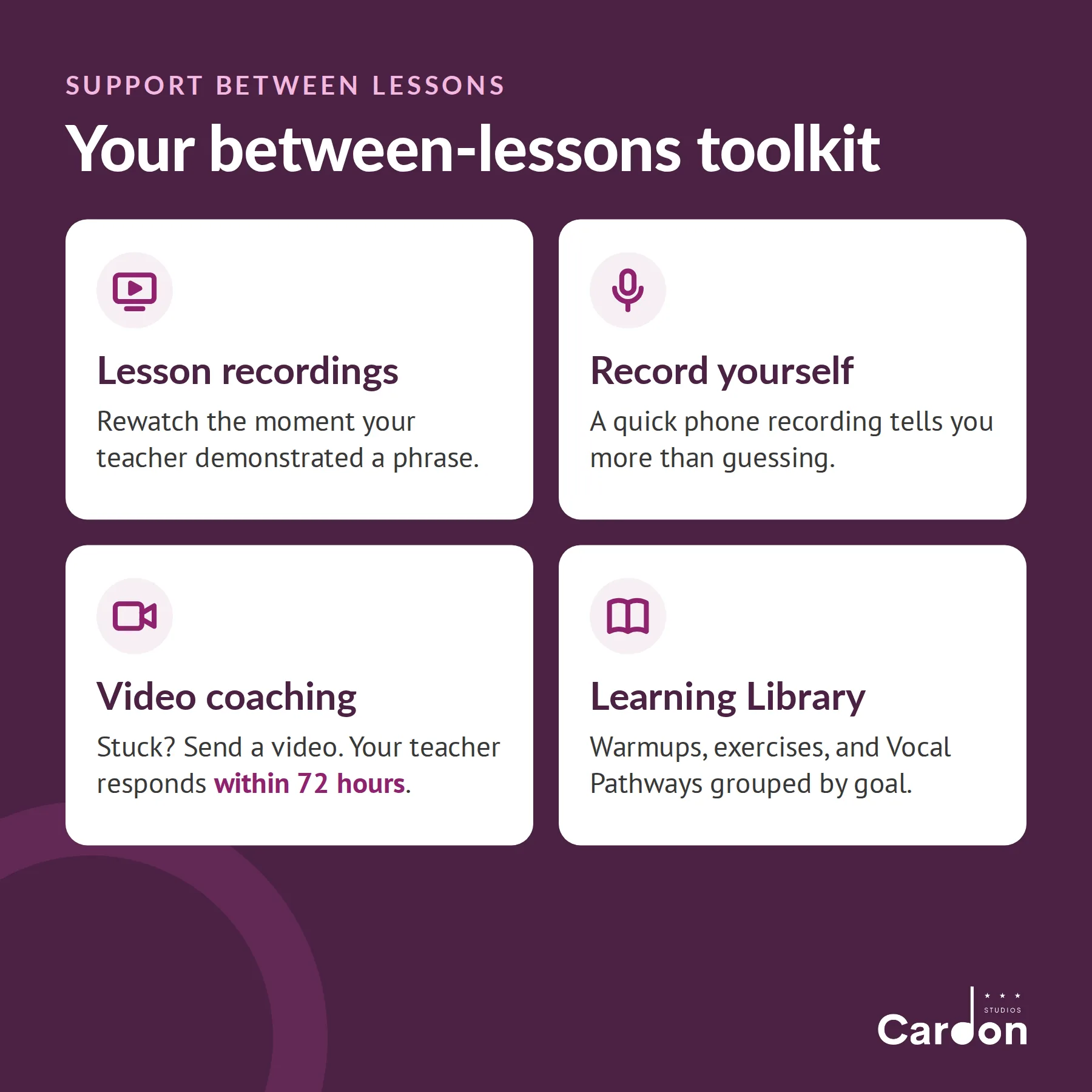
Memory is unreliable, especially for how something felt. Cardon Studios lessons are recorded for your review, so before you practice, you can rewatch the moment your teacher demonstrated a phrase or explained an exercise.
Record yourself
What you hear while you sing isn’t what others hear. A quick phone recording of your run-through tells you more than any amount of guessing. Our article on the benefits of recording yourself covers how to start, even if you dislike hearing your own voice.
When you get stuck, send a video
Sometimes practice stalls. An exercise doesn’t feel the way it did in your lesson, or a phrase keeps falling apart. Rather than practicing the problem for a week, record it and send it to your teacher. Every Cardon Studios membership includes a video coaching submission each month, with a personalized response video from your teacher within 72 hours.
Practice with the Learning Library
The Learning Library has warmups, exercises, and Vocal Pathways, which are sets of resources grouped around goals such as warming up for a performance, widening your range, or building power. That way you always have guided material to work with between lessons.
Practice the performance, not just the notes
Technique work matters, but so does singing your song the way you’ll perform it. Every so often, sing it for a trusted audience, such as a family member in your living room or a friend on a video call. Singing for even one person shows you which parts hold up under a little pressure, and it helps you get comfortable being heard. Our guide to conquering stage fright has more ways to build that confidence.
Practicing when you live with other people
Worried about neighbors, roommates, or family hearing you? You can still practice well. Our guide to practicing singing in an apartment has practical ideas for keeping your practice consistent without worrying about who’s listening.
Know when to stop
When to rest
Practice should leave your voice feeling used, not sore. If you notice strain, tightness, or hoarseness, stop, rest, and mention it to your teacher. If hoarseness or pain doesn’t clear up with rest, see a doctor.
Practicing for choir or a show
If you sing in a choir or you’re preparing for a musical, use practice time for what rehearsal can’t give you: your own voice on your own line. Our guide to singing in a choir covers blend, volume, and diction, and our article on picking an audition song helps you start audition preparation on the right foot.
Online voice lessons
Practice with a teacher behind you
One monthly membership includes four private online voice lessons, one video coaching submission, the Learning Library, and member online events, with a teacher matched to your style, goals, age, and schedule.
Common questions about practicing singing
How long should I practice singing each day?
There’s no single right number. Short, focused sessions on most days work well for many singers. Your teacher can suggest a routine that fits your voice, age, and goals.
What if I only have a few minutes?
A few minutes still helps: a short warmup and one phrase from your song. Consistency matters more than length.
Should I practice exercises or songs?
Both. Start with the exercise your teacher gave you for your current goal, then apply it to one section of a song. The exercise builds the coordination, and the song is where you use it.
Can I practice too much?
Yes. If your voice feels tired, tight, or sore, that’s a signal to rest. Quality of practice matters far more than quantity.