


Practice makes permanent: whatever you repeat, good habits or bad ones, is what your voice learns. That’s why how you practice singing matters more than how much. A short, focused session where you notice your body, fix mistakes as they happen and stop before you tire will move you further than hours of singing the same song on autopilot.
“Practice makes perfect” and “you are what you repeatedly do” both hold some truth. But how well you repeatedly do something is the more interesting part. Singers who want to improve, protect their voices and grow as artists absolutely must practice. This guide shows you how to make that practice count: what mindful practice looks like, how to judge your singing by feel as well as by ear, and a simple method you can use for any song.
Key takeaways
- Your voice learns what you repeat, so repeating a mistake practices the mistake.
- Focused, mindful practice beats long hours. Work smarter, not harder.
- Your ears can mislead you in different rooms; your body’s comfort is a steadier guide.
- Calm, even breathing in the practice room helps you stay steady when adrenaline kicks in on stage.
Practice makes permanent: what it means for singers
Every time you sing a phrase, you rehearse a set of movements: how you breathe, how your jaw and tongue move, how much effort you put into a high note. Repeat those movements often enough and they become automatic. That’s wonderful when the movements are easy and efficient. It’s a problem when they aren’t, because a habit you drill becomes just as automatic as a skill you drill.
That’s the idea behind the phrase practice makes permanent. Practice doesn’t decide whether a habit is good or bad. It only makes it stronger. If you sing a tricky passage ten times with a clenched jaw, you have practiced singing it with a clenched jaw ten times. If you sing it three times slowly and easily, you have practiced ease.
Coaches often add a second version of the saying: perfect practice makes perfect. For singers, “perfect” doesn’t mean flawless. It means practice where you pay attention, notice what isn’t working and correct it before you repeat it. That kind of attention is what turns repetition into progress.
How vs. how much: why more hours isn’t the answer
Singers who simply put in the hours, going over and over their scales and songs, may earn a badge for dedication. But here’s another saying worth remembering: work smarter, not harder. Your voice is part of your body, and like any other part of the body it has limits. Long, unfocused sessions tend to tire both the mind and the voice, and a tired voice is more likely to slip back into old habits.
Mindful practice works differently. You set a goal, give it your full attention and stop when the work is done. Truly focused practice may even leave you more mentally tired, in less time, than singing the same song over and over. Real concentration takes a lot of mental energy, but it saves vocal stamina. That’s an excellent trade for a performer, because it leaves more time for voice rest and care, and for the fun part: sharing your singing with an audience.
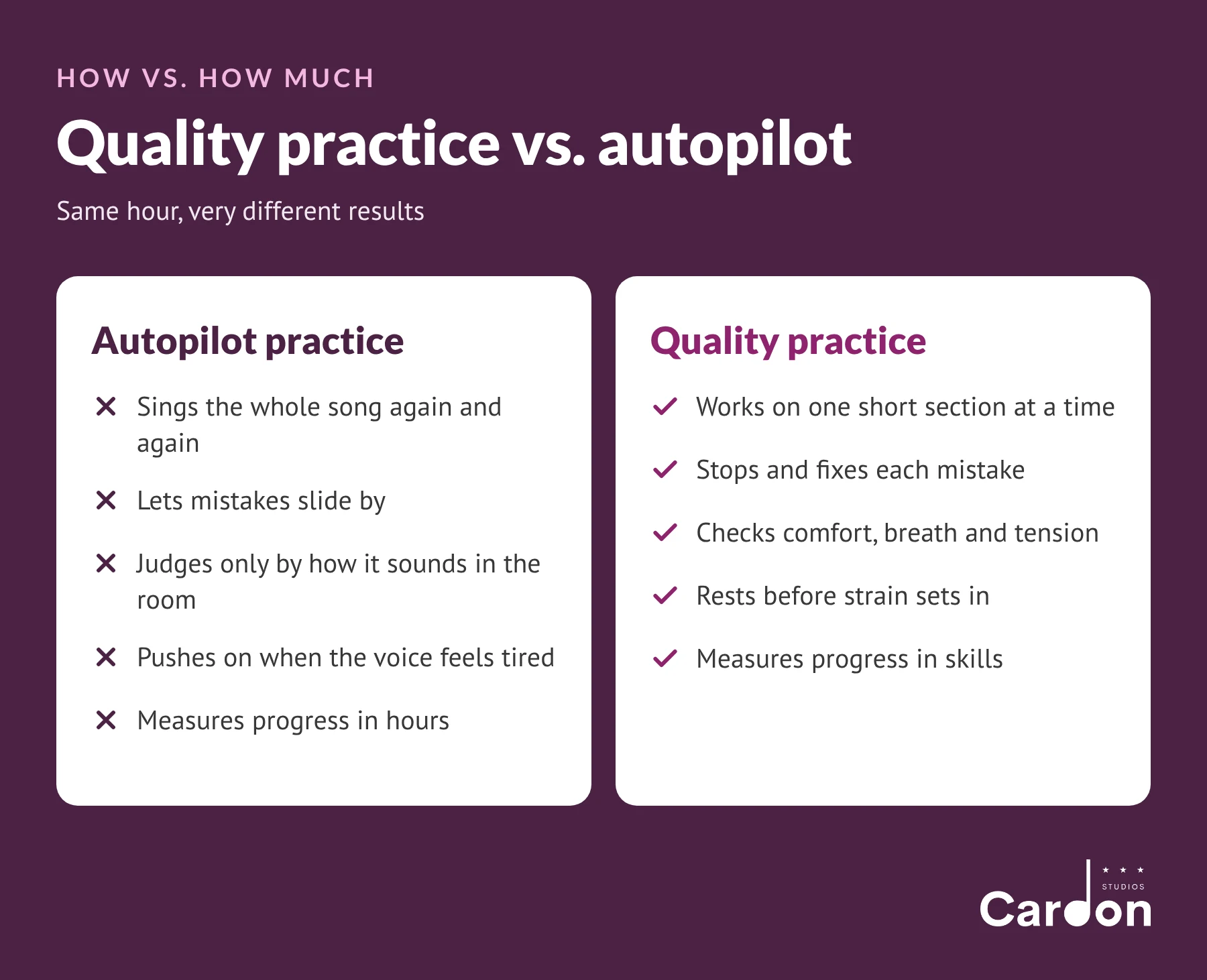
None of this means practice time doesn’t matter. Regular practice is how skills grow. It means the quality of each session matters more than the total. If you’re new to building a routine, our guide to deliberate practice for singers explains the ingredients of purposeful practice, and mastery through mindfulness goes deeper into staying present while you work.
Practice by feel, not just by ear
Whenever you set out to practice singing, focus on awareness and feeling. Your voice sounds different to you in every room you sing in. A small bedroom, a bathroom, a car and a big hall all change what reaches your ears. That means listening to yourself can actually be misleading. A sound that seems thin at home may carry well on stage, and a sound that seems huge in a tiled room may be pushed.
Instead, learn to trust your body. The comfort you feel in your own body is a reliable sign of how efficiently you’re singing. Your ears will always play a part: unless pitch matching is a challenge for you, your musicianship is close to impossible to switch off, so you can afford to spend your attention elsewhere. Ask yourself questions like these as you sing:
- Can you hear yourself inhale? A noisy, gasping breath often means tension in the throat. Aim for a quiet, open breath.
- Is your exhale even across the phrase? Notice whether you run out of air early or squeeze out the last few notes.
- Where is the effort? Check your jaw, tongue, neck and shoulders. If one of them is gripping, let it go and sing the phrase again.
- Does it feel the same at the end of the session as at the start? If your voice starts to feel scratchy or tired, that’s your cue to stop.
Try to catch yourself working too hard and find ways to bring in more comfort. If you want an outside view of what you can’t feel, record yourself singing and watch it back. A camera often shows a lifted chin or tight shoulders long before you notice them.
Perfect practice makes perfect: a method you can use for any song
Here is a simple loop you can use for scales, exercises or a hard section of a song. It keeps your attention on quality, so every repetition teaches your voice something useful.
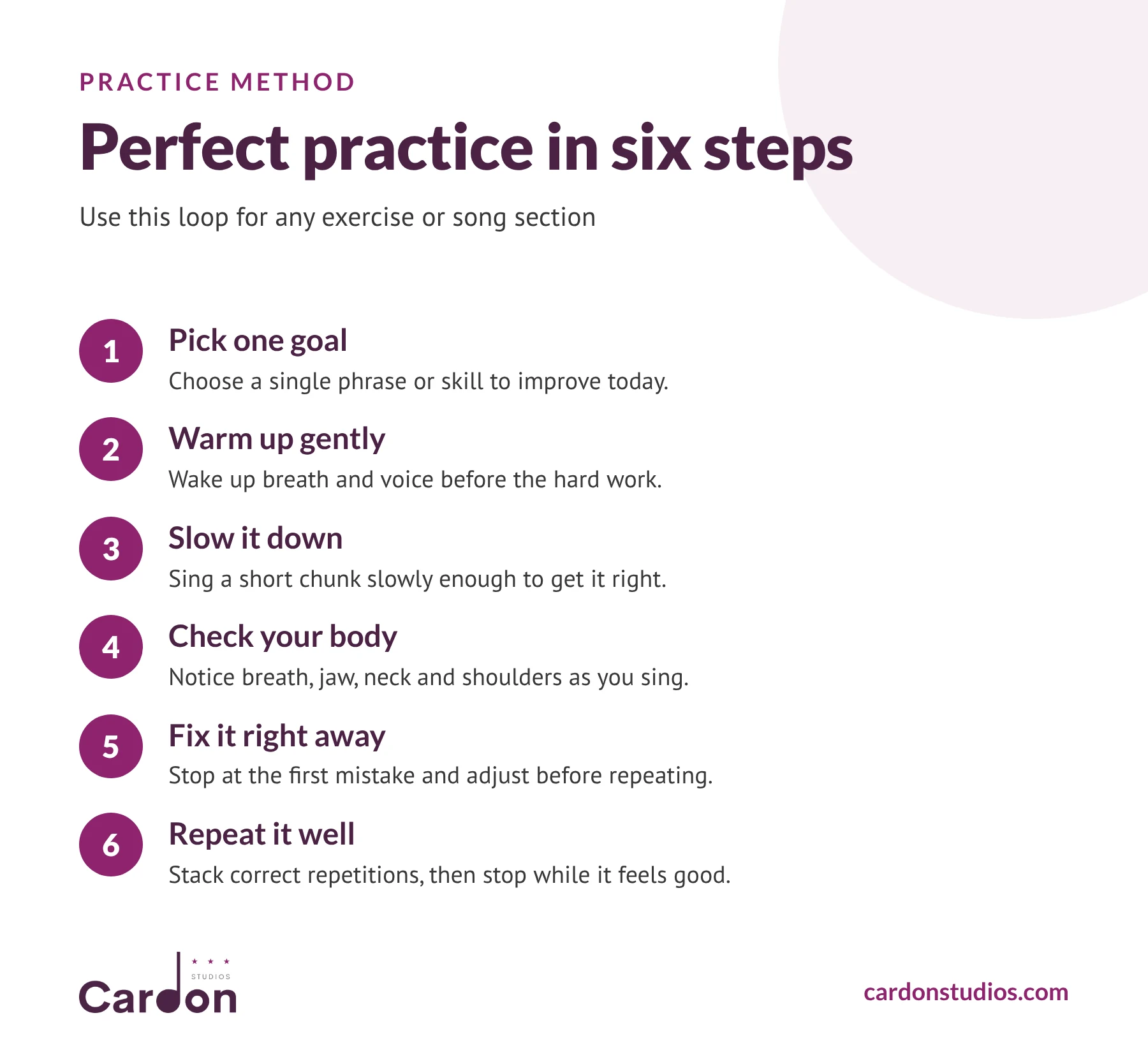
- Pick one goal. Choose one phrase or one skill for this session, such as a smoother breath before the bridge or an easier high note in the chorus. Write it down.
- Warm up gently. Wake up your breath and voice with easy exercises such as lip trills or humming on a comfortable five-note scale, up and down, three or four times. See our vocal warm-up guide for a full routine.
- Slow it down. Take a short chunk, two to four bars, and sing it slowly enough that you can get it right. Speed comes later; accuracy comes first.
- Check your body. As you sing, notice your breath, jaw, neck and shoulders. Is everything as easy at the end of the phrase as at the start?
- Fix it right away. When something goes wrong, stop. Work out what happened (a late breath, a tight jaw, a vowel that closed) and adjust before you sing it again. Repeating a mistake only makes it more permanent.
- Repeat it well. Once you get it right, sing it correctly three to five times in a row. Then stop while it still feels good, or move on to the next chunk.
This loop asks for patience. You may sing fewer phrases in a session than you used to, but each one is practiced correctly. Over a week or two, that adds up to real change. When it’s time to put a song together from memory, our guide on how to memorize a song fast builds on the same chunking idea.
The inside work: calm breath and mindset
Practicing singing well is often more about the inside work, managing your breath and mindset, than the outside work of preparing what your audience sees and hears. Remember that as soon as the excitement of singing in front of a crowd kicks in, you’re likely to become less detail-oriented. Adrenaline speeds you up, and old habits come back.
Your practice session can be the calm, focused workout that helps your body stay in control despite any adrenaline spike during a show. Singers often find that things go differently on stage than they do in the practice room. Often that’s because they practiced in a way that didn’t prepare them for pressure. By tuning in to calm, yes, even for high-energy songs, you learn to keep your breath steady without sacrificing an exciting, emotional performance.
Try this during practice: before each run of a phrase, take one slow breath in through your nose, let your shoulders settle, and breathe out on a gentle “sss.” Then sing. Over time, that calm breath becomes the habit you take on stage. For more on breathing well, read how to breathe when singing, and for nerves before a show, see how to conquer stage fright.
Signs your practice is working (and signs it isn’t)
It can be hard to tell whether practice is paying off, especially on days when your voice feels different. Use the questions below at the end of each session. If you can answer yes to most of them, you practiced well, even if the session was short.
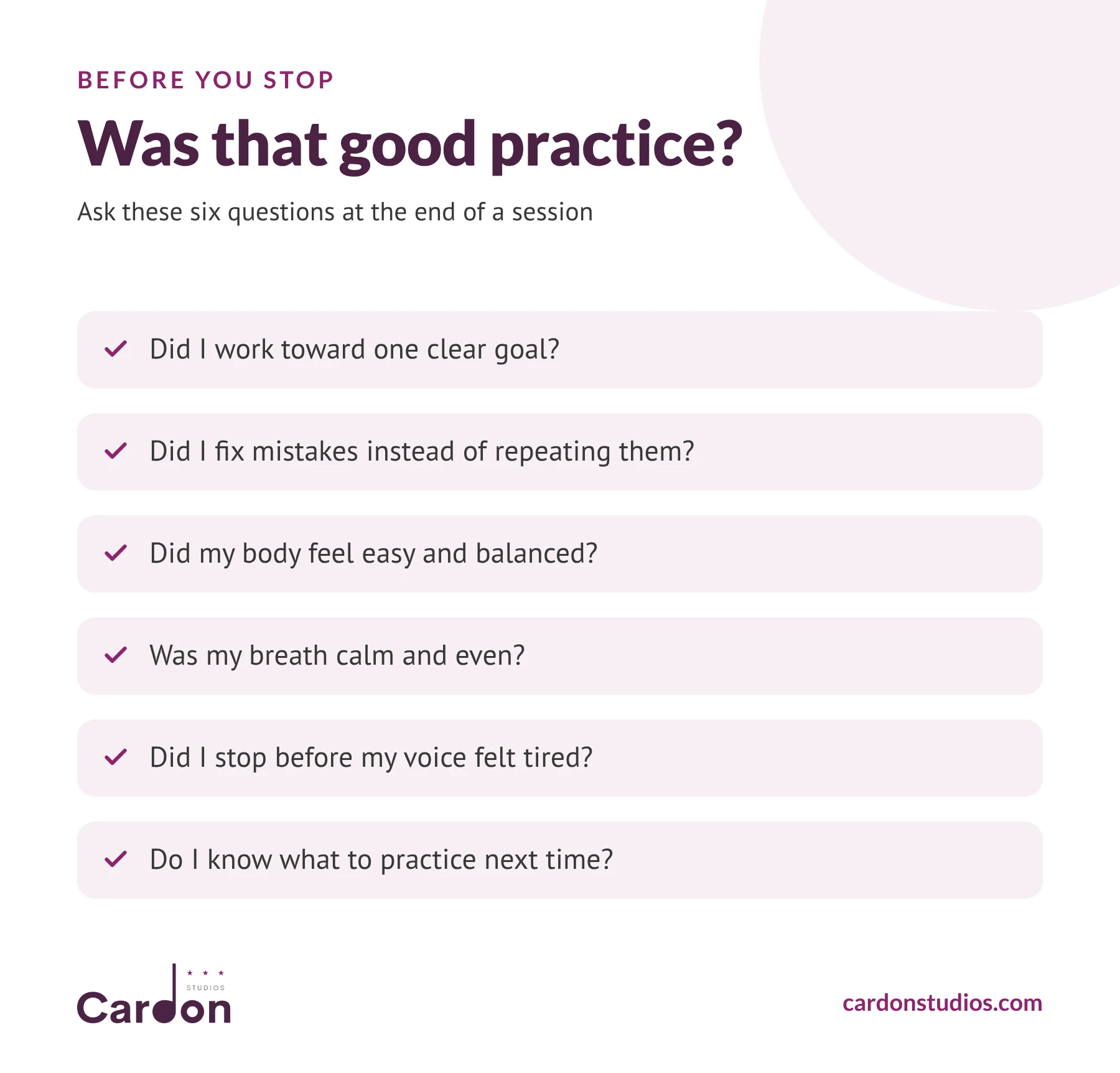
Watch for warning signs too. If you often finish practice with a scratchy throat, if your speaking voice sounds hoarse afterward, or if a passage gets worse the more you sing it, your practice is probably too long, too loud or too unfocused. Shorten the session, lower the volume and go back to the slow, one-goal loop above.
| What you notice | What it may mean | Try this |
|---|---|---|
| A phrase gets worse each time | You’re repeating a mistake, or you’re getting tired | Stop, slow the phrase down, and fix one thing before the next try. |
| Your throat feels scratchy after practice | Too much volume or effort, or too long without rest | Sing more quietly, take short vocal rests, and end sooner. |
| It sounds great at home, harder on stage | The room was flattering, or you practiced without pressure | Practice by feel, record yourself, and rehearse the calm breath routine. |
| You feel busy but not better | No clear goal for each session | Write one goal before you start and check it off when you finish. |
A sample week of quality practice
Here’s one way to spread focused practice across a week. Keep each session short enough that you can stay fully attentive, and adjust it to your own songs and schedule.
| Day | Focus | What to do |
|---|---|---|
| Monday | Breath and ease | Gentle warm-up, then sing one easy song paying attention only to quiet, even breathing. |
| Tuesday | One hard phrase | Use the six-step loop on the hardest two to four bars of your current song. |
| Wednesday | Rest or light work | Hum or lip trill gently, read through your music silently, and listen to your recording. |
| Thursday | Second hard phrase | Loop a different tricky section, then join it to the phrase from Tuesday. |
| Friday | Run-through with calm | Sing the whole song once with your calm breath routine, as if on stage, and record it. |
| Weekend | Review and plan | Watch the recording, note what improved, and pick next week’s goals. |
Notice that the plan includes a lighter day. Rest is part of practice, not a break from it. For a simple session plan between lessons, read how to practice singing between voice lessons. If you find it hard to get started at all, our guide to beating practice procrastination can help.
Listen to your voice
Good practice should never hurt. If singing becomes painful, or your throat feels tight, scratchy or tired, stop and rest. The National Institute on Deafness and Other Communication Disorders recommends drinking plenty of water and taking vocal naps, resting your voice throughout the day. It also advises seeing a doctor if your voice has been hoarse for more than three weeks. For everyday care, see our guide to vocal health for singers.
From the studio
A teacher can help you build a practice routine that fits your voice and goals. In a live online voice lesson, your teacher hears and sees what you can’t, gives you specific things to work on, and helps you turn them into focused practice for the week. Between lessons, you can send a video of a song for personalized feedback from your teacher within two business days, so you know your practice is heading in the right direction.
Online voice lessons
Practice smarter with a teacher’s plan
One monthly membership includes four private online voice lessons, one video coaching submission, the Learning Library, and member online events, with a teacher matched to your style, goals, age, and schedule.
Common questions about practicing singing
What does “practice makes permanent” mean?
It means that whatever you repeat becomes a habit, whether it’s correct or not. If you practice a song with tension or mistakes, you make those habits stronger. Practicing slowly and correctly makes good habits permanent instead.
Does practice make perfect?
Not on its own. Practice makes your habits stronger, so repeating mistakes only makes them stick. Practice that is focused, corrects errors as they happen and stops before you tire is what leads to real improvement.
Can you get better at singing with practice?
Yes. Breath control, pitch, tone and range all respond to regular, focused practice. Progress comes fastest when you practice with a clear goal, pay attention to how singing feels, and get feedback from a teacher or recordings.
How do you practice singing effectively?
Pick one goal per session, warm up gently, work on short sections slowly, and fix each mistake before repeating. Check your body for tension, keep your breath calm and even, and stop while your voice still feels good.
How often should I practice singing?
Short, focused sessions on most days usually work better than one long session a week, with lighter days for rest. Our guide to practicing between lessons suggests a simple routine you can adjust to your schedule.