

Most people dislike hearing their voice on a recording. Even a voicemail played back can sound “weird” and uncomfortable. For singers, though, it’s a dislike worth getting past. If you can’t hear yourself the way other people hear you, it’s hard to know what to work on. Here’s why recordings sound different, how to make a useful one with just your phone, and what to listen for.
Key takeaways
- Your voice sounds different on a recording because you normally hear yourself partly through the bones of your head.
- A phone is all you need: a quiet room, the phone at about arm’s length, and a quick test take.
- Listen back like an impartial observer, one thing at a time: pitch, breath, tone, and expression.
- Record a benchmark song now and again later, so you can hear your progress.
Why your voice sounds different on a recording
When you sing, you hear your voice two ways at once: through the air, like everyone else does, and through vibrations that travel through the bones and tissues of your head. That inner route tends to make your voice sound fuller and lower to you. A recording captures only the sound that travels through the air, which is much closer to what your listeners hear. That’s why so many singers listen back and think, “Do I really sound like that?”
It’s normal for your first few recordings to feel uncomfortable. The discomfort fades with practice, and what you gain is an accurate picture of your sound.
How to record yourself singing
You don’t need special equipment to start. The voice memo or camera app on your phone works well.
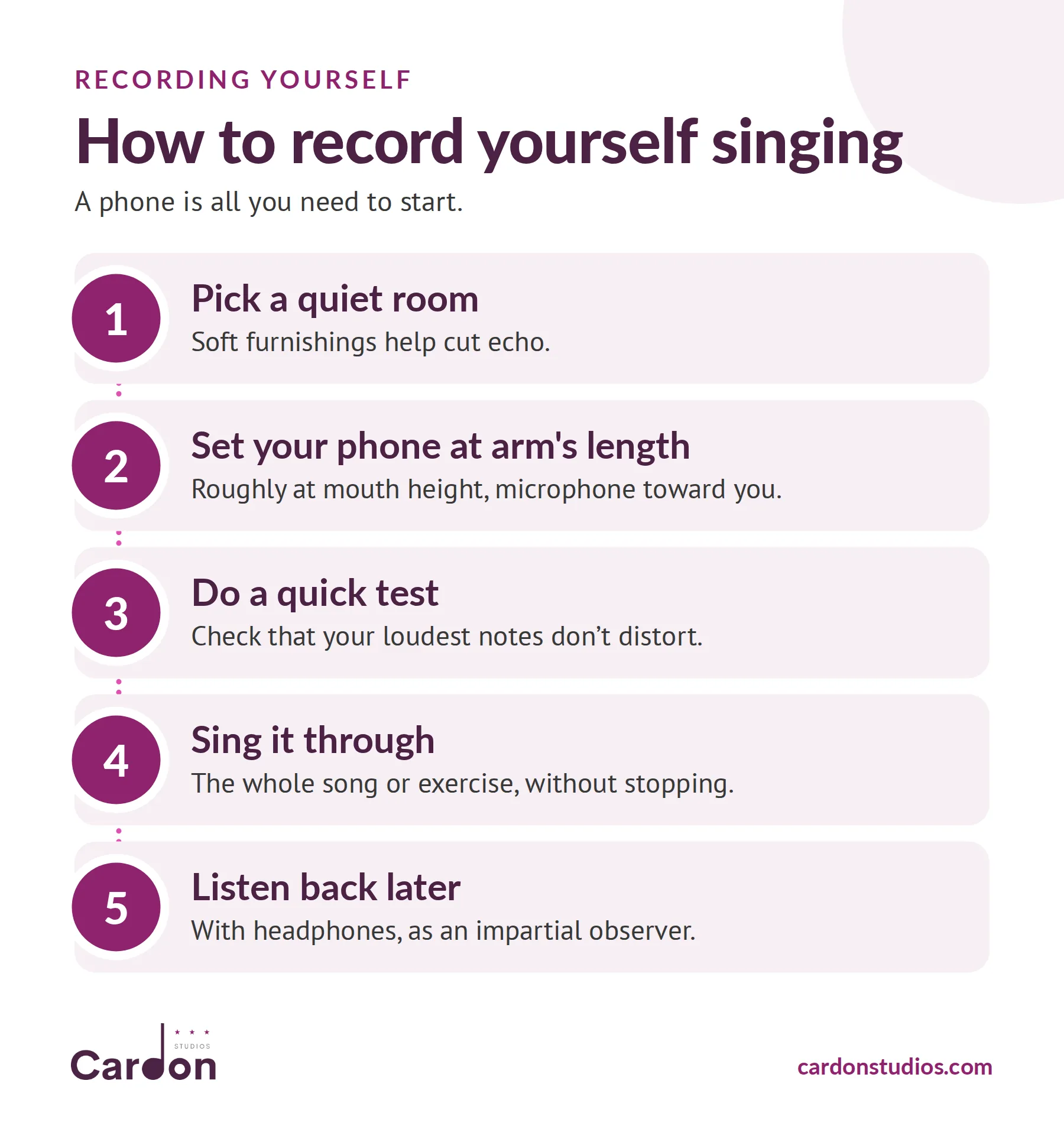
- Pick a quiet room. Turn off fans and appliances, and choose a space with soft furnishings, which cut echo.
- Set your phone at about arm’s length. Place it roughly at mouth height with the microphone toward you. A stack of books works as well as a stand.
- Do a quick test. Sing your loudest phrase and play it back. If it crackles or distorts, move the phone a little farther away.
- Sing it through. Run the whole song or exercise without stopping, as if it were a performance.
- Listen back later. Give yourself a little distance, then listen with headphones as an impartial observer.
Start small
If recording yourself makes you uncomfortable, start with something that isn’t a performance. Sing one of your exercises through your whole range and listen back. It’s not artful, but is it functional? Do you hear areas of discoordination or weakness? Does your voice sound like one voice from bottom to top, or are you creating different colors without meaning to?
Record a benchmark song
Next, sing your best song for yourself: the one you feel so confident with that you can stop thinking and really be expressive. Whether you’re singing into a voice memo app or a studio microphone, the goal is the same: sing with expression and authenticity. Use this recording as a benchmark for what you want all of your singing to sound like, and update it as you improve.
Listen like an impartial observer
Listening to recordings of yourself might surprise you. Some things may sound better than you expected, and others worse. That’s OK. What matters is listening with an open mind. Try not to react emotionally; instead, notice things as specifically as you can, one area at a time.
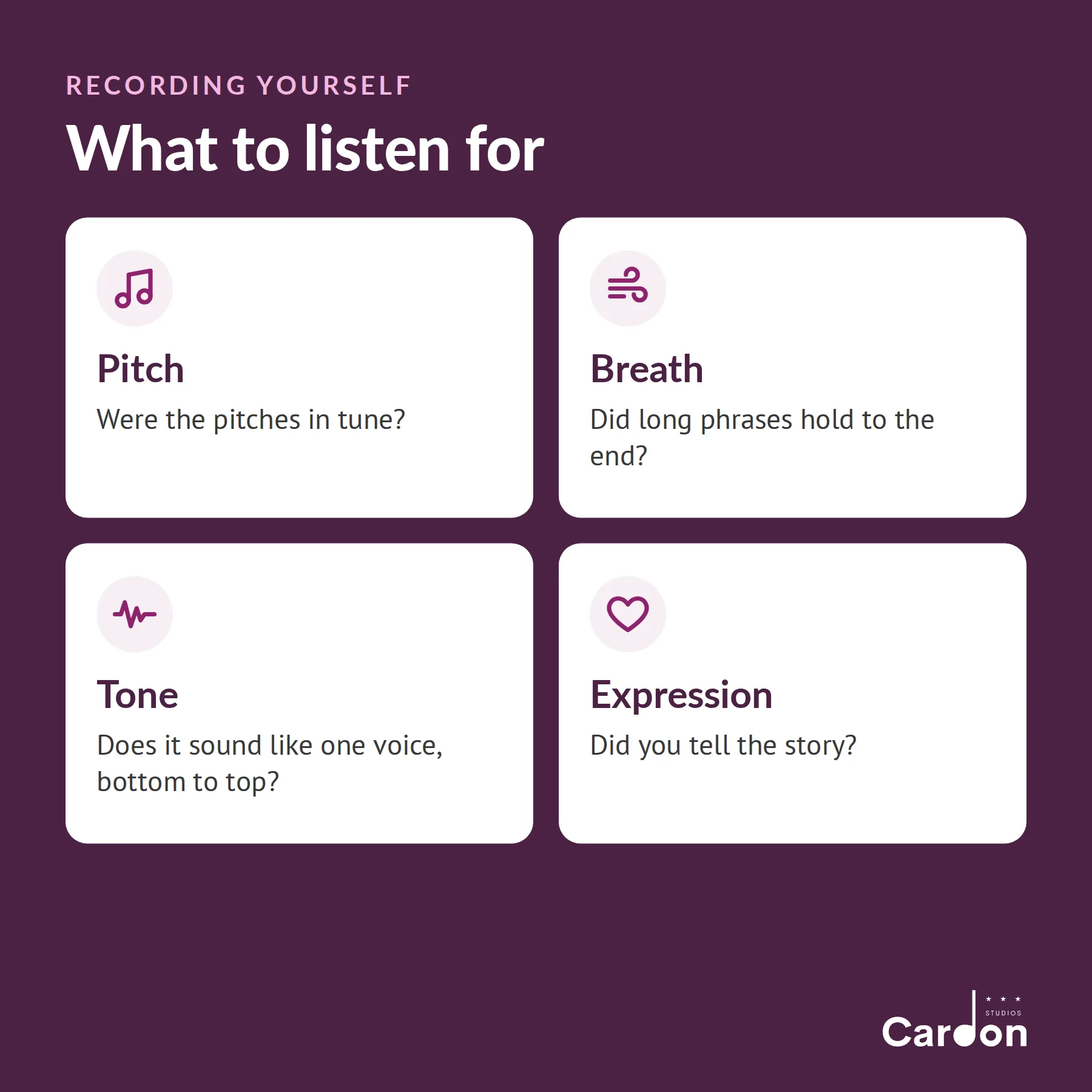
- Pitch: were all the pitches in tune?
- Breath: did longer phrases hold steady to the end?
- Tone: does your voice sound like one voice from bottom to top?
- Expression: did you tell the story of the song?
Answers to questions like these give you specific tasks to work on, before you record the song again to hear the improvement.
Add video to see your habits
Recording video gives you valuable insight into your habits in performance. Are your shoulders slumping forward? If so, that may be connected to running out of breath in longer phrases. Are you connecting with your audience, in this case the camera, or do you seem to be in your own world? Do you have a habit of fidgeting, or could you use movement to better support your voice and expression?
Make recording a habit
A single recording is a snapshot; a series shows you your progress. Try recording one run-through a week, name each file with the date and song, and jot down one thing you noticed. Every few weeks, listen to an older take next to a new one. Changes that are hard to notice day to day become easy to hear.
Share it with your teacher
Recordings are even more useful with an expert listener. Every Cardon Studios membership includes a video coaching submission each month: send a recording of a song, an audition cut, or a passage you’re stuck on, and your teacher sends back a personalized response video within 72 hours.
From the studio
Cardon Studios lessons are recorded for your review, so you can compare how a phrase sounded in your lesson with how it sounds in your own practice recordings.
For a routine to fit recording into, read how to practice singing between voice lessons. If recording yourself brings up nerves, our guide to conquering stage fright can help.
Online voice lessons
Get a teacher’s ears on your recordings
One monthly membership includes four private online voice lessons, one video coaching submission, the Learning Library, and member online events, with a teacher matched to your style, goals, age, and schedule.
Common questions about recording yourself
Why does my voice sound weird on a recording?
When you sing, you hear your voice partly through vibrations in your head, which make it sound fuller to you. A recording captures only the sound traveling through the air, which is what other people hear.
Why does my singing sound better to me than on a recording?
Part of it is that inner route, and part is that in the moment you hear what you intend to sing. A recording shows what actually came out, which is exactly why it’s such a useful practice tool.
Can I record myself singing with just a phone?
Yes. A phone’s voice memo or camera app is plenty for practice. Choose a quiet room, place the phone at about arm’s length, and do a quick test to make sure loud notes don’t distort.
Should I record audio or video?
Audio is enough to check pitch, breath, and tone. Video adds posture, tension, and how you connect with your audience, so it’s worth using for songs you plan to perform.
How often should I record myself singing?
Once a week is a good starting point for a full run-through, with quick recordings of tricky passages whenever they help. Your teacher can suggest a rhythm that fits your goals.