


If you sing popular styles or contemporary musical theater, you’re probably familiar with the sound of mixed voice. Most pop singers rely on a flexible mixed voice to carry them through the bulk of their range, using head voice or chest voice as effects for contrast. Mixed voice is an important part of most contemporary singing. So how do you find yours?
This guide focuses on higher voices: singers whose voices did not go through a testosterone-driven puberty, which strongly shapes how a voice develops. For lower voices, see Finding Your Mix: Lower Voices.
Key takeaways
- Mixed voice isn’t a separate register. It’s a balance between two muscles that always work together.
- When the TA muscle leads, you hear a chest-dominant sound; when the CT muscle leads, a head-dominant one.
- Most pop and contemporary musical theater singing lives in a balanced mix.
- Start light, sing problem spots softer, and balance air with effort to find yours.
What is mixed voice?
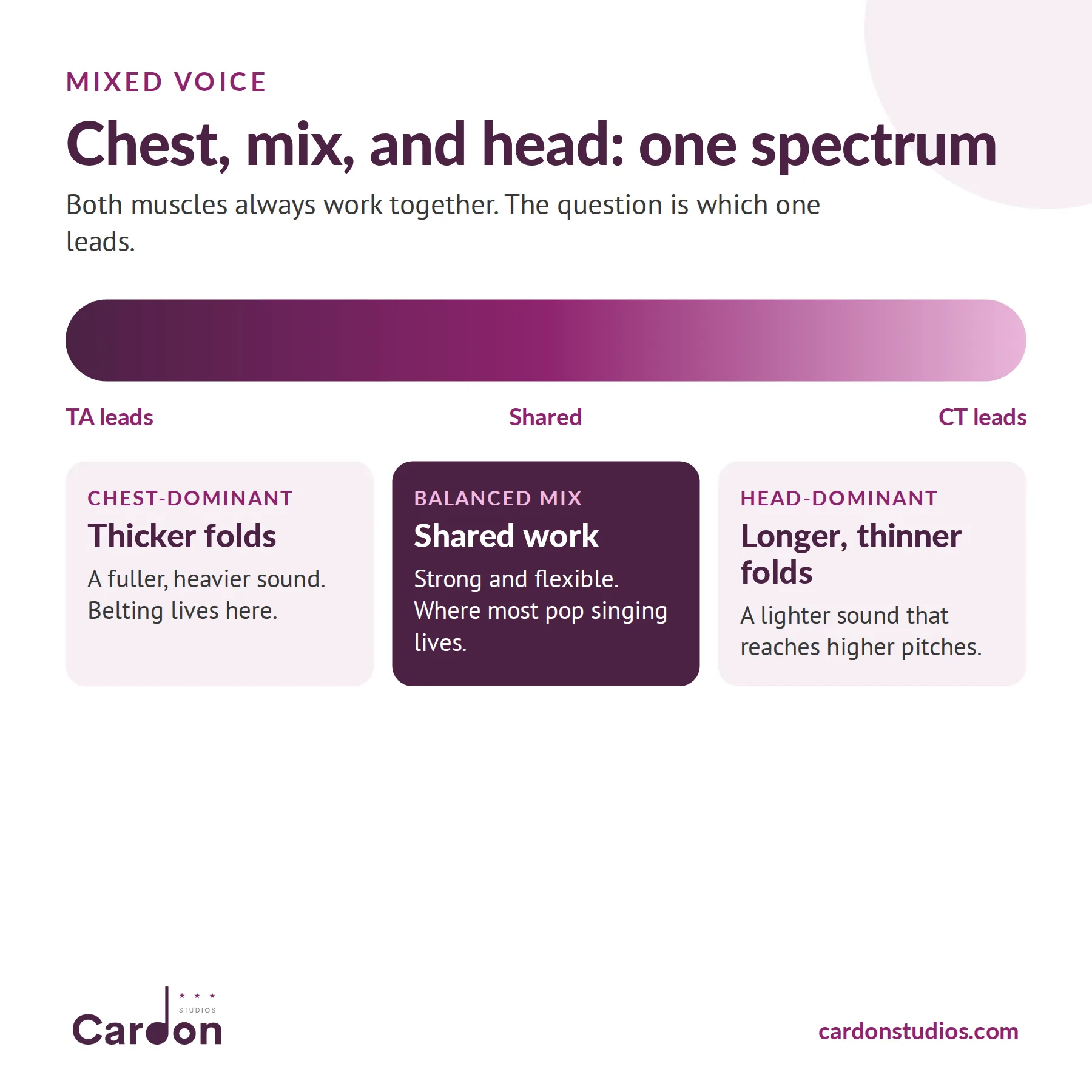
Mixed voice is confusing because it’s a spectrum. Two small muscles in your larynx work together all the time in a kind of push and pull. Your thyroarytenoid (TA) muscle, associated with chest voice, bulks up your vocal folds so they get thicker. Your cricothyroid (CT) muscle, associated with head voice, stretches the folds longer and thinner so you can reach higher pitches. (There’s arguably some tilting of the voice box involved too, but let’s keep things simple.)
We almost never use TA or CT alone, so in a sense, everything is a mix. What changes is which muscle is doing more of the work: in other words, dominance.
Hear it: three versions of one phrase
A Cardon Studios student, Diane, kindly agreed to share this demonstration. Diane sometimes struggled to find, or stay in, her mix, so she recorded this video during a practice session to ask her teacher about the degrees of mix she was discovering.
Head voice
Diane’s head voice is a CT-dominant sound. When she recorded this, using head voice at all was still fairly new to her, so it sounds a little unfocused and breathy; her coordination on higher pitches still needed strengthening. When a natural belter starts using head voice, it can feel uncoordinated at first. They need to feel out how much air to move and how much pressure to build up beneath the vocal folds, not to mention how to support the sound with the lower body, which they should be doing in their belt voice too.
Belt
Her second option, belting, is a TA-dominant sound, and you can hear that it’s a bit strained and reaching, probably not comfortable or sustainable for long. When Diane started lessons, this was her default: loud and strong, with little room to maneuver. Many singers start in the same place, as capable singers who recognize the limits of their technique.
Balanced mix
Finding her balanced mix was a very happy day for Diane. She can now blend her chest and head sounds for flexibility and power. Both TA and CT are engaged and sharing the work, and her air flows more freely as a result. It sounds even better through a microphone, and it’s where pop singers spend most of their time.
How to find your mix
Mix is a coordination, not a trick, so work slowly and lightly. These four approaches help many singers find it.
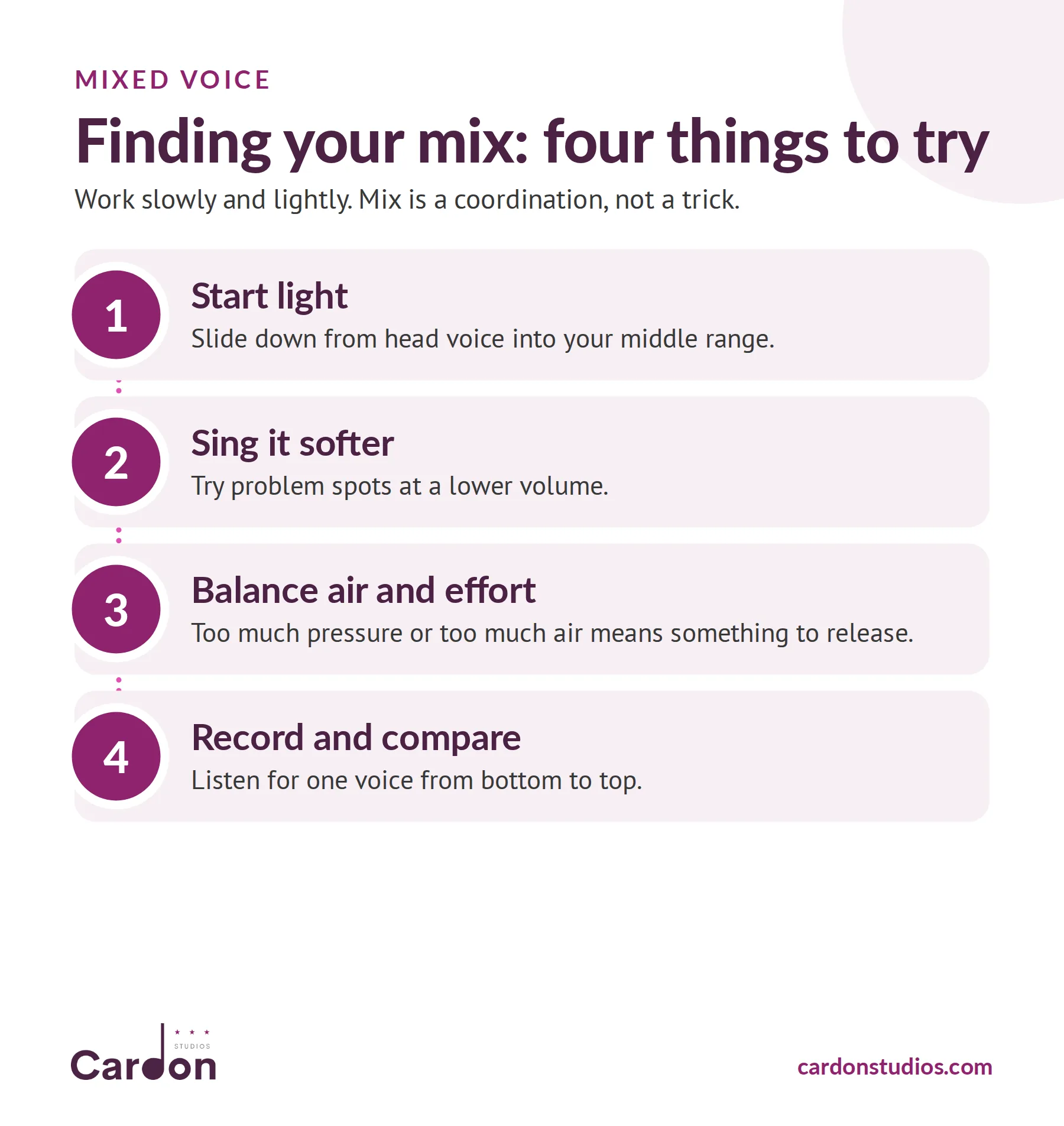
- Start light. Begin in head voice and slide gently down into your middle range, keeping the sound easy. Let the lighter coordination carry down rather than pushing chest voice up.
- Sing it softer. Sometimes the difference between a chest-dominant and a head-dominant sound is simply volume. Try problem spots more softly and notice what changes.
- Balance air and effort. Aim for an even balance between airflow and the physical pressure you feel. Too much pressure, or too much air, means there’s tension to release or support to add.
- Record and compare. Listen back for one voice from bottom to top. Our guide to recording yourself singing shows you how.
Belting has a place, as a color
A heavy, TA-dominant belt can have a place in healthy singing, especially when you support the sound low in your body. But if you sang that way all the time, it would be exhausting, and a weekend of shows would feel daunting. Think of belt as a color to use for powerful moments, not the voice you live in.
Why a strong mix is worth the work
A balanced mix is the zone most singers want to live in: strong and consistent, but flexible and comfortable too. From there you can turn up the power for big moments and move into belt territory briefly, or lighten toward head voice for tender, intimate ones, knowing your voice is working with you rather than against you. Our guide to breath support is a good companion as you practice.
From the studio
Diane’s video is exactly what video coaching is for. Cardon Studios members can send a recording like this each month and get a personalized response from their teacher within 72 hours, and lessons give active practice using the voice in a variety of modes.
Preparing a musical theater song? See how to prepare for a community theater or school musical audition.
Online voice lessons
Find your mix with a teacher
One monthly membership includes four private online voice lessons, one video coaching submission, the Learning Library, and member online events, with a teacher matched to your style, goals, age, and schedule.
Common questions about mixed voice
What is mixed voice in singing?
It’s a balanced coordination of the muscles behind chest voice and head voice, so you can sing through your range with one connected sound. Because both muscles always work together, it’s really a matter of balance rather than a separate register.
Is mixed voice the same as belting?
No. Belting is a heavier, chest-dominant sound. A mix shares the work between both muscles, which makes it more flexible and easier to sustain. Many singers use belt as an occasional color on top of a strong mix.
How long does it take to find your mix?
It varies from singer to singer. Consistent, light practice with feedback, from recordings and ideally a teacher, usually makes the biggest difference.