

Two singers can practice for the same amount of time and get very different results. The difference is usually how they practice, not how long. Researchers call focused, goal-directed practice with quick feedback “deliberate practice,” and it’s one of the most useful ideas a singer can borrow.
Key takeaways
- Deliberate practice means working on one specific goal with full attention and quick feedback.
- How well you practice matters more than how many hours you put in.
- Feedback can come from your own recordings, your lesson recordings, or your teacher.
- Short, focused sessions on most days usually beat long sessions on autopilot.
What is deliberate practice?
The idea comes from research led by psychologist K. Anders Ericsson at Florida State University. His 1993 study of expert musicians found that the strongest performers had accumulated more time in focused, effortful practice aimed at improving their performance. That work shifted attention toward how musicians practice, which is good news for any singer who worries about not having enough “natural talent.”
Deliberate practice isn’t the same as repetition or going through the motions. Its goal is to improve a specific part of your performance, and it’s usually challenging, because it targets what you can’t yet do reliably.
The four ingredients of deliberate practice
Each practice session works best when it meets four conditions. Together they form a loop you can repeat as often as you need.
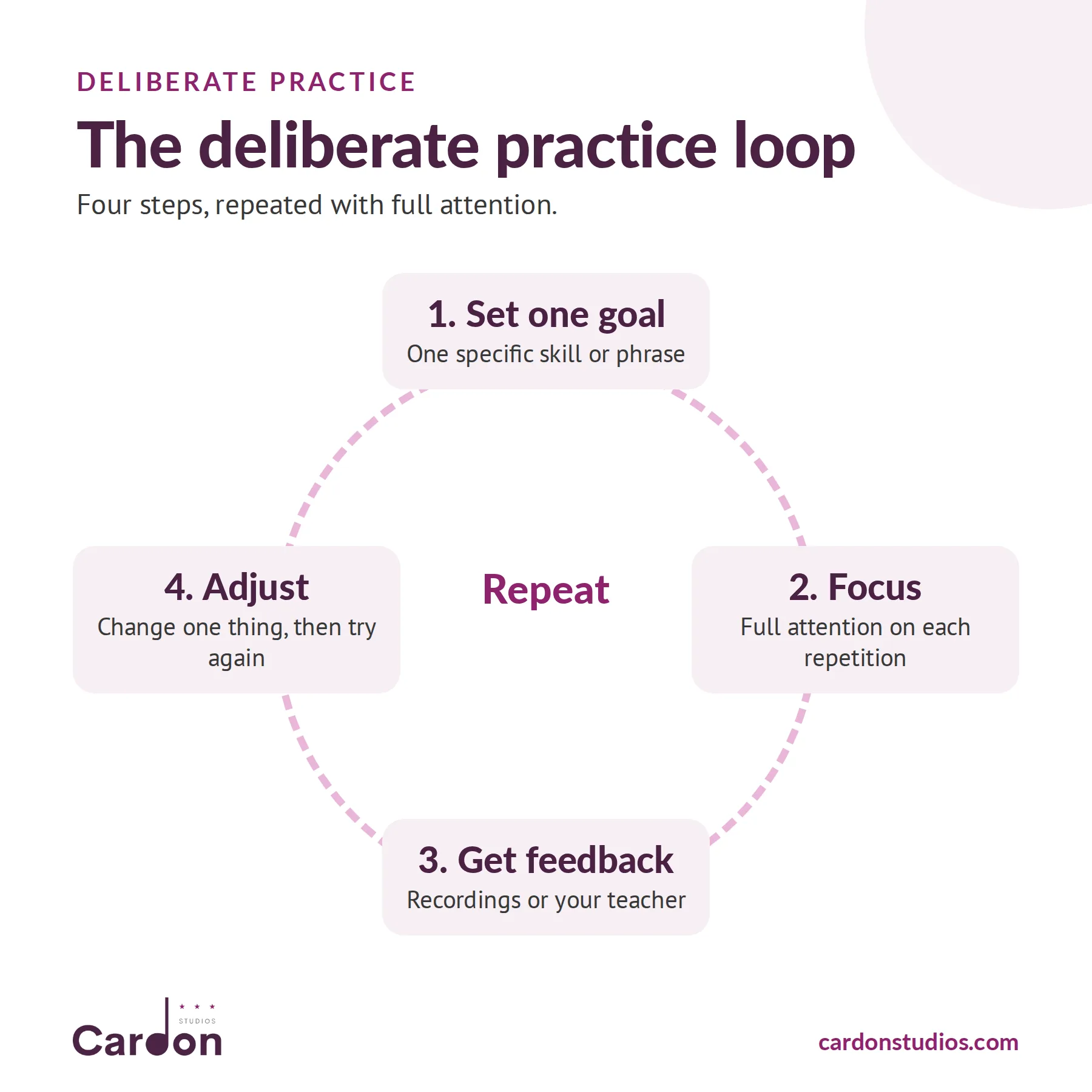
- It builds on what you already know. Each task should sit just beyond your current skill and be clear enough to understand after a quick explanation.
- You’re fully focused. Deliberate practice takes concentration and effort, which is why it works best in shorter sessions.
- You repeat a specific task. Not the whole song over and over, but the phrase, interval, or vowel that needs work.
- You get feedback quickly. Without informative feedback, expect little improvement. You need to know whether each attempt got closer.
Deliberate practice vs. practice on autopilot
Most singers have had sessions that felt busy but changed nothing. Usually the difference is attention and feedback, not effort.
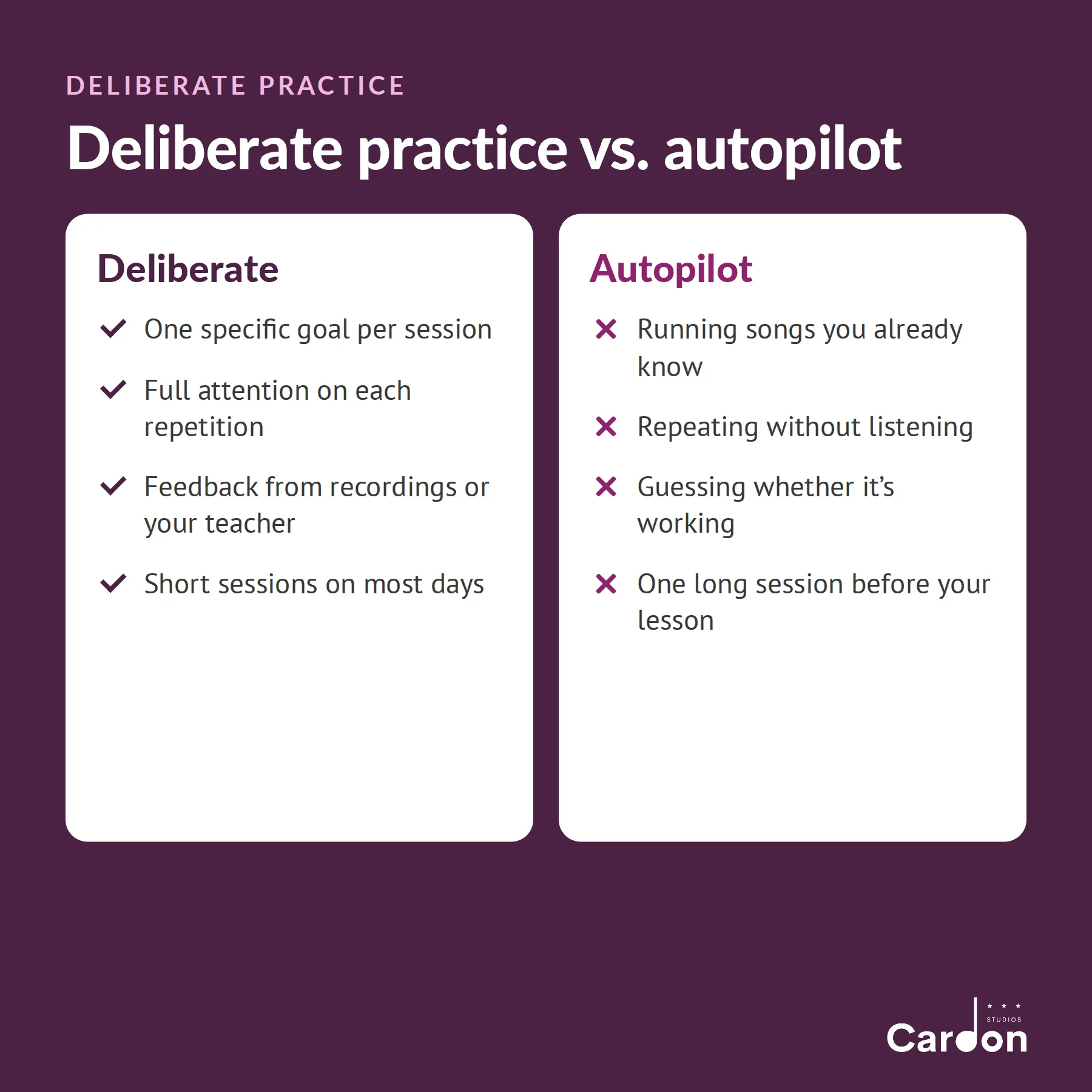
| Deliberate | Autopilot |
|---|---|
| One specific goal per session | Running songs you already know |
| Full attention on each repetition | Repeating without listening |
| Feedback from recordings or your teacher | Guessing whether it’s working |
| Short sessions on most days | One long session before your lesson |
Practice smarter, not longer
Practicing too much can be as unhelpful as practicing too little. Decide on one objective before you start, and spend most of your session on it. If a problem is eating your whole session, set it aside and come back to it tomorrow; a rested voice and a fresh mind often solve it faster. For voice-specific guidance on how much to practice, read Practicing: How vs. How Much.
Don’t always start at the beginning
Many singers run songs from the top every time, so the opening gets polished while the ending stays shaky. Start with the hardest section instead, or work backward from the final phrase, so every part of the song gets your freshest attention.
Practice away from your voice
Some of the most useful practice is silent. Read through the lyrics or your music without singing, speak the words in rhythm to learn them, and picture yourself performing the song: the breath before the first line, the phrase you’re working on, the ending. Silent practice also gives your voice a rest while your learning keeps going.
A deliberate practice session, step by step
Here’s what deliberate practice can look like for a singer working on one tricky phrase:
- Name the goal. Be specific: “Sing the climb into the chorus without my jaw tightening,” not “Get better at the chorus.”
- Warm up, then isolate. After a short warmup, take only the two or three bars around the problem. Slow them down until you can sing them the way you want.
- Repeat with attention. Sing the passage a handful of times, noticing one thing on each attempt. Stop when you feel your focus drifting.
- Check it. Record one attempt and listen back. Did it get closer to your goal?
- Put it back in context. Sing the phrase before and after it, then the whole section, so the fix holds up inside the song.
Write down what changed and what’s still tricky. That note becomes the goal for your next session, or the first question for your next lesson.
Where your feedback comes from
- Your recordings: record the passage you’re working on and listen back with one specific question in mind. Our guide to recording yourself singing shows you how.
- Your lesson recordings: Cardon Studios lessons are recorded for your review, so you can compare your practice with what your teacher demonstrated.
- Your teacher: in lessons, and between them with a video coaching submission and a personalized response within 72 hours.
- A mirror: for posture and tension you can see but can’t always feel.
From the studio
Lessons are where deliberate practice gets designed. Your teacher can pinpoint the one thing to work on next and give you exercises that target it, so the time you spend practicing on your own points in the right direction.
For a ready-made session plan, read how to practice singing between voice lessons.
Online voice lessons
Practice with purpose and a teacher behind you
One monthly membership includes four private online voice lessons, one video coaching submission, the Learning Library, and member online events, with a teacher matched to your style, goals, age, and schedule.
Common questions about deliberate practice
What is deliberate practice in singing?
It’s focused practice on one specific skill, with full attention and quick feedback, aimed at something you can’t yet do reliably. For singers, that might be a single phrase, a register transition, or a tricky interval.
How long should a deliberate practice session be?
There’s no fixed number. Because it takes real concentration, many singers do better with shorter sessions on most days than with one long one. Your teacher can suggest what fits your voice and goals.
Can I practice deliberately without a teacher?
Partly, yes. Recordings and a mirror give you useful feedback on your own. A teacher adds expert feedback and helps you choose what to work on next, which keeps your practice pointed at the right goal.