


The fastest way to memorize a song is to learn its shape first, then the words, then the melody, one short chunk at a time, and to test yourself away from the page. Spread that work over several days and the song moves from “I think I know it” to “I can sing it in front of people.” This guide gives you a seven-step method, a one-week plan, and what to do if your mind goes blank while you’re singing a performance piece.
Key takeaways
- Map the song’s structure before you try to memorize any words.
- Learn short chunks, chain them together, and test recall without the page.
- Use more than one kind of memory: muscle, sound, visual and analytical.
- Short practice sessions on several days usually stick better than one long cram.
How to memorize a song fast: seven steps
Whether you’re preparing an audition song, a recital piece or a solo for choir, the same method works. Each step builds on the one before, so don’t skip ahead.
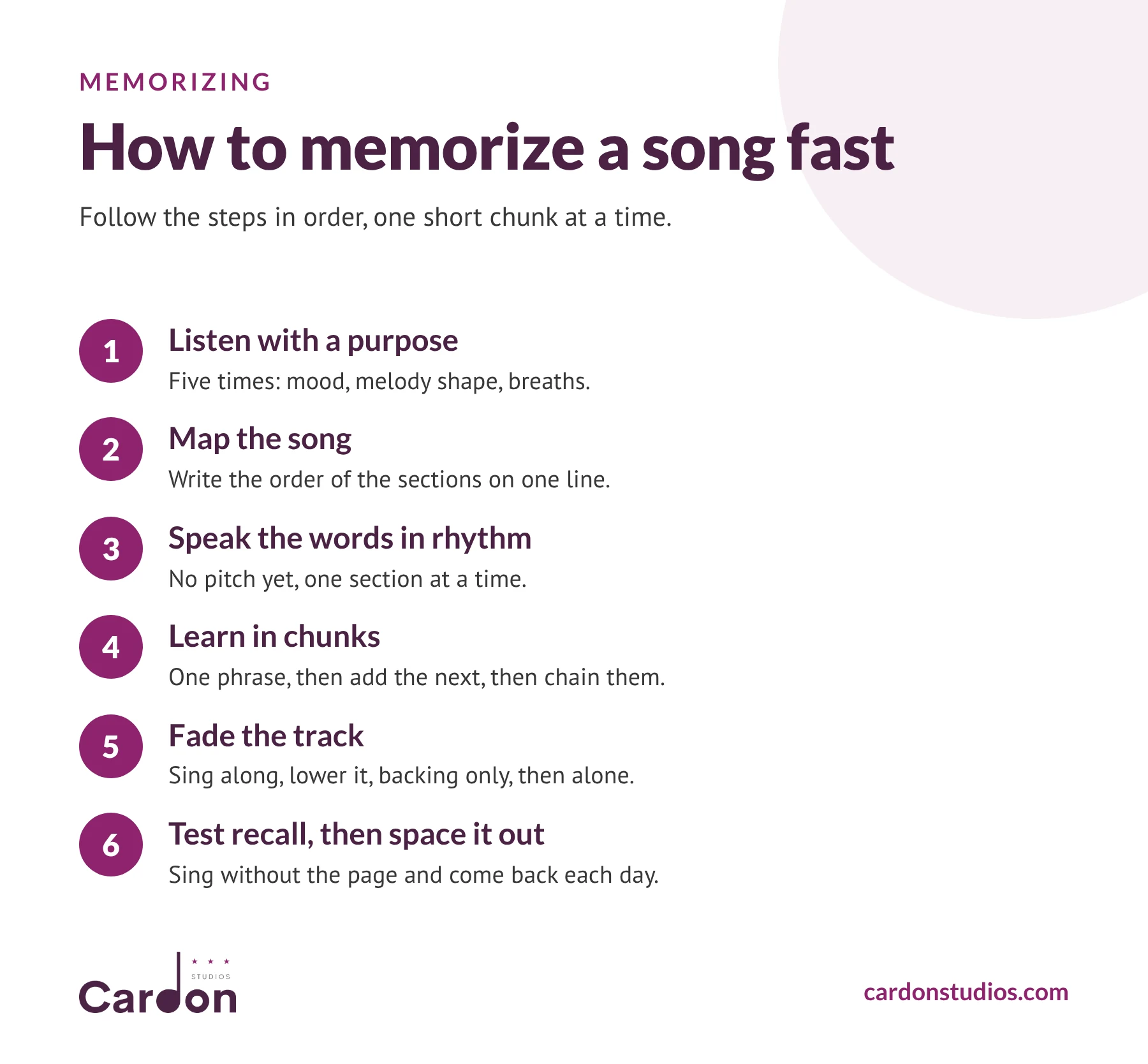
- Listen with a purpose. Play a good recording five times before you sing a note. First notice the mood, then where the melody rises and falls, then where the singer breathes.
- Map the song. On one line of paper, write the order of the sections, for example: intro, verse 1, chorus, verse 2, chorus, bridge, chorus. Memory slips often happen at the joins between sections, and a map shows you where they are.
- Speak the words in rhythm. Say the text out loud in the song’s rhythm, without pitch, one section at a time. You’ll find the tricky spots before the melody hides them.
- Learn in chunks. Take one phrase, sing it three times, then add the next phrase and sing both. Keep adding until the section is complete. Some singers learn the final section first, so the end of the song always feels the most secure.
- Fade the track. Sing along with the recording, then with the volume lower, then with only the backing track, then alone.
- Test recall away from the page. Close the music and sing the section from memory. Mark every spot where you hesitated, and practice only those spots next time.
- Space it out. Come back to the song once or twice a day for several days. Each time you pull it from memory, it gets easier to find the next time.
Record yourself at the end of each session. Our guide to recording yourself shows you what to listen for, and a recording makes it obvious which lines still need work.
Four kinds of musical memory
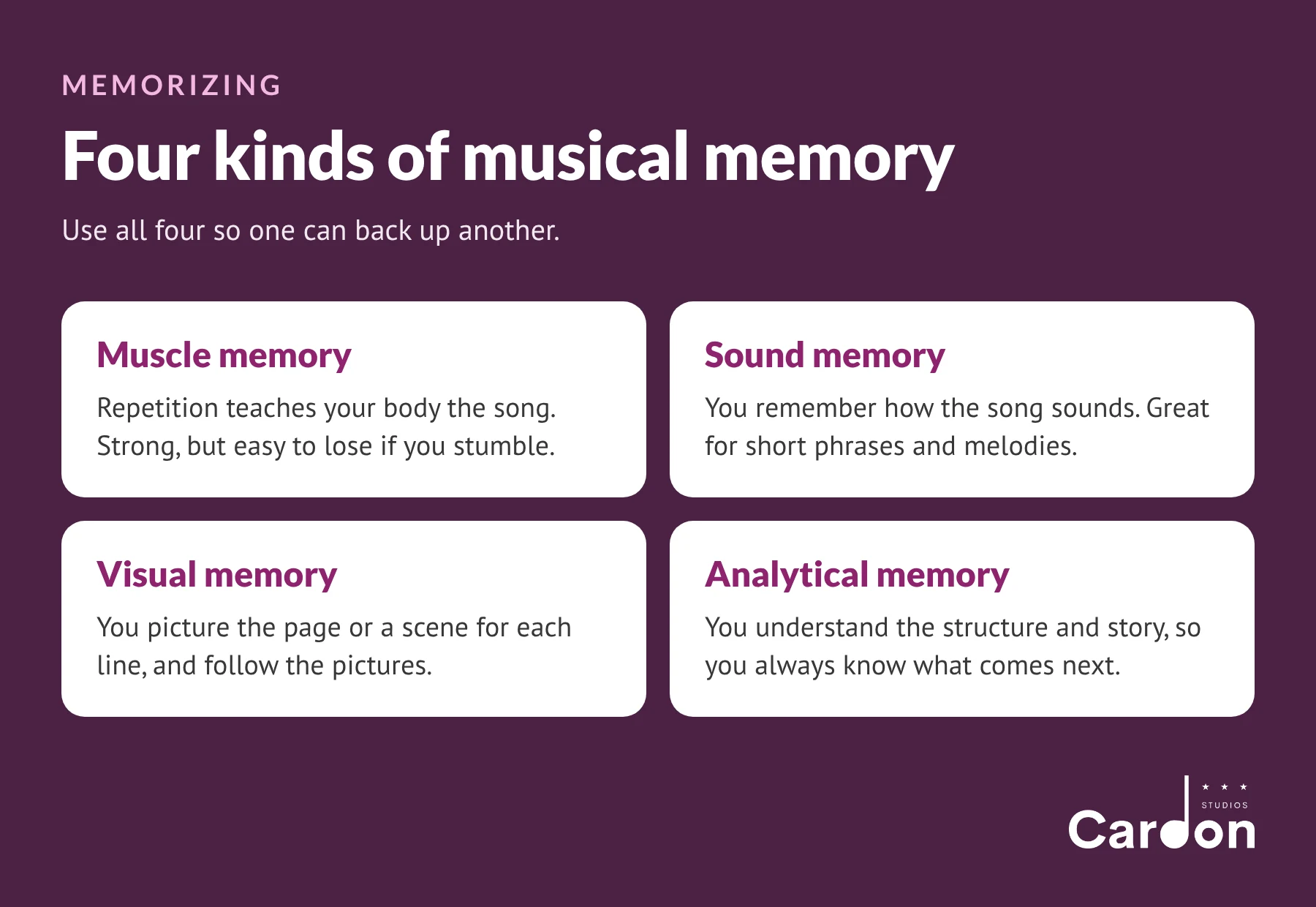
When you learn how to memorize music, it helps to know that you remember a song in several ways at once. Singers who use all four have a backup when one of them slips.
Muscle memory
The act of physically practicing is the strongest yet the most fragile way to memorize a piece. Its strength lies in the way you repeatedly perform the song until you understand and recognize every aspect of it. It’s fragile because when you rely on muscle memory and fail in the middle of a piece, it’s highly likely that you’ll have to repeat at the beginning.
Sound memory
This is the second most common way of memorizing a performance piece: when you remember how a song sounds. This method works well on short pieces or short sections of longer ones. Singers who learn songs by ear are often good at this method. Singing the piece will definitely help enhance your sense of listening and memory as well.
Visual memory
This is the most sought after and admired method of memorization. Like in other fields, photographic memory is quite rare among people, but visual memorization can be taught to an extent.
Memorizing a physical sheet is like listening to a storybook on repeat. You can put colorful drawings and scenes that best describe the melody of the piece. Associating sounds with characters and emotions of a story can help you to visualize a melody with a simple look!
Analytical memory
This is a method of memorization that requires a deeper level of concentration. We analyze the story and make a personal connection with the piece. Identifying musical phrases or chords as characters or scenes will strengthen one’s memory of the musical score.
Many people also swear by the effectiveness of drawing pictures along with them! These pictures can be drawn in sequence to complete a logical story that the student can tell in words. Once they can tell this story, they’re far more likely to be able to sing it from memory. Personalizing the piece with colors and pictures can make the whole practice more enjoyable. After all, there’s a stronger chance of remembering the piece. For a routine to fit memorization into, read how to practice singing between voice lessons.
How to memorize lyrics
Words are usually the first thing to slip, especially in a verse that comes back with small changes. These techniques help the words stick on their own, so you aren’t relying on the melody to carry them.
- Write the words out from memory. Close the page and write every line by hand. Then compare and circle anything you missed or changed.
- Use a first-letter cue sheet. Write only the first letter of each word. Reading from those letters forces your memory to fill in the rest, and you can drop the sheet once it feels easy.
- Picture each line. Turn every line into a small scene in your mind and string the scenes together in order. The story becomes a path you can walk through.
- Know what you’re saying. Paraphrase each verse in your own words. Once you know why one line leads to the next, the order takes care of itself.
- Mark the differences. If verse 1 and verse 3 are nearly the same, highlight the words that change. Those are the spots where singers mix them up.
Practice the words while you walk or do chores, speaking them in rhythm. Words that you can say without the music are words you’ll remember under pressure.
How to memorize a song in a week: a practice plan
A week is often enough for a song if you practice a little every day. Warm up first; our vocal warm-up guide has a short routine.
| Day | Focus | What to do |
|---|---|---|
| 1 | Listen and map | Listen five times, write the section map, and speak the first verse and chorus in rhythm. |
| 2 | First half | Learn the first verse and chorus in chunks. Test them from memory at the end. |
| 3 | Second half | Review day 2 from memory, then learn the rest of the song in chunks. |
| 4 | Joins | Practice only the moments where one section turns into the next, five times each. |
| 5 | Fade the track | Sing the whole song with a lower track, then with the backing track only. |
| 6 | Full run | Sing it alone from start to finish and record it. Mark any slips and fix only those. |
| 7 | Perform it | Sing it for a friend or family member, or stand up and sing it for the camera as if it were the real thing. |
If you have less time, keep the same order and do two days’ work in one. If you have more, repeat days 5 to 7 until the song feels easy.
If you forget while performing
Even well-prepared singers occasionally go blank. What matters is that you keep going, and that you’ve practiced keeping going.
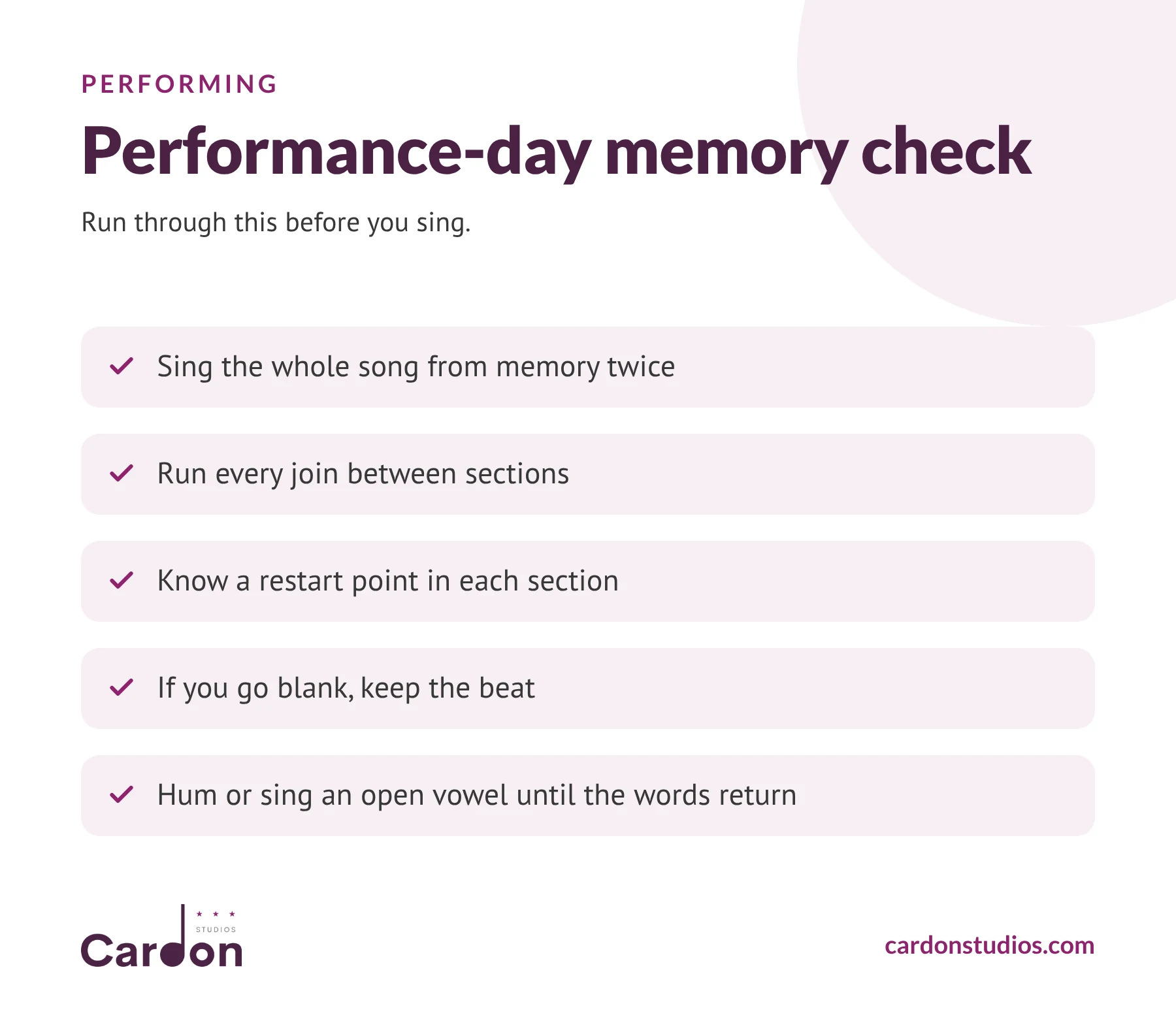
- Keep the beat. Stay with the music even if a word disappears. The audience follows your confidence more than your exact words.
- Hum or sing an open vowel. Carry the melody on “ah” or “oo” until the next word you know comes back.
- Jump to a restart point. Choose one place in every section where you can always pick the song up, such as the start of the next chorus, and practice jumping there.
- Don’t stop to apologize. A small slip often passes unnoticed unless you point it out.
Nerves make memory slips more likely, so practice performing, not just singing. Our guide to handling stage fright has ways to calm your body before you sing, and picking the right audition song starts you with a piece you’ll enjoy learning.
From the studio
In Cardon Studios lessons, your teacher can help you map a new song, find the spots that keep slipping, and practice performing it. Every lesson is recorded, so you can rewatch it while you practice, and your monthly video coaching submission is a good way to get feedback on a full run of your song.
Online voice lessons
Learn your next song with a teacher
One monthly membership includes four private online voice lessons, one video coaching submission, the Learning Library, and member online events, with a teacher matched to your style, goals, age, and schedule.
Common questions about memorizing songs
What is the best way to memorize a song?
Map the structure first, learn the words as speech, then learn the song in short chunks and test yourself without the page. Short sessions on several days usually work better than one long session.
How can I memorize a song in one day?
Follow the seven steps in order and split your day into several short sessions with breaks between them. Spend most of your time on the joins between sections, and sing the whole song from memory before you go to sleep.
How do I remember song lyrics while singing?
Learn the words separately from the melody first, by speaking them in rhythm and writing them out from memory. When the words stand on their own, nerves and the music are less likely to knock them loose.
How long does it take to memorize a song?
It depends on the song’s length, how many verses repeat, and how well you already know it. A week of daily practice is often enough for a typical song, and less for one you’ve known for years.
How do I memorize a performance piece for an audition?
Start early, so the song has had at least a week to settle. Practice the cut you’ll actually sing, perform it for someone before audition day, and choose a restart point in case you go blank.