


Look closely at the daily lives of famous composers and a pattern appears. There’s no single magic schedule, but there is almost always a routine: a regular time to work, a limit on how long, and time away to let ideas settle. Singers can borrow the same structure, whatever their style or schedule.
Key takeaways
- Great composers rarely worked all day; they worked regularly, for limited stretches.
- Many built time away from work, like long walks, into every day.
- For singers, short, consistent practice beats occasional marathon sessions.
- A simple five-step routine gives every practice session a clear purpose.
What the great composers actually did
Writer Mason Currey collected the routines of well over a hundred artists, writers, and composers in his book Daily Rituals: How Artists Work (2013). A few of the musicians in it stand out, and summaries of the book in Hyperallergic and The Believer capture what made their days work.
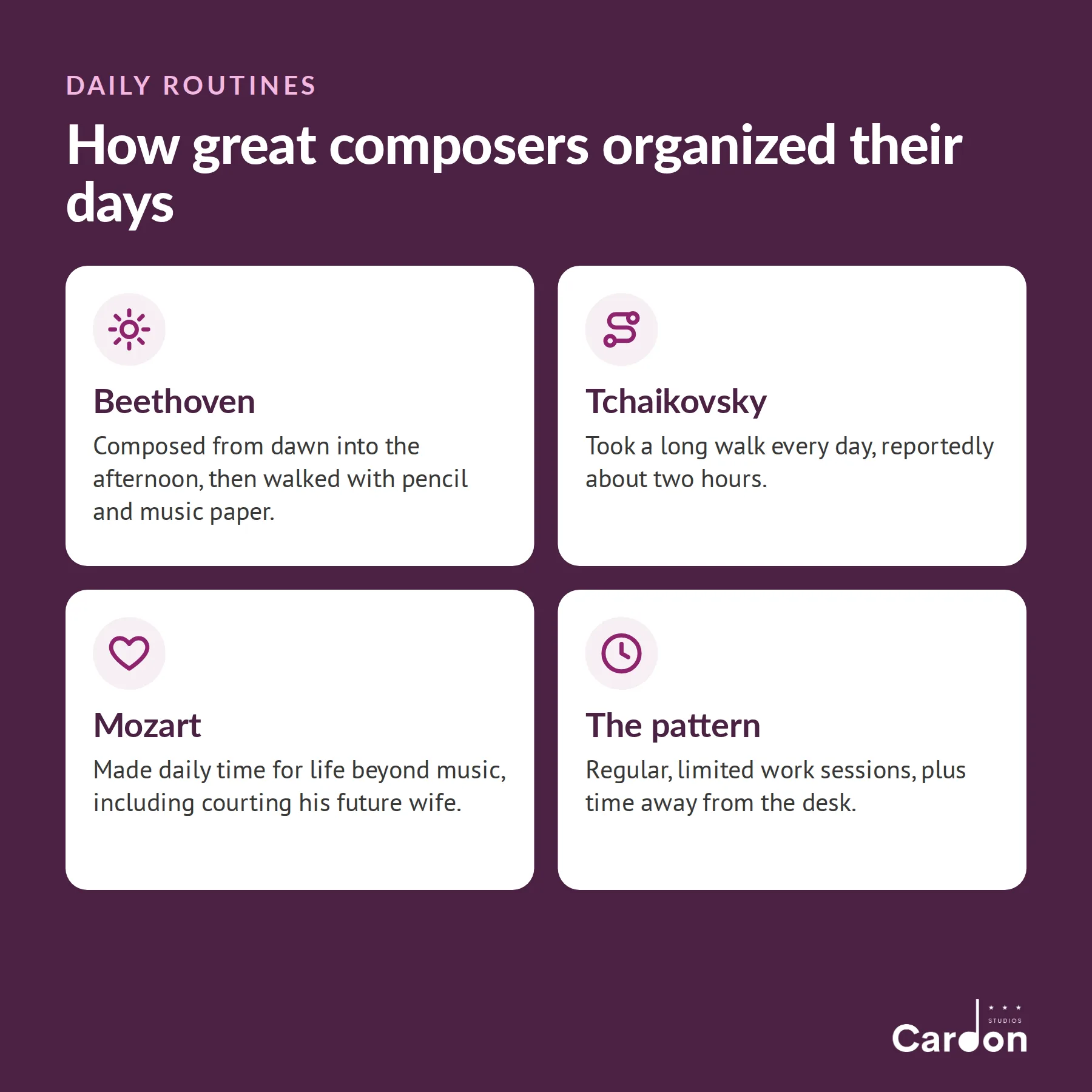
Beethoven
Beethoven rose at dawn and made his coffee with exactly 60 beans per cup, which he counted out himself. He composed until about two or three in the afternoon, then went for a long walk, taking a pencil and some music paper to capture any ideas that came to him along the way.
Tchaikovsky
Tchaikovsky took a long walk every day. By most accounts he was so attached to it that he made sure it lasted about two hours.
Mozart
Even Mozart, famous for his output, made room in his day for life beyond music. In 1781 he set aside time each day to court Constanze Weber, whom he married the following year.
The pattern
As The Believer’s review of the book points out, these schedules are regular, but they are almost always limited. The great composers didn’t squeeze every possible minute out of the day. They worked at a set time, stopped, and did something else.
Lesson 1: Consistency beats intensity
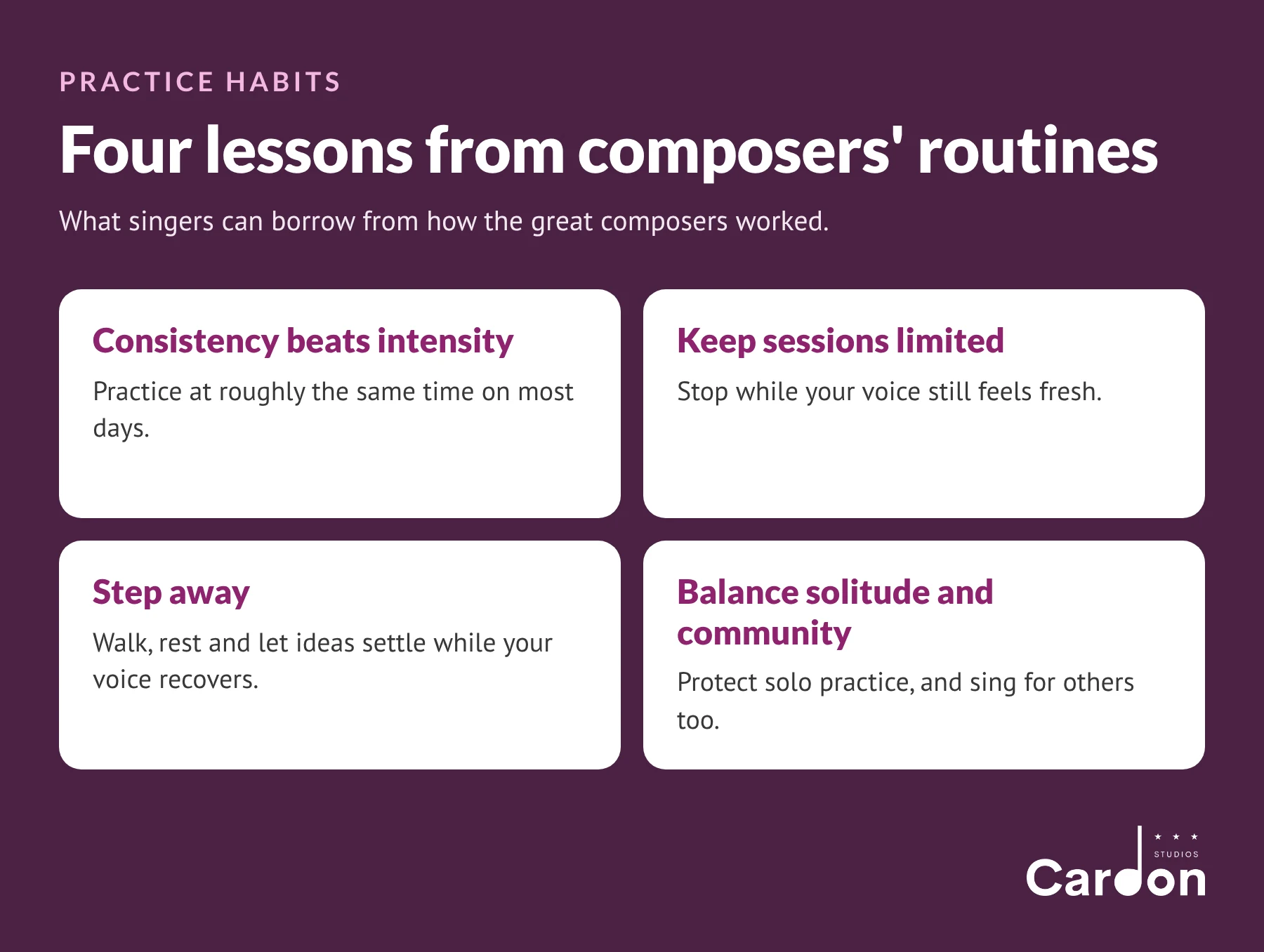
The common thread isn’t how many hours these musicians worked; it’s that they worked at roughly the same time, day after day. For singers, that’s good news. Your voice learns through repetition of good habits, and a focused session on most days usually does more than one long session the night before a lesson. A regular time also removes a daily decision: when practice is simply what you do at 7:30, you spend less energy talking yourself into it.
Lesson 2: Keep your sessions limited
Limits matter even more for singers than for composers, because your instrument is part of your body. A session that ends while your voice still feels fresh is more useful than one that runs until you’re tired and tight. Keep each session’s goal small and specific, and stop while the work is still going well. Our guide to deliberate practice explains why focused, limited sessions work so well.
Lesson 3: Step away to let ideas settle
Beethoven and Tchaikovsky didn’t treat their walks as time off. Beethoven carried paper to catch ideas as they came. Singers can use time away from practice in the same way: listen to your lesson recording on a walk, think through the story of a song, or decide where you’ll breathe in a tricky phrase. Your voice rests while your musical thinking keeps going.
Lesson 4: Balance solitude and community
Many composers valued quiet time alone to think and work. But growth also comes from other musicians: hearing them, singing for them, and learning from their feedback. Aim for both. Protect your solo practice time, and balance it with chances to sing for others, such as an open mic, a group class, or a choir rehearsal. Our article on practicing between lessons covers the solo side in more detail.
Build your own singing routine
You don’t need to rise at dawn or count coffee beans. You need a routine that’s small enough to repeat and specific enough to move you forward.
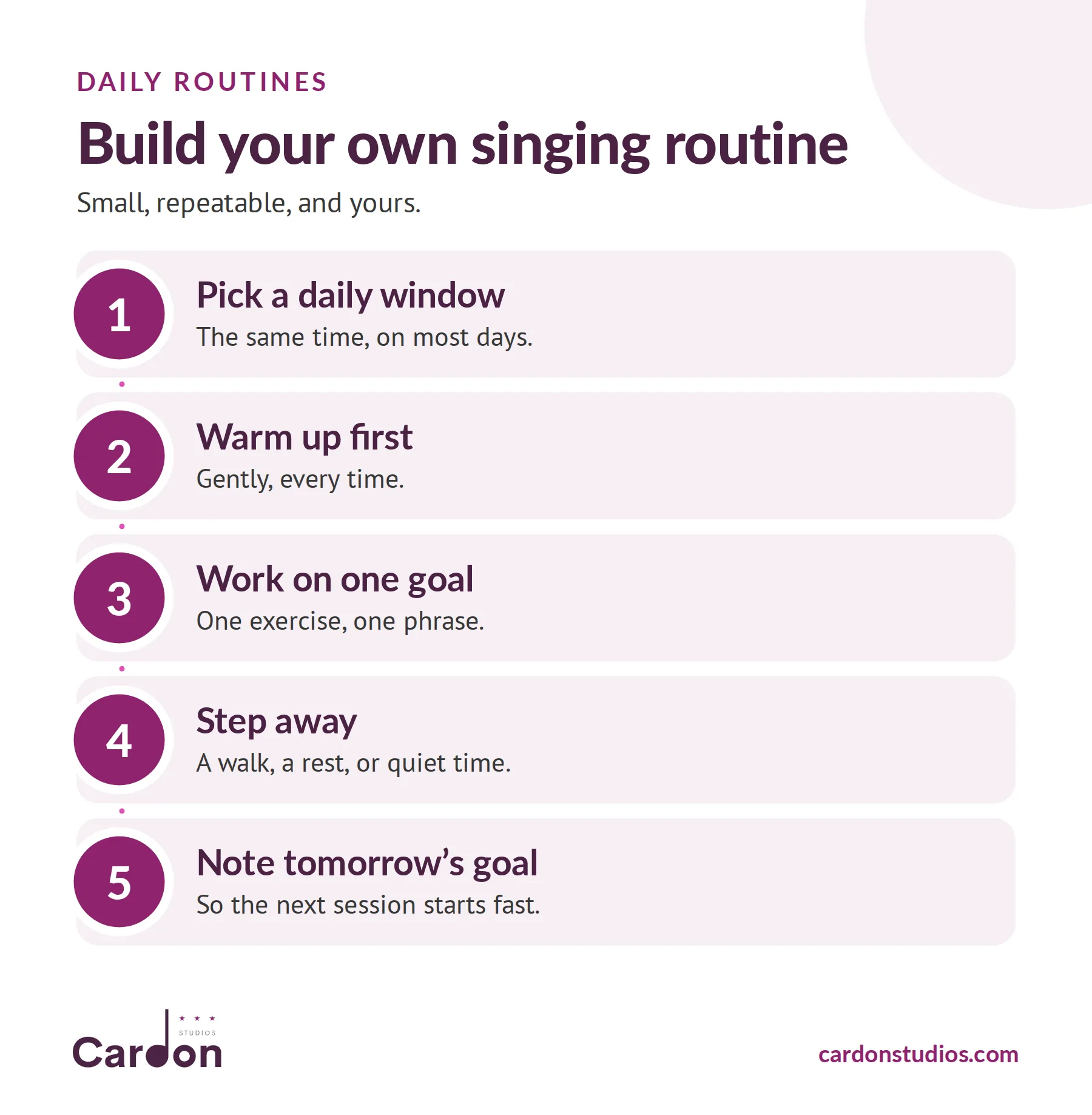
- Pick a daily window. Choose a time that works on most days and treat it like an appointment.
- Warm up first. Start gently and build. Our guide to warming up explains why it matters.
- Work on one goal. One exercise from your lesson and one phrase from your song.
- Step away. A walk, a rest, or quiet time to let the work settle.
- Note tomorrow’s goal. Write one line so your next session starts quickly.
Daily vocal exercises for your routine
The “work on one goal” step goes further when the exercises before it are the same every day. A short, fixed set of daily vocal exercises works like Beethoven’s set working hours: you don’t decide what to do, you just start. Here’s a simple daily sequence that suits most voices. Sing everything at a comfortable volume, in the middle of your range, and stop if anything feels tight or hurts.
| Exercise | How to do it | What it trains |
|---|---|---|
| Breath release | Breathe in low and easy, then let the air out on a steady “sss.” Repeat 4 times. | A calm, steady airflow before you make a sound |
| Lip trill slides | Trill your lips and slide up and down a comfortable fifth, then an octave. Repeat 5 times. | Connected airflow and an easy start to each note |
| Five-note hum | Hum “mm” on a five-note scale (1-2-3-4-5-4-3-2-1), moving up a half step each time for 4 or 5 keys. | Forward resonance without pushing |
| Vowel line | Sing “mee-meh-mah-moh-moo” on one comfortable note, then on a three-note scale. Repeat 3 times. | Even vowels and a steady tone as your mouth shape changes |
| Siren | On “ng” or “oo,” glide lightly from the bottom of your comfortable range to the top and back. Repeat 3 times. | A smooth path through your registers |
| Cool-down | Finish the session with a few gentle descending hums or lip trills. | Ending with an easy, relaxed voice |
Then move on to the one exercise your teacher assigned and the one phrase from your song. On days when you’re short of time, the first three rows alone keep the habit going. If breathing feels like the weak link, our guide to breathing when singing goes deeper, and if you’re just starting out, try these vocal exercises for beginners.
Keep a simple log beside your practice space: the date, the exercises you did, and one word about how your voice felt. After a few weeks you’ll start to see patterns in your own days, such as which time of day suits your voice and which exercises make your song feel easier.
A sample week of practice
Here’s one way a routine can look across a week. Move the days and times to suit your schedule; what matters is that the pattern repeats.
- Lesson day. Rewatch the key moments from your lesson recording and write down the two or three things your teacher asked you to work on.
- Two or three short sessions. Warm up, then spend the rest of the session on one exercise and one phrase from your song.
- One longer session. Sing through the whole song, record it, and listen back with your lesson notes in hand.
- One listening day. No singing. Listen to recordings of your song, read through the words, and plan where you’ll breathe.
- One rest day. Let your voice and your attention recover, the way the composers stepped away from their work.
If your voice feels tired or hoarse, swap a singing session for a listening day; our guide to vocal health for singers explains why rest matters. For a more detailed plan, see the sample week in how to practice singing between lessons.
Make it fit your life
Not everyone can practice in the morning, and that’s fine. What matters is choosing a window you can actually keep. If you work full time, our guide to balancing singing with a day job shows how to fit practice around a busy week. If you live with other people, see how to practice singing in an apartment.
From the studio
Cardon Studios lessons are recorded for your review, which makes them easy to fold into a routine: rewatch one demonstration before you practice. When a session stalls, you can send your teacher a video and get a personalized response within 72 hours.
Online voice lessons
Build a routine with a teacher behind you
One monthly membership includes four private online voice lessons, one video coaching submission, the Learning Library, and member online events, with a teacher matched to your style, goals, age, and schedule.
Common questions about musicians’ routines
What was Beethoven’s daily routine?
According to Mason Currey’s Daily Rituals, Beethoven rose at dawn, made coffee with exactly 60 beans, composed until mid-afternoon, and then took a long walk with a pencil and music paper to note down ideas.
How long should a singer practice each day?
There’s no single right number. Short, focused sessions on most days work well for many singers, and stopping while your voice still feels fresh is wiser than pushing on. Your teacher can suggest a routine for your voice and goals.
What’s a good daily routine for a singer?
A simple one: practice at a regular time, warm up first, work on one exercise and one phrase, take a break to let it settle, and note your goal for tomorrow.
What does a singer do on a daily basis?
It depends on the singer, but most serious singers’ days mix practice, voice care and work on songs. A typical day might include a warm-up and a short set of daily vocal exercises, focused work on music for an upcoming lesson, rehearsal or performance, some listening and planning away from singing, and enough rest, water and sleep to keep the voice ready. Singers who perform for a living also spend time preparing for auditions and rehearsals with other musicians.
Is it better to practice singing in the morning or at night?
Either can work. If you sing early in the day, give yourself a longer, gentler warm-up so your voice has time to wake up. The best time is the one you can keep on most days.
What should I do on days I can’t sing?
Keep the routine going without your voice. Listen to your lesson recording, read through the words of your song, mark your breaths, or listen to other singers perform it. Coming back to the song with a plan makes your next session more productive.
How do I stick to a practice routine?
Make it small and specific: a set time, a short session and one clear goal. Write tomorrow’s goal at the end of each session, and mark the days you practiced on a calendar. If you miss a day, simply start again the next day rather than making up for it with one long session.