


To stop feeling overwhelmed as a singer, shrink your goals until each one is achievable, believable and worth committing to, then take one small step toward it every day. Overwhelm usually comes from goals that are too vague, too far away or too many at once, not from a lack of talent.
For singers of every style and level, a healthy practice mindset is key to success. The singers who stay focused on their goals and structure their progress step by step are the ones who eventually build the voice, and the career or creative outlet, they’re dreaming of. This guide shows you how to set goals that keep you moving instead of leaving you feeling lost.
Key takeaways
- Overwhelm grows when goals are vague, far in the future, or piled up all at once.
- Good singing goals are Achievable, Believable and Commit-able: the ABCs.
- Zoom in on a big dream until you find a step you can start this week.
- Consistency beats intensity: small, regular practice keeps overwhelm away.
- You don’t have to do it alone. Teachers and collaborators help you stay on track.
Why singers feel overwhelmed
Singing looks simple from the outside: you open your mouth and a song comes out. From the inside, it’s a long list of skills that all have to work together. When you’re learning, it’s easy to look at that whole list at once and wonder where to start. That feeling of standing at the bottom of a mountain is what we mean by overwhelm.
In practice, overwhelm usually comes from one of three places:
- Goals that are too vague. “Get better at singing” doesn’t tell you what to do today, so every session feels like guesswork.
- Goals that sit too many steps in the future. “Sing the lead in a musical” is a wonderful dream, but if it’s the only goal you have, the gap between today and that day can feel impossible to cross.
- Too many goals at once. Working on breath, range, a new song, stage presence and recording all in the same week spreads your attention so thin that nothing seems to improve.
Losing sight of your goals in any of these ways is the fastest route to feeling lost or even hopeless about your voice. The good news is that each one has a practical fix, and none of them requires you to practice harder. They ask you to practice smarter.
How to stop feeling overwhelmed in singing practice
The cure for overwhelm is a smaller next step. There’s no need to dive into the deep end. Instead, work backward from your big goal until you find something you can actually do this week, then put all your attention on that one thing.
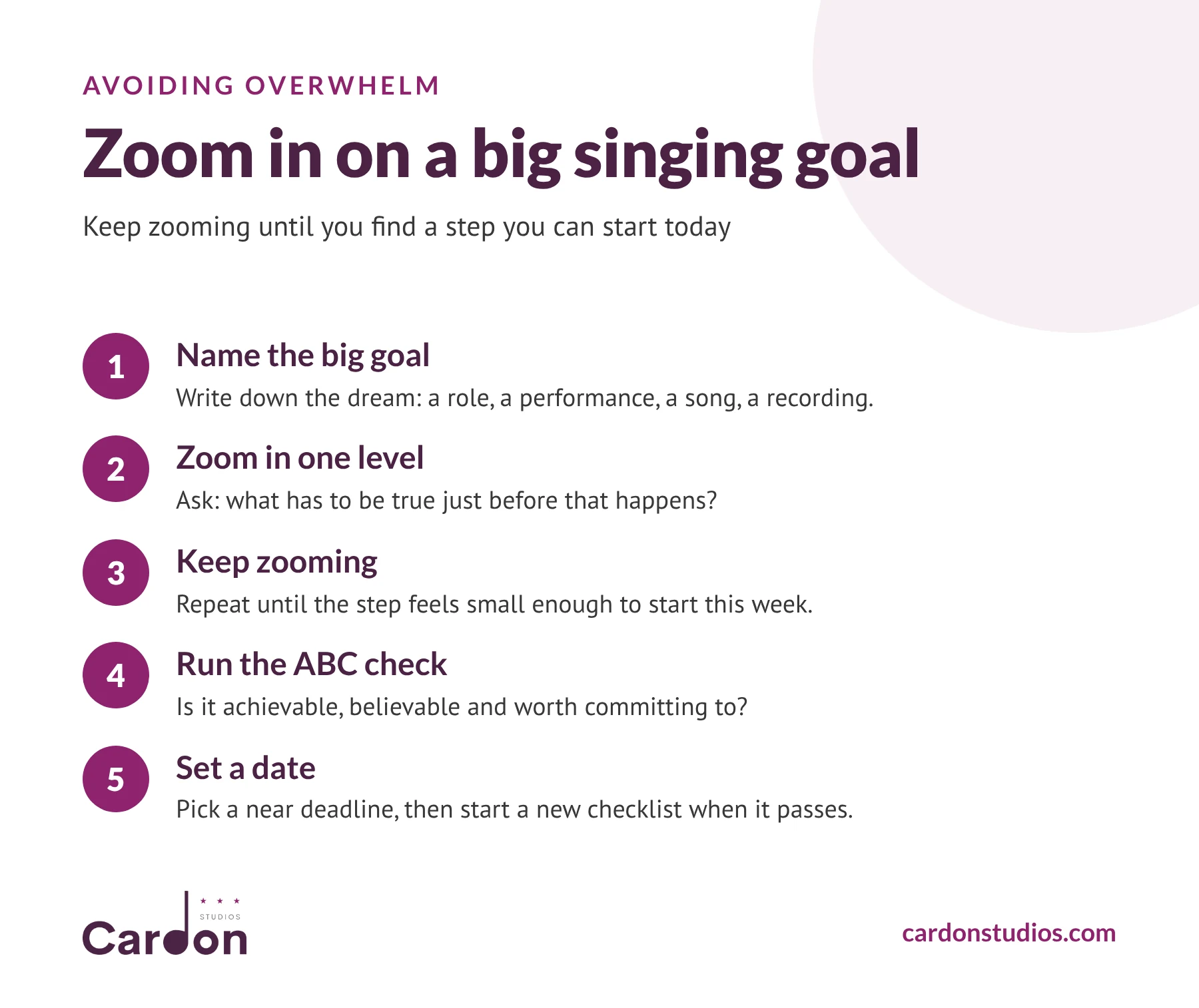
Here’s how the zoom-in method works with a real goal. Say your dream is to sing a solo at your choir’s spring concert.
- Name the big goal. “Sing a solo at the spring concert.” Write it down so it stops floating around in your head.
- Zoom in one level. What has to be true just before that? You’d need to audition for the solo with a song you know well.
- Keep zooming. Before the audition, you’d need to sing the song from memory, steady from start to finish. Before that, you’d need to get through the hardest phrase without running out of air. Before that, you’d need to know exactly where you breathe.
- Stop when it’s small enough. “Mark every breath in my song and practice the first two phrases with those breaths” is something you can start tonight.
- Set a near deadline. Give that small step a week, then zoom back out and choose the next one.
Once you have that small step, protect it. Let the other goals wait their turn. You’ll still warm up and sing for fun, but your focused practice goes to the one step in front of you. Our guide to setting singing goals and building a practice plan shows how to turn these steps into a monthly and weekly plan.
How to set achievable singing goals: the ABCs
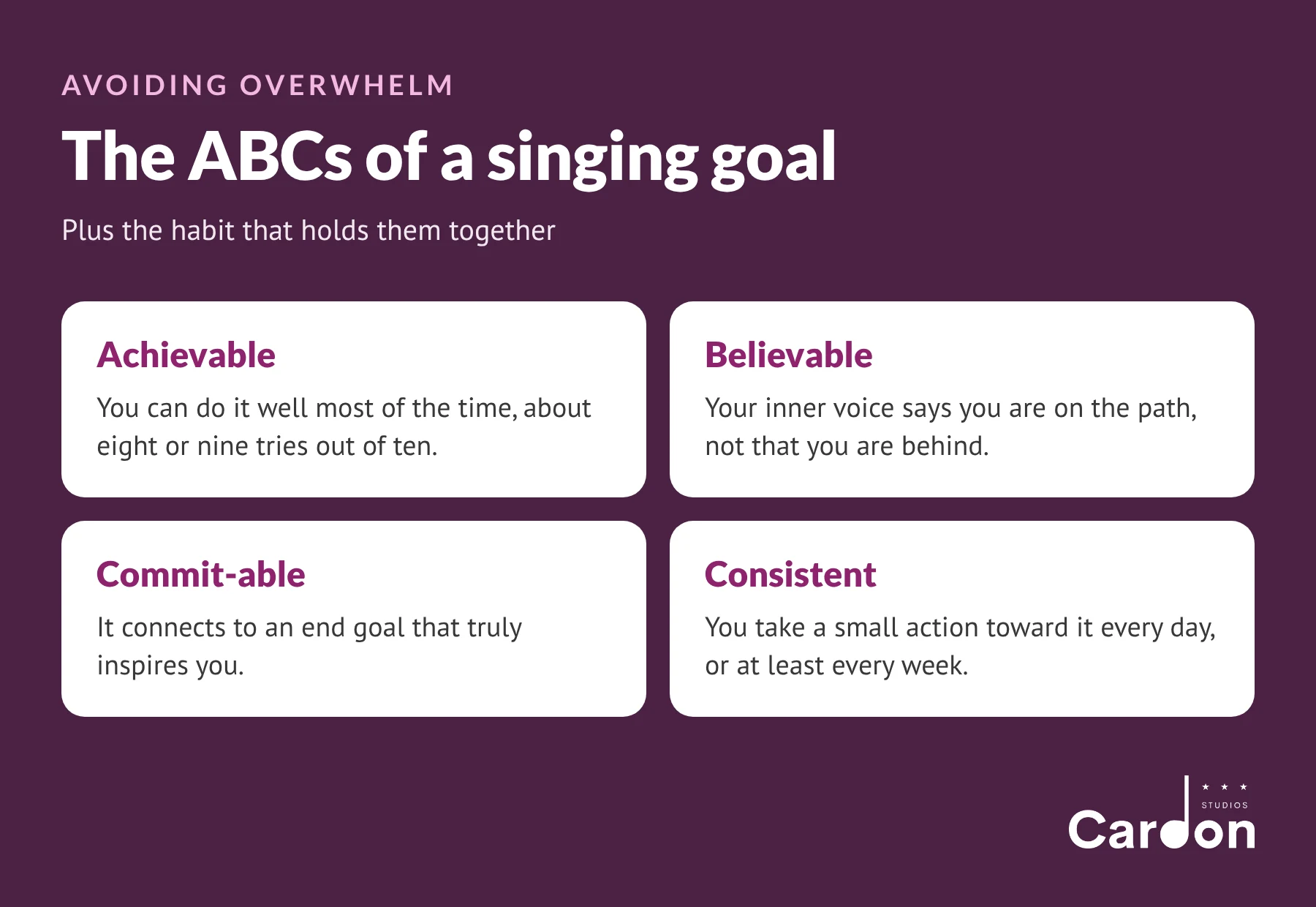
Not every small goal is a good goal. To avoid singing overwhelm, check each goal against three simple rules before you commit to it. A good goal is Achievable, Believable and Commit-able. And the habit that holds all three together is consistency.
A is for Achievable
Set goals you can do successfully most of the time: think eight or nine tries out of ten. That small margin matters. When you succeed several times in a row, you give yourself the feedback you need to learn the task, and “most of the time” gradually turns into “every time.” From there, you can set your next small goal on the way to the big picture.
On the flip side, if you can only manage a task once in a while, every failed attempt teaches your body the wrong version. Picking a goal that’s too advanced, or a song that’s too advanced, can actually add to your struggles, because repeating an action poorly muddies the waters for your voice and your brain. Singing is a physical skill, and the way you repeat something is the way it sticks. Our guide on why how you practice matters more than how much explains this in more detail.
There’s no shame in starting small. In fact, it’s completely necessary. Skilled singers build their abilities on simple foundational work, so don’t be too proud to do it. A useful test: if you can’t do the task well at least eight times out of ten, make it smaller. Sing it slower, sing a shorter section, take it down a step in key, or practice it on a lip trill before adding words.
B is for Believable
You can be your own worst enemy, and what you tell yourself inside often counts more than anything anyone else says. Singing is a mental game on many levels. Before you can strengthen your control over your voice, it helps to strengthen your control over your thought patterns. What you believe about yourself and your voice makes a real difference.
This doesn’t mean telling yourself you’re the greatest singer the world has ever known. It means reminding yourself that you’re on the path. Wherever your skills are today, they can improve if you commit to the right strategic work. Try replacing “I can’t sing high notes” with “I’m learning to sing higher notes with less effort.” The second sentence is true, and it points you toward practice instead of away from it.
Remind yourself often that you have the capacity to grow, the resolve to do the work, and the heart to be an expressive, powerful artist. If self-doubt gets loud before you sing for others, our guide to conquering stage fright has practical tools.
C is for Commit-able
Your commitment comes from your passion. If the end goal doesn’t inspire you, you’re unlikely to follow through on the smaller steps that lead there. So never lose sight of where you want to be, even if you’re still figuring out how to get there.
Does the end goal feel overwhelmingly large? That’s when you use the zoom-in method above. Zoom in to the step that comes before the end goal, then keep zooming until you find a step that’s Achievable and Believable, and start there. Building a roadmap with levels to unlock, a bit like a game, keeps you accountable without losing the inspiration that got you singing in the first place.
Map the skills singing asks of you
Singing isn’t a pursuit with a single step to success, whether your goal is performing, recording or both. It covers vocal function, technique, expression, stage presence, recording and, for some singers, marketing their own music. Trying to improve all of them at once is a recipe for overwhelm.
Instead, list the areas and decide which ones matter for your goals right now. You might pick a few checkboxes across several areas, or focus on just one. Here’s what small, achievable goals can look like in each area:
| Skill area | Example of a small, achievable goal |
|---|---|
| Vocal function | Take a quiet, low breath before every phrase of verse one. |
| Technique | Sing a five-note scale on a lip trill, up and down, three times, keeping the sound smooth across the middle of your range. |
| Expression | Speak the words of your song aloud and mark the one word in each line you most want the listener to hear. |
| Stage presence | Sing your song once, standing, with your eyes on a spot just above where an audience would sit. |
| Recording | Record the first chorus on your phone and write down one thing you like and one thing to work on. |
| Sharing your music | Choose one short clip you’re proud of and decide where you’d like to share it. |
Notice that every example is small enough to finish in a single session and specific enough to check off. That’s what keeps a long skills list from turning into a weight on your shoulders. If recording is on your list, our guide to recording yourself singing walks you through it.
Use seasons and deadlines to reset
New seasons are a great time to make a change. A new school year, a new calendar year or the start of a new choir or show season gives you a natural moment to take stock and take charge of your goals.
Deadlines can be powerful motivators, too. Try choosing a specific date, such as the new year or your birthday, for a small collection of tasks. When that deadline passes, celebrate what you finished and start a new checklist. Short cycles like this keep goals close enough to feel real, and they give you regular chances to adjust.
Keep each checklist short. Three to five items is plenty. If a deadline arrives and you’ve only finished half of them, that isn’t a failure. It’s information: the goals were a little too big for the time, so make the next checklist smaller.
You don’t have to do it alone
Working smarter, not harder, includes recruiting help. Supporters, collaborators, mentors and teachers can keep you focused on the steps that build toward your main goal, and there’s no need to pursue your singing journey alone.
The people you trust help in two ways. Their input gives you guidance you can’t get on your own, like a teacher hearing tension you can’t feel or a friend noticing that your confidence has grown. And simply having people in your corner brings more confidence and clarity to your journey. Teachers and collaborators can be instrumental in supporting you and fostering your belief in your potential, so don’t sell yourself short by practicing in isolation.
Look for people who are encouraging and honest at the same time: a voice teacher, a choir director, a duet partner, or a friend who’s also learning. Share your current small goal with one of them and ask them to check in with you next week. That small bit of accountability can make the difference between a goal that drifts and a goal that gets done.
Consistency beats intensity
Whatever goals you choose, consistency is key. Take some action toward them every day, or at least every week. Short, regular practice is easier on your voice and easier on your motivation than occasional marathon sessions that leave you tired and discouraged.
A little practice most days is often easier to stick with than a big weekly push, because it becomes part of your routine. Tie your practice to something you already do, like right after school, work or dinner. On busy days, a tiny version counts: a gentle warm-up and one run of your current goal still keeps the habit alive. Our guide to how to practice singing between voice lessons shows a simple routine, and if getting started is the hard part, see how to stop procrastinating on singing practice.
Keep a simple practice log as well. Write the date, the goal and one sentence on how it went. Over a few weeks, that log becomes proof that you’re moving forward, which is one of the best defenses against feeling overwhelmed.
What to do on an overwhelmed day
Even with good goals, some days the whole thing feels like too much. On those days, don’t try to catch up on everything. Run through a quick reset and give yourself one small win.
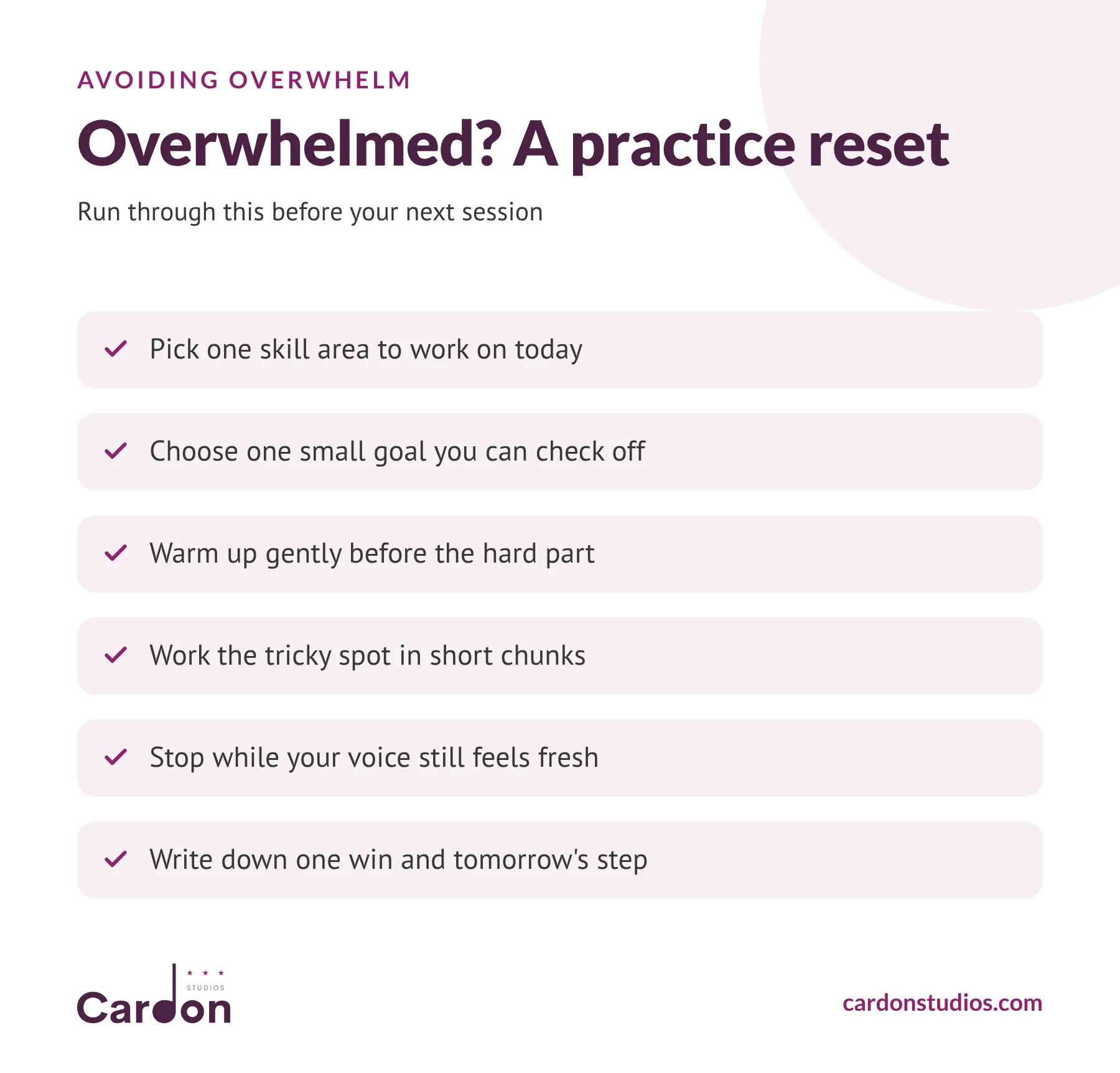
Start with a gentle vocal warm-up, such as humming or lip trills on an easy five-note scale, up and down, three or four times. Then work the trickiest spot of your song in short chunks: two or three notes at a time, slowly, before you link them together. Stay comfortable, and stop if anything hurts.
Finish while your voice still feels fresh, and write down one thing that went well plus tomorrow’s step. If your mind keeps racing during practice, our guide to mindfulness for singers has simple ways to bring your attention back to the moment. And if feelings of overwhelm stick around outside of singing too, talk with someone you trust or a health professional.
Listen to your voice
Pushing through when you feel overwhelmed can lead to pushing your voice, too. If singing becomes painful, or your throat feels tight, scratchy or tired, stop and rest. The National Institute on Deafness and Other Communication Disorders advises drinking plenty of water, taking vocal naps through the day, and avoiding singing when your voice is hoarse or tired. It also recommends seeing a doctor if your voice has been hoarse for more than three weeks. For everyday care, see our guide to vocal health for singers.
From the studio
A teacher can help you break big goals into manageable steps. In live, one-on-one online voice lessons, your teacher hears where you are today, helps you choose achievable goals and gives you exercises for the next step. Between lessons, you can send a video for personalized feedback within two business days and rewatch your lesson recordings. Learn more about membership here.
Online voice lessons
Break your goals into steps with a teacher
One monthly membership includes four private online voice lessons, one video coaching submission, the Learning Library, and member online events, with a teacher matched to your style, goals, age, and schedule.
Common questions about overwhelm
What should I do when I’m feeling overwhelmed by singing practice?
Pause and shrink the task. Pick one skill area, choose one small goal you can check off today, warm up gently and work only on that. Write down one win when you finish. A single small success is the quickest way to get your momentum back.
Why do I feel overwhelmed when I practice singing?
Usually because the goal is too vague, too far in the future, or one of too many goals at once. Singing involves many skills, and looking at all of them together can feel like too much. Zooming in to one clear, achievable step usually helps.
How do I set achievable goals for singing?
Choose a goal you can do well about eight or nine times out of ten, that you believe you can reach, and that connects to something that inspires you. Give it a near deadline, such as a week, then review it and set the next step.
How do I not feel overwhelmed when learning a hard song?
Break the song into sections and start with the hardest phrase, sung slowly and in short chunks. If it still feels out of reach, try it in a lower key or on a lip trill first. Our guide on how to memorize a song shows how to learn it in layers.
How often should I practice singing to make progress?
Regular, shorter sessions on most days usually work better than one long session a week. Consistency matters more than length. On busy days, a gentle warm-up and one run of your current goal still keeps your habit going.