


To get gigs as a singer, build a short, well-organized set list, record a few samples that show you singing live, and pitch local venues with one clear message that answers every question a booker will have. Start close to home, at restaurants, cafes, open mics and community events, and let each good performance lead to the next.
Getting your first gig may seem like a difficult task, but if you look closely enough in your area, it can be a lot simpler than you may think. Perhaps just asking the owner of a restaurant you regularly visit, or emailing a couple of businesses nearby, will open the door. Opportunity is abundant. This guide walks you through every step, from your set list to the morning after the show.
Key takeaways
- Most first gigs come from local places you already know: restaurants, cafes, bars, open mics and community events.
- Venues book singers who are easy to say yes to: a clear set list, a short sample and every detail in one message.
- Recordings don’t need to be professional. A good live clip often shows a venue more than a polished studio track.
- Show up on time and prepared, support other musicians, and follow up, because many gigs come from people who have seen you sing.
How to get gigs as a singer, step by step
Booking gigs is less about luck than about being organized. A venue owner or booker is busy, and they have a simple question in mind: will this singer fill the room with the right sound, show up when they say, and be easy to work with? Everything you prepare should answer that question quickly.
In fact, the hardest part for most singers is not finding venues. It’s getting their act organized in a way that businesses can understand and accept. Once you have a set list, a sample and a short pitch ready, asking for gigs becomes routine. Here is the path most singers follow.
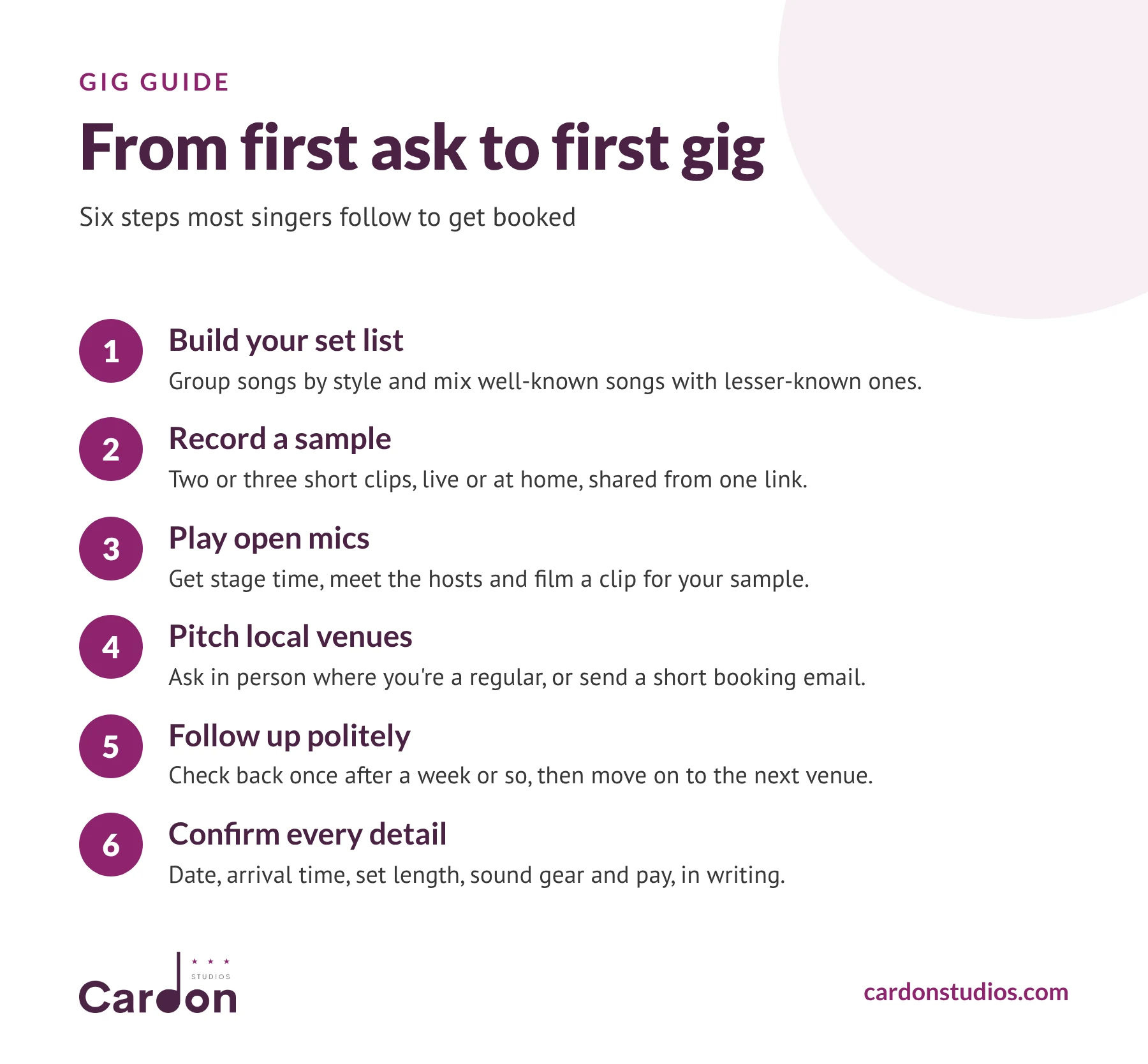
You don’t have to finish every step before you start asking. Many singers book their first small gig with a handful of songs and one phone video, then improve their materials as they go. Gigging has a learning curve, and each show teaches you something about your set, your sound and your audience. Between shows, singing lessons for adults can help you build the stamina and technique a longer set asks for.
Where to find singing gigs
The best places to look for gigs for singers are usually the ones closest to you. Think about the places where you already spend time and where live music would fit: a coffee shop with a corner stage, a restaurant that hosts a weekend brunch, a bar with a regular music night, or a community festival that books local acts every year.
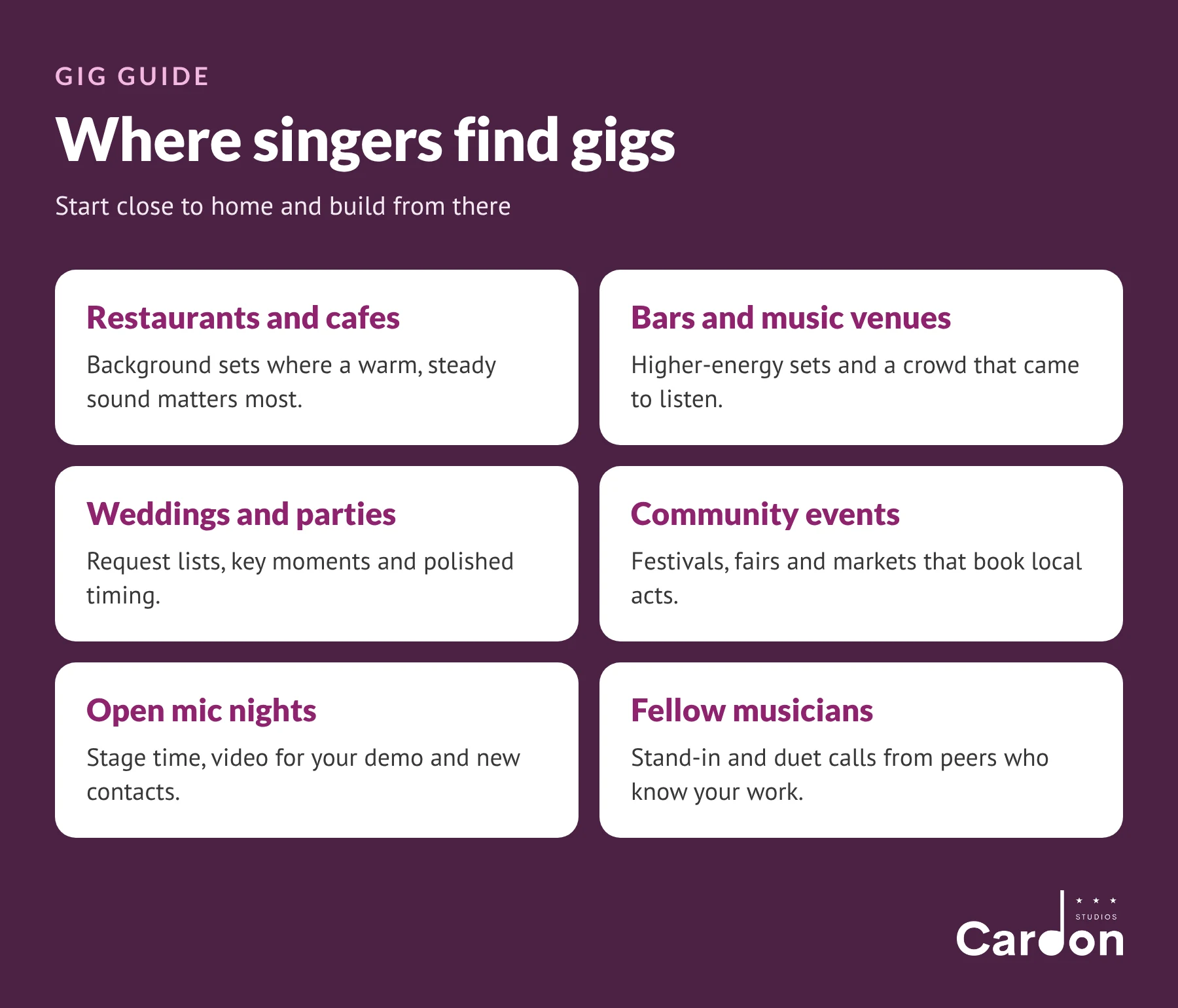
Each kind of venue wants something a little different, so tailor what you offer:
- Restaurants and cafes usually want a warm, steady background sound that lets people talk. Choose songs with a relaxed feel and keep your volume comfortable.
- Bars and music venues expect more energy and an audience that came to listen. A strong opening song and smooth transitions matter here.
- Weddings and private parties come with request lists and key moments, like a first dance or an entrance. Reliability and timing count as much as your voice.
- Community events such as festivals, fairs and markets often post calls for local performers months ahead. Check event websites and local arts groups.
If you’re a teen singer, involve a parent or guardian from the start: they can help you choose suitable venues, handle the booking conversation and come along on the day.
Build a set list venues can book
The first thing to compile is your set list, and to organize your act in a way that businesses can understand at a glance. Especially if you sing many different musical styles, make sure your set list is clearly grouped and marketable. A booker should be able to read it and picture your act in their room. If country is one of your styles, our guide to how to sing country covers its twang, slides and storytelling.
Balance your offerings: some well-known songs and some lesser-known pieces. If you write your own music, include it, but balance it with recognizable tunes so your set has the widest appeal. A simple way to plan a set:
- Open strong. Start with a song you know inside out, in a comfortable part of your range, so nerves settle quickly.
- Vary the pace. Alternate upbeat songs with slower ones so the set breathes and your voice gets natural rests.
- Place your hardest song in the middle. By then you’re warmed up, but not yet tired.
- Close with a favorite. End on a song the room is likely to know, or your most memorable original.
- Prepare extra songs. Keep two or three spares ready in case the venue asks you to play longer.
Know every song well enough to sing it under pressure. Our guide on how to memorize a song shows you how to learn a full set reliably, and music theory for singers covers the keys, counts and song maps that make rehearsals with accompanists faster.
Make a demo: recordings that show you live
Many potential gig venues will ask for recordings, so keep a folder of samples you can share from one link, for example a shared drive folder or a private video playlist. Creating samples tailored to the specific types of gigs you could be hired for, such as bars, restaurants or weddings, is worth the time it takes to get organized.
Professional recordings aren’t necessary when you reach out to venues. In fact, it can help to showcase yourself live in action, so they can see what the experience of your performance is like. Seek out open mic nights in your area and bring a friend along to act as your videographer for the evening.
When compiling your demo, home recording is a simple solution as well, and it gives you more control over your sound and video quality. Consider a sample set with a healthy mix of live and home recordings to show every angle. If you’re not sure where to start, check out some easy-to-work-with mics we recommend, and try an audio editor such as Audacity. Nowadays, anyone can be their own sound engineer.
How to make a demo that bookers will actually watch:
- Keep each clip short and start with your strongest moment, not a long intro.
- Choose two or three contrasting songs that match the venues you’re pitching.
- Film in landscape with steady framing, good light on your face and the mic close enough to hear you clearly.
- Listen back before you share. Our guide on how to record yourself singing explains what to listen for.
- Label each clip with the song, the style and where it was recorded.
Put together a simple press kit
A musician press kit, often called an electronic press kit or EPK, is a single page or folder that tells a booker everything about your act in one place. It doesn’t need to be fancy. A shared document or a simple web page works, as long as it’s easy to open on a phone.
| Press kit item | What to include | Why bookers want it |
|---|---|---|
| Short bio | Two or three sentences: who you are, your styles, where you perform. | They can introduce you to their audience. |
| Recordings | Your best two or three clips, live and home recorded. | They hear your sound before they book. |
| Set list | Songs grouped by style, with originals marked. | They can check the music fits the room. |
| Photos | One or two clear, recent photos of you performing. | They can advertise the show. |
| Practical details | Act size, set lengths, sound gear, the area you cover. | They can plan the evening. |
| Contact | Email, phone and your social links. | They can book you without searching. |
Keep your press kit up to date. Every new clip, photo or venue you play is a reason to refresh it, and an up-to-date kit tells bookers you’re active.
Want a teacher’s ear on your voice? Cardon Studios teaches private online voice lessons for singers ages 10 and up, live over Zoom with a teacher matched to your style and goals. See how lessons work
Pitch venues: what to put in your booking email
Booking staff want you to tell them everything they need to know without making them work to get the details out of you. Businesses are more likely to call you back if you’ve already answered their questions, because going back and forth for more information is a hassle for them.
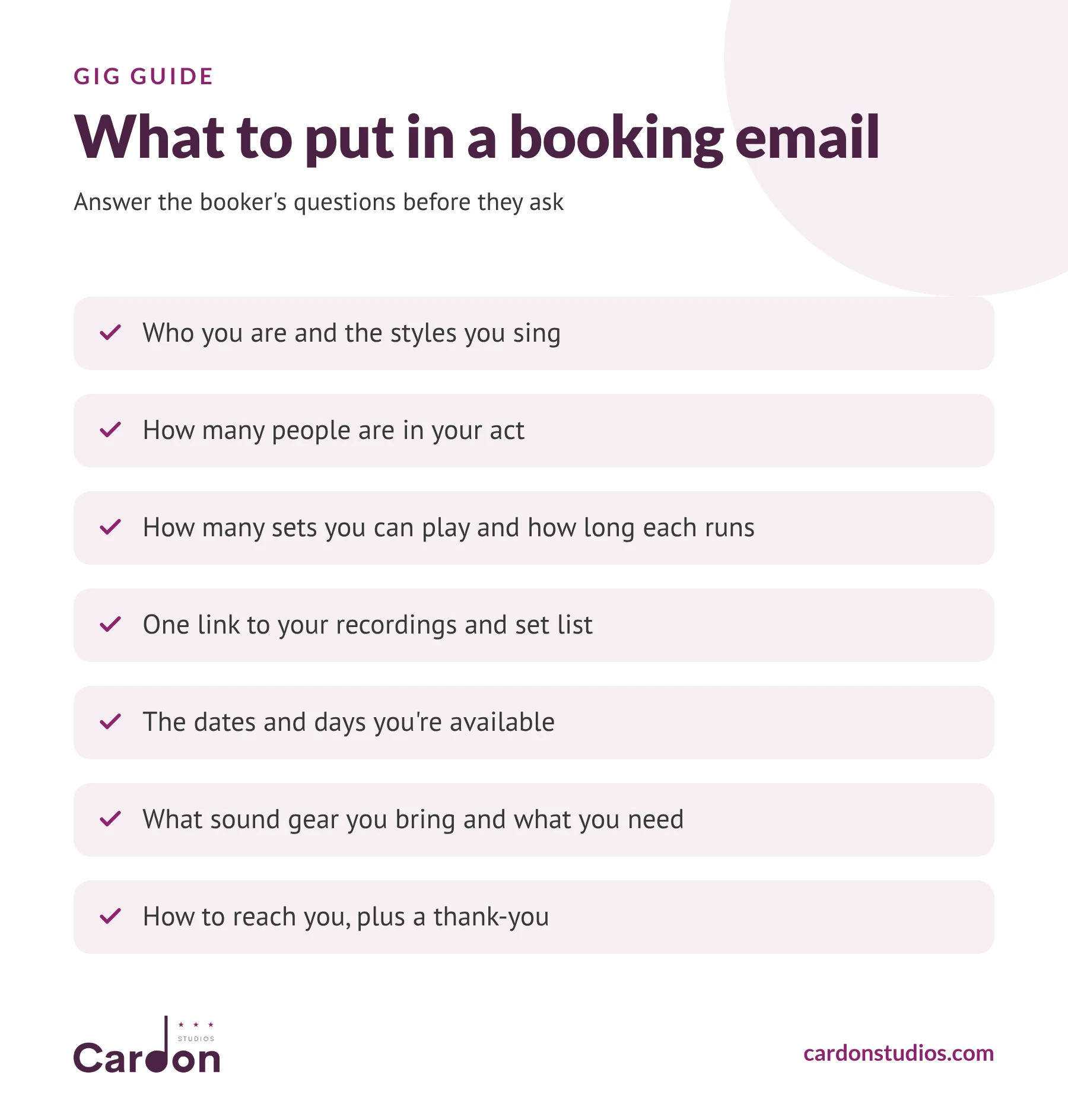
Tell them how long a set you can provide, what kinds of music you sing, how many people are in your group, what days you’re available and what sound equipment you’ll bring. If you have a following, describe it honestly, for example the friends and regulars who came to your last open mic, and never promise a crowd you can’t deliver.
Keep the email short: a friendly greeting that shows you know the venue, two or three sentences about your act, the practical details as a short list, one link to your press kit, and a thank-you. If you’re a regular at the place, speaking to the owner or manager during a quiet moment works well too. Bring a business card so they have your details.
Then follow up once, politely, after a week or so. If you don’t hear back, move on to the next venue on your list without taking it personally. Bookers get many requests, and timing plays a large part in who gets a date.
Open mics and the musician community
Open mic nights are the training ground for gigging singers. You get real stage time, a chance to test new songs in front of an audience, and video for your demo. Keep in mind that if a venue likes you and your act, they may call you later for paid gigs, so leave a good impression, as well as a current business card.
Don’t just sing your set and leave. Stick around, watch the other acts, introduce yourself and form connections. That includes attending other people’s shows, because singers often get gigs from peers who one day need a stand-in, a harmony singer or a duet partner. Our guide to musical collaboration covers how to work well with other musicians once those calls come.
Either way, the musician’s life is best lived in the spirit of supporting one another, and people remember and appreciate it when you do. If nerves are holding you back from that first open mic, start with our guide to conquering stage fright.
On the day: show up on time and prepared
On the day of the gig, show up on time and prepared. Make sure you know everything about the venue that could affect your performance: where to load in, where the power outlets are, whether there’s a sound system, and who your contact is on the night. Do you have to bring any instruments, speakers, monitors or other gear? If so, bring backup parts like spare cables in case something fails.
| When | What to do |
|---|---|
| The week before | Confirm the date, arrival time, set length, sound setup and pay in writing. Run your full set at least twice. |
| The day before | Pack your gear, set list, water and business cards. Charge anything that needs batteries. |
| On arrival | Arrive early, find your contact, set up and do a short sound check at performance volume. |
| Before you sing | Warm up gently, sip water and look over your set list one more time. |
| During the set | Watch the room, adjust the energy, thank the venue and the audience, and mention where people can find you. |
Warm up before you leave home or in a quiet spot at the venue. Our vocal warm-up guide has a short routine you can do almost anywhere, and the performance preparation guide covers how to plan the whole show, from rehearsal to your last song.
Look after your voice and your ears during long nights. The National Institute on Deafness and Other Communication Disorders (NIDCD) advises drinking plenty of water, balancing caffeine or alcohol with water, and resting your voice throughout the day. NIDCD also notes that long or repeated exposure to sounds at or above 85 decibels can cause noise-induced hearing loss, and recommends earplugs or other protection for loud activities, so keep a pair in your gig bag for loud rooms and rehearsals.
Listen to your voice
Long sets in noisy rooms make it tempting to push. Use the microphone and the sound system to carry your voice instead of singing louder, and stop if anything hurts. NIDCD notes that singing loudly and talking for too long without rest can cause temporary hoarseness, and recommends seeing a doctor if your voice has been hoarse for more than three weeks. For everyday care, see our guide to vocal health for singers.
After the gig: follow up and get booked again
The gig isn’t quite over when you finish your last song. Thank the owner or manager before you leave, and ask whether they’d like to have you back. A short thank-you message the next day, with a note of any dates you’re available, keeps you in mind when they plan their calendar.
Then review the night while it’s fresh. Which songs got the best response? Where did the energy dip? Was your voice tired by the end of the set? Write it down, adjust your set list and add any good new video to your press kit. If you’d like a structured way to grow, our guide to balancing a day job with a music career shows how to fit gigging around the rest of your life.
With careful attention to detail and a little practice, gigging becomes routine, and you’ll become a convincing pro sooner than you think.
From the studio
Need help picking the right songs to round out your set, or bringing polish to your sound and presentation? In live, one-on-one online voice lessons, your teacher can help you choose keys that suit your voice, build stamina for longer sets and prepare songs for your next gig. Between lessons, you can send a performance video for feedback within two business days, and member live online events, including open mics and showcases, give you a place to try new songs before your first public or paid gigs. Learn more about membership here.
Online voice lessons
Get your voice ready for the stage
One monthly membership includes four private online voice lessons, one video coaching submission, the Learning Library, and member online events, with a teacher matched to your style, goals, age, and schedule.
Common questions about getting gigs as a singer
How do I get gigs as a singer with no experience?
Start with open mics and small local venues where you’re already a customer. Use the open mics to gain stage time and film clips, then pitch cafes, restaurants and community events with a short set list and one or two of those clips.
Where can singers find gigs?
Restaurants, cafes, bars, music venues, weddings and private parties, community festivals and markets, and open mic nights are the most common places. Fellow musicians are another good source, because they often need a stand-in or a harmony singer.
What should a singer put in a press kit?
A short bio, two or three recordings, your set list, one or two performance photos, the practical details of your act such as set lengths and sound gear, and your contact information. Keep it in one place that opens easily on a phone.
Do I need professional recordings to book gigs?
No. Clear live clips and good home recordings are usually enough for local venues, and live video shows a booker what your performance feels like. Make sure the sound is clear and the clips start with your strongest moment.
What should a singer wear to a gig?
Dress for the venue and the style of music, one step smarter than the audience is a good rule. Choose clothes you can breathe and move in easily, and shoes you can stand in comfortably for the whole set.