


Preparing for college voice auditions means getting four things ready: your application materials, a prescreen recording if the school asks for one, a memorized set of contrasting songs for the live audition, and the musicianship skills that entrance exams check, such as sight-singing and music theory. Start by listing every school’s requirements and deadlines, then work backward from the earliest one.
Once you’ve decided which universities or conservatories to apply to, you may be wondering what comes next. Some schools want prescreening materials with your application, while others wait to hear you until they invite you to a live audition. This guide walks through what to expect at each stage, how to choose and prepare your repertoire, and how to walk into the room ready to show who you are as a singer.
Key takeaways
- Every program sets its own rules. Read each school’s audition page carefully and keep the requirements in one list.
- A prescreen is a recorded first round. Many schools ask for unedited video with clear sound, so plan and practice the recording like a performance.
- Live auditions usually ask for contrasting pieces sung from memory, often including a foreign language for classical voice.
- Sight-singing and music theory matter too. Some schools test them at the audition, and others use them for placement after you’re admitted.
How college voice auditions work
If you plan to major in voice, music education, musical theatre or another music degree, the audition is usually as important as your grades and essays. Most programs hear you in up to three stages:
- The application. Forms, a personal statement, a repertoire list and sometimes a resume and headshot.
- A prescreen. A recorded first round that decides who is invited to audition live. Not every school requires one.
- The live audition. You sing your prepared pieces for faculty, often followed by sight-singing, aural skills or a short interview.
Requirements differ widely from school to school, and from undergraduate to graduate level. For example, DePaul University’s School of Music asks undergraduate voice applicants for a prescreen with two songs, one in English and one in a foreign language, and assesses sight-singing and aural skills at the live audition. Another school may ask for different pieces, a different number of songs or no prescreen at all. That’s why the first step is always the same: read each program’s audition page and write down exactly what it asks for.
If you’re still deciding which kind of degree fits you, our guide to becoming a voice major explains the difference between BA, BM and BFA programs.
Build your audition timeline
Audition season comes with firm dates, and some arrive early. DePaul, for instance, lists a prescreen deadline of December 1 and asks singers to register for a live audition by January 15. Missing a deadline can take a school off your list, so put every date in one calendar as soon as you choose your schools.
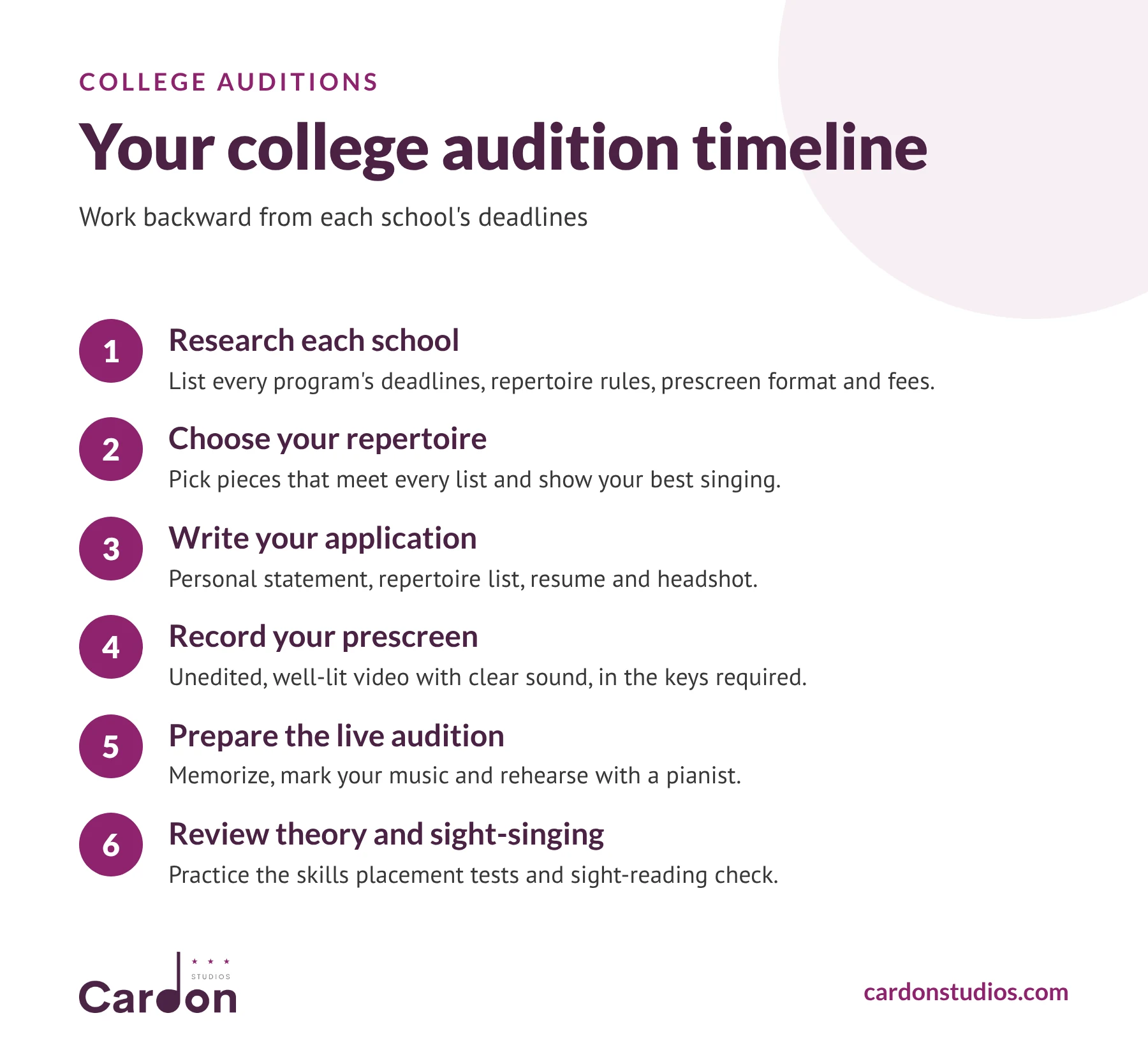
A simple spreadsheet works well. Give each school a row and add columns for the application deadline, prescreen deadline and format, required repertoire, languages, whether you need to memorize, application and audition fees, and whether a pianist is provided. When you can see everything side by side, you can choose pieces that satisfy several schools at once.
Fees deserve their own column. Check whether a school charges an audition fee in addition to the application fee, and whether you need to arrange and pay for your own pianist for the live audition.
Your application materials
Many applications ask for more than forms. Give yourself time to make each piece reflect you.
Personal statement
Many applications request a personal statement about your goals, background and desire to study music. Writing it is a wonderful exercise for any teen or young adult considering a music major, whether the school requires it or not. Picture where you hope this degree will take you and work backward from that goal. What skills do you hope to learn to help you get there? Why is this school the right fit for that vision? What do you hope to share with the world as a musician and singer, and in what way?
Repertoire list
Whether it’s required or not, a list of songs you have studied or performed, especially those relevant to your major, shows the kind of singer you are and what interests you. List each piece with its title, composer, and the opera, musical or song cycle it comes from. Group the list by language or style so faculty can read it at a glance, and include only pieces you could sing well if asked.
Resume and headshot
A one-page performance resume lists your training, ensembles, roles, recitals and other musical experience. A clear, current headshot helps faculty remember you. Even when they’re optional, these materials are never a bad idea to include.
How to record a prescreen audition
A prescreen audition is a recorded first round. Faculty watch it to decide whom to invite to a live audition, so it deserves the same care as a performance. Not all schools require prescreen recordings, but if they do, read the requirements carefully. Schools often require that recordings not be edited and that songs be sung in their original keys, and some set rules about live or recorded accompaniment or how you film. James Madison University, for example, asks graduate voice applicants for unedited video shot with a single camera angle and good-quality sound.
These habits help any prescreen:
- Follow the format exactly. Check the file type, whether each song needs its own file, how to slate (introduce yourself and your pieces), and where to upload.
- Check the accompaniment rules. Some schools want a live pianist and don’t allow recorded tracks. Rehearse with your pianist before recording day.
- Get the sound right first. Record in a quiet room without echo, and set the microphone or phone so your loudest notes don’t distort. Our guide to better audio for online singing covers microphone placement and room setup.
- Frame and light yourself simply. Use a steady camera at about eye level, light from the front, and a plain background, with your whole upper body in the frame.
- Record several takes. Because you can’t edit within a song, plan time for a few complete takes and pick the best one.
Watch your takes back with fresh ears before you submit. Our guide to the benefits of recording yourself explains how to listen back usefully and what to listen for.
Choosing your audition repertoire
At the undergraduate level, live auditions generally ask for two to four songs, and graduate auditions ask for more. Most programs want contrasting selections. For musical theatre majors that’s often an uptempo song and a ballad; for voice performance majors, it’s usually songs from different musical periods or in different moods. Classical programs commonly ask for a variety of languages, most often Italian, French or German in addition to English.
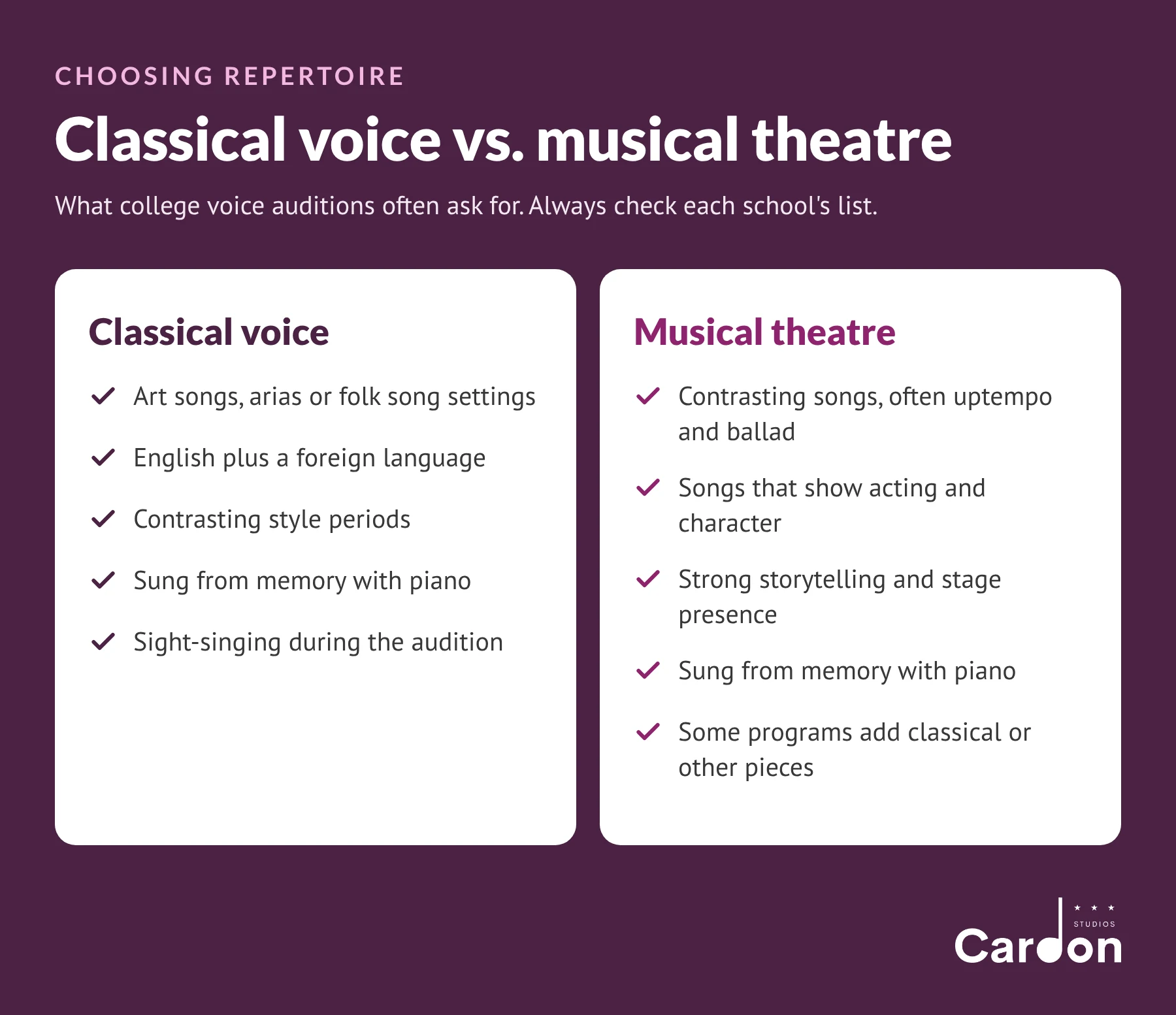
Here is how three schools described their undergraduate voice repertoire on their own audition pages when we checked them in November 2026. Requirements change, so always confirm on the school’s site.
| School | Undergraduate voice repertoire | Also at the audition |
|---|---|---|
| DePaul University | Prescreen: two songs, one in English and one in a foreign language. Live: three selections, one in English and two in foreign languages. | Sight-singing and aural skills |
| James Madison University | Two solo selections, one in English and one classical selection in another language, from memory with piano. | Sight-reading and a short interview |
| University of Northern Colorado | Two classical pieces from memory, contrasting songs in two languages preferred. | Sight-singing |
Within those rules, choose songs that show your voice at its best today, not the hardest pieces you know. Faculty listen for healthy technique, musicality, good diction and real communication of the text. A piece that sits comfortably in your range and that you can sing well even on a nervous day is worth more than an impressive aria you only manage on a good one. Our guides to picking an audition song and voice types can help you narrow the list.
Learn every required piece completely from memory, and keep it there through months of applications. Our guide on how to memorize a song shows how to make it stick.
The live audition: what happens in the room
A live audition is usually short and focused. You walk in, introduce yourself and your first piece, sing for a panel of faculty, and may be asked for a second piece, a sight-singing exercise or a few questions about your goals. Some schools provide a collaborative pianist and allow no rehearsal time, so your music must be clear. JMU, for example, asks singers to have all music in the right key with any changes marked.
From what you decide to wear on audition day to how you introduce yourself as you walk into the room, the smallest details help build the overall picture of who you are and how seriously you take your future. Practice your introduction out loud: your name, then the title and composer of your first piece, said warmly and clearly.
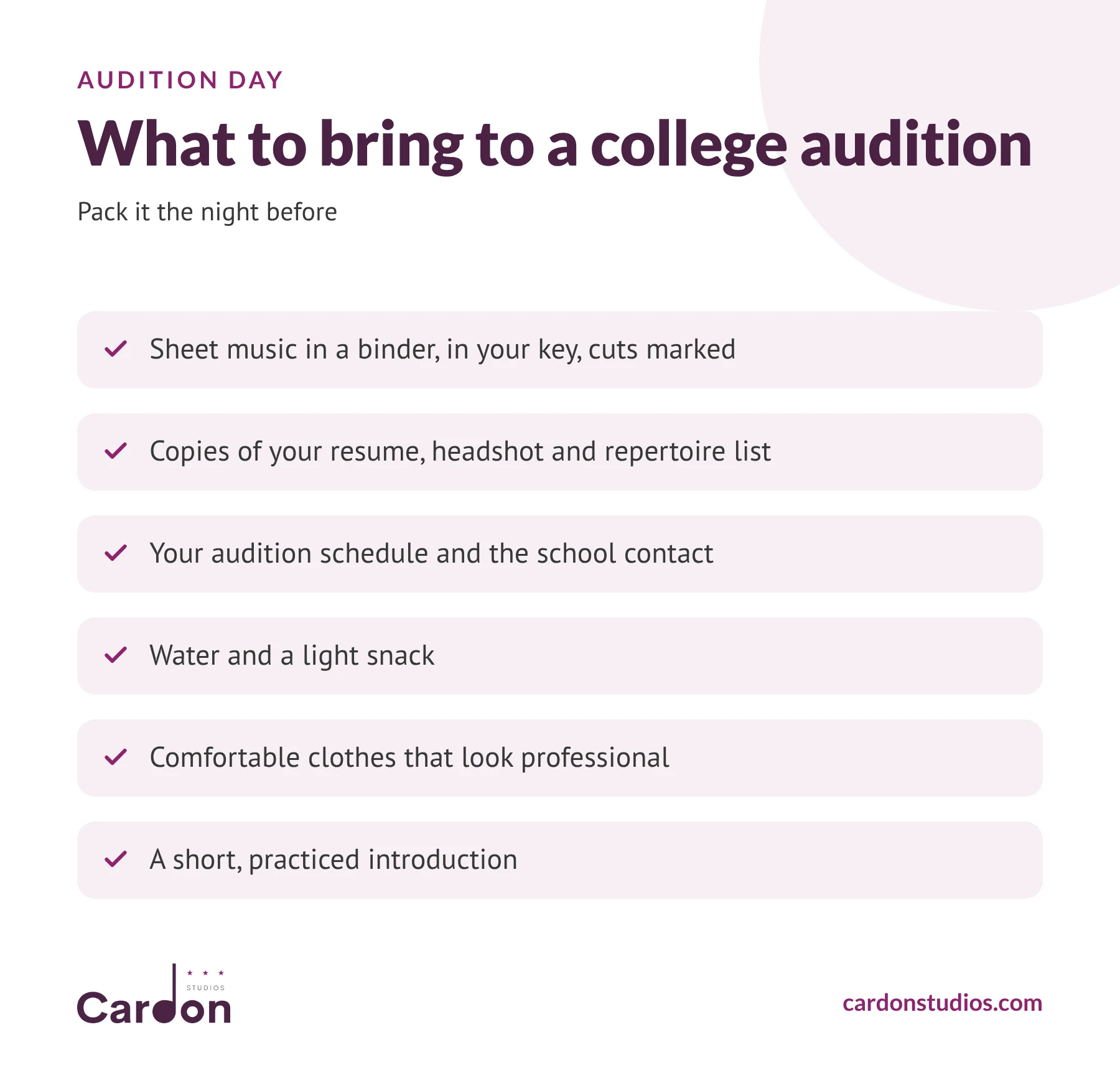
A few habits make the room feel easier:
- Prepare your music for the pianist. Use clean copies in a binder, in your key, with cuts, repeats, breaths and tempo changes clearly marked. Tell the pianist your tempo by singing a line or two.
- Warm up before you arrive. You may not get a warm-up room, so sing through a gentle routine earlier in the day. Our guide to warming up your voice has ideas.
- Bring your performance skills. Faculty watch how you communicate the story and emotion of a song, not only how you sound. Acting and stage presence count.
- Handle mistakes calmly. If you slip, keep going. Recovering gracefully shows the poise teachers look for.
Nerves are normal on audition day. Our guides to conquering stage fright and preparing for a performance cover ways to stay steady.
Listen to your voice
Audition season often means extra practice, travel and dry hotel air, all while you need your best voice. The NIDCD recommends staying hydrated, taking vocal naps through the day and using a humidifier, especially in winter or dry climates. Stop practicing if anything hurts, and see a doctor if your voice has been hoarse for more than three weeks. For everyday care, see our guide to vocal health for singers.
Music theory placement tests and sight-singing
Many music programs also check your musicianship. These checks take different forms:
- Sight-singing. You sing a short melody you haven’t seen before, sometimes with solfege and sometimes on a neutral syllable. Several schools build it into the audition itself.
- A music theory placement test. A written or online exam on topics such as reading notes in treble and bass clef, key signatures, scales, intervals, chords and basic harmony.
- Aural skills. Identifying intervals, chords or rhythms by ear, or singing back a pattern the examiner plays.
Sometimes these tests aren’t given until you’ve been admitted. In that case, they’re used as placement tests to decide which courses you start with, so they don’t affect admission, but strong results can save you a semester of review. Ask each school when its exams happen and what they cover.
The best preparation is steady, daily work. Sight-read a few short melodies each day, starting simple, and review one theory topic a week. Our guides to sight-singing and musicianship for singers are good places to start.
A practice plan for the months before
Preparing for all of this may seem like a lot, but careful planning makes it manageable. Here is one way to spread the work across the months before your first deadline:
| When | Focus | Done when |
|---|---|---|
| Six months or more ahead | Research schools, build your requirements list, choose repertoire with your teacher | Every piece is chosen and fits every school’s list |
| Four to five months ahead | Learn notes, rhythms, translations and diction; begin memorizing; draft your personal statement | Each piece is memorized and you can explain what every line means |
| Three months ahead | Rehearse with a pianist, record practice run-throughs, finish your resume and repertoire list | Practice recordings sound like performances |
| Two months ahead | Record and submit prescreens, keep up daily sight-singing and theory review | Prescreens are uploaded before each deadline |
| The final weeks | Mock auditions for family, friends or teachers; practice your introduction; plan travel | You can sing your whole set calmly for a small audience |
Be thorough and take your time as you gather your materials and practice your music. Your attention to detail will be appreciated, and it will help you feel confident and proud of your audition package whatever the result.
After the audition
As a prospective music major, you’re being compared with many other talented singers from across the country and sometimes the world, and competition for college programs can be fierce. Even if you don’t gain acceptance into all of your chosen schools, remember that sometimes there just isn’t room for everyone who is qualified. Not receiving an invitation to enroll doesn’t necessarily reflect your ability or potential.
You may be able to re-audition the next year or transfer in later from a less competitive school. Write down what went well and what you’d change after each audition, while it’s fresh, and use it to make the next one stronger. Keep singing, keep learning and never give up on your dreams. We wish you the best this audition season.
From the studio
Care for some backup as you prepare? Cardon Studios teachers know what university and conservatory auditions involve. In live, one-on-one online voice lessons, your teacher can help you choose repertoire that suits your voice, polish diction and technique, and run mock auditions. Between lessons, you can send a video of a practice run for feedback within 72 hours, and you can rewatch your lesson recordings as you practice. Learn more about membership here.
Online voice lessons
Walk into your audition ready
One monthly membership includes four private online voice lessons, one video coaching submission, the Learning Library, and member online events, with a teacher matched to your style, goals, age, and schedule.
Common questions about college voice auditions
How many songs do I need for a college voice audition?
Undergraduate auditions generally ask for two to four contrasting pieces, and graduate auditions ask for more. The exact number, languages and styles vary by school, so check each program’s audition page and choose pieces that meet every list on yours.
What is a prescreen audition?
A prescreen is a recorded first round. You submit video of required pieces, and faculty use it to decide whom to invite to a live audition. Follow the school’s format exactly, since many ask for unedited recordings with clear sound.
What are good college audition songs?
Good choices meet the school’s requirements, sit comfortably in your range and show your voice at its best today. Pick contrasting pieces, such as different languages or periods for classical voice, or an uptempo song and a ballad for musical theatre, and work with a teacher on the final list.
What is on a music theory placement test?
Placement tests usually cover reading treble and bass clef, key signatures, scales, intervals, chords and basic harmony, and some add ear training. Many schools use the results to place you in the right first-year courses, so ask each school what its test covers.
Will I have to sight-sing at my audition?
Many schools include sight-singing or sight-reading in the voice audition, sometimes with solfege. Practice a few short, unfamiliar melodies every day in the months before, starting simple and adding challenge as you improve.
What if I don’t get into the school I want?
Competition is strong, and a rejection doesn’t necessarily reflect your ability or potential. You may be able to re-audition the next year or transfer later from another school, and each audition teaches you something for the next one.