


Music theory for singers comes down to a handful of practical skills: speaking the band’s language, keeping steady rhythm, knowing the form of your song, and knowing which keys suit your range. You don’t need a degree or a second instrument to learn them, and they make you far easier to work with in any band, choir or audition room.
Singers, let’s face some ugly truths. Within the music industry, singers get a bad rap. Too many beautiful voices are running amok without realizing the musical errors they’re making, and how hard those errors make them to work with. Singers who get ahead are often the ones who make their bandmates’ jobs easier: friendly and professional, yes, but also on the same page musically. This guide shows you what to learn and how to practice it.
Key takeaways
- Musicianship is your ability to understand and communicate about music, not just to sing it beautifully.
- Learn the basic terms your bandmates use, such as beat, bar, time signature, key and bridge, so rehearsals move quickly.
- Lock your rhythm into the drums and bass, and map the form of every song before the first rehearsal.
- Know your comfortable range so you can judge whether a new key will work for your voice.
What musicianship means for singers
Musicianship is the set of skills that lets you understand music and work with other musicians: hearing what is going on around you, knowing how a song is built, and being able to talk about it clearly. A beautiful voice is your instrument. Musicianship is how well you play it with others.
Instrumentalists usually learn these skills early, because they read parts, count rests and play in ensembles from the start. Many singers learn by ear and by imitation instead, which is a wonderful way to learn melodies but can leave gaps. Those gaps show up the moment you step into a rehearsal with a band, a pianist or a choir director who expects you to follow along.
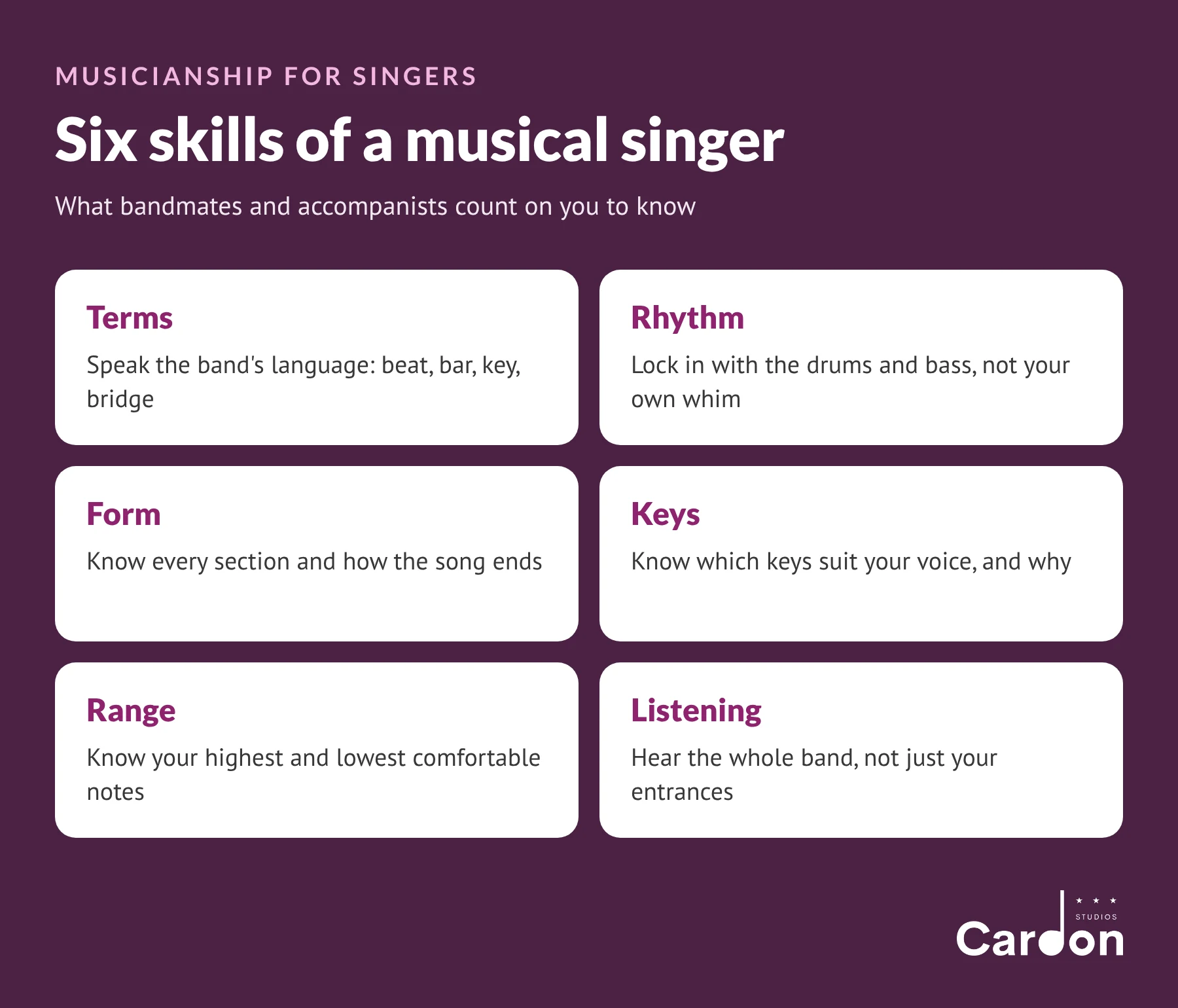
The good news is that the musicianship skills singers need most are practical and learnable. You don’t have to master harmony textbooks. You need to know the terms, keep the beat, know your song inside out and understand your own voice well enough to make good decisions about keys.
Why music theory matters for singers
When you keep in mind that singers are often called on to be the band leader, music theory for singers becomes doubly important. The singer is usually the one who counts off the song, chooses the key, decides how many times the chorus repeats and signals the ending. If you can’t communicate those choices clearly, the band has to guess, and guessing wastes rehearsal time.
Theory also protects your voice. A guitarist who plays in an awkward key is inconvenienced. A singer in the wrong key can be completely derailed, or strain to reach notes that sit outside a comfortable range. Knowing the basics lets you speak up for your voice with confidence instead of hoping the next run-through feels better.
Finally, theory helps you learn songs faster. Once you can see the form of a song and hear how the melody relates to the key, you memorize with understanding rather than by rote. Our guide on how to memorize a song builds on exactly this idea.
Music theory terminology every singer should know
If someone says you’re singing in 4 but they want a cut-time feel, you’ve got to adapt. Mixing up similar terms like “beat” and “rhythm” can call your meaning into question, too. Here is the core vocabulary, in plain words. Some of it varies from genre to genre, and it’s your job to know the lingo for whatever space you happen to be working in.
| Term | What it means | Why a singer needs it |
|---|---|---|
| Beat | The steady pulse you would tap your foot to. | Everyone in the band shares it. You stay with it, not ahead or behind. |
| Rhythm | The pattern of long and short sounds, including your melody’s. | Your rhythm sits on top of the beat. They are not the same thing. |
| Tempo | How fast the beat goes. | You often set it when you count the song in. |
| Bar (measure) | A group of beats, marked off in written music. | Bands count intros, solos and endings in bars. |
| Time signature | How many beats are in each bar and which note gets the beat. | It tells you how to count, for example in 4 or in 3. |
| Key | The home note and scale a song is built on. | It decides how high or low the song sits in your voice. |
| Transpose | Move the whole song higher or lower into a new key. | It’s how a song is fitted to your range. |
| Verse, chorus, bridge | The sections of a song. | They’re how everyone talks about where you are in the song. |
Time signatures are a common source of confusion. The most common ones include 4/4, also called common time, and 2/2, also called cut time, as well as 2/4, 3/4 and 6/8 (LibreTexts, Time Signature). In cut time, the music feels like two big beats per bar instead of four, so a song can feel faster and lighter even when the written notes look the same. If a bandmate asks for a cut-time feel, they usually mean exactly that: think in two.
Rhythm: lock in with the rhythm section
Singers, regrettably, are often stereotyped as not having a very strong sense of rhythm, forcing their accompanying musicians to follow their whims instead of staying true to the rhythm of the song. You can break that stereotype with one habit: when preparing your song, listen to the ensemble from the bottom up, starting with the rhythm section. If your vocals are always locked into the drums and bass, you’ll always be with everyone else.
Musicians tend to listen to the complete fabric of the song, whereas singers often listen lazily and only tune in to the other instruments when they’re waiting for an entrance. Avoid this habit. The more of the band you hear, the more musical your phrasing becomes.
How to count beats in music
Counting is the most useful rhythm skill a singer can learn. Try this with any recording you know well:
- Find the pulse. Tap your foot along with the drums or the bass for a full verse, without singing.
- Find beat one. Listen for the strongest beat, often where the kick drum or a chord change lands. Say “one” there.
- Count the bar. Count out loud, “one, two, three, four,” over and over. If “one” keeps landing on the strong beat, the song is in 4. If it only works as “one, two, three,” it’s in 3.
- Sing over the count. Sing the first phrase quietly while someone else counts, or while you tap. Notice which beat you start on. Many phrases start just before or just after beat one.
- Count the intro. Count how many bars play before you come in. Write the number down.
Do this with three or four songs from your set. Stay relaxed and keep your voice easy, since the goal here is the count, not the high notes.
Musical form: map your song
How many verses does your song have? Is there a bridge? Does the chorus repeat at the end, with variations, or do you sing it straight? Does anyone take a solo? Some of these elements are more common in some genres than others, but understanding the form of your song will help you memorize it more effectively and talk about it with others more efficiently.
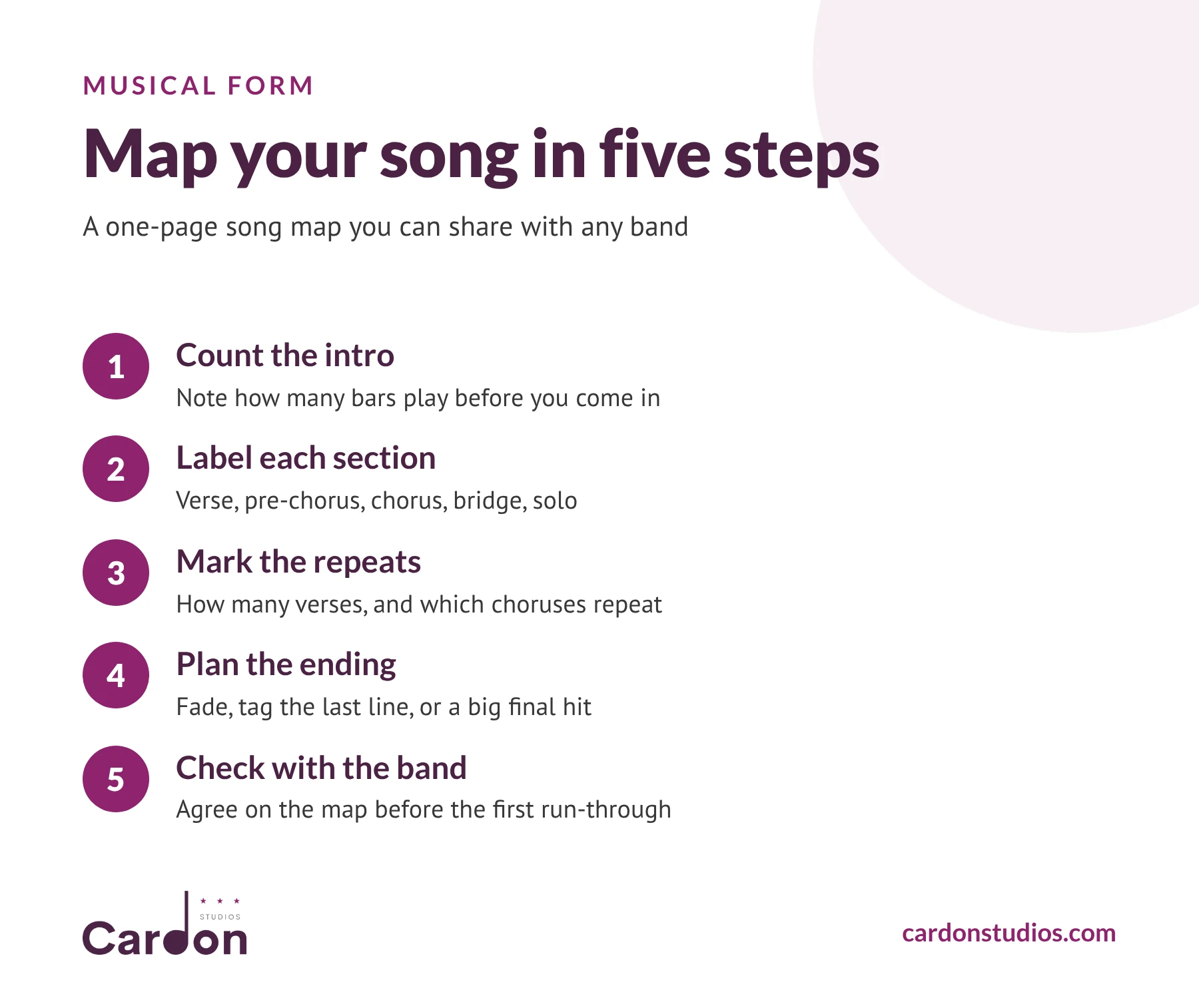
A song map is a simple written outline, one line per section. For example: “Intro 4 bars. Verse 1. Chorus. Verse 2. Chorus. Bridge. Guitar solo 8 bars. Chorus twice. Tag the last line, end on a held note.” Bring copies for the band, or share it before rehearsal. When everyone works from the same map, nobody gets lost and nobody has to guess where the ending is.
Pay special attention to endings. Fades, repeated tags and big final hits all need a clear signal from you, often a look, a nod or a raised hand. Agree on that signal in rehearsal rather than on stage. For more on planning a performance from start to finish, see our performance preparation guide.
Musical keys and your range
While knowledge of another instrument isn’t necessary for your success, you do need to know the extent of your own instrument, the voice. That means your vocal range and where your register shifts happen. This basic information tells you whether a particular key will work for your voice. If you’re not sure of your voice type yet, our guide to voice types and ranges shows you how to find your range at home, and finding your mixed voice explains those register shifts.
Changing the key of a piece is called transposing it, and it’s done by moving every note up or down by the same interval, often to make music more singable or playable (LibreTexts, Transposition). The same source notes that instrumentalists also have preferences: string players often find sharp keys easier, while many wind and brass players prefer flat keys.
That’s why key discussions can get tense. If someone suggests a new key that’s easier to play on guitar, you need to know whether that change will throw off your voice within the song. As a rule of thumb, the singer should get the final say on questions like this. A guitarist will be inconvenienced by a bad key, but a singer can be completely derailed, or pushed toward strain.
How to find the key of a song by ear
You don’t need perfect pitch to find a song’s home note. Play the recording and hum along until you find the note that sounds most “at rest,” the one the song keeps coming back to and usually ends on. That note is the tonic, and it names the key. Check it on a piano or a tuner app, and write it down with your starting note.
If the band changes the key, your ear needs to follow. If you can’t find your starting note in the new key, it wastes everyone’s time and makes you look unprepared, especially when knowing a few basic tonal relationships could easily solve the problem. A simple fix: ask the keyboard player or guitarist to play your starting note, then the tonic, and sing from there.
Show up prepared: a rehearsal checklist
In the end, musicianship is really about showing up prepared for a rehearsal, audition or gig. Surface knowledge of your song is a good start, but working together with other musicians requires a deeper understanding. Do your homework before the first run-through.
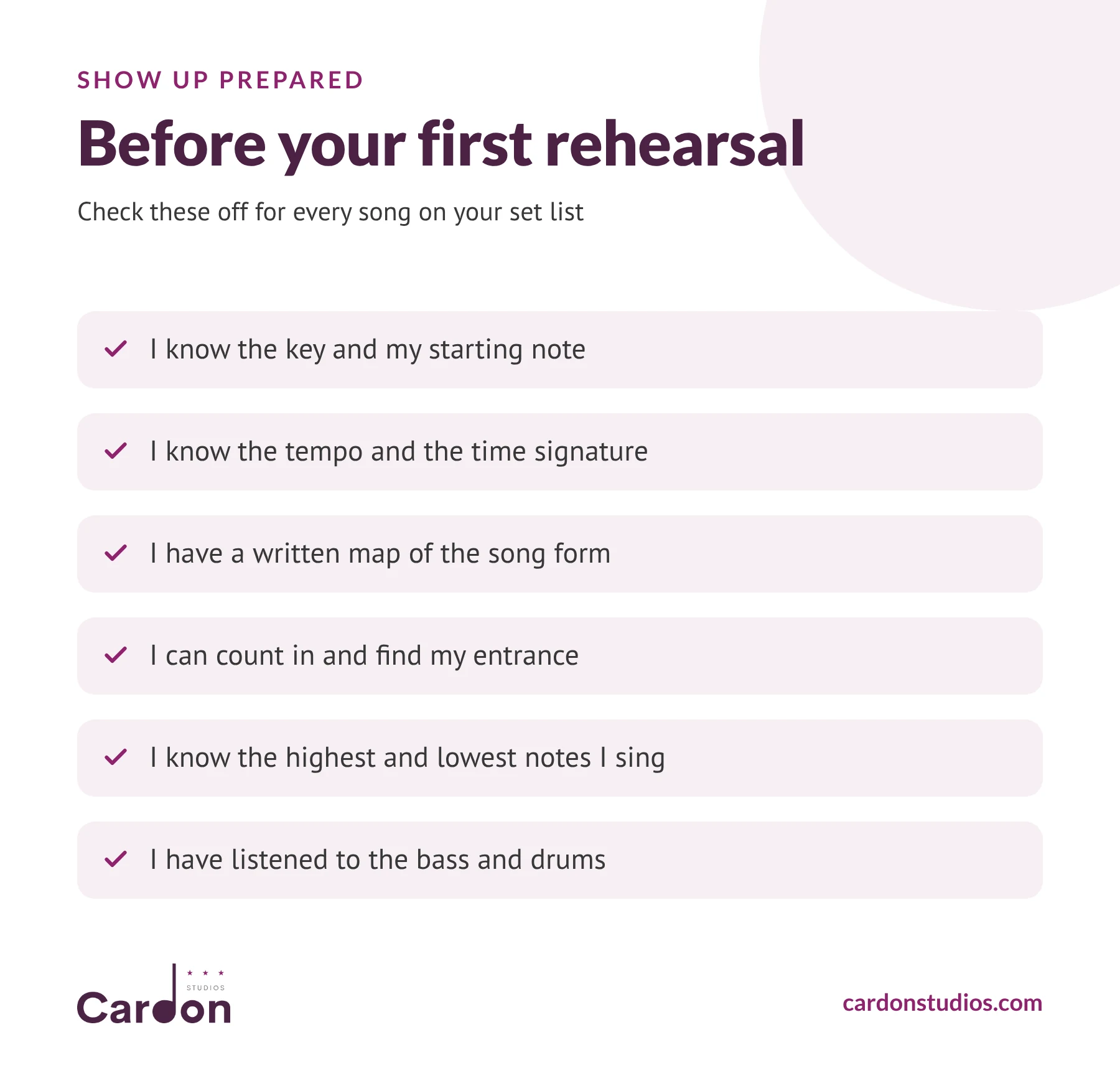
Bring your song map, a note of the key and tempo, and any written music you have. If you’re auditioning with a pianist, mark the tempo and any cuts clearly on your music, and be ready to describe the feel in a word or two. Our guide to picking an audition song covers what to bring. For band work, the gig guide and our article on musical collaboration go further.
Sing in a choir? The same habits apply: know the form, count your rests and keep listening to the other parts. Put these skills to work with how to hold your harmony part in a choir.
How to build your musicianship skills
Musicianship grows with steady, focused practice, the same way your vocal technique does. Work on one skill at a time and use the songs you’re already learning. Here is a simple four-week plan you can repeat with new songs.
| Week | Focus | What to do |
|---|---|---|
| 1 | Terms and counting | Learn the terms in the table above. Count the beat and the bars of two songs out loud each practice session. |
| 2 | Form | Write a one-page song map for every song on your list. Check each map against the recording. |
| 3 | Keys and range | Find the home note and your starting note for each song. Note your highest and lowest notes in each one. |
| 4 | Listening | Listen to each song three times: once for the bass, once for the drums, once for the chords. Then sing along and stay locked in. |
Record yourself singing with a backing track or the band, then listen back for timing. Are you rushing the ends of phrases, or coming in late after a breath? Our guide on how to record yourself singing shows you how. For more ways to structure focused sessions, read deliberate practice for singers and how to practice singing between lessons.
Help break the stereotype of the “unmusical” singer and elevate yourself in the process. Every term you learn and every song you map makes the next rehearsal easier.
Listen to your voice
A key that’s too high or too low can push you toward strain. If singing in a key feels tight, painful or tiring, stop, rest and ask for a different key. The National Institute on Deafness and Other Communication Disorders advises drinking plenty of water and resting your voice when it’s hoarse or tired, and recommends seeing a doctor if your voice has been hoarse for more than three weeks. For everyday care, see our guide to vocal health for singers.
From the studio
Your teacher can help you find your range, choose keys that suit your voice and practice counting, form and entrances with the songs you’re working on. In live, one-on-one online voice lessons, you work on these skills together, and between lessons you can send a video for personalized feedback within two business days. Learn more about membership here.
Online voice lessons
Become the singer bands want to hire
One monthly membership includes four private online voice lessons, one video coaching submission, the Learning Library, and member online events, with a teacher matched to your style, goals, age, and schedule.
Common questions about music theory for singers
What is musicianship?
Musicianship is your ability to understand music and work with other musicians: keeping the beat, knowing the form of a song, understanding keys and talking about music clearly. For singers, it’s what turns a good voice into a reliable bandmate.
Do singers need to learn music theory?
You can sing well without formal training, but basic music theory makes you faster to learn songs and easier to work with. The essentials for singers are the core terms, counting, song form, and keys in relation to your range.
Why is music theory important for singers?
It lets you communicate with accompanists and bands, choose keys that suit your voice, and follow changes in rehearsal without getting lost. It also helps you memorize songs with understanding instead of by rote.
How long does it take to learn music theory?
It depends on how deep you go and how often you practice. The practical basics in this guide can become habits within a few weeks of steady practice if you apply them to the songs you’re already singing. Deeper theory, such as harmony and reading complex scores, takes longer.
Do I need to play an instrument to learn music theory?
No. Knowledge of another instrument isn’t necessary, although a keyboard or a pitch app is handy for checking notes. Your own voice and ears, plus counting and song maps, cover most of what singers need.