

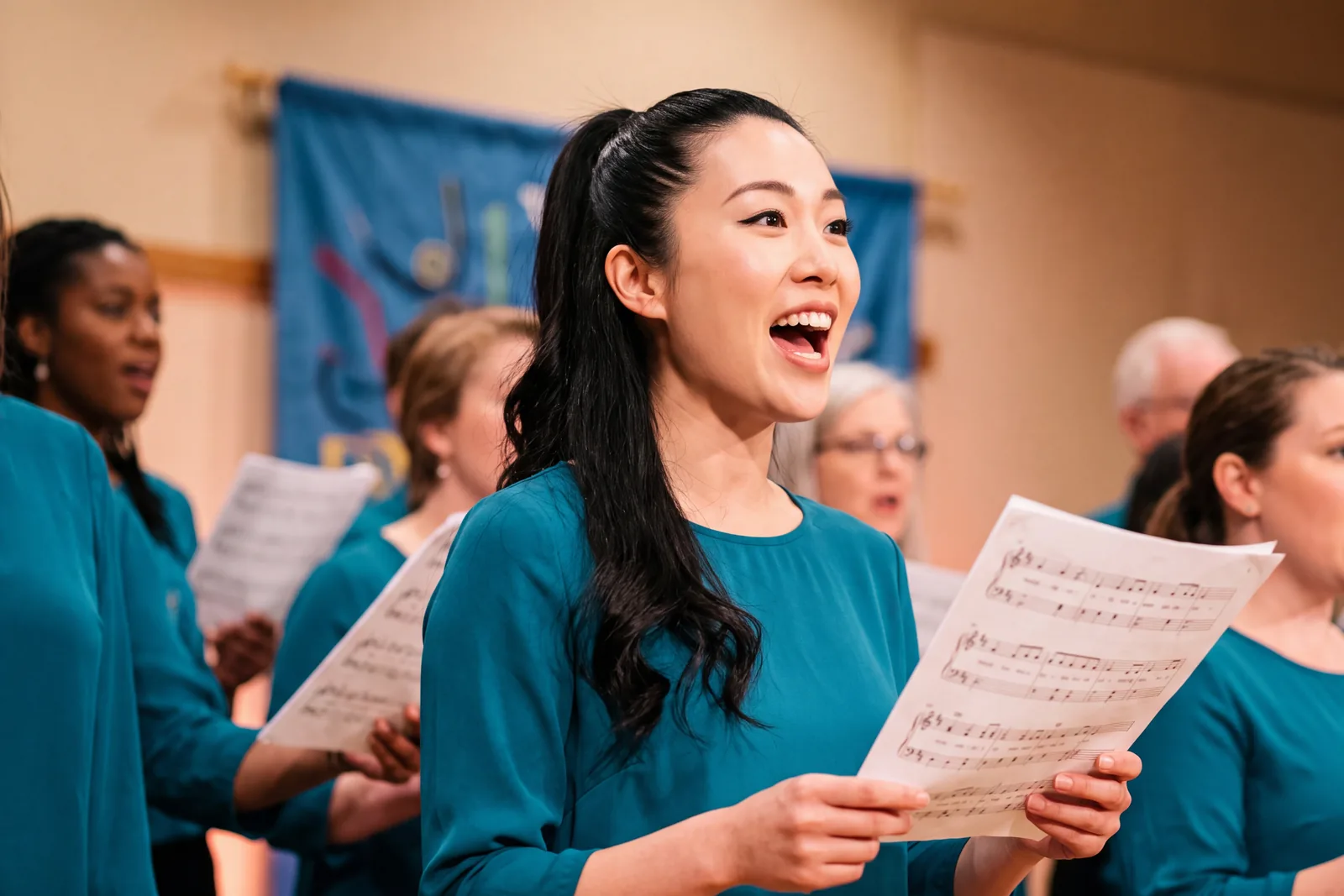
Sight singing is singing written music at first sight, without hearing it played first. To sight sing, find do from the key signature, sing the scale and tonic triad to set the key in your ear, find your starting note, read the rhythm, then sing slowly on solfège without stopping. Short daily sight singing exercises build the skill fastest.
Sight singing is one of the most useful skills a choir singer can build: you learn new music faster, hold your part with more confidence, and walk into auditions ready for the sight-reading test. The good news is that sight singing is a learnable skill, not a talent you either have or don’t, and a few minutes of daily practice makes a real difference.
Key takeaways
- Sight singing uses relative pitch: you find each note by its relationship to the key, not by memorizing exact pitches.
- Solfège with a movable do (do, re, mi, fa, sol, la, ti) is the most common system for learning it.
- Scan the music before you sing: key, time signature, starting note, rhythm and tricky leaps.
- Short daily practice beats long occasional sessions. Read one new short melody every day.
What is sight singing?
Sight singing means reading written music and singing it accurately the first time you see it. You work out the pitches from the notation, keep the rhythm steady, and keep going even when you’re not certain of every note. Instrumentalists call the same skill sight reading; for singers it’s harder in one way, because there’s no key to press. You have to hear each pitch in your head before you sing it.
That inner hearing is built on relative pitch: knowing how far one note is from another, and how each note relates to the home note of the key. You don’t need perfect pitch to sight sing well. Most fluent sight singers don’t have it.
Sight reading for choir: why it matters
- You learn music faster. Instead of waiting for your part to be played over and over, you can read it yourself, so rehearsal time goes to blend, phrasing and expression.
- You hold your part. When you can see that your line moves down a step while the sopranos leap, you’re less likely to drift toward the melody. Our guide to holding your harmony part builds on this.
- You’re ready for auditions. Many school, community and honor choir auditions include a short sight-reading exercise, so practice pays off on audition day.
- You become more independent. Reading well lets you prepare between rehearsals and sing with confidence in smaller groups.
Sight singing methods: solfège and movable do
Most choirs teach sight singing with solfège, the syllables do, re, mi, fa, sol, la and ti. The system goes back to Guido of Arezzo, an 11th-century monk who took the syllables from the opening notes of the lines of a Latin hymn, as Encyclopaedia Britannica explains.
Choirs in the United States usually use movable do: do is always the first note of the major scale, whatever the key. In C major, do is C; in G major, do is G. Because the syllables describe each note’s job in the key rather than its letter name, the same patterns feel the same in every key. Sol to do always sounds like coming home, whether it’s G to C or D to G. (Some countries use fixed do, where do is always C.)
A few more tools you’ll meet:
- Hand signs. Many teachers pair each syllable with a hand shape, often called Curwen or Kodály hand signs, so you can feel the height of each note.
- Minor keys. Some choirs call the home note of a minor key la; others keep do as the home note and change the syllables. Ask which your director uses.
- Numbers. Some singers use scale-degree numbers (1 to 7) instead of syllables. Either works; consistency matters more than the system.
Before you sing: scan the music
Good sight singers spend the first few seconds looking, not singing. A quick scan catches most of the problems before they happen.
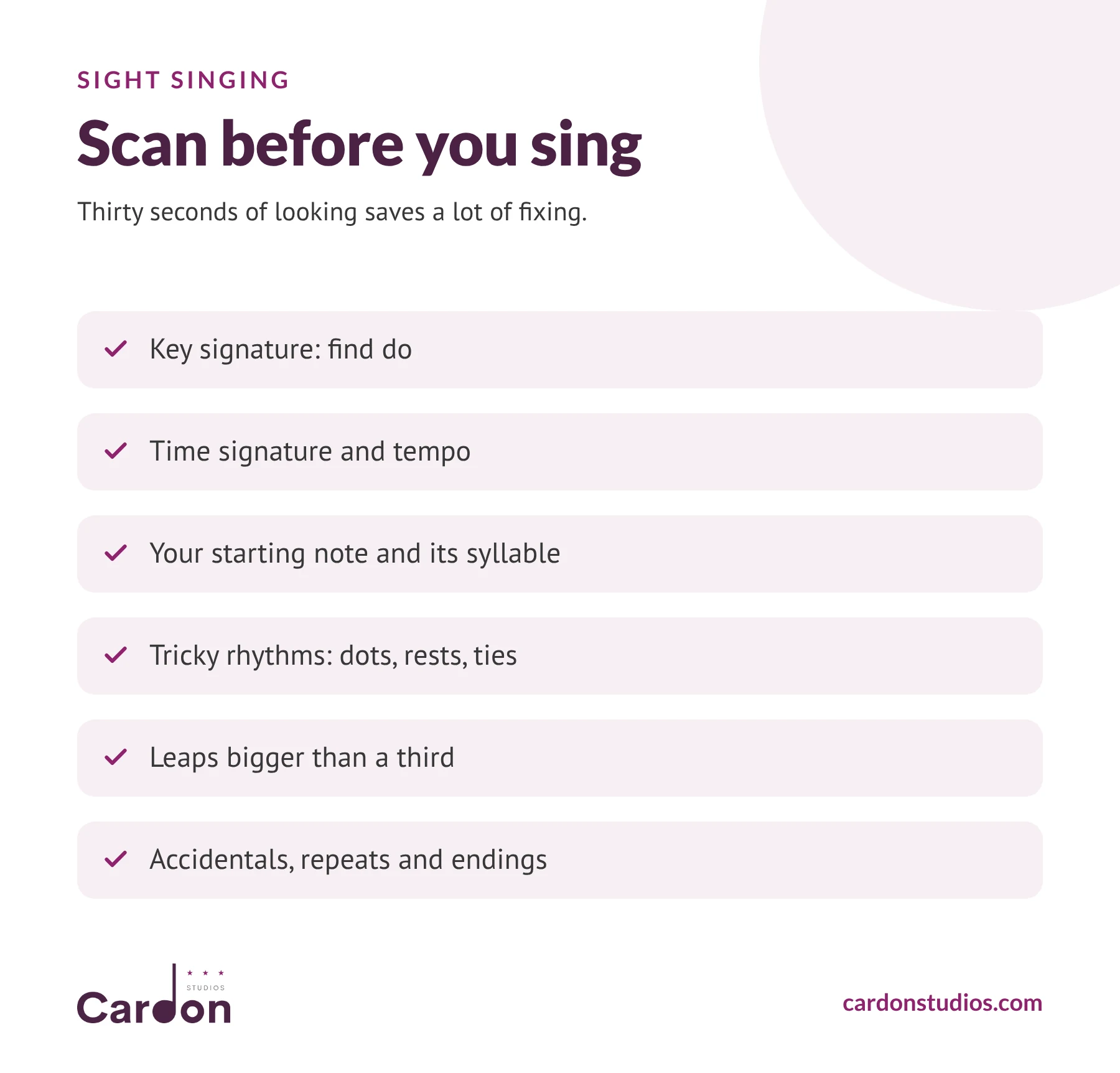
- Key signature: count the sharps or flats and find do.
- Time signature and tempo: how many beats in a bar, which note gets the beat, and how fast.
- Your starting note: what syllable it is, and how it relates to do.
- Rhythm: dotted notes, rests, ties and syncopation.
- Leaps: any jump bigger than a third. Name the interval before you get there.
- Accidentals, repeats and endings: sharps, flats or naturals added mid-line, and where the music goes back.
How to sight sing, step by step
Once you’ve scanned the music, these six steps take you from the key signature to a finished phrase.
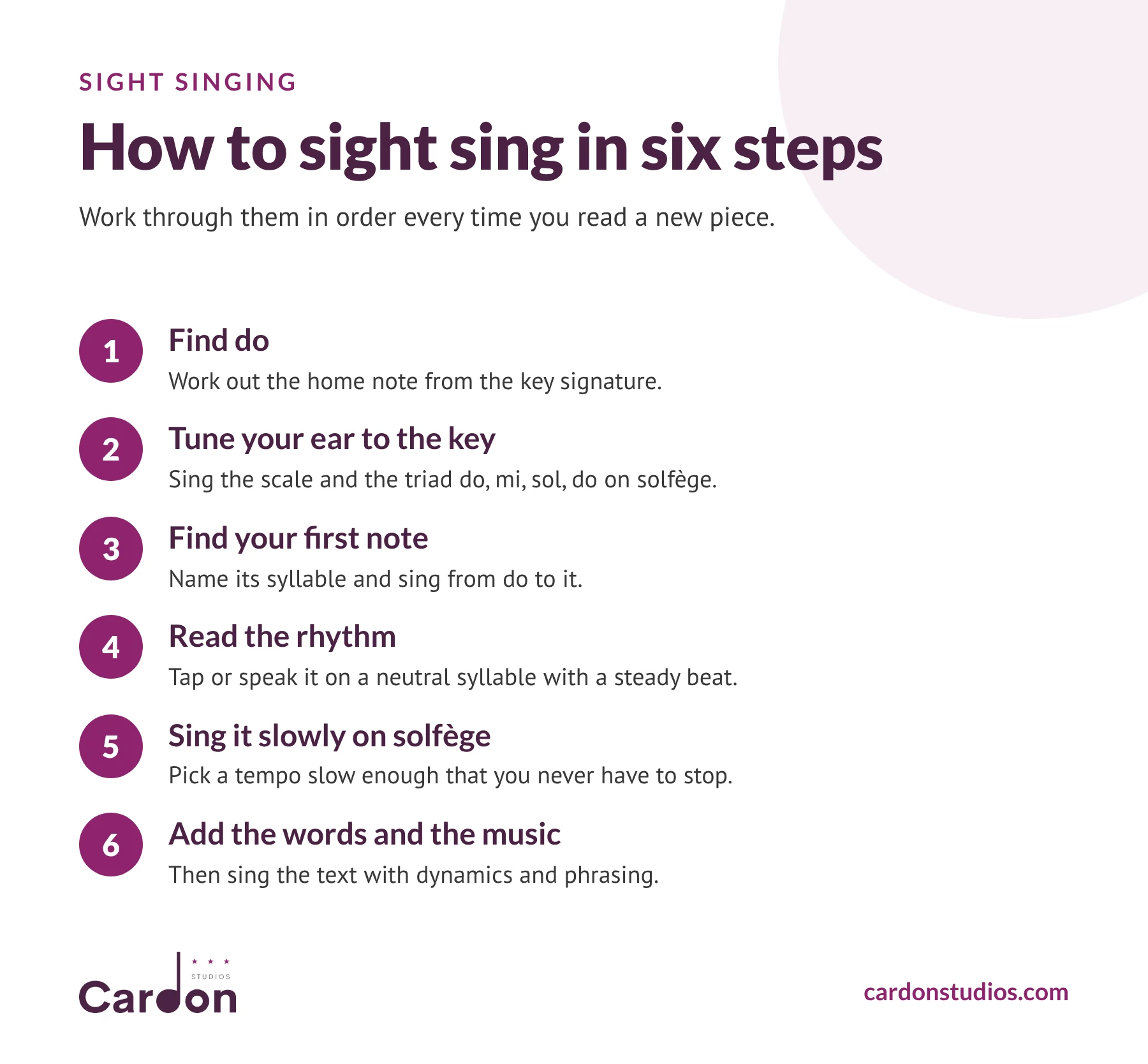
- Find do. From the key signature, work out the home note. In a sharp key, do is a half step above the last sharp; in a flat key with two or more flats, do is the second-to-last flat.
- Tune your ear to the key. Sing the scale and the tonic triad (do, mi, sol, do) on solfège so the key is in your ear before you start.
- Find your first note. Work out its syllable and sing from do to it, so you start in the right place.
- Read the rhythm. Tap or speak the rhythm on a neutral syllable with a steady beat. Rhythm mistakes cause more breakdowns than pitch mistakes.
- Sing it slowly on solfège. Choose a tempo slow enough that you never have to stop. If you miss a note, keep going and find the next one.
- Add the words and the music. Once the notes and rhythm are secure, sing it on the text with dynamics and phrasing.
Want a teacher’s ear on your voice? Cardon Studios teaches private online voice lessons for singers ages 10 and up, live over Zoom with a teacher matched to your style and goals. See how lessons work
Sight singing exercises
1. Scales and triads on solfège
Sing the major scale up and down on solfège, then the tonic triad (do, mi, sol, do). Then sing do, re, do, mi, do, fa, and so on, returning to do each time. This builds a mental map of every note in relation to home.
2. Interval ladders
Practice the intervals you’ll see most: steps (seconds), thirds, fourths, fifths and octaves. Sing them up and down from do, then from other notes. Some singers remember each interval by the opening of a familiar tune; if that helps you, pick your own reference tunes.
3. Rhythm reading
Count and clap short rhythms from your choir music, or from a rhythm book, without pitch. Keep a steady beat with your foot or a metronome app, and say the counts out loud.
4. One new melody a day
Read one short melody you’ve never heard, every day. Hymnals, folk-song collections and graded sight-singing books are full of them. A graded sight-singing book also makes a useful present for a choir friend; see our guide to gifts for choir members. Choose melodies that feel a little easy, then increase the difficulty slowly.
5. Sing your choir part
Before rehearsal, sight sing your own line from the choir music. Check yourself afterward with a keyboard app or a practice track, and mark any spot you missed so you know what to listen for. If you take online singing lessons, bring those spots to your teacher.
6. Record and check
Record yourself sight singing a melody, then check it against the notes. Listening back shows patterns, such as always going flat on descending leaps, that are hard to notice while you sing.
Sight singing practice: a daily routine
Ten focused minutes a day will move you faster than an hour once a week. This routine fits before homework, after work, or as part of your vocal warm-up.
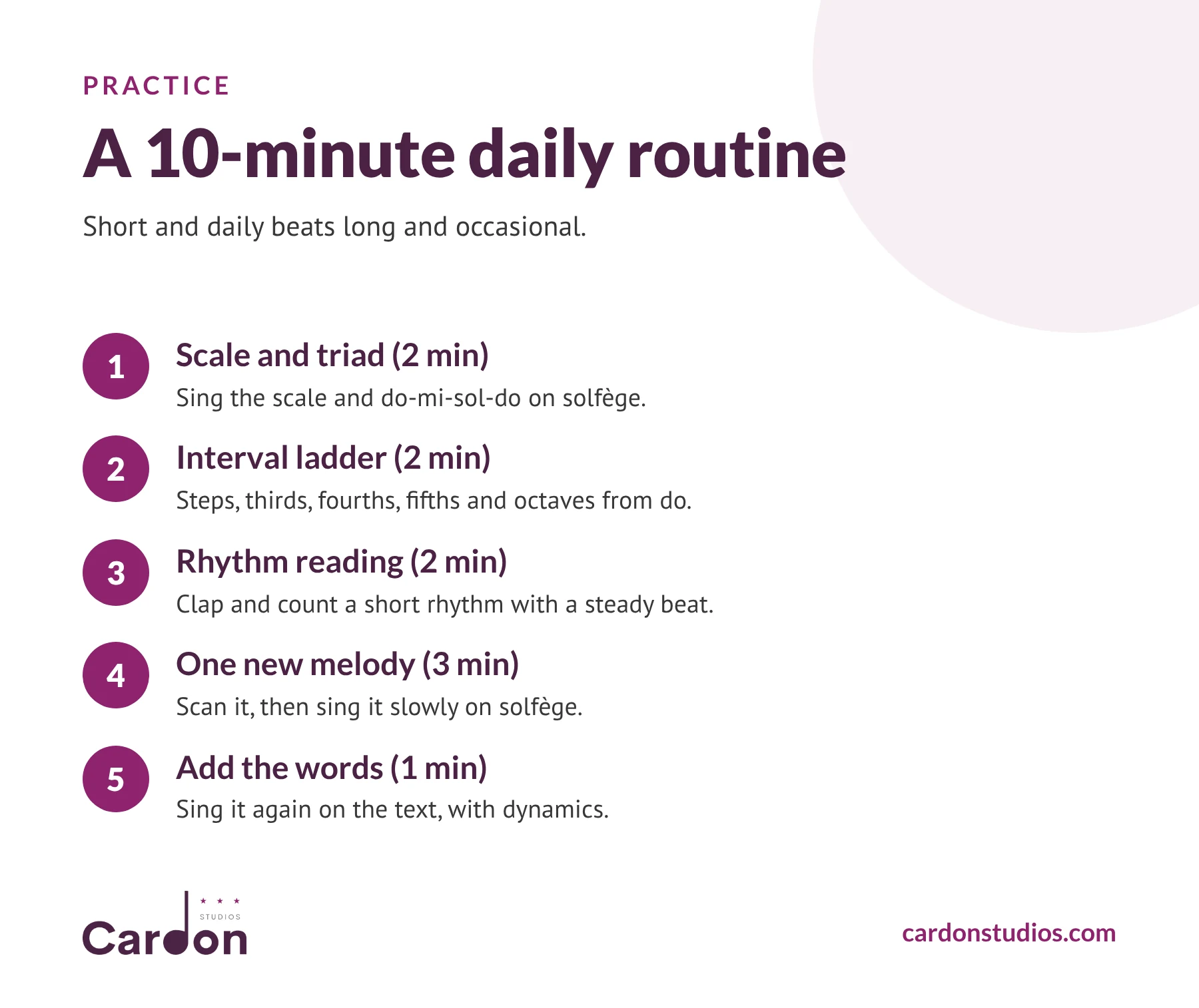
Track what you read in a notebook: the title, the key and anything that tripped you up. Over a few weeks you’ll see which intervals and rhythms still need work. For more on making short practice count, read deliberate practice for singers.
Common sight singing mistakes
- Stopping to fix every note. In a test or rehearsal, keeping the rhythm going matters more than any single pitch. Keep going and recover.
- Starting too fast. Pick a tempo that lets you think ahead to the next beat.
- Skipping the scan. Most errors happen at a key change, an accidental or a leap you didn’t see coming.
- Following your neighbor. Leaning on a stronger reader in your section feels safe but slows your own progress. Practice reading on your own between rehearsals.
- Losing do. When you get lost, go back to the home note in your head and find your place from there.
Sight singing is part of a bigger set of skills that includes rhythm, ear training and theory. Our guide to musicianship for singers covers the basics, and singing in a choir has more tips for choral singers.
From the studio
Sight singing improves fastest with someone listening. In a live online lesson, your teacher can give you new melodies at the right level, catch the intervals you consistently miss, and connect your reading to your choir music. Between lessons, you can send a video of yourself reading a melody and get a personalized response from your teacher within two business days.
Online voice lessons
Read your choir music with confidence
One monthly membership includes four private online voice lessons, one video coaching submission, the Learning Library, and member online events, with a teacher matched to your style, goals, age, and schedule.
Common questions about sight singing
Can anyone learn to sight sing?
Yes. Sight singing is a skill built through regular practice, not a gift. Singers who think of themselves as poor readers usually improve quickly once they practice a little every day with music at the right level.
Do I need perfect pitch to sight sing?
No. Sight singing relies on relative pitch: hearing how each note relates to the key and to the note before it. Most strong sight singers don’t have perfect pitch.
How long does it take to learn to sight sing?
It varies with how often you practice and where you start. With short daily practice, most singers notice they read simple melodies more easily within a few weeks, and keep improving for years.
Is solfège better than numbers for sight singing?
Both work. Solfège with a movable do is the most common system in choirs, so it’s useful to know. What matters most is using one system consistently.
How can I practice sight singing for a choir audition?
Read one new short melody every day at the level of the audition, always scanning the key, time signature and starting note first. Practice keeping going after a mistake, since auditions usually reward recovery and steady rhythm.
Is sight reading for choir the same as sight singing?
Yes. Choir directors often call it sight reading, and it means singing your part from the page without hearing it first. In choir you also have to keep your line while other parts move around you, so practice reading your part alone, then against a recording of the other voices. Our guide to holding your harmony part shows how.
How do I practice solfège on my own?
Sing the major scale and the tonic triad on solfège in a comfortable key, then short patterns that return to do, such as do-re-do and do-mi-sol-mi-do. Add hand signs if they help you feel each note’s height, and move the same patterns to a new key each day so the syllables become your map. A few patterns fit easily into your choir warm-up.