


To sing in tune, you need two skills working together: hearing the pitch clearly in your head, and coordinating your voice to land on it. For most people who sing off pitch, the ear isn’t the problem. Research suggests the more common issue is the link between hearing a note and producing it, which is a skill you can train. Start by matching single notes against a steady reference, slide into pitches until they lock in, record yourself, and keep your breath steady and your body clear of the tension that pulls notes flat or sharp.
Key takeaways
- Most people who sing off pitch can hear pitch differences; the challenge is coordinating the voice.
- Matching single notes, sliding into pitches and singing with a drone build that coordination.
- Tension, tiredness and uneven breath are common reasons singers go flat or sharp.
- Recording yourself shows you what you can’t hear while you sing.
Why people sing off pitch
Many people who think they’re “tone deaf” aren’t. In a well-known 2007 study in Music Perception, Peter Pfordresher and Steven Brown asked participants to listen to short, unfamiliar melodies and sing them back. About 10 to 15 percent were consistently a semitone or more off. Yet those poor-pitch singers could tell pitches apart just as well as good singers. The researchers concluded that the problem was a mismapping between hearing a pitch and producing it with the voice.
That’s encouraging, because coordination can be trained. Singing in tune is a skill built through practice, the same way you learn to throw a ball to a target. Our article from “tone deaf” to talented explains why most people can learn to sing.
Other things can pull you off pitch, too: tension in the throat or jaw, uneven breath, a voice that cracks or strains around a register shift, nerves, tiredness, or simply not hearing the note clearly before you sing it.
Exercises to sing in tune
Practice these a little every day, in a comfortable part of your range. Use a keyboard app, a tuner app or a recorded reference note.
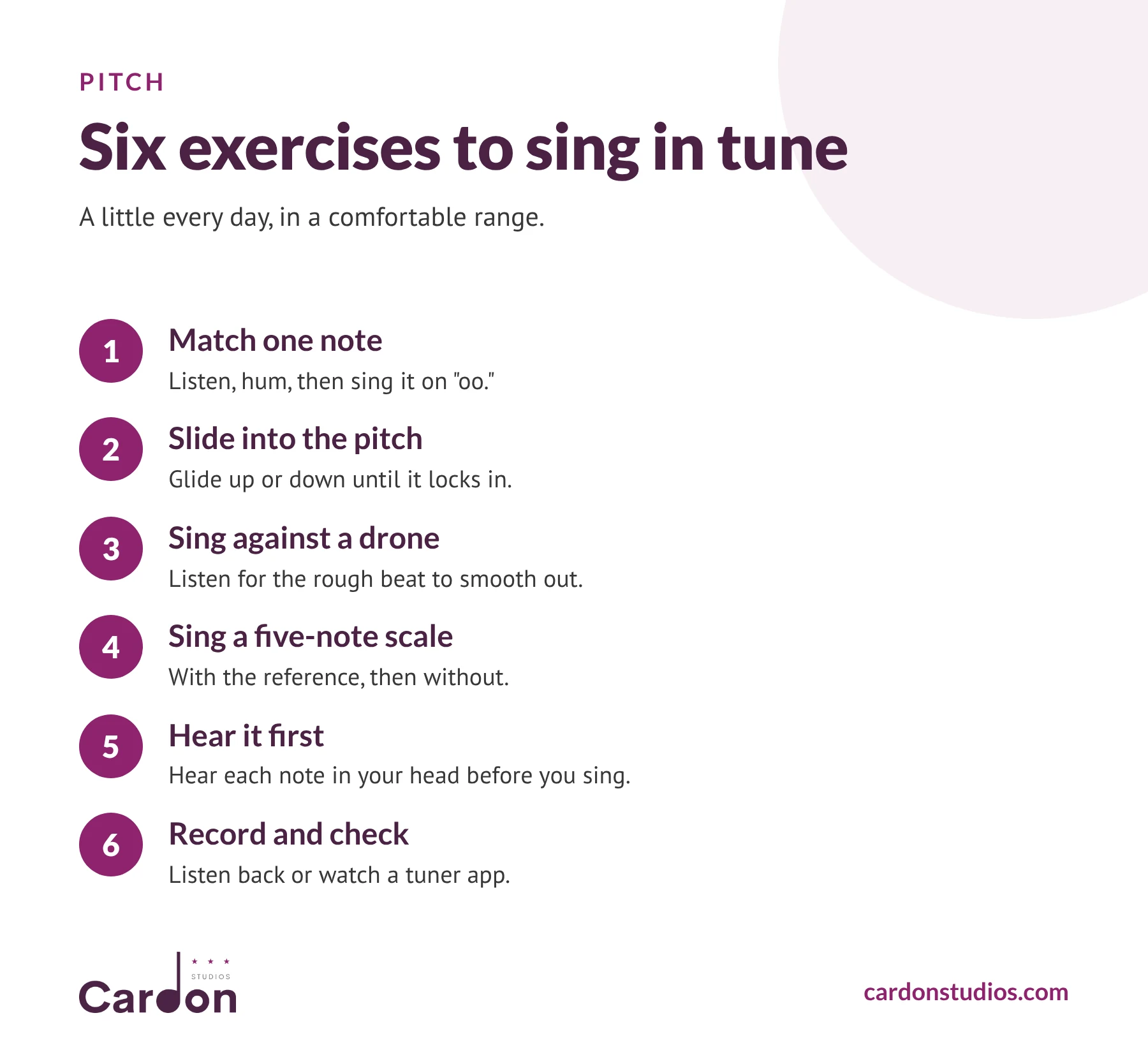
- Match one note. Play a comfortable note, listen, hum it, then sing it on “oo.” Check whether you match. Start in the middle of your speaking range, where it’s easiest.
- Slide into the pitch. If you miss, start below the note and slowly slide up until it locks in, then try from above. Sliding teaches your voice what “on pitch” feels like.
- Sing against a drone. Play a sustained reference note and sing the same note with it. When you’re off, you’ll often hear a rough, wavering “beat” between your voice and the drone; when you’re in tune, it smooths out.
- Sing a five-note scale. Sing up and down five notes with the reference, then without it, and check your last note against the reference to see if you drifted.
- Hear it first. Before each note or phrase, hear it clearly in your head, then sing. This habit, called audiation, is covered in our guide to visualization for singers.
- Record and check. Record a short phrase and listen back, or watch a tuner app as you sing. Notice whether you tend to land flat, sharp or right on.
Why you go flat or sharp
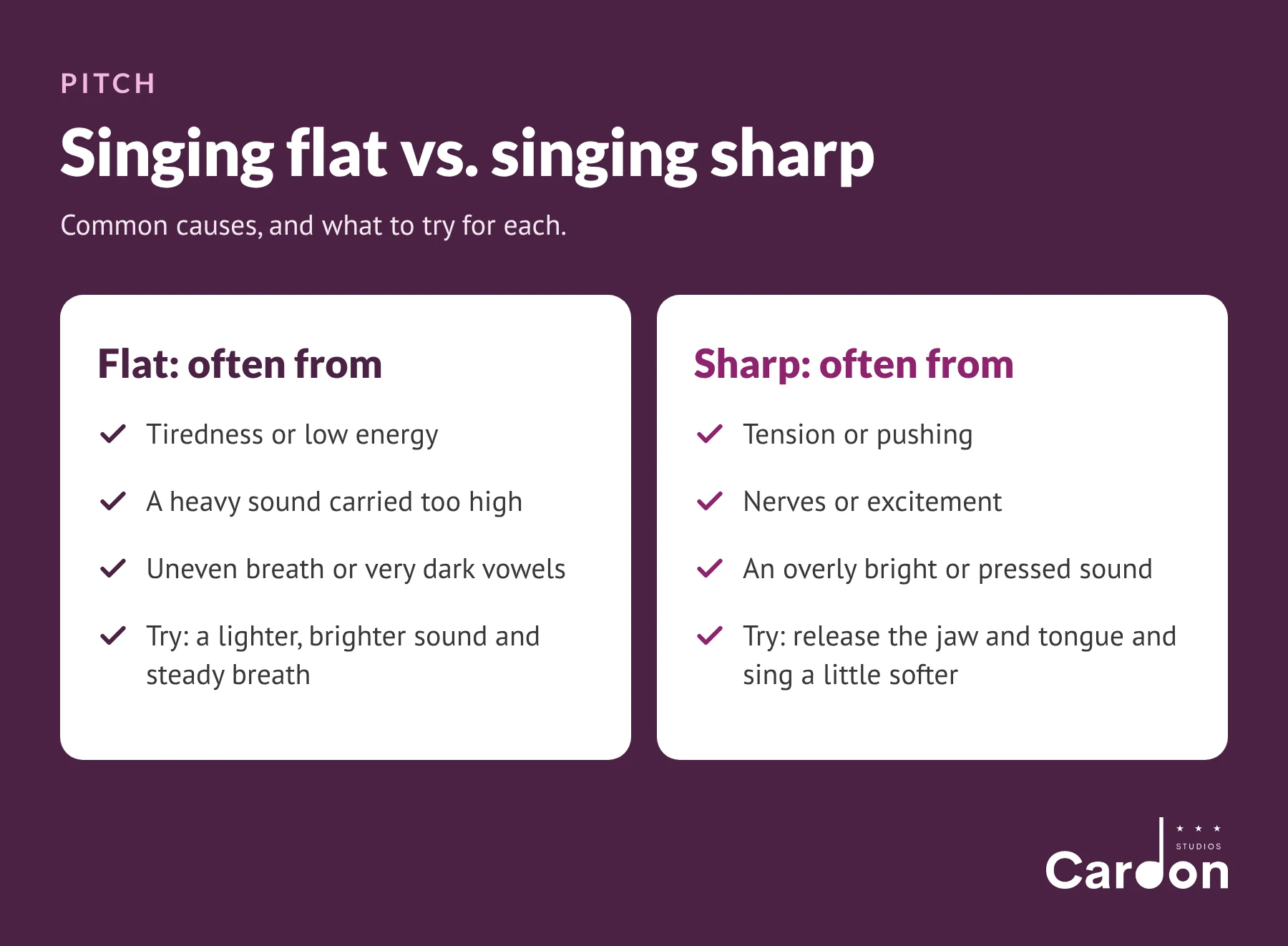
Flat and sharp singing usually have different causes, so it helps to notice which way you tend to miss.
| Pattern | Common causes | Try |
|---|---|---|
| Singing flat | Tiredness, low energy, a heavy sound carried too high, uneven breath, very dark vowels | A lighter, brighter sound, steady breath and thinking of the pitch as slightly higher |
| Singing sharp | Tension, pushing, nerves or excitement, an overly bright or pressed sound | Release the jaw and tongue, take a calming breath and sing a little less loudly |
| Drifting over a song | Not checking against the accompaniment, holding the breath, fatigue | Listen to the accompaniment and check pitches at the ends of phrases |
| Missing leaps | Not hearing the second note before singing it, reaching physically | Hear the note first, and picture the leap straight ahead rather than up |
| Off at the break | An uncoordinated shift between registers | Slides and lighter singing through the shift; see voice cracking |
Breath plays a big part. An uneven or held breath makes pitch unsteady, while a low, steady flow helps the voice settle on a note. Our guide to how to breathe when singing walks you through it.
Staying in tune in songs
Exercises build the skill; songs test it. Start with simple melodies that move mostly by step, in a comfortable key. Learn the melody slowly on a single vowel before adding words, because words and pitch together are harder than pitch alone.
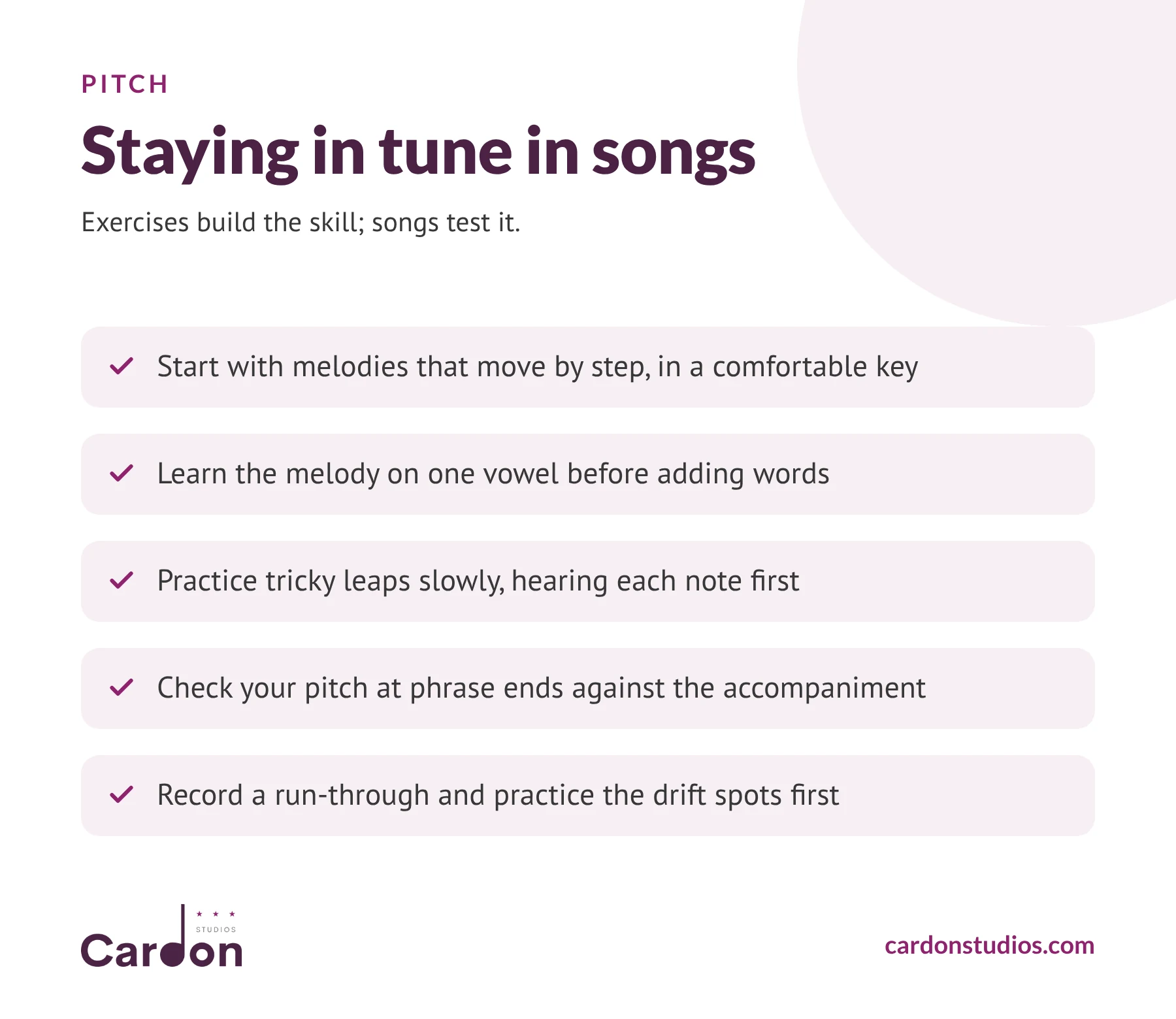
- Practice tricky leaps on their own, slowly, hearing each note before you sing it.
- Check your pitch at the ends of phrases against the accompaniment or a reference note.
- Choose a key that suits your voice; straining for high or low notes often pulls pitch off.
- Record a run-through and mark the spots where you drift, then practice those first.
How to sing on key: a worked example
Singing on key means every note of the melody sits in the song’s key, the set of pitches built around one home note. Here’s how to work through a new song so you stay on key from the first note to the last.
- Find the home note. Many melodies end on the home note of their key, called the tonic. Check the key on the sheet music, or play the melody’s last note on a keyboard app, and hum it until it feels settled.
- Sing the scale of the key. From the home note, sing up and down the scale on “do re mi” or on one vowel. This tunes your ear to the pitches the song uses before you sing a single word. Our guide to sight singing explains how these syllables work.
- Find your starting note. Play the melody’s first note, hear it in your head, then sing it. Many off-key starts come from guessing the first pitch instead of checking it.
- Mark checkpoints. Pick two or three long notes in the song, often at the ends of phrases, and check each against the keyboard or a tuner app as you practice. If you drift, you’ll catch it there instead of at the end.
- Change the key if you need to. If the highest or lowest notes feel strained, move the whole song up or down a step or two with the transpose setting on your keyboard app or backing track. A comfortable key is much easier to sing on.
Finish by singing the whole song once and checking your last note against the home note. If they match, you stayed on key; if not, record a run-through and listen for where the drift began. To find the range a key should fit, see our guide to voice types and vocal range.
Singing in tune with others
Singing in a choir or with harmonies adds a new challenge: holding your own pitch while others sing different notes. It’s a skill that develops with practice, and reading music helps a lot. See how to hold your harmony part in a choir and our guide to sight singing for choir singers.
When you sing with others, listen to the voices around you as well as your own. Matching vowels with your section also helps the pitch lock in. Building general musicianship skills, such as intervals and scales, makes every part easier to hold.
Tools that help
- A tuner app. Shows whether you’re flat, sharp or in tune as you sing. Use it as a check, not a crutch; your ear is the goal.
- A drone or keyboard app. Gives you steady reference pitches to match and sing against.
- Your phone’s recorder. The simplest way to hear yourself as others do. See how to record yourself singing.
- A teacher. Can hear patterns, such as going flat on certain vowels or at the break, and give you targeted exercises.
Whatever tools you use, keep sessions short and regular. A few focused pitch-matching exercises on most days build the ear-to-voice connection faster than an occasional long session, and they’re easier on your voice. Our guide to how to practice singing has a simple routine to fit them into.
From the studio
Pitch is one of the most common goals new singers bring to lessons, and one of the most rewarding to work on. In a live online lesson, your teacher can hear exactly where your pitch drifts and why. Lessons are recorded so you can rewatch them, and between lessons you can send a video and get a personalized response within 72 hours.
Online voice lessons
Train your ear and your voice together
One monthly membership includes four private online voice lessons, one video coaching submission, the Learning Library, and member online events, with a teacher matched to your style, goals, age, and schedule.
Common questions about singing in tune
Can you learn to sing in tune?
Yes, for most people. Research suggests that many people who sing off pitch can hear pitch differences fine; what needs training is the coordination between hearing and singing, which improves with regular practice.
Why do I sing off key?
Common reasons include not hearing the note clearly before you sing it, tension, uneven breath, tiredness and nerves. Matching single notes, sliding into pitches and recording yourself help you find the cause.
How do I know if I’m singing in tune?
Record yourself and listen back, or sing against a drone and listen for a rough, wavering sound that smooths out when you’re in tune. A tuner app gives you a visual check.
Am I tone deaf?
Probably not. In research, many people who sing off pitch could still tell pitches apart as well as good singers. If you can tell when two notes are different, you can likely learn to sing them.
How long does it take to learn to sing on pitch?
It varies with your starting point and how regularly you practice. Short, daily pitch-matching practice usually brings steady improvement, and a teacher can speed up the process.
What are good pitch matching exercises?
Start with single notes: play a note, hum it, then sing it on “oo.” Then slide into notes from below and above, sing against a drone, and sing short five-note scales with and without a reference. Check yourself with a tuner app or a recording.
Why do I sing flat?
Singing flat is often linked to tiredness, a heavy sound carried too high, very dark vowels or uneven breath. Try a lighter, brighter sound and steady airflow, and hear the note clearly in your head, even slightly higher, before you sing it.