

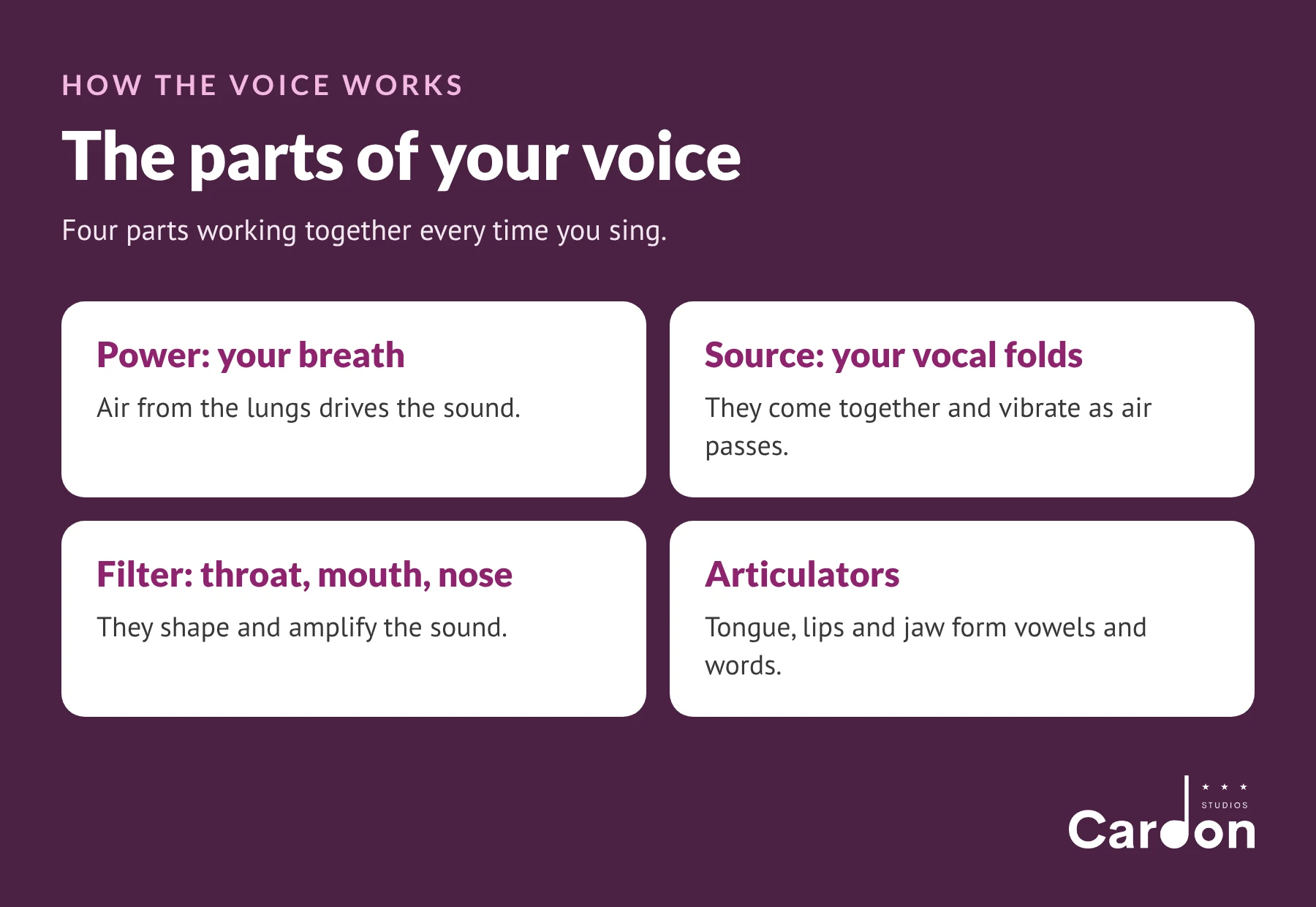
Your voice works as a system of three parts. Air from your lungs is the power. Your vocal folds, inside the voice box in your neck, are the source: they come together and vibrate as the air passes, creating sound. Your throat, mouth and nose are the filter: they shape and amplify that sound into the voice people hear, while your tongue, lips and jaw form it into words. Understanding how those parts fit together makes it much easier to know what you’re working on when you sing.
Key takeaways
- Breath powers the voice, the vocal folds create the sound, and the throat, mouth and nose shape it.
- The voice box’s first jobs are protecting your airway and helping you cough. Speaking and singing use the same structures.
- Pitch changes as the vocal folds lengthen and thin or shorten and thicken.
- Every voice sounds different because every body is built differently.
The three parts of your voice
Singers and voice teachers often describe the voice as three linked parts: a power source, a vibrating source and a filter. When all three are balanced, singing feels easy and sounds clear. When one part is working too hard, the others usually compensate, and that’s where tension and strain creep in.
That’s why voice lessons spend so much time on breathing and alignment. They’re not separate from your voice; they’re part of it.
Your voice box
Your voice box, or larynx, sits in the front of your neck, between the base of your tongue and the top of your windpipe. According to TeachMeAnatomy, its important functions include phonation (making sound), the cough reflex and protecting your lower airway. Its framework is made of nine cartilages, three unpaired and six paired, held together by ligaments and membranes and moved by small muscles. One of those cartilages, the epiglottis, folds back during swallowing to help keep food and drink out of your airway.
In other words, the structures we speak and sing with are also part of our body’s defenses for breathing and swallowing. That’s a good reason to treat them with care.
The larynx also moves. Rest your fingers lightly on the front of your neck and swallow: you’ll feel it rise and then settle again. When you sing higher, it may rise slightly too, but you don’t need to push it up or reach with your head and neck to sing high notes. If you feel yourself “reaching” for a note, that’s usually extra effort you don’t need. Staying in a neutral, balanced posture makes high notes easier.
How the vocal folds make sound
Inside the larynx are your vocal folds, sometimes called vocal cords. The National Institute on Deafness and Other Communication Disorders explains that the folds are two bands of tissue positioned opposite each other. When you breathe, they stay open. When you speak or sing, they come together while air from your lungs flows past, which makes them vibrate. Those vibrations produce sound waves that travel through your throat, nose and mouth.
Have you ever pinched the neck of a balloon so it’s nearly closed and let the air squeal out? That’s a simple picture of how the vocal folds work: a valve that vibrates as air passes through it. Because the folds act as a valve, steady, well-managed airflow matters. Too much air pressure makes them work harder; too little makes the sound breathy.
How pitch works
Stretch the neck of that balloon longer and thinner, and the pitch rises. Your vocal folds do something similar. To sing higher, they lengthen and thin; for lower notes, they shorten and thicken. NIDCD describes the same idea in simpler terms: relaxing the vocal folds makes a voice deeper, and tensing them makes it higher.
The way the folds vibrate also changes across your range, which is why your low and high notes have different colors. Those settings are your registers. To learn more, read our guides to voice types and vocal range and finding your mix, or, if your voice cracks between registers, voice cracking and other common vocal problems.
How resonance shapes your sound
The sound your vocal folds make on their own is quite small. It’s the spaces above them, your throat, mouth and nasal passages, that shape and amplify it. NIDCD describes these as resonating cavities that modulate the sound. Changing the shape of those spaces, by moving your tongue, jaw, lips and soft palate, changes your vowels and the color of your voice.
That’s why small changes, such as a more relaxed tongue or a slightly different vowel, can transform how a note sounds and feels. It’s also how trained singers are heard over a full orchestra without pushing harder. Our guide to vocal projection explains more.
Why every voice is unique
No two voices sound exactly alike. According to NIDCD, the quality of a voice, its pitch, volume and tone, depends on the size and shape of the vocal folds and the resonating cavities, which is why people’s voices sound so different. Your height and build, the shape of your throat and mouth, your hormones and the way you’ve used your voice over the years all play a part.
Hormones influence the size of the larynx and the general color of the voice, especially during puberty. Even so, healthy voices vary widely within any gender, and the voice works the same way for everyone. Voice types describe ranges and colors, not who you are.
Imitating other singers can be a useful learning tool, but don’t try to copy someone else’s sound exactly. Your voice is built differently, and the goal is to find your own best sound.
What you can and can’t feel
You can’t feel your vocal folds working in the direct way you can feel your fingers move. Most of what singers use to guide their voices is indirect: vibration in the chest and face, the sense of air pressure, the feeling of ease or effort, and how the sound changes. That’s why recording yourself and working with a teacher, who can hear and see what you can’t, help so much.
It also means that warning signs deserve attention. A scratchy or tickly throat, a need to keep clearing your throat or coughing, or a voice that tires quickly are all signals to ease off and rest.
Listen to your voice
If your voice stays hoarse, rest it. According to the National Institute on Deafness and Other Communication Disorders, see a doctor if your voice has been hoarse for more than three weeks. Our guide to vocal health for singers covers everyday care.
From the studio
Knowing how your voice works is the first step; learning to coordinate it is the fun part. In a live online lesson, your teacher can connect each exercise to what’s happening in your voice, so you understand why it works. Lessons are recorded so you can rewatch them, and between lessons you can send a video and get a personalized response within 72 hours.
Online voice lessons
Learn to use your voice with ease
One monthly membership includes four private online voice lessons, one video coaching submission, the Learning Library, and member online events, with a teacher matched to your style, goals, age, and schedule.
Common questions about how the voice works
How does the voice produce sound?
Air from your lungs flows past your vocal folds, which come together and vibrate. The vibrations create sound waves, which your throat, mouth and nose shape and amplify into your voice.
Are vocal cords and vocal folds the same thing?
Yes. “Vocal folds” is the term most voice scientists and teachers prefer, because the tissue is a layered fold rather than a string, but both names refer to the same structures.
How do you sing higher notes?
Your vocal folds lengthen and thin to raise the pitch. You don’t need to reach up with your head or push more air. A balanced posture, steady breath and a lighter sound make high notes easier.
Why does my recorded voice sound different?
When you sing, you hear your voice partly through the bones and spaces of your own head, so it sounds different to you than it does to listeners. A recording is closer to what others hear.
Can you change your voice?
You can’t change your anatomy, but you can change how you use it. Training improves your range, tone, power and control, and helps you find the best version of your own voice.