


To sing low notes, relax instead of pressing down. Keep your posture tall, your jaw loose and your larynx comfortable rather than pushed low, use an easy, speech-like sound, and let the breath flow steadily but gently. Low notes are naturally quieter than high ones, so the biggest mistake is forcing them louder or darker. Accept a softer, warmer sound, choose keys that suit you, and let a microphone or the accompaniment do some of the work.
Key takeaways
- Low notes come from relaxation, not from pushing your voice or your chin down.
- Low notes are naturally quieter; don’t force extra volume or darkness.
- Speech-like exercises, gentle slides and humming help you find an easy low range.
- Your lowest notes depend partly on your anatomy, but relaxation often adds a few.
Why low notes feel hard
As you sing lower, your vocal folds shorten and thicken. The National Institute on Deafness and Other Communication Disorders puts it simply: relaxing the vocal folds makes a voice deeper, and tensing them makes it higher. That’s the key to low notes. They need less effort, not more.
The problem is that many singers treat low notes like high ones and add effort: pushing the chin down, pressing the voice box low, or blowing extra air to make the sound bigger. That tightens the very muscles that need to relax, and the notes get breathy, croaky or disappear.
Low notes also carry less naturally. They won’t project like your middle and upper range, especially over a band or in a big room. That’s normal, and fighting it usually makes things worse.
How to sing low notes
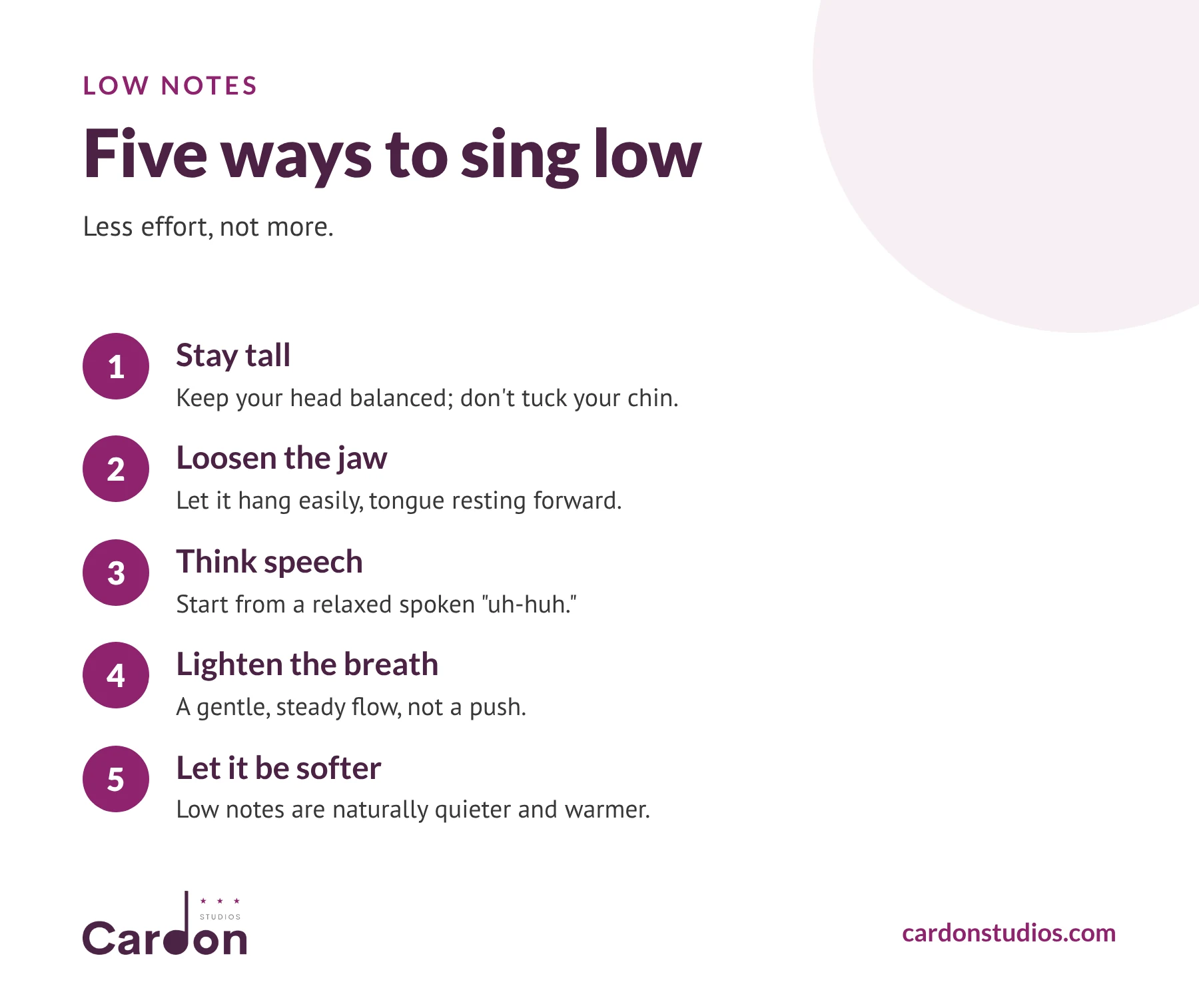
- Stay tall. Keep your head balanced over your shoulders. Tucking your chin toward your chest to “reach” a low note squeezes the throat. See alignment.
- Loosen the jaw. Let the jaw hang easily, with your tongue resting forward. Tension here makes low notes croaky.
- Think speech. Low notes usually sit in chest voice, close to your speaking voice. Start from a relaxed spoken “uh-huh” and let it turn into a sung note. Our guide to chest voice explains this setting.
- Lighten the breath. Low notes need a steady, gentle flow of air, not a big push. Too much air makes them breathy.
- Let it be softer. Accept that low notes are quieter and warmer. If you need to be heard, use a microphone or ask for a softer accompaniment rather than forcing volume.
Exercises for low notes
Practice these gently, after a warm-up, and stop before your voice gets tired or scratchy.
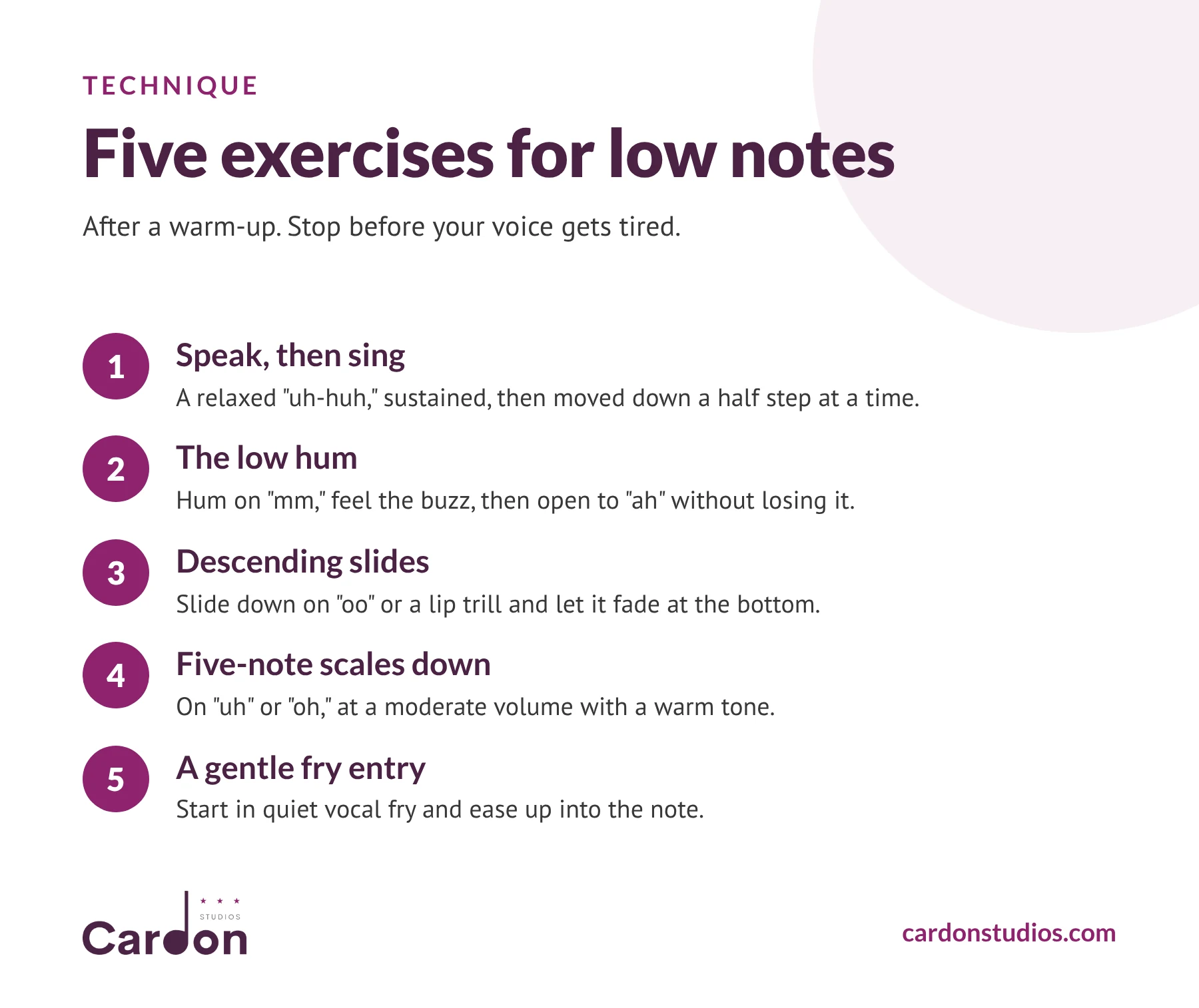
1. Speak, then sing
Say “uh-huh” or “mm-hmm” in a relaxed, low speaking voice. Then sustain the same sound on one pitch. Move the pitch down a half step at a time, keeping the easy, speechy feeling.
2. The low hum
Hum on “mm” in the lower part of your range and feel the buzz in your chest and lips. Then open to “ah” (mm-ah) without losing the buzz. Humming helps you find resonance without pushing.
3. Descending slides
Slide gently down on “oo” or a lip trill from the middle of your range to as low as is comfortable, then back up. Don’t press at the bottom; let the slide fade as you run out of easy notes.
4. Five-note scales down
Sing five-note scales starting in your comfortable middle and moving down, on “uh” or “oh.” These vowels tend to sit easily in the low range. Keep the volume moderate and the tone warm.
5. A gentle fry entry
Some singers find their lowest notes by starting in vocal fry, the creaky sound at the very bottom of the voice, and easing up into the note. Keep it quiet and low in pressure. Our guide to vocal effects explains how to use fry safely.
Common low-note mistakes
Most low-note mistakes add effort where the voice needs less, and each has a simple fix.
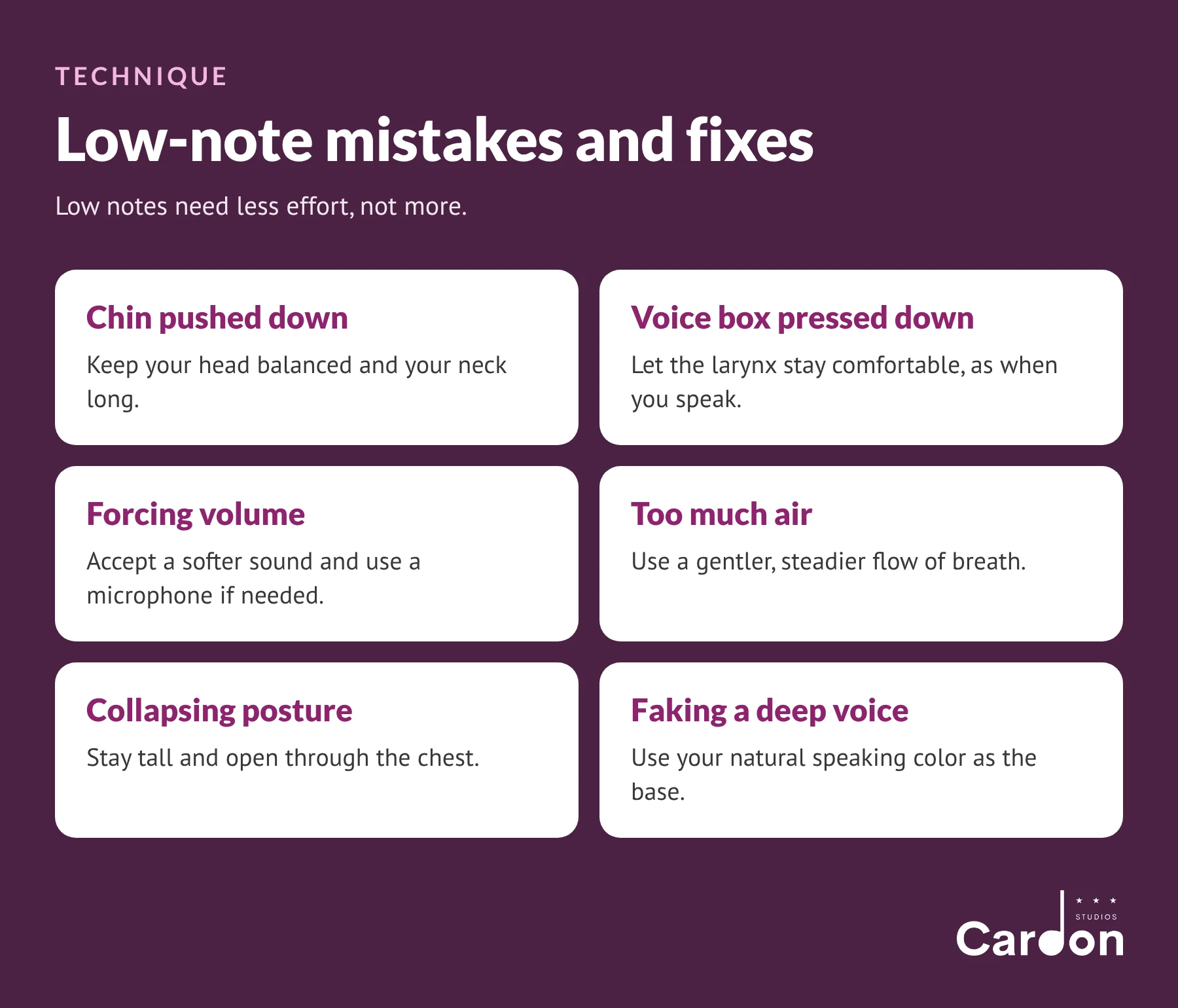
| Mistake | What happens | Try instead |
|---|---|---|
| Pushing the chin down | The throat squeezes and the note thins or cracks | Keep your head balanced and your neck long |
| Pressing the voice box down | A dark, swallowed, effortful sound | Let the larynx stay comfortable, as it is when you speak |
| Forcing volume | Croaking, strain and hoarseness | Accept a softer sound, and use a microphone if needed |
| Too much air | A breathy, weak tone that runs out quickly | A gentler, steadier flow of breath |
| Collapsing posture | Less breath support and a muffled sound | Stay tall and open through the chest |
| Faking a deep voice | An artificial, tiring sound | Use your natural speaking color as the base |
How to sing low: a daily low-range routine
To sing low with more ease, practice a short low-range routine on most days and let your range settle over a few weeks, instead of forcing it in one session. This routine puts the exercises above in the order that works best.
- Warm up in the middle first. Start with lip trills or humming in your comfortable middle range, then slide gently down. Never begin a session at the bottom of your voice.
- Find your speaking pitch. Say “mm-hmm” in a relaxed voice, then sing it on one sustained note. Repeat three times, moving down a half step each time.
- Five-note scales down, four repetitions. On “uh” or “oh,” sing from the fifth note of a scale down to the first (5-4-3-2-1). Start each repetition a half step lower, and stop at the first one that feels pressed.
- Set today’s floor note. Find the lowest note that still feels easy today. Hum it, then open to “ah,” three times. That’s your floor for the day; don’t push below it.
- Use it in a song. Sing one low phrase from a song you’re learning, first on “uh,” then on the words, keeping the same relaxed, speech-like feeling.
Write down your floor note each day. After a few weeks you’ll know where your easy low range really sits, and you may notice it reaches a little lower on days you’re rested and well warmed up. If a note only comes with pressing, it isn’t part of your range yet. Stay comfortable, and stop if anything hurts.
Low notes work best when the rest of your body stays loose, too. Our guide to releasing tension when singing helps with the jaw, neck and shoulders. To fit this routine into a weekly plan, see how to practice singing.
Can you extend your low range?
Partly. The lowest notes you can sing depend a lot on the size and shape of your voice, which you can’t change. But many singers can’t reach the bottom of their natural range at first because of tension, and relaxation often adds a few comfortable notes. Your low range may also be more available at some times than others, so don’t judge it on a single day.
What you shouldn’t do is force your way lower by pressing down. If a note needs effort to reach, it’s probably outside your healthy range for now. To find where your voice sits, read our guide to voice types and vocal range, and for lower voices building a connected sound up through the range, see finding your mix for lower voices.
Low notes in songs
- Choose the right key. If a song sits too low, move it up. Bringing low notes into a comfortable range usually helps the whole song.
- Use the microphone. Move a little closer to the mic on low phrases so you don’t have to push.
- Shape the phrase. Let low notes be part of the story, often intimate or reflective, rather than the loudest moment.
- In a choir, listen to your section and blend rather than pressing to be heard. See how to hold your harmony part.
Listen to your voice
Low notes should never hurt. If singing low leaves you hoarse or scratchy, rest. According to the National Institute on Deafness and Other Communication Disorders, see a doctor if your voice has been hoarse for more than three weeks.
From the studio
Low notes are often about letting go, which is easier with someone listening. In a live online lesson, your teacher can hear whether you’re pressing or relaxing and adjust exercises for your voice. Lessons are recorded so you can rewatch them, and between lessons you can send a video and get a personalized response within 72 hours.
Online voice lessons
Find an easy, warm low range
One monthly membership includes four private online voice lessons, one video coaching submission, the Learning Library, and member online events, with a teacher matched to your style, goals, age, and schedule.
Common questions about singing low notes
How can I sing lower?
Relax rather than push. Keep your posture tall and your jaw loose, start from an easy speaking sound, use a gentle flow of breath, and accept that low notes are softer. Relaxation often makes a few more low notes available.
Why can’t I sing low notes?
Often because of tension: tucking the chin, pressing the voice box down or pushing more air. Your anatomy also sets a natural limit, so some notes may simply be outside your range.
Why do my low notes sound breathy?
Usually because there’s more air than the folds need. Lighten the breath, try a gentle hum to find a clearer buzz, and move closer to the microphone instead of blowing harder.
Can women sing low notes?
Yes. Every voice has a low range, and many sopranos and altos have rich low notes in chest voice. Use the same principles: relax, think speech, and don’t force volume.
Is it bad to push for low notes?
Pushing tends to make low notes croaky and can tire your voice. If a note needs effort to reach, it’s likely outside your comfortable range for now.
How do I sing deeper?
Let your voice relax rather than pushing it down. A deeper sound comes from a comfortable, speech-like low range, a loose jaw and a balanced head, not from pressing the voice box low or faking a darker tone, which tires your voice. A lower key for songs that suit you helps too.
How do I sing bass?
Bass is the lowest male voice type, and whether you’re a bass depends mostly on your natural range. If your low notes are comfortable and strong, the routine above helps you use them with ease. Our guide to voice types, linked above, helps you find where your voice sits.