

Vocal projection is the ability to make your voice carry clearly to the back of a room without forcing it. It depends far more on resonance, clear vowels and steady breath than on raw volume. To sing louder safely, think about sending your voice a distance, the way you’d call to a friend across the street, rather than pushing more air through your throat.
Key takeaways
- Volume is how loud a sound is; projection is how clearly and far it carries. You can project without shouting.
- Trained voices carry partly because of how they shape resonance, not just how hard they push.
- Steady breath, an easy onset, open vowels and clear consonants do most of the work.
- Don’t carry extra force up into your higher range. Lighten as you go up, and the sound still carries.
Projection vs. volume
As singers, we all want to be heard. But volume and projection aren’t the same thing. Volume is the intensity of the sound, measured in decibels. Projection is how distinctly your voice reaches the listener: whether they can hear the words, the pitch and the color of your sound from the back of the room.
Many singers feel that their lower range is their “loud” range, because it’s the range they use for speech all day and it feels strong. That feeling leads to a common trap: carrying the same heavy effort up into higher notes to stay loud. As you go higher, the vocal folds stretch and thin, and extra force isn’t tolerated well. The voice strains or cracks. Projection gives you another way to be heard, one that works across your whole range.
Why some voices carry
Opera singers are heard over a full orchestra without microphones, and it isn’t only because they’re loud. According to the National Center for Voice and Speech, an orchestra’s sound energy is strongest around 500 Hz and falls off at higher frequencies, while a well-trained operatic voice produces a concentration of energy around 3,000 Hz, often called the singer’s formant. That band of energy lets the voice cut through.
You don’t need to sing opera to use the principle. Every style benefits from a voice that’s resonant and clear rather than pushed. In practice, singers find that resonance with exercises that create buzz and brightness, and by keeping the throat open and free.
How to project your voice
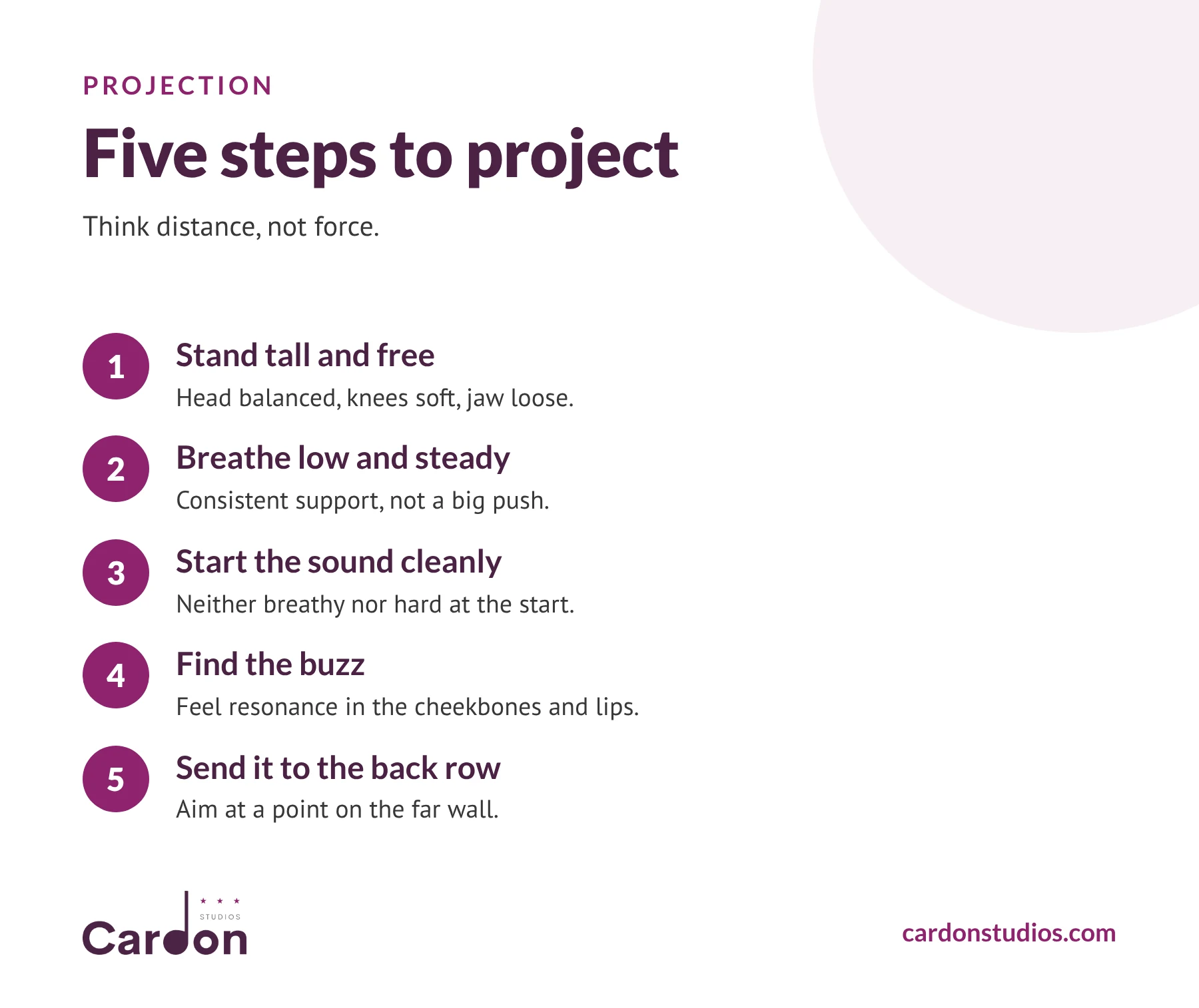
- Stand tall and free. Feet hip-width apart, knees soft, head balanced over your shoulders. A collapsed or tense posture muffles the sound. See singing posture and alignment.
- Breathe low and steady. Let the breath drop in low and keep it flowing steadily. Projection needs consistent support, not a big push. Our guide to breath support for singing explains how.
- Start the sound cleanly. Begin each phrase with a balanced onset, neither breathy nor hard and glottal. A clean start uses breath efficiently.
- Find the buzz. Notice vibration in the “mask”: around the cheekbones, the roof of the mouth, the lips and the area above the upper lip. That buzz is a sign of efficient resonance.
- Send it to the back of the room. Pick a point at the far wall and sing to it. Thinking about distance, rather than loudness, tends to free the throat and focus the sound.
Exercises to sing louder safely
1. Call across the street
Imagine seeing a friend across the street and calling “Hey!” Will you scream as loud as you can, or toss your voice over to them? Try it out loud. Most people naturally project when they call over a distance, with less push in the throat. Notice that feeling, then bring it into a sung phrase.
2. Hum into “ah”
Hum on “mm” or “ng” on a comfortable pitch until you feel a buzz in your face, then open to “ah” (mm-ah) without losing the buzz. Repeat on a five-note scale. This connects resonance to an open vowel.
3. Swell on one note
On a comfortable note, start softly, grow to a moderate volume, and fade back down, all on one breath. Keep the tone steady and the throat relaxed throughout. This builds volume control without force.
4. Count to the back wall
Speak, then sing, the numbers one to ten on a single pitch, aiming each number at a spot on the far wall. Keep consonants crisp. Clear diction carries further than extra volume.
5. Lip trill to a vowel
Sing a phrase on a lip trill, then sing it again on words with the same steady breath and ease. The trill teaches an even flow of air that keeps a projected sound free.
Projecting higher notes
Higher notes naturally carry well, so you don’t need to add force to be heard. In fact, to move smoothly into your upper range, it often helps to think of singing a little more softly and lightly as you rise, while keeping the breath steady and the resonance bright. You may be surprised how little volume you lose.
If strong, full high notes matter to you, they come from coordination, not effort. A balanced mixed voice lets you keep power and fullness higher in your range; see our guides to finding your mix for higher voices and lower voices. For powerful contemporary high notes, read how to belt safely.
With a microphone or without
- Acoustic singing (choirs, classical, many theater and church settings) depends on projection. Resonance and clear diction matter most.
- Microphone singing (pop, rock, jazz, worship bands) lets the mic handle much of the volume. Projection still matters for clarity and tone, but you rarely need to sing at full volume. Learning good mic technique, and trusting the sound system, protects your voice.
Either way, the goal is the same: a clear, resonant sound that reaches the listener without strain. If you sing in a choir, projecting your part while blending is its own skill; our choir singing tips cover it.
Common projection mistakes
- Pushing more air. Extra breath pressure makes the sound harsh and tires the voice. Aim for steady, not forceful.
- Tightening the neck or jaw. Tension muffles the sound. Keep the jaw loose and the neck long.
- Swallowing the sound. Pulling the tongue back or pressing the larynx down to sound “bigger” makes the voice darker but less clear.
- Mumbling. Unclear consonants are lost first in a big space. Crisp diction carries.
- Singing loud all the time. Dynamics make a performance interesting. Save full volume for the moments that need it.
Listen to your voice
Projection should feel energized but easy. Stop if singing louder causes pain, scratchiness or hoarseness, and rest your voice. According to the National Institute on Deafness and Other Communication Disorders, see a doctor if your voice has been hoarse for more than three weeks. For everyday care, read our guide to vocal health for singers.
From the studio
We’re all shaped differently and experience our voices differently, so the right path to a bigger sound varies. In a live online lesson, your teacher can hear whether your voice is projecting or pushing and give you exercises that fit your voice. Between lessons, you can send a video of a song and get a personalized response within 72 hours.
Online voice lessons
Be heard without straining
One monthly membership includes four private online voice lessons, one video coaching submission, the Learning Library, and member online events, with a teacher matched to your style, goals, age, and schedule.
Common questions about vocal projection
How can I sing louder without straining?
Use steady breath, a clean onset and bright, resonant vowels, and aim your voice at a point across the room rather than pushing. Lighten as you go higher. If it hurts or leaves you hoarse, stop and rest.
Why is my singing voice so quiet?
A quiet voice is often a breathy one, where air escapes without being turned into sound, or a voice held back by tension or nerves. Resonance exercises, clean onsets and practice singing to the back of a room usually help.
Is projection the same as singing from your diaphragm?
Not exactly. Steady breath support is part of projection, but projection also depends on resonance, vowel shape and diction. Pushing harder from the belly alone doesn’t make a voice carry.
Can anyone learn to project?
Yes. Projection is a skill built through practice. Most singers carry much further after a few weeks of focused resonance and breath work.
How do I project in a choir without sticking out?
Keep your sound resonant and clear, match vowels with your section, and listen for the blend. Projection in a choir means your part is clear, not that your voice is louder than everyone else’s.