

How long it takes to learn to sing depends on your goal and how often you sing. With short, regular practice, most beginners hear a difference within the first few weeks, sing simple songs with more control after a few months, and keep growing for years. Singing is a skill you build, so steady practice matters more than talent.
No one can promise a timeline for your voice in particular. What you can do is pick a clear goal, practice in a way that builds on itself, and track your progress so you can see it. This guide shows you how.
Key takeaways
- Your goal sets the time frame: singing on pitch in your comfortable range comes well before a solo or an audition.
- How often you sing matters more than how long each session lasts. Short practice most days beats one long session a week.
- Research suggests accurate singing is a learned skill that improves with use and training.
- Record yourself each month and compare. Progress is easy to miss from the inside.
How long does it take to learn to sing? The short answer
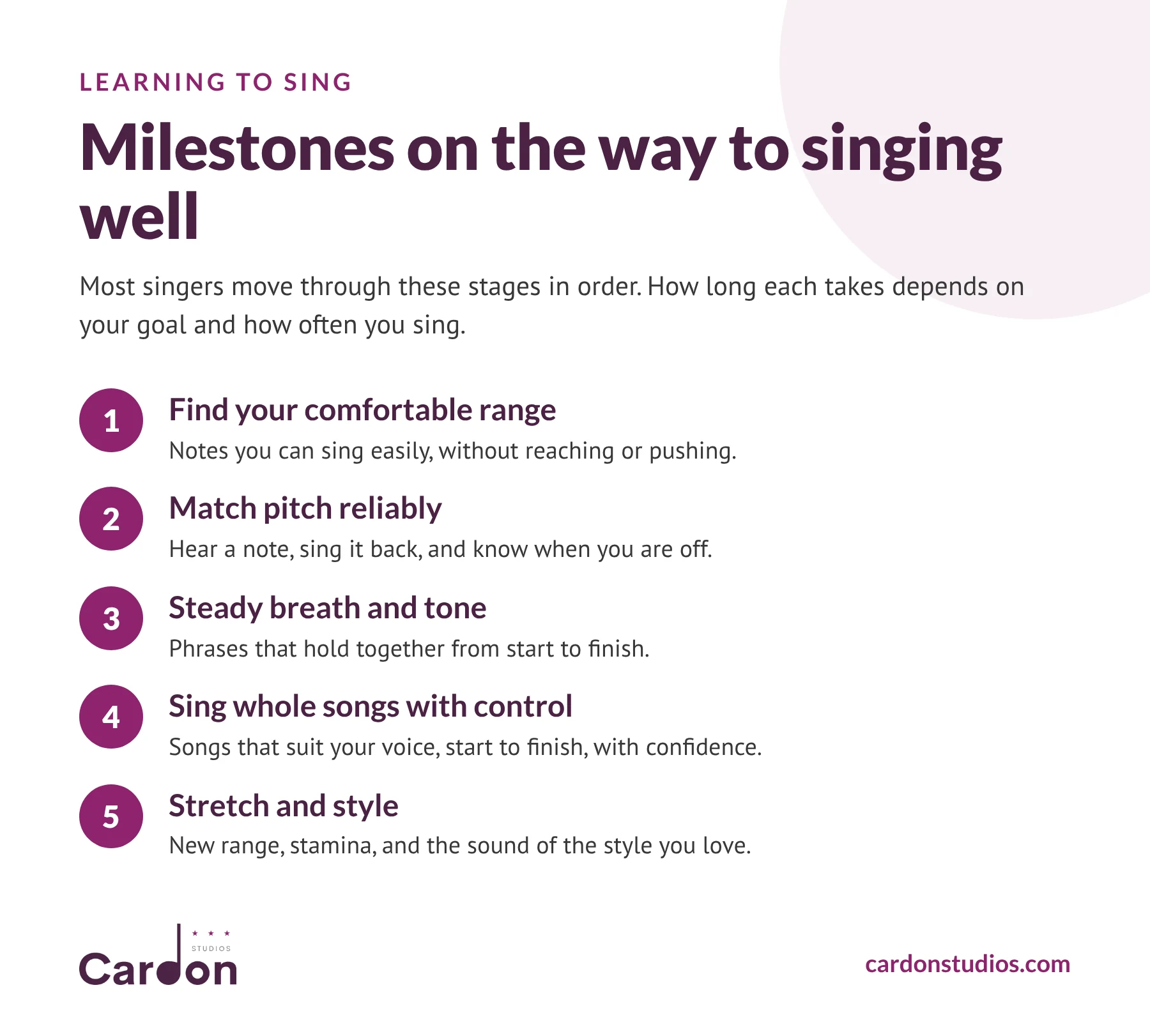
Think of learning to sing in stages rather than as one finish line. Most singers pass through the same milestones in roughly the same order. The pace is different for everyone.
- The first few weeks. You learn your comfortable range, get used to warming up, and start to notice when a note is off. Many people already hear small changes in tone and breath.
- The first few months. Pitch becomes more reliable, phrases hold together, and you can sing a song that suits your voice from start to finish with more control.
- Around the first year. Your range feels more even, your voice lasts longer, and you start shaping a song with style and feeling instead of just getting through it.
- Years. Advanced skills such as a strong belt, a smooth mix across your whole range, or audition-ready performance keep developing for as long as you train.
These stages assume short practice most days. If you sing once a week, expect each stage to take longer. If you already sing in a choir or play an instrument, you may move through the early stages faster.
How long does it take to get good at singing? Time frames by goal
“Good” means different things to different singers. The clearer your goal, the easier it is to plan your practice and see your progress. Here is what each common goal usually involves, and the kind of time frame to expect with regular practice.
| Your goal | What it takes | Typical time frame |
|---|---|---|
| Sing on pitch in your comfortable range | Pitch matching, a basic warm-up, easy breathing | Weeks to a few months |
| Sing a favorite song with confidence for friends | A song in the right key, steady breath, knowing the song well | A few months |
| Join a choir or group | Holding your part, blending, following the music | A few months, sooner if you already read music |
| Sing a solo or a school audition | Control under nerves, a prepared song, consistent tone | Several months to a year |
| Extend your range, belt or mix | Coordination between registers, built gradually | Months to years, depending on the skill |
| College or professional level | Advanced technique, musicianship and repertoire | Years of focused training |
Use the table as a rough guide, not a deadline. A singer who practices most days with feedback can move faster than one who sings now and then. Someone whose voice is changing during puberty may need to adjust goals for a while (see how to keep singing while your voice changes).
What affects how fast you learn to sing
Two people can start on the same day and progress at very different speeds. These are the factors that make the biggest difference.
How often you sing
Your voice responds to regular use. Singing a little on most days keeps the coordination fresh, so each session starts where the last one ended. A long session once a week means relearning some of what you did last time.
Where you start
Experience with music helps. If you sang as a child, play an instrument or read music, you already have useful listening skills. If you’re starting from scratch, the first stages may take a little longer, and that’s normal. Our guide to whether anyone can learn to sing explains why most people who miss notes can learn to sing in tune.
How you practice
Mindless repetition can lock in habits you don’t want. Practice with a clear aim for each session, such as one exercise for breath and one tricky phrase, builds skill faster. Read more about why how you practice matters more than how much.
Feedback
It’s hard to judge your own voice while you’re singing, which is why so many people are surprised by their first recording. A teacher, a recording or both show you what others hear, so you can fix problems before they become habits.
Your goal and style
Some styles ask for skills that take longer to build. A comfortable folk song in your middle range is a nearer goal than a powerful belt or a classical aria. Knowing your voice type helps you choose songs that fit while you build toward harder ones.
Vocal health
Colds, tiredness, dehydration and pushing too hard all slow progress. A voice that’s rested and cared for learns faster than one that’s strained. Our guide to vocal health for singers covers the basics.
What research says about learning to sing
Research on singing accuracy supports the idea that singing is a skill you develop through use, rather than a fixed gift.
In a 2015 study in Music Perception, Steven Demorest and Peter Pfordresher compared pitch-matching accuracy in 77 kindergartners, 55 sixth graders and 78 college-age adults, most of them without vocal training. The sixth graders, who had regular music classes, were the most accurate. The college students scored about the same as the kindergartners on two of the three pitch-matching tasks (Demorest and Pfordresher, 2015). The authors suggest that singing skill may fade when people stop singing, and note that this still needs to be tested by following singers over time. Demorest described accurate singing as “a skill that can be taught and developed” (Northwestern University).
A larger 2021 study in the Journal of Research in Music Education tested 632 people online. Years of musical training were linked with more accurate pitch matching, and people with private training matched pitch correctly 87 percent of the time on average, compared with 68 percent for people with no formal training (Pfordresher and Demorest, 2021). The study shows a link, not cause and effect, and training explained only part of the differences between people. Still, the message for a new singer is encouraging: practice and training go hand in hand with better singing.
A weekly singing practice routine that builds skill
The quickest way to shorten your timeline is a routine you can keep. For most beginners, a short session of about a quarter of an hour, five or six days a week, works better than an occasional long one. Build up to half an hour as your voice gets stronger.
Each session
- Warm up. Do lip trills on a five-note scale (1-2-3-4-5-4-3-2-1) on “brr,” starting low in your comfortable range and moving up by half steps for five repetitions. If trills are hard, hum the same pattern on “mm.” See our full vocal warm-up routine.
- Work on one skill. Pick one focus for the day, such as breath or pitch. For pitch, play a single note on a tuner app or keyboard, sing it back on “ah,” and check whether you landed on it. Repeat with five different notes.
- Sing part of a song. Choose one phrase or section, not the whole song. Sing it slowly, fix one thing, then sing it again at full speed.
- Cool down. Finish with gentle hums or sirens on “oo” from the middle of your range downward, three or four times.
A sample week
| Day | Focus | Try this |
|---|---|---|
| Monday | Breath | Hiss out slowly on “sss” for a steady count, four times, then sing one long phrase on one breath |
| Tuesday | Pitch | Match five single notes, then sing a five-note scale on “ah” |
| Wednesday | Song work | Learn the next section of your song, slowly at first |
| Thursday | Range | Gentle sirens on “ng” or “oo” through your range, never pushing at the edges |
| Friday | Song work | Sing the song from the start and record it |
| Saturday | Review | Listen back, note one thing to improve, and practice it |
| Sunday | Rest | Give your voice a break |
Stay comfortable throughout. Stop if anything hurts, and rest if your voice feels tired or scratchy. For more structure, our guide to how to practice singing between lessons includes a full practice plan and tips for practicing at home.
How to tell your singing is improving
Progress in singing is gradual, so it’s easy to feel stuck even when you’re moving forward. Recording yourself is the most reliable way to see change. Once a month, record the same song or exercise in the same place, then compare it with earlier recordings. Our guide to recording yourself singing shows how to set up and what to listen for.
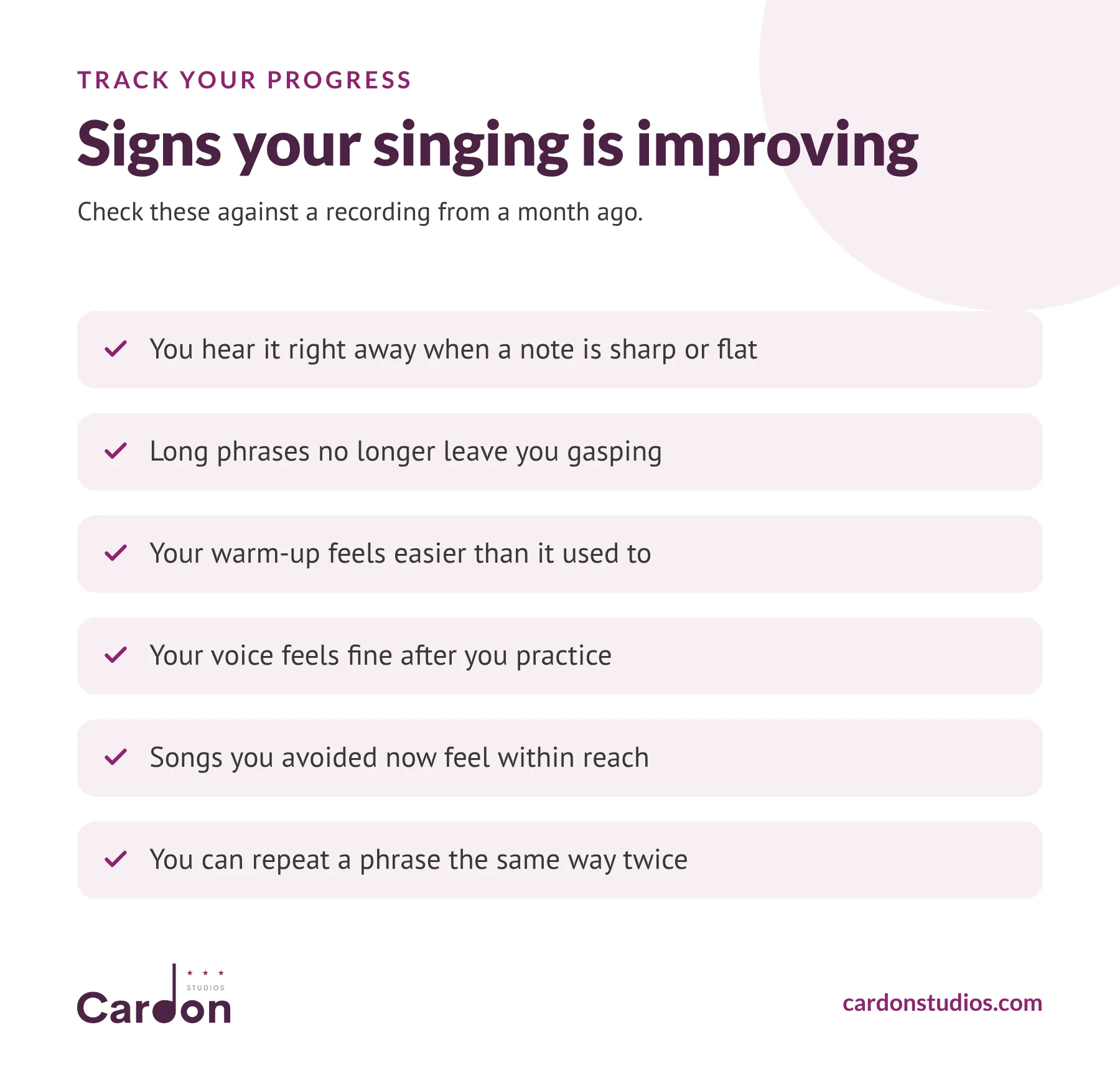
Other signs are easy to miss. Warm-ups feel easier, your voice feels fine after practice, and you catch your own mistakes faster. If pitch is your main hurdle, our step-by-step guide to singing in tune has exercises to track.
How to learn to sing faster (without rushing your voice)
You can’t force your voice to change overnight, but you can stop wasting practice time. These habits make the same hours count for more.
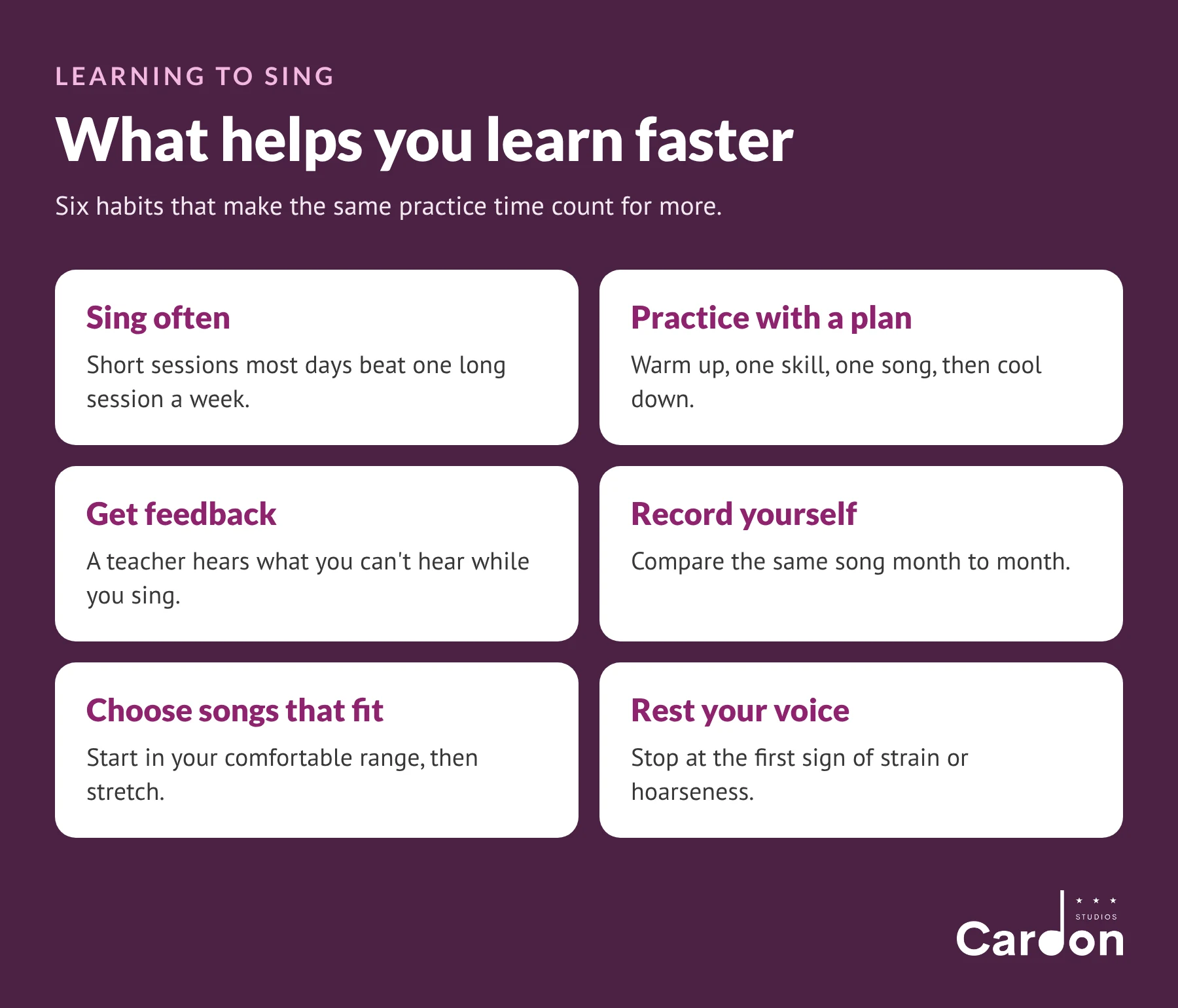
- Sing most days. Even a short session keeps your coordination fresh.
- Practice one thing at a time. A single clear goal per session beats running through everything.
- Get expert ears on your voice. A teacher can hear tension or a habit you can’t feel and give you an exercise to fix it. Read whether singing lessons are worth it.
- Choose songs that fit your voice now. Build confidence in your comfortable range before stretching it.
- Learn some musicianship. Reading rhythms and hearing intervals makes every new song quicker to learn. Try our guide to musicianship for singers.
- Rest when you need it. Practicing through hoarseness sets you back. A rest day is part of the plan.
Rushing tends to backfire. Pushing for high notes or volume before your coordination is ready can lead to strain, and strain means time off. Patient, steady work is the faster route in the end.
Learning to sing as a teen or adult
It’s never too late to start. Adults often learn quickly because they practice with purpose and know what they want from singing. Teens can make great progress too, though a voice that’s changing during puberty may need gentler goals for a while. Our guide to learning to sing as an adult covers what to expect when you start later.
Whatever your age, the same principles apply: start in your comfortable range, sing often, get feedback and be patient with the process. If you’re brand new, begin with our singing tips for beginners.
Listen to your voice
Learning to sing should never hurt. Stop and rest if you feel pain, tightness or a scratchy throat, or if you’re hoarse after practice. According to the National Institute on Deafness and Other Communication Disorders, you should see a doctor if your voice has been hoarse for more than three weeks. An otolaryngologist (ear, nose and throat doctor) can examine your vocal folds. For everyday care, see our guide to vocal health for singers.
From the studio
The fastest way to learn is with a teacher who hears your voice regularly. In private, live online lessons over Zoom, your teacher is matched to your style, goals, age and schedule, and builds your practice plan around where your voice is now. Between lessons, you can rewatch your lesson recordings and send a video of a song or exercise for feedback from your teacher within two business days.
Online voice lessons
Make every week of practice count
One monthly membership includes four private online voice lessons, one video coaching submission, the Learning Library, and member online events, with a teacher matched to your style, goals, age, and schedule.
Common questions about how long it takes to learn to sing
How long does it take to get good at singing?
It depends on what “good” means to you. Singing a favorite song on pitch and with confidence often takes a few months of regular practice. Advanced skills, such as a wide, even range or audition-ready performance, usually take years of steady training.
How long does voice training take?
Voice training doesn’t have a fixed end point. Most singers notice early changes within weeks, build solid basics over months, and keep refining technique for as long as they sing. Regular practice and feedback make the biggest difference to the pace.
How long should I practice singing a day?
For most beginners, a focused session of about a quarter of an hour on most days is a good start. As your voice gets stronger, you can build up to half an hour or more. Stop sooner if your voice feels tired, and take at least one rest day a week.
Can you learn to sing as an adult?
Yes. Adults learn to sing all the time, and they often practice with clear goals that help them progress. Research suggests singing accuracy is linked to training and use, not just childhood talent.
Can anyone learn to sing?
Most people who think they can’t sing can learn to sing more in tune with practice. Missing notes is often a matter of training the link between hearing a note and singing it. See our guide to whether anyone can learn to sing.
Do you need lessons to learn to sing?
You can make progress on your own with a good routine and recordings. A teacher speeds things up by catching habits you can’t hear, choosing exercises for your voice and keeping your technique healthy. Many singers combine both.