

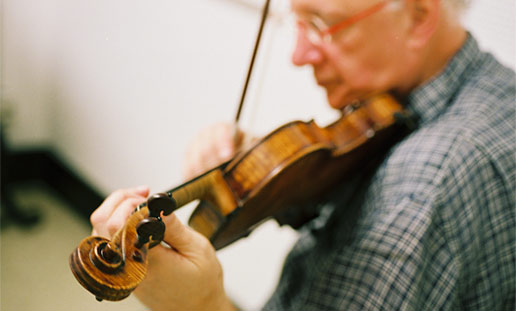
“I wish I’d learned to sing when I was younger.” If you’ve ever said that, here’s the good news: it isn’t too late. Adults learn to sing all the time, and they often bring strengths that make them excellent students. Whether you’re starting from scratch or returning after years away, here’s what adult singers bring to lessons, what to expect, and how to get started.
Key takeaways
- There’s no age at which you can no longer learn to sing better.
- Adults bring motivation, understanding, focus, and clear goals to lessons.
- Progress may feel awkward at first, and that’s a normal part of learning.
- Singing with others, online or in a choir, adds connection and confidence.
Why it’s never too late
A common misconception is that you eventually reach an age where you can’t learn to sing well. It isn’t true. Singing is a skill built from coordination, listening, and practice, and those can be developed at any stage of life. You may not learn exactly the way a child does, but you can absolutely improve, and many adults find singing one of the most rewarding things they’ve ever taken up.
What adult learners bring
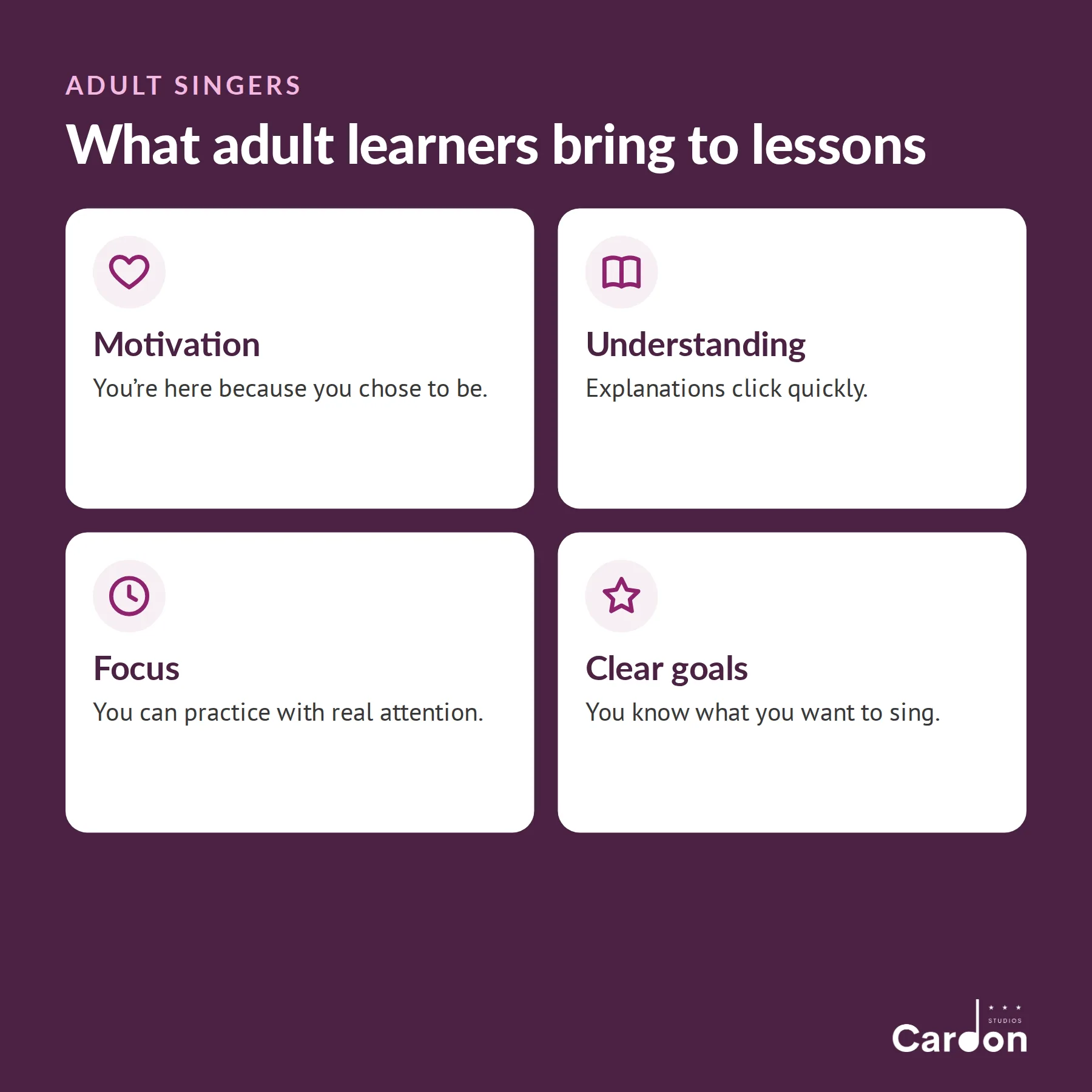
- Motivation. Children are often persuaded to go to lessons. Adults go because they decided to, which makes lessons more enjoyable for everyone.
- Understanding. Adults tend to grasp explanations and musical concepts quickly. Understanding why an exercise works makes practice far more effective.
- Focus. Mindful practice takes concentration, and adults can bring real attention to every repetition.
- Clear goals. You usually know what you want: a song to sing well, a choir to join, a stage to step onto, or simply the joy of singing.
What to expect as an adult beginner
Expect progress, and expect some awkwardness along the way. If you’ve ever learned a new language as an adult, you know the feeling: you understand more than you can do at first. Your voice may feel unfamiliar as you try new coordinations, and that’s a sign you’re learning, not a sign you can’t.
Many adults also carry old habits or old beliefs about their voice, like being told they couldn’t sing. A good teacher meets you where you are and builds from there. Our article on going from “tone deaf” to talented explains why most people can learn to sing in tune.
Fitting lessons into adult life is easier than it used to be. Online lessons remove the commute, and short practice sessions fit around work and family. If time is tight, our guide to balancing singing with a day job shows how.
Singing with other people
Making new friends as an adult can be hard, and music is a wonderful way to connect. Group classes, choirs, and open mics bring together people of every age and background who share a love of singing. You’ll learn from hearing others, gain confidence by singing for a supportive audience, and enjoy the music more because you’re sharing it.
If performing feels intimidating, start by listening. Many people watch a few open mics or group classes before they sing, and that’s completely fine.
How to get started
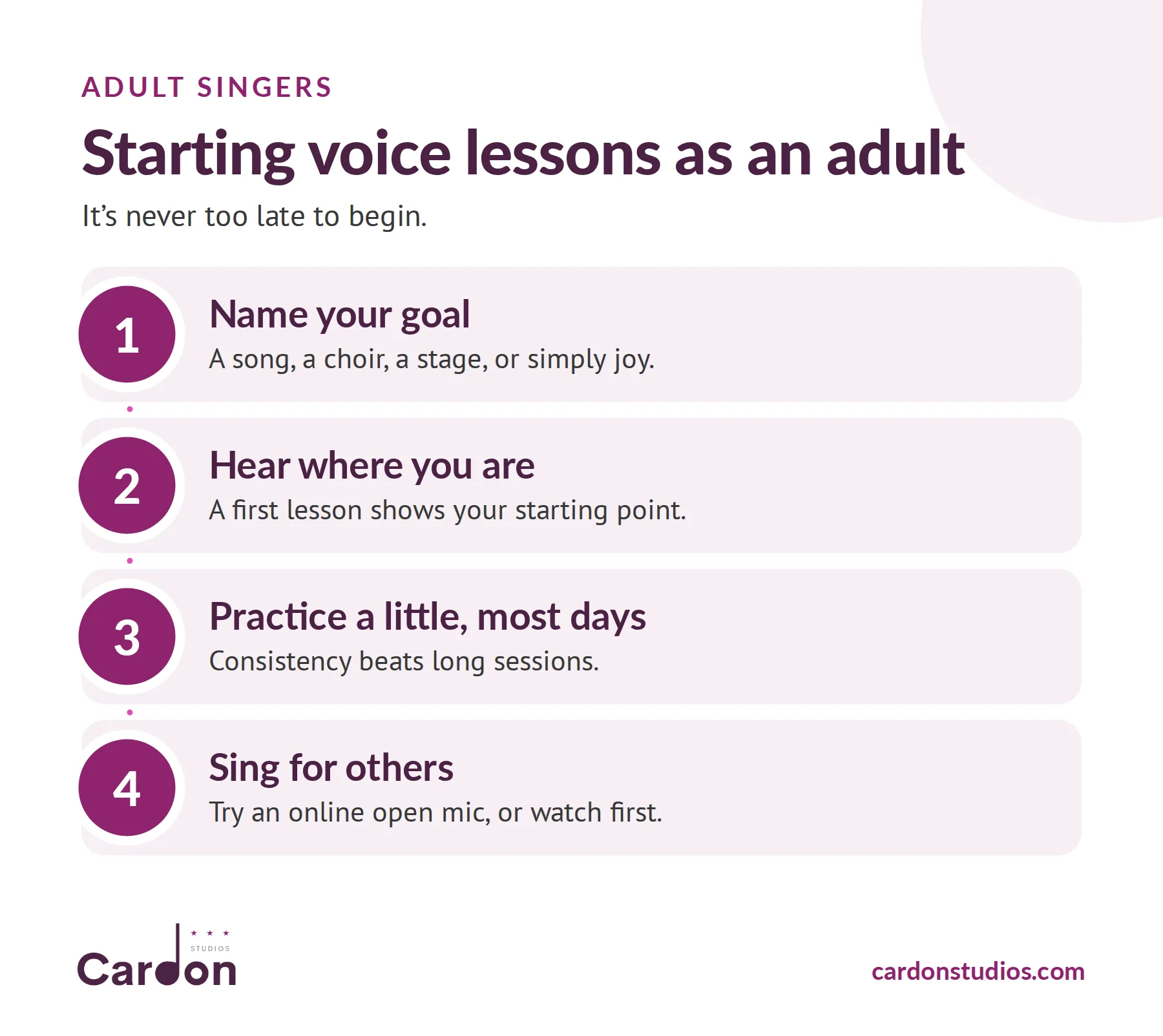
- Name your goal. A song, a choir, a stage, or simply the joy of singing well.
- Hear where you are. A first lesson shows your starting point and gives you a plan.
- Practice a little, most days. Consistency matters more than long sessions; see how to practice between lessons.
- Sing for others. Try an online open mic or group class when you’re ready, or watch first.
Not sure where to begin? Our beginner’s roadmap walks you through your first weeks.
Returning to singing after years away
Many adults sang in a school choir, a musical, or a band years ago and want to come back. If that’s you, expect your voice to feel familiar and unfamiliar at once. Your range, tone, or stamina may have changed, and old habits may resurface. Start gently, rebuild your warmup and breath support, and give your voice time to wake up. Returning singers often find the music comes back quickly once they’re practicing regularly again, because so much of their musical understanding is still there.
Your voice changes with you
Voices keep changing gradually throughout adult life, sometimes in response to hormones or health. That isn’t a reason to stop; it’s a reason to keep singing and to get to know the voice you have now. If you notice persistent hoarseness, pain, or sudden changes, see a doctor. Our guide to vocal health for singers covers everyday habits that help.
Goals adult singers often set
- Singing a favorite song with confidence.
- Joining a community or church choir.
- Auditioning for a community theater production.
- Singing at a family celebration, an open mic, or a karaoke night.
- Simply enjoying music more, for its own sake.
From the studio
Cardon Studios works with singers ages 10 and up, including adults fitting singing around busy lives. You’re matched with a teacher by your style, goals, age, and schedule, lessons are live and one-on-one online, and member online events, including open mics, group classes, and recorded showcases, give you a friendly place to sing for others.
Online voice lessons
It’s not too late to start
One monthly membership includes four private online voice lessons, one video coaching submission, the Learning Library, and member online events, with a teacher matched to your style, goals, age, and schedule.
Common questions from adult singers
Is it too late to learn to sing at 30, 40, or 50?
No. Adults of every age learn to sing better with good guidance and regular practice. Your starting point and pace are personal, but improvement is possible at any age.
Can adults really learn to sing in tune?
Most can. True tone deafness is uncommon, and pitch trouble is often a matter of coordination and practice rather than hearing.
How long until I see progress as an adult beginner?
It varies. Many adults notice small changes in the first few weeks, like a phrase that feels easier, with bigger progress building over months of regular practice.