


Vocal gymnastics is an informal term for agile, athletic singing: fast runs and riffs, big leaps across your range, and quick shifts between registers and styles. Like a gymnast, a singer builds that agility through strength, flexibility, and coordination over time, not by forcing it.
This guide focuses on one of the most useful kinds of vocal gymnastics: cross-training your voice so you can move between different singing styles. You’ll learn what each style asks of your voice, how to build the baseline technique that makes switching possible, and a simple practice plan for trying a new style without strain.
Key takeaways
- Vocal gymnastics means agile, flexible singing: runs, leaps, register shifts, and moving between styles with control.
- Your voice is one instrument. Every style is built on the same healthy basics: easy posture, steady breath, and clean, balanced onsets.
- Styles differ mostly in register balance, vowel shape, onset, phrasing, and vibrato, which you can learn by careful listening.
- Practice a new style one change at a time, at a comfortable volume, and stop if anything hurts.
What vocal gymnastics means
You won’t find “vocal gymnastics” in a textbook as a formal technique. Singers and teachers use it, along with “vocal acrobatics,” to describe singing that shows off agility and control: a quick riff that lands cleanly, a leap from a low note to a high one, a phrase that moves from a soft head voice into a full belt, or a performer who can sing a classical piece and a pop song on the same night.
Sometimes the phrase is used as a criticism, for singers who add so many runs and flourishes that the song gets lost. That’s worth remembering. Agility is a tool, and the goal is always to serve the music and the story. A singer with real vocal flexibility can choose a simple, plain line as easily as an ornamented one.
The gymnastics comparison fits in another way, too. Gymnasts don’t start with their hardest routine. They spend years building strength, balance, and flexibility, and they learn each skill in small steps. Your voice works the same way: control comes first, and the impressive moves grow out of it.
Why learn more than one style
A ballet dancer often trains in modern or jazz dance as well, and the extra training makes them a more complete mover. Singers are taking the same approach more and more. Many modern musicals draw on pop, rock, gospel, and other contemporary styles, so theater singers are often asked to move between a legit, classical-leaning sound and a contemporary belt within a single show. Choirs sing everything from early music to pop arrangements, and many working singers perform in more than one genre.
You don’t need professional goals to benefit. Maybe you love singing with a classical chorus but also want to sing your favorite pop songs at karaoke night. Maybe you’re a musical theater kid who wants to try jazz, or a pop singer who wants the breath control that classical training builds. Here’s what cross-training gives you:
- Better control. Each style exercises a different balance of registers, resonance, and breath, so working in several styles fills gaps in your technique.
- A bigger palette. Once you know how to make a brighter, breathier, darker, or more speech-like sound on purpose, you can use those colors in any song.
- More opportunities. Auditions, choirs, bands, and showcases welcome singers who can adapt.
- Clearer self-knowledge. Trying many styles is one of the best ways to discover the one that feels most like you.
One voice, many styles
Dancers and gymnasts can switch styles because their whole body is trained and coordinated. The same can be true for your voice when you train every kind of coordination and spend time learning what each style asks for. Your voice is one instrument, and it works in one basic way: breath from your lungs sets your vocal folds vibrating, and the spaces above them shape that buzz into the sound people hear. If you’d like a short tour of the parts involved, read how your voice works.
That means your first goal, in any style, is producing sound efficiently. Start by working toward consistent, balanced vocal fold closure (not breathy, not pressed) and steady air pressure. Good singing posture and breathing set this up.
Next, depending on the styles you want to sing, build control and flexibility in each vocal register and practice moving between them smoothly. Most singers work with chest voice, head voice, a mix of the two, falsetto, and sometimes vocal fry or whistle tones at the extremes. Our guides to chest voice, head voice, and finding your mix cover each one.
From there, style is largely about shaping the space above your vocal folds. Singers call this the vocal tract: the whole passage from your folds up through your throat and mouth to your lips. Small changes in tongue position, mouth opening, larynx height, and soft palate change the color of your sound. When you understand how to adjust your vocal tract for the sounds you want, and learn to do it comfortably and safely, ideally with a teacher’s guidance, there’s no limit to how many styles you can sing convincingly.
Different singing styles and what each asks of your voice
Once you have a reliable baseline, these are the main differences to listen for among the different types of singing. They’re general starting points to build your listening vocabulary, not strict rules: every singer, song, and era varies.
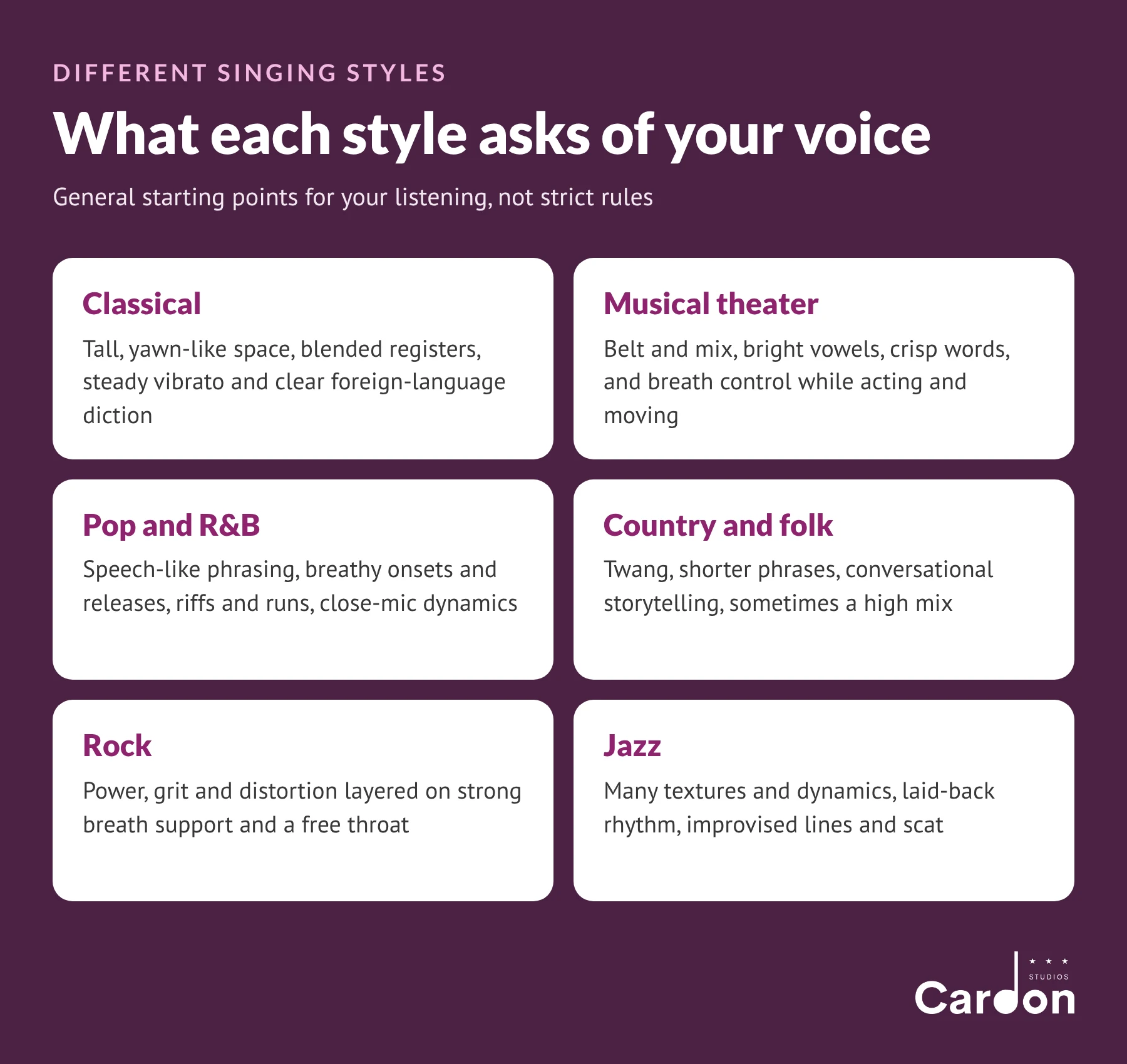
| Style | Listen for | Skills to build |
|---|---|---|
| Classical | A tall, yawn-like space, a generally lower larynx, blended registers, consistent vibrato | Long legato lines, even registers, clear diction in several languages |
| Musical theater | High mix or belt, bright vowels, often more nasal resonance than classical singing allows, crisp diction | Belt and mix, breath control while acting and dancing, telling the story through the words |
| Pop and R&B | Conversational phrasing, breathy onsets and releases, glottal scrapes, riffs and runs, sometimes a high mix or belt | Agility, microphone dynamics, light and heavy textures on demand |
| Country and folk | Twang, shorter phrases, more breathy tones, conversational phrasing, sometimes a high mix or belt | Speech-like delivery, twang without squeezing, storytelling |
| Rock and metal | Grit, growls, and screams layered on a strong sound, with big demands on breath support | Power with an easy throat, distortion learned slowly with expert guidance |
| Jazz | Lots of variety in vocal texture and dynamics, laid-back or back-beat phrasing, improvisation | Rhythmic freedom, scat, a wide palette of tone colors |
Rock’s gritty sounds are a good example of why it pays to learn carefully. A 2025 study in the Journal of Voice filmed six professional singers’ larynxes with high-speed cameras while they used distortion in rock, metal, pop, and throat singing. The researchers found more than one kind of distortion: in some, vibration in the region above the vocal folds shaped the sound, and in others the vocal folds themselves vibrated irregularly. In other words, “grit” isn’t one sound, and it’s made in different ways, so it’s best learned step by step. Our guide to vocal effects covers rasp, fry, and breathiness in more detail.
Even if you plan to focus on writing your own music, every singer can learn a lot from covering artists from different styles and time periods. Each one you study adds new vocal colors to your palette.
Want a teacher’s ear on your voice? Cardon Studios teaches private online voice lessons for singers ages 10 and up, live over Zoom with a teacher matched to your style and goals. See how lessons work
How to cross-train your voice, step by step
Cross-training works best in a set order: a reliable baseline first, then registers, then the style details. Use these steps whenever you start a new style, on your own or with an online vocal coach.
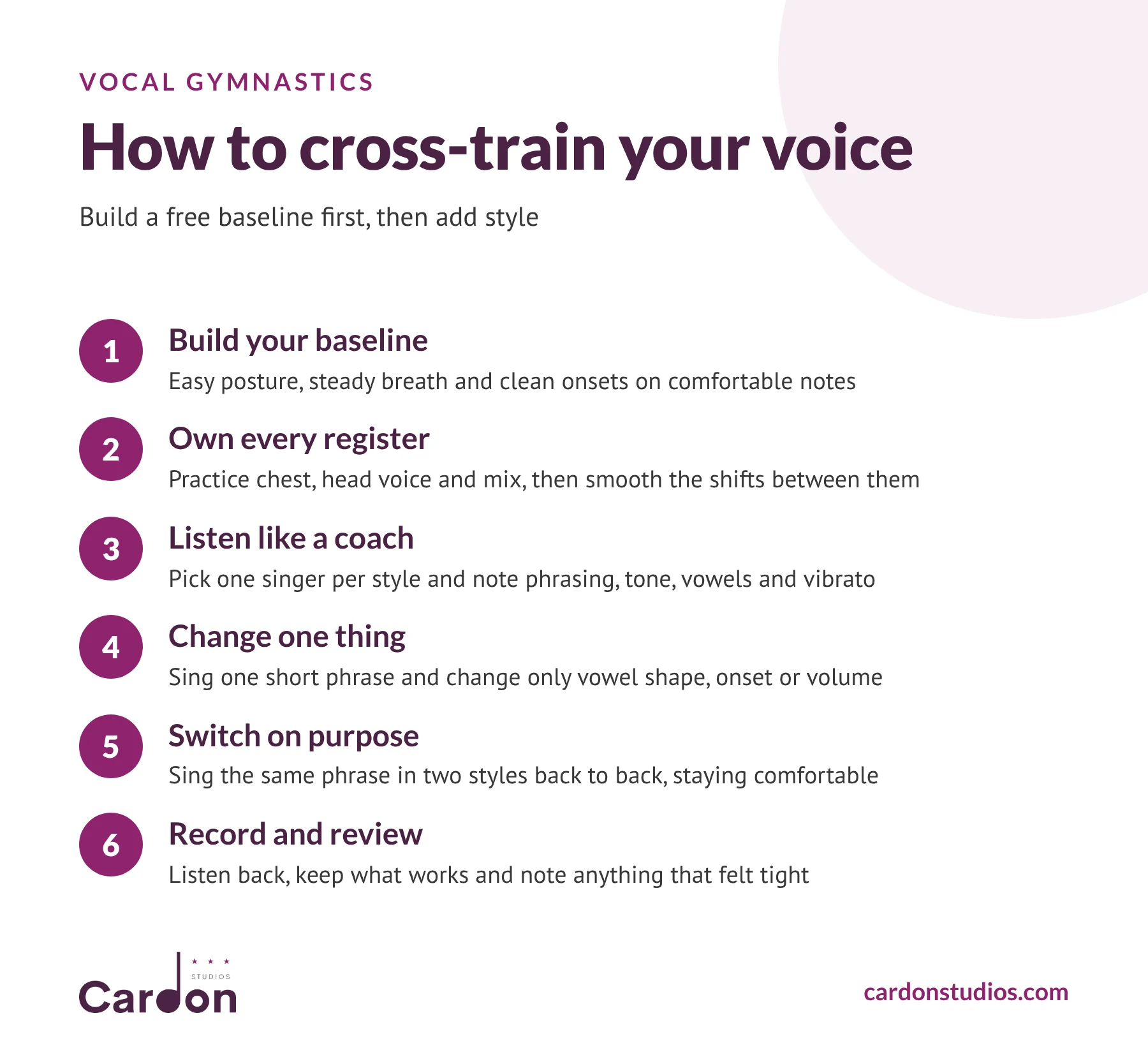
- Build your baseline. Begin every session with your usual vocal warm-up. Check your posture, take a low, easy breath, and sing a five-note scale (1-2-3-4-5-4-3-2-1) on “ah” in a comfortable middle range, three times, aiming for clean, balanced onsets.
- Own every register. Slide on “ng” or “ee” from a low comfortable note up into head voice and back down, five times, letting the sound change as it rises rather than pushing one quality upward. Then sing the same five-note scale in chest, head, and mixed voice.
- Listen like a coach. Choose one recording in the style you want to learn. Listen three times, each time for one thing: phrasing (where they breathe and how speech-like the line is), tone color (bright, dark, breathy, pressed), and ornaments (vibrato, slides, runs, cries).
- Change one thing. Take a short phrase you know well and sing it in your usual way. Then change only one element: a brighter vowel, a breathier onset, straight tone instead of vibrato, or more speech-like rhythm. Sing each version three times.
- Switch on purpose. Sing the same phrase in two styles back to back, for example classical then pop, five rounds, at a comfortable volume. Notice exactly what you change. The goal is to switch cleanly, not to sing loudly.
- Record and review. Record yourself and listen back the next day. Keep what sounds like the style, and note anything that felt tight in your jaw, tongue, or neck.
A simple style-switching exercise
Pick a well-known tune with no words, such as a simple folk melody you can hum, or just a five-note scale. Sing it four ways, twice each: as a classical singer (tall space, gentle vibrato, legato), as a musical theater singer (brighter vowels, speech-like and forward), as a pop singer (softer onset, a little breath, straight tone), and as a country singer (light twang, conversational). Stay in a comfortable range and volume. If one version feels harder, spend your next practice on that one alone.
A weekly style-switching plan
You don’t need hours of practice to cross-train. A short, regular routine works better than an occasional long one. Here’s a sample week for a singer who mainly sings one style and wants to add a second.
| Day | Focus | What to do |
|---|---|---|
| Day 1 | Baseline | Warm up, then five-note scales on “ah” and “oo” in chest, head, and mix |
| Day 2 | Listening | Study one recording in your new style; write down three things you hear |
| Day 3 | One change | Sing a short phrase, changing only one element; three rounds per version |
| Day 4 | Rest or light practice | Gentle humming and slides only |
| Day 5 | Switching | Sing the same phrase in both styles back to back, five rounds |
| Day 6 | Song work | Learn a song in the new style; record one run-through |
| Day 7 | Review | Listen to your recording and choose next week’s single change |
For more on building a routine that sticks, read our guide to practicing singing between lessons.
How to find your own singing style
Cross-training is also one of the best ways to find your own style. As you try different styles, notice three things: which songs you keep coming back to, which sounds feel easy and natural in your body, and which performances make you lose track of time. Your style usually lives where those three overlap. It can also blend genres. Many singers settle into a personal sound that borrows phrasing from one style and tone color from another.
Switching styles safely
New styles ask your voice to do new things, so take them slowly. A sound that’s new to you will feel unfamiliar at first, but it shouldn’t feel painful, scratchy, or tight. Use this checklist before you add a new sound to your singing.
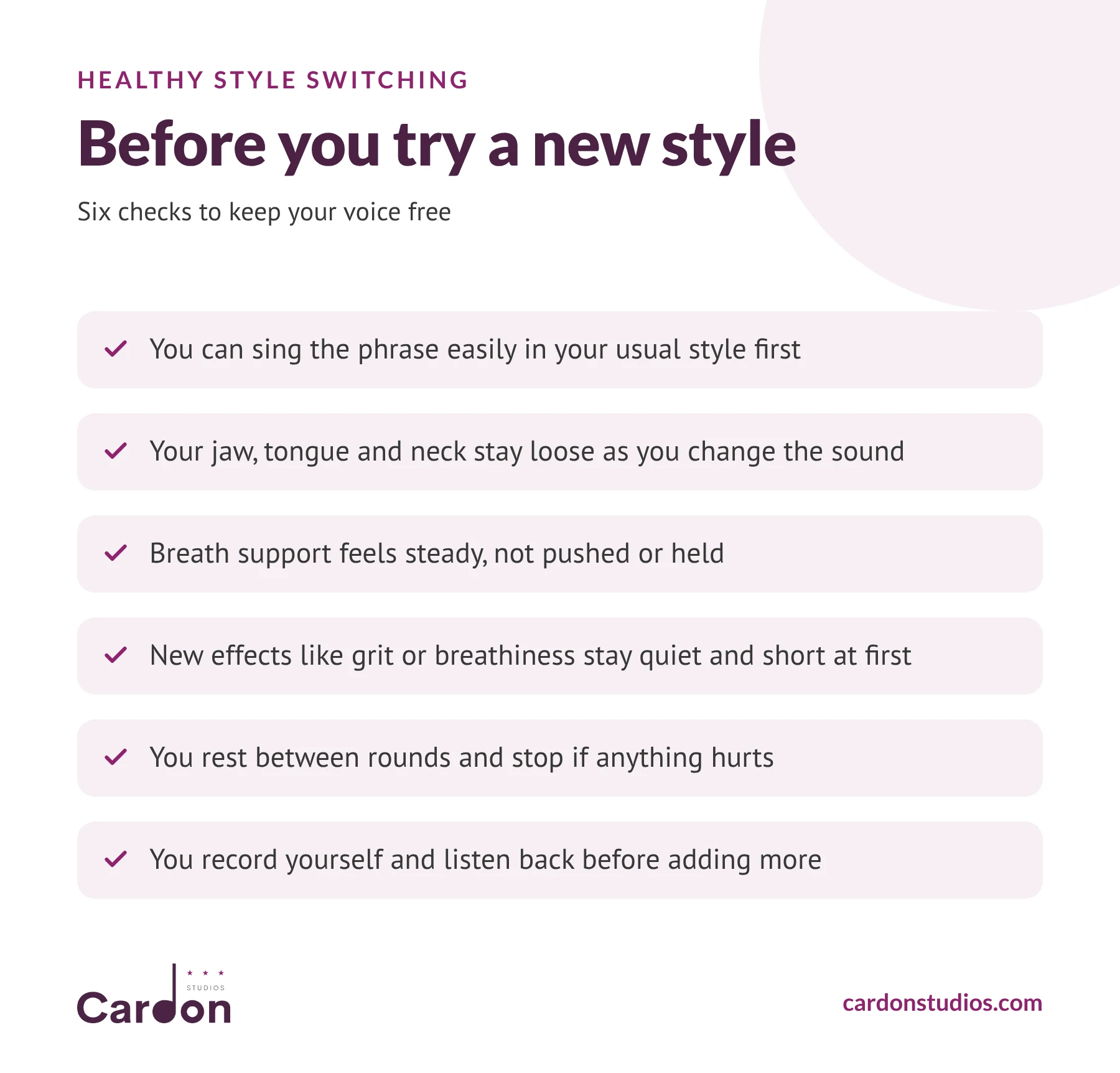
- Start from comfort. Make sure you can sing the phrase easily in your usual style before you change it.
- Watch for tension. Your jaw, tongue, and neck should stay loose as you change the sound. Our guide to releasing tension when singing shows where tension tends to hide.
- Keep breath steady. Bigger styles, like belting and rock, need more breath energy, not more throat squeeze. If you’re pushing, back off the volume.
- Go small with effects. Practice grit, breathiness, or cries quietly and briefly at first, and add them to whole phrases only when they feel easy.
- Rest between rounds. Alternate new sounds with your usual singing, and take breaks.
- Get feedback. A teacher can hear things you can’t, especially with high belting and distortion. Our step-by-step guide on how to belt is a good place to start for theater and pop.
Listen to your voice
Trying a new style should never hurt. If singing causes pain, or your voice feels tight, scratchy, or hoarse afterward, stop, rest, and go back to sounds that feel easy. According to the National Institute on Deafness and Other Communication Disorders, you should see a doctor if your voice has been hoarse for more than three weeks. For everyday care, see our guide to vocal health for singers.
From the studio
Whether you’re ready to explore the details of different styles or need a little help getting started, a teacher makes the journey easier. Cardon Studios matches each student with a teacher who fits their style, goals, age, and schedule, and lessons are live, private, and online. Between lessons, you can send a video of a song in your new style for a personalized response from your teacher within two business days.
Online voice lessons
Learn to sing any style with a teacher
One monthly membership includes four private online voice lessons, one video coaching submission, the Learning Library, and member online events, with a teacher matched to your style, goals, age, and schedule.
Common questions about vocal gymnastics and singing styles
What does vocal gymnastics mean?
Vocal gymnastics is an informal term for agile, athletic singing: fast runs and riffs, wide leaps, quick register shifts, and the ability to move between styles. It can be a compliment for a flexible singer, or a criticism when ornaments get in the way of the song.
What is vocal acrobatics?
Vocal acrobatics is another name for the same idea: showy, agile singing with runs, leaps, and quick changes in tone or register. Like vocal gymnastics, it works best when it’s built on solid technique and used to serve the music.
What are the different types of singing styles?
Common singing styles include classical, musical theater, pop, R&B, country, folk, rock, and jazz, plus many more such as gospel and choral singing. They differ in register balance, vowel shape, onsets, phrasing, and vibrato, but all of them rely on the same healthy basics.
Can you sing more than one style without hurting your voice?
Yes, if you build a healthy baseline first and learn each style gradually. Keep new sounds comfortable, rest between practice rounds, and stop if anything hurts. Effects like distortion are best learned with a teacher.
How do I find my singing style?
Try singing in several styles and notice which songs you return to, which sounds feel natural in your body, and which performances you enjoy most. Your style often sits where those overlap, and it can blend more than one genre.