

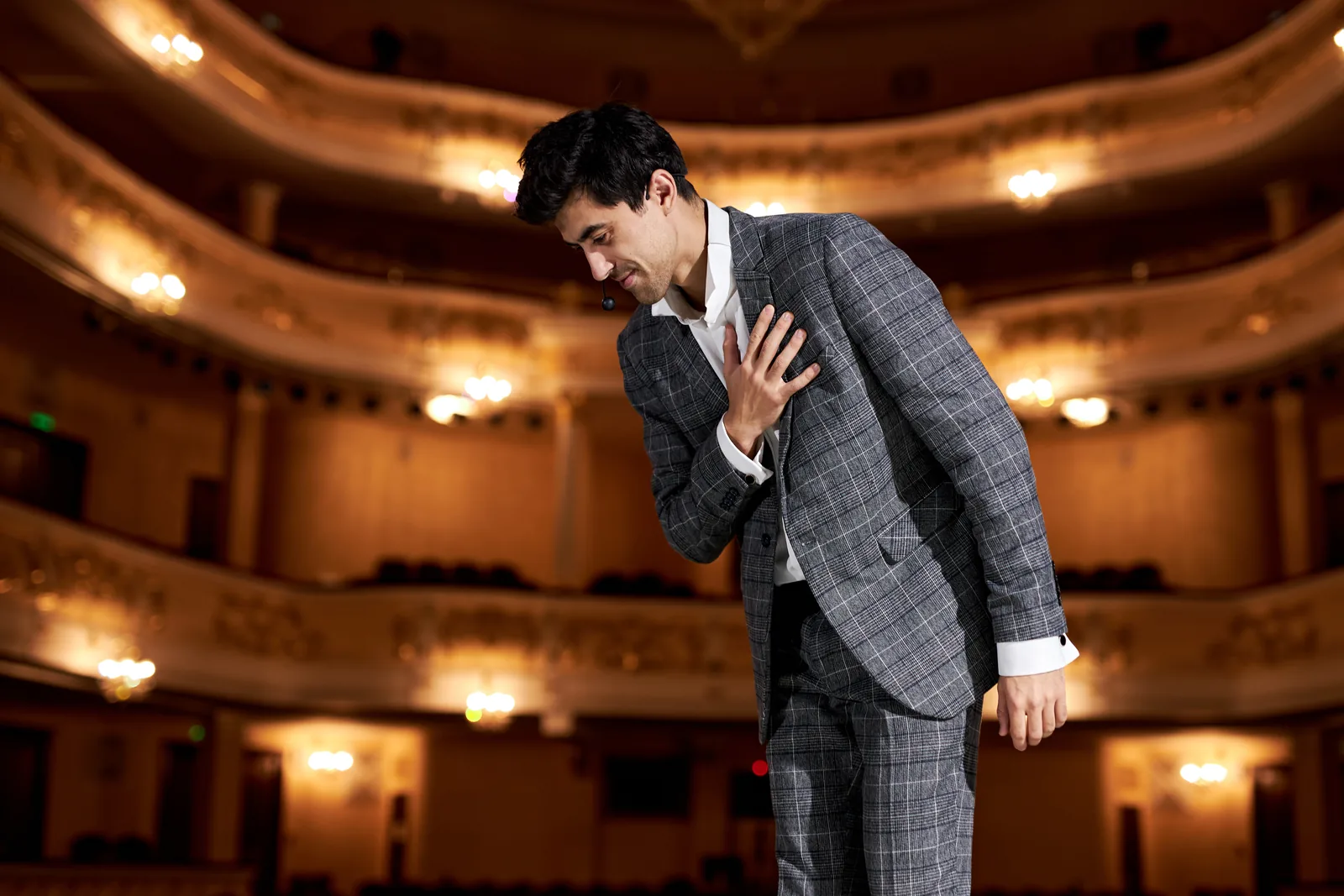
To sing opera, you train classical vocal technique: a tall, balanced posture, a low breath managed with steady support, a resonant, ringing tone that carries without a microphone, smooth legato phrasing, and clear vowels in languages such as Italian, German and French. Most singers start with a classically trained teacher and simple art songs, then build range, stamina and repertoire gradually. Operatic voices take years to mature, so patience and healthy habits matter as much as talent.
Key takeaways
- Opera singing is unamplified, so it depends on resonance and efficient technique rather than force.
- Trained operatic voices carry partly because of a concentration of energy called the singer’s formant.
- Breath support, legato, pure vowels and foreign-language diction are core skills.
- Start with art songs and a classical teacher; operatic voices develop over many years.
What makes opera singing different
The biggest difference is that opera singers aren’t amplified. They’re heard over a full orchestra in large halls using only their voices. According to the National Center for Voice and Speech, an orchestra’s sound energy is strongest around 500 Hz and falls off at higher frequencies, while a well-trained operatic voice produces a concentration of energy around 3,000 Hz, known as the singer’s formant. That band of energy helps the voice cut through without simply being louder.
Classical singing also emphasizes:
- Legato: long, smooth, connected lines, with each note flowing into the next.
- Consistent tone: an even color from the bottom of the range to the top.
- Vibrato: a natural vibrato through most sustained notes. See our guide to vibrato.
- Languages: repertoire in Italian, German, French, English and other languages, sung with careful diction.
- Stamina: whole roles, sometimes for hours, without amplification.
Classical singing vs. contemporary singing
Classical singing is the trained, unamplified style used for opera, art song and much choral music, while contemporary styles such as pop, rock and musical theater are usually built around a microphone and a speech-like sound. Both use the same instrument and the same healthy basics, but they balance them differently.
| Feature | Classical singing | Contemporary singing |
|---|---|---|
| Amplification | Unamplified; resonance carries the voice | Usually amplified; the microphone handles volume |
| Tone | Rounded, ringing and even from bottom to top | Closer to speech; the color changes with the style |
| Vowels | Tall, pure vowels, adjusted gradually as the pitch rises | Speech-like vowels, often brighter or wider |
| Higher notes | The tone rounds and the vowel shifts to keep the line even | Mix and belt, which keep a brighter, more speech-like sound |
| Vibrato | Present through most sustained notes | Varies; straight tones are common, with vibrato added at phrase ends |
| Language | Italian, German, French, English and more, often learned with IPA | Mostly the singer’s own language |
If you already sing pop or musical theater, expect the biggest adjustments in your vowels and in how you approach high notes. Belting and a speech-like mixed voice keep a brighter sound as you rise, while classical singing rounds the tone and adjusts the vowel so the line stays even. Many singers practice both styles; what matters is knowing which coordination you’re using and switching on purpose.
A simple way to hear the difference: sing a short, comfortable phrase twice, first as you’d speak it, then with taller vowels, a smooth legato line and a rounder tone. Record both and compare them. The second version points in the direction classical training takes, developed gradually over years.
How to start singing opera
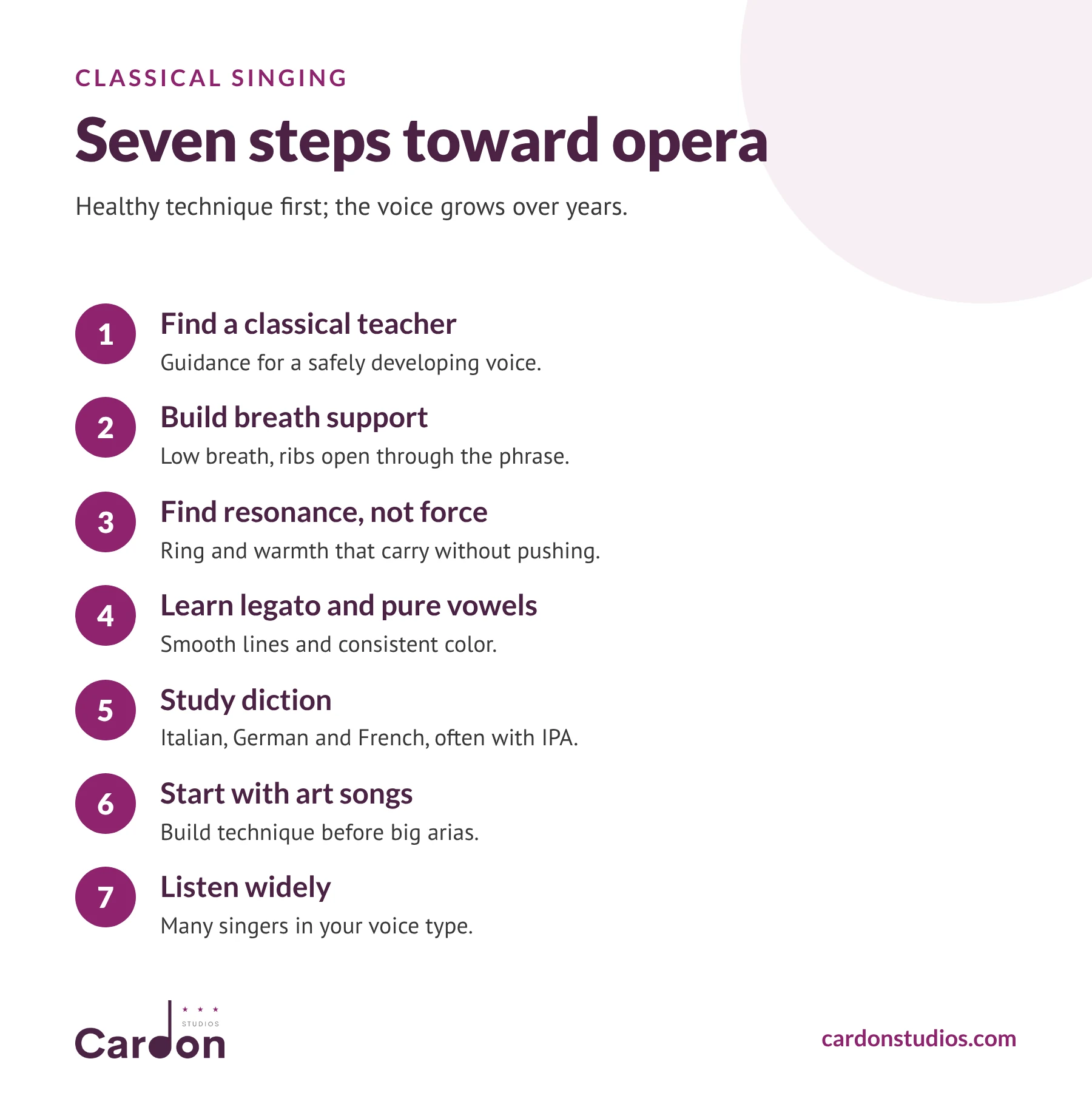
- Find a classically trained teacher. Classical technique is detailed and physical, and it’s hard to learn from recordings alone. A teacher can guide your voice safely as it develops.
- Build breath support. Classical singers often describe appoggio, leaning into the expansion of the ribs and resisting letting them collapse until the end of the phrase. Start with our breathing primer and what breath support really is.
- Find resonance, not force. Look for a bright, ringing quality balanced with depth and warmth. Projection should come from resonance, not pushing; see vocal projection.
- Learn legato and pure vowels. Practice moving smoothly between notes and keeping vowels clear and consistent, especially as you go higher.
- Study diction. Many classical singers learn the International Phonetic Alphabet, or IPA, to pronounce Italian, German and French accurately. Start with Italian, whose open, pure vowels suit classical singing.
- Start with art songs. Simple classical songs build technique before full operatic arias.
- Listen widely. Listen to many recordings of classical singers in your voice type, and notice their phrasing, tone and diction, without trying to copy one singer exactly.
Classical exercises to practice
Warm up first, keep the volume moderate, and stop if your voice feels tired.
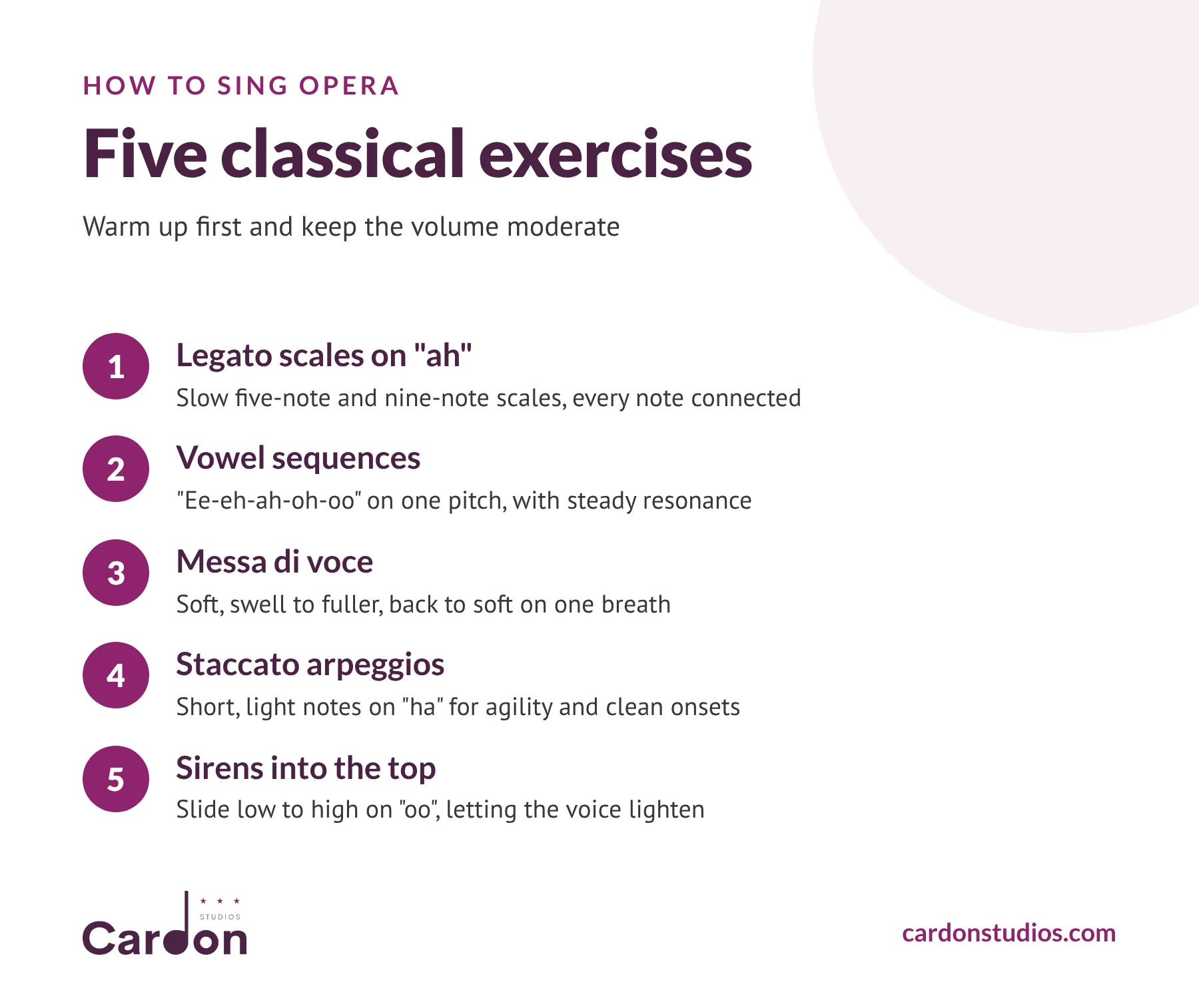
1. Legato scales on “ah”
Sing five-note and nine-note scales slowly on “ah,” connecting every note. Aim for an even tone with no bumps between notes.
2. Vowel sequences
On one pitch, sing “ee-eh-ah-oh-oo” without stopping the sound. Keep the resonance and tone steady as the vowel changes. This builds the consistent color classical singing needs.
3. Messa di voce
On a comfortable note, start softly, swell to a fuller sound and return to soft, all on one breath. It’s a classic exercise for breath control and tone.
4. Staccato arpeggios
Sing short, light, detached notes on “ha” or “ah” up and down an arpeggio. This builds agility and a clean, efficient onset.
5. Sirens into the top
Slide gently from low to high and back on “oo,” letting the voice lighten as it rises. Classical high notes come from a coordinated, lighter upper range; see our guide to head voice.
Operatic voice types
Classical singing classifies voices in detail, based on range, weight and color. Opera houses sometimes use a German system called Fach, which groups voices and the roles that suit them.
| Voice type | General description |
|---|---|
| Soprano | The highest voice type, from light, agile coloratura voices to fuller lyric and dramatic voices |
| Mezzo-soprano | A middle female voice with a warmer, darker color than most sopranos |
| Contralto | The lowest female voice, rich and dark |
| Countertenor | A male voice singing in a high range, usually using a developed head voice |
| Tenor | The highest common male voice, from light lyric tenors to heavier dramatic tenors |
| Baritone | The middle male voice, between tenor and bass |
| Bass | The lowest male voice, deep and resonant |
Don’t rush to label yourself. Young and developing voices often change, and a teacher can help you find your type over time. Our guide to voice types and vocal range covers the basics.
Where to start with repertoire
Many classical teachers start students with Italian art songs, which are short, melodic and excellent for building legato and pure vowels. From there, singers often add English and American art songs, simple German songs, and eventually arias suited to their voice type and level.
- Choose songs that sit comfortably in your current range.
- Learn the translation of every word, so you can sing with meaning.
- Speak the text in rhythm before singing it, to settle the diction.
- Save heavy, dramatic arias for when your voice is ready.
As you progress, your teacher can help you choose arias that suit your voice type and level, and prepare for recitals, competitions or college auditions. See preparing for college auditions if a music degree is on your horizon.
Opera myths
Four common beliefs put many beginners off classical singing. Here’s what’s true.
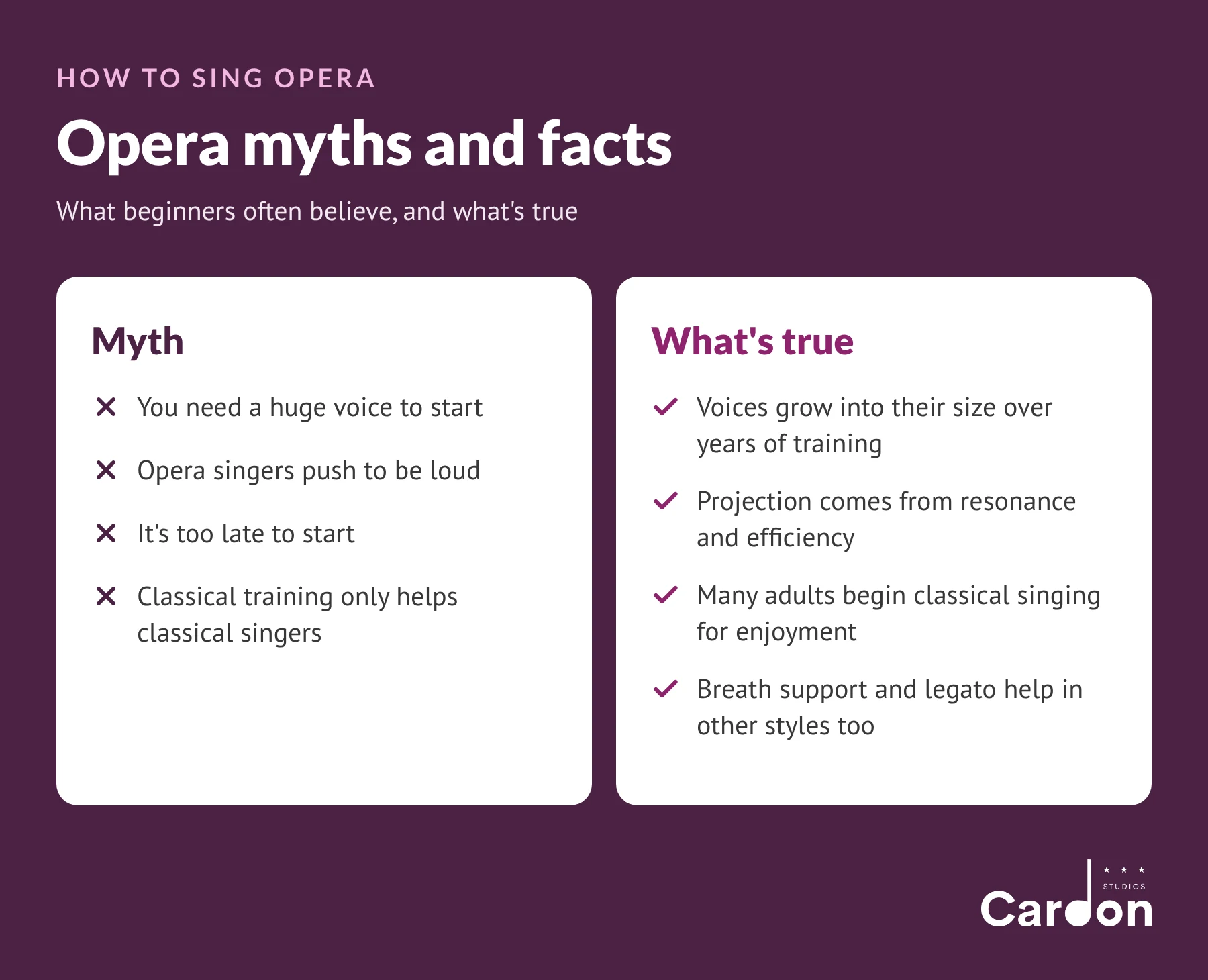
- “You need a huge voice to start.” Most voices grow into their full size over years of training. Start with healthy technique.
- “Opera singers push to be loud.” Classical projection comes from resonance and efficiency, not force.
- “It’s too late to start.” Many adults begin classical singing for enjoyment. See voice lessons for adults.
- “Classical training only helps classical singers.” Many singers find that classical skills, such as breath support and legato, strengthen their singing in other styles too.
Listen to your voice
Classical singing should feel strong but never strained. If singing hurts or your voice stays hoarse, rest. According to the National Institute on Deafness and Other Communication Disorders, see a doctor if your voice has been hoarse for more than three weeks.
From the studio
Cardon Studios teachers work with singers across styles, including classical and opera, and every singer is matched with a teacher by style, goals, age and schedule. In a live online lesson, your teacher can guide your breath, resonance and diction step by step. Lessons are recorded so you can rewatch them, and between lessons you can send a video and get a personalized response within two business days.
Online voice lessons
Begin your classical training
One monthly membership includes four private online voice lessons, one video coaching submission, the Learning Library, and member online events, with a teacher matched to your style, goals, age, and schedule.
Common questions about opera singing
Can anyone learn to sing opera?
Most people can learn classical technique and enjoy singing classical music. Singing opera professionally takes years of training, a voice suited to the repertoire, and a lot of dedication.
How long does it take to learn to sing opera?
Operatic voices develop over many years. You can start singing classical songs well much sooner, but full operatic roles usually come after long, gradual training.
How do opera singers sing so loud without a microphone?
Mostly through resonance and efficient technique rather than force. Trained operatic voices concentrate energy around 3,000 Hz, the singer’s formant, which helps them carry over an orchestra.
Do I need to speak Italian to sing opera?
No, but you need to pronounce it accurately and understand what you’re singing. Many singers learn diction through the International Phonetic Alphabet and word-by-word translations.
How do you become an opera singer?
Most professional opera singers study voice for many years, often through a college or conservatory voice program, while building classical repertoire and language skills. They gain stage experience through recitals, competitions, choruses and training programs, then audition for roles. Begin with a classical teacher and art songs, and let your voice develop at its own pace.
What are good opera vocal exercises for beginners?
Start with slow legato scales on “ah,” vowel sequences on one pitch, gentle sirens on “oo,” and the messa di voce, a swell and fade on one note. Keep the volume moderate and practice them after a warm-up. The exercises section above explains each one.
Can I learn opera singing online?
Yes. Live online lessons let a classical teacher hear and guide your voice in real time, and recordings help you review between lessons. A good audio setup makes a big difference.