

Mindfulness for singers means paying close, calm attention to what your body and breath are doing while you sing, without judging it. That body awareness is the first major step in learning to sing well: once you can feel your habits, you can release the tension that holds your voice back and practice with far less wasted effort.
You might think that singing is closer to an athletic feat than to a meditative practice, but think again. It’s true that the muscle coordination needed to sing at a high level takes real work. But if your mind and body aren’t listening to each other, that work goes in circles. This guide shows you how to build a mind-body connection you can use every time you practice and perform.
Key takeaways
- Mindfulness is attention to the present moment without judgment. For singers, it starts with noticing your body and breath.
- A quick body scan before you sing shows you where tension hides: jaw, tongue, shoulders, neck, knees and lower back.
- Notice a habit first, then experiment with letting it go. Awareness comes before change.
- Mindful practice means checking in between exercises, so every repetition builds the habit you want.
What mindfulness means for singers
The National Center for Complementary and Integrative Health describes mindfulness as maintaining attention or awareness on the present moment without making judgments (NCCIH). For a singer, the present moment is very physical: the breath coming in, the feeling of the sound, the muscles that help or get in the way.
That last part is why mindfulness matters so much in singing. Your instrument is your body. You can’t see your vocal folds or watch your tongue while you sing, so you learn to play this instrument mostly by feel and by ear. The more clearly you can feel what is happening, the more choices you have about what happens next.
Mindfulness for singers isn’t about emptying your mind or sitting still for a long time. It’s about bringing curious attention to the work you’re already doing. You notice, you name what you notice, and you decide whether to keep it or let it go. Over time, that loop of noticing and choosing becomes the way you practice.
It also changes how you treat yourself. When you notice a cracked note or a tight high note without judging it, you can treat it as information rather than as proof that you can’t sing. That kinder, clearer attention is what makes steady improvement possible.
Body awareness: getting to know your instrument
What do we mean by body awareness? Try this now. Take a deep breath. What did you feel?
If you can’t answer that question in a clear, specific way, this is a great starting point for you. Try again, breathing deeply, and this time listen and feel more closely. Ask yourself:
- Did your belly expand, or did your chest and shoulders rise?
- Did you feel any tension in your jaw, tongue or throat?
- Did you breathe in through your mouth or through your nose?
- Are you standing or sitting tall, or slumping?
- Are your knees locked straight?
Any observation, no matter how small, is useful in getting to know your body, your instrument. There are no wrong answers here. The goal is simply to notice what you already do, so you have something real to work with.
Once you’re familiar with what your habits feel like, you can start to dismantle them and understand which changes might help. This is the order that works: awareness first, change second. Trying to fix a habit you can’t yet feel usually just trades one kind of tension for another.
Body awareness exercises for singers
These body awareness exercises take very little time and need no equipment. Do one or two at the start of every practice session. Stay comfortable throughout, and stop if anything hurts.
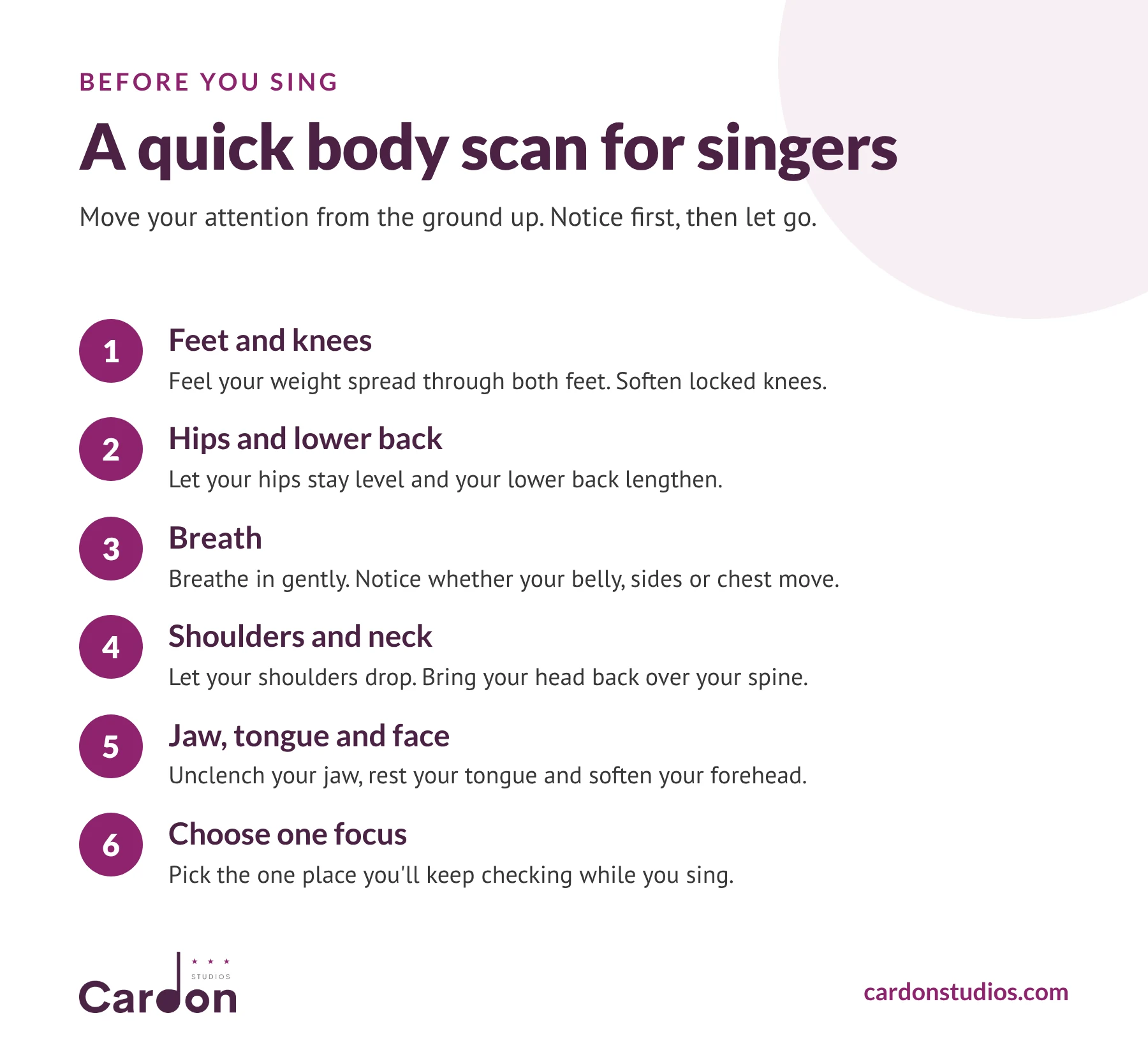
- The body scan. Stand with your feet about hip-width apart. Move your attention slowly from your feet up to your face, as in the graphic above. At each stop, ask: where are you tense, and what can you let go of? Picture your stresses melting down through the soles of your feet and away.
- The floor breath. Lie on your back with your knees bent and your feet flat. Place your hands on your belly and breathe in gently through your nose. Notice how your belly rises under your hands while your shoulders stay still. Take five slow breaths. If your shoulders usually rise when you breathe in standing up, this shows you what a lower, easier breath feels like.
- Stand and compare. Get up slowly and take the same easy breath standing. Can you keep your shoulders quiet and your belly and sides moving? Go back to the floor whenever you lose the feeling.
- Hum and feel. Hum a comfortable note on “mm” for one long breath, three times. Each time, notice one thing: where you feel the buzz, whether your jaw is clenched, whether your tongue is pressing. Change nothing at first. Then let go of one tension and hum again.
- The mirror check. Sing a short, easy phrase in front of a mirror. Watch your jaw, neck and shoulders. Many singers are surprised by what they see, such as a chin that lifts on high notes or shoulders that creep up.
For a full posture routine, see our guide to singing posture and alignment.
Where singing tension hides
As modern humans, we’re often in a hurry, and we regularly crane our necks forward to look at a computer or phone screen. Those habits come with us when we sing. Releasing that tension and finding efficiency in your breath and movements is key to unlocking the full potential of your voice.
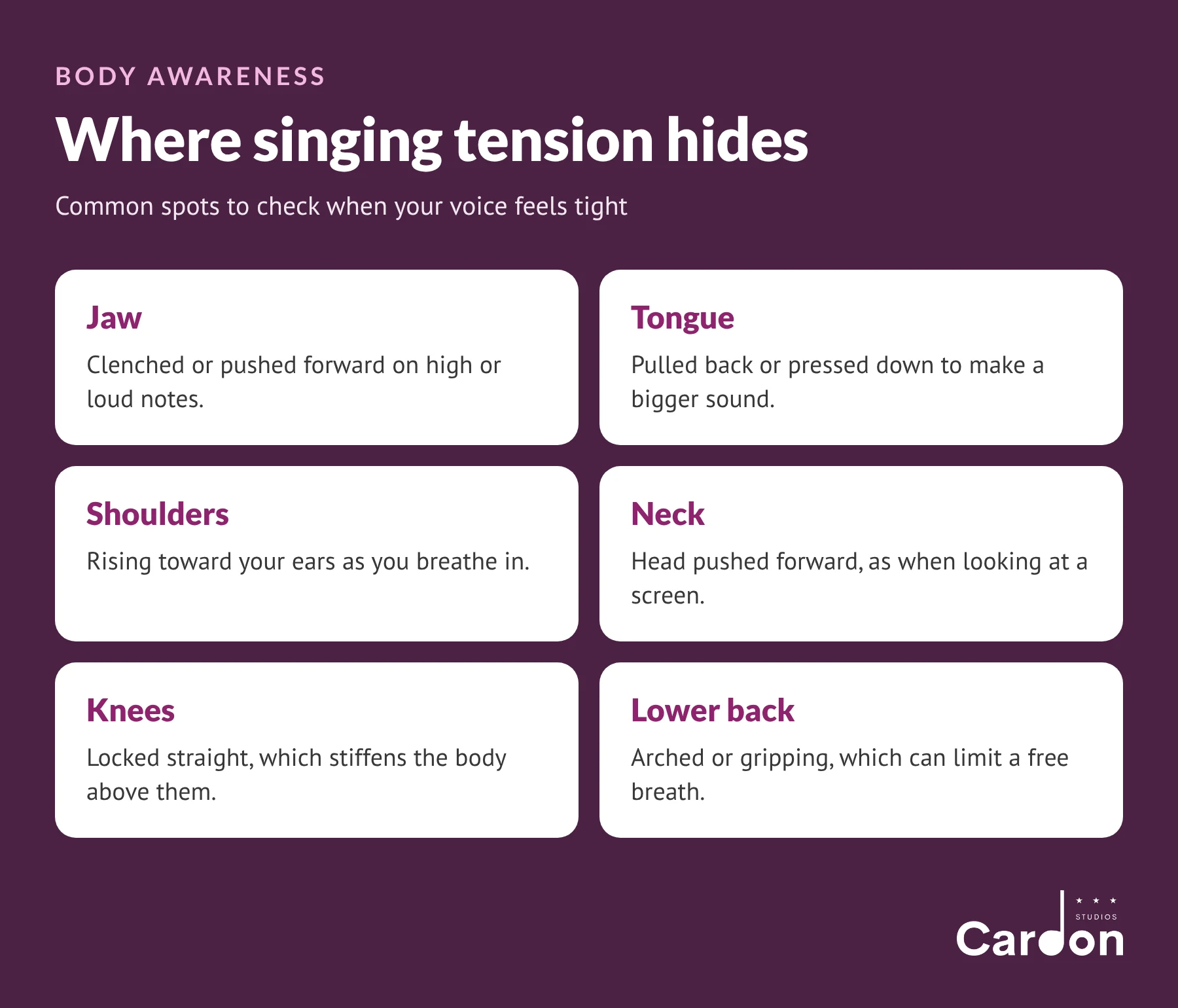
Your muscles are connected throughout your body, so, surprising as it may be, tension in your lower back or locked knees can have trickle-down effects that reach your voice. That’s why a singer who only focuses on the throat often misses the real source of a squeeze. The jaw, tongue and neck sit right next to the larynx, so tension there tends to show up in the sound quickly, especially on high or loud notes.
When you find tension, don’t fight it with more effort. Notice it, breathe, and invite that area to soften while you keep singing. Our guide to releasing tension when singing has more exercises for the jaw, tongue and neck.
Breath awareness for singing
Breath awareness simply means noticing your breath as it is, before you try to control it. Most singers want to jump straight to breath control, but it’s much easier to build good breathing habits once you can feel your current ones.
Try this breath awareness exercise. Sit or stand comfortably and breathe normally for a few breaths, without changing anything. Then notice:
- Where the breath goes. Do you feel movement in your belly, your sides, your back or your upper chest?
- How it sounds. A noisy, gasping inhale often means tension in the throat. A quiet inhale usually means an open, released throat.
- The pause. Is there a moment between breathing in and breathing out, or do you hold your breath with a tight throat before you sing?
- The release. Does your breath leave in a steady stream, or in a rush?
Then bring the same attention to singing. Choose an easy phrase, take a quiet breath, and notice whether the breath lasts to the end of the phrase without squeezing. A singer who can feel the breath can start to shape it. Our guides on how to breathe when singing and breath support take you through the next steps.
Mindful practice: how to practice singing with attention
Mindful practice means doing each exercise and each run-through with full attention, then checking in before the next one. It’s the opposite of practice on autopilot, where you sing a song again and again while your mind wanders. Because your voice learns from every repetition, mindful practice makes sure you’re repeating the habits you actually want. We explain this idea in depth in why how you practice matters more than how much.
Start with a mental scan
If you’re beginning to learn your body and study singing, start every practice with a short mental scan: where are you tense, and what can you let go of? A body that is relaxed and released allows for flexibility, an even flow of energy and, ultimately, efficiency in whatever challenges you take on.
Check in between repetitions
After each exercise or section of a song, pause for a breath and ask yourself a few questions:
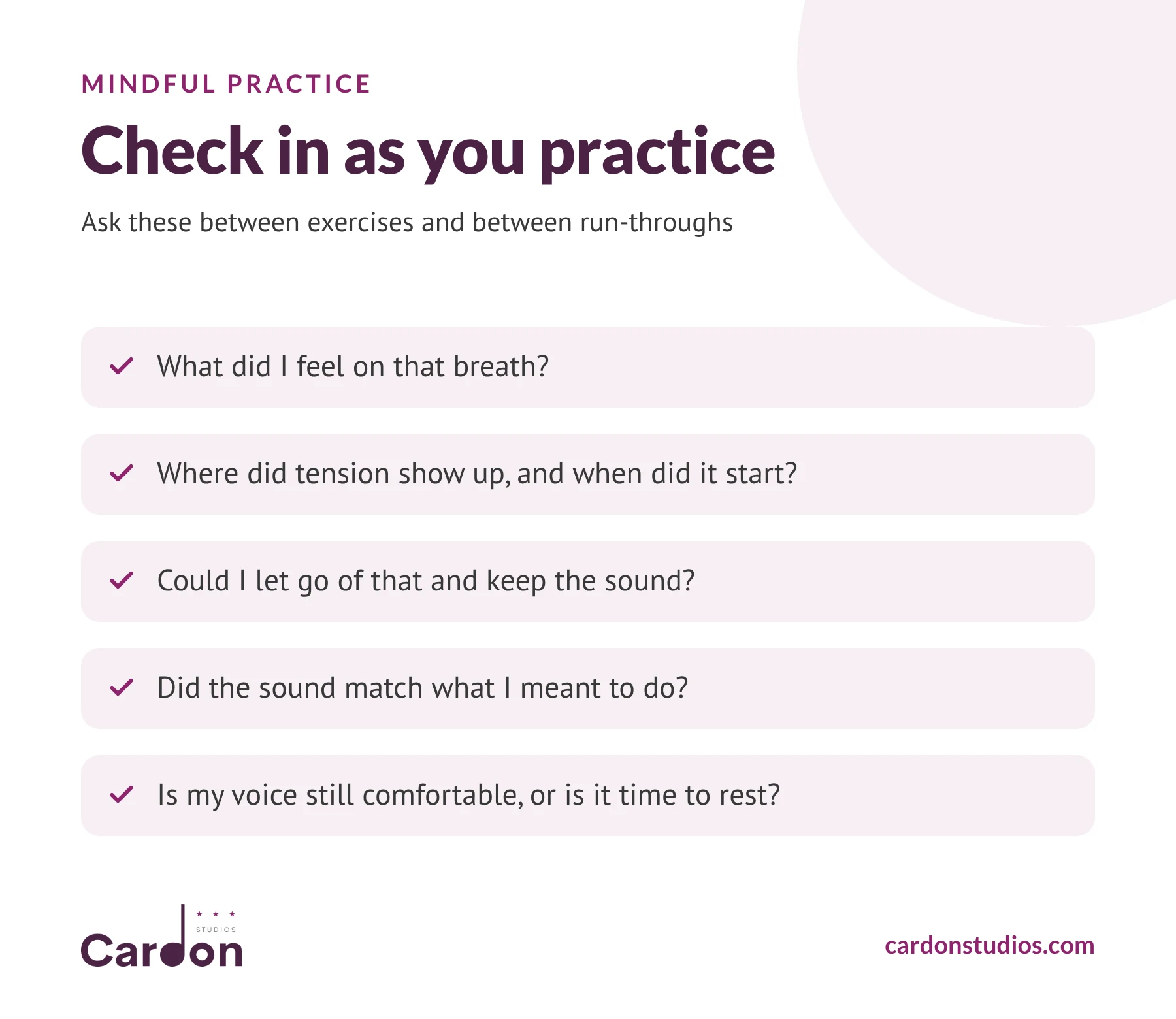
Notice when tension starts, too. Does your jaw tighten as the melody rises, or only on one vowel? Knowing the exact moment tells you where to work.
Listen without judging
Listening is part of mindfulness, but your own ears can mislead you while you sing, because what you hear inside your head isn’t quite what a listener hears. Recording yourself gives you a second, more accurate view. Listen back the same way you scan your body: notice what you hear, name it, and decide what to try next, without harsh self-criticism. Our guide on how to record yourself singing shows you how. For a structured way to plan focused sessions, read deliberate practice for singers.
A mindful practice session, step by step
Here’s one way to shape a single practice session around mindfulness. Keep the session short enough that you can stay focused the whole time, and adjust each step to your voice and your goals.
| Step | What to do | What to notice |
|---|---|---|
| Arrive | Stand or sit tall, take three quiet breaths and do a body scan. | Where you feel tension today, and your one focus for the session. |
| Warm up | Gentle humming and lip trills on a five-note scale, up and down, three or four times. | Whether your jaw, tongue and shoulders stay easy as the pitch moves. |
| Focus | Work one small section of a song, slowly, three times. | Your breath at the start of each phrase and the moment tension begins. |
| Run it | Sing the whole song once, as if performing. | Whether your focus point stays released when you add expression. |
| Reflect | Write down one thing that improved and one goal for next time. | How your voice feels now. Easy and clear means you worked well. |
To turn single sessions into a weekly routine, see how to practice singing between voice lessons and our guide to setting singing goals.
Taking mindfulness to the stage
A voice that is relaxed and released responds better to your musical and artistic intent. That’s true in every style, yes, even if you sing hard rock styles that use distortion. When you aren’t fighting your own tension, you can spend your attention on the story, the phrasing and the people listening.
Performing adds adrenaline, and adrenaline tends to pull attention away from the body. The habits you build in practice give you an anchor. Before you sing, take one quiet breath and do a very short scan: feet, shoulders, jaw. During the song, come back to your one focus point whenever your mind races ahead. Between songs, notice your breath again.
If nerves are a big part of your experience, our guide on how to overcome stage fright has more strategies. And if practice ever starts to feel like too much at once, read how to stop feeling overwhelmed as a singer.
Listen to your voice
Mindful singing should feel easy, never painful. If your throat feels sore, tight or tired, stop and rest. The National Institute on Deafness and Other Communication Disorders advises drinking plenty of water, taking vocal naps through the day, and avoiding singing when your voice is hoarse or tired. It also recommends seeing a doctor if your voice has been hoarse for more than three weeks. Mindfulness exercises are not a substitute for medical care. For everyday care, see our guide to vocal health for singers.
From the studio
Body awareness grows faster with a second set of eyes and ears. In live, one-on-one online voice lessons, your teacher can spot tension you can’t feel yet and give you exercises to release it. Between lessons, you can send a video for personalized feedback within two business days and rewatch your lesson recordings to notice your own habits. Learn more about membership here.
Online voice lessons
Build body awareness with a teacher
One monthly membership includes four private online voice lessons, one video coaching submission, the Learning Library, and member online events, with a teacher matched to your style, goals, age, and schedule.
Common questions about mindfulness for singers
What is mindfulness for singers?
It’s paying calm, curious attention to your body, breath and sound while you sing, without judging what you notice. That awareness helps you find and release tension, so your voice can work more easily.
What is mindful practice?
Mindful practice means doing each exercise with full attention and checking in before the next repetition: what you felt, where tension showed up and whether the sound matched your intent. It keeps you from repeating habits you don’t want.
Is singing a form of meditation?
Singing can feel meditative, because it asks you to focus on your breath and on the present moment. Singing meditation practices such as chanting or humming use the same idea. For practice, the goal is focused awareness rather than relaxation alone.
How do I stay relaxed when singing?
Relaxed singing starts before the first note: do a quick body scan, take a quiet breath, and release your jaw, tongue and shoulders. While you sing, check one focus point and let go of tension as soon as you notice it. Our guide to releasing tension when singing has exercises.
Why do I tense up when I sing high notes?
Many singers reach for high notes by pushing with the jaw, tongue or neck, or by taking a high, gasping breath. Noticing exactly when the tension starts is the first step. A teacher can then help you find coordination that lets high notes feel easier.