


To set singing goals that actually work, start with a clear picture of the singer you want to become, then break that vision into small steps: a few long-term skills, one focus each month, a plan for each week and one goal for every practice session. Build your singing fundamentals first, so every song you learn later sits on solid technique.
If you’ve ever tackled a big project, you know that a step-by-step plan can really save the day. From a home repair to balancing a budget, focusing only on the end result can leave you feeling like you don’t know where to start. Singing is the same. This guide shows you how to turn big musical dreams into stepping stones you can work on today.
Key takeaways
- Start with a vision of the singer you want to be, then work backward to today’s practice.
- Build your foundation first: breathing, knowing your range and coordination across your whole voice.
- Give every practice session one clear goal you can check off at the end.
- Fit your plan to how you work best, track your progress weekly, and adjust as you grow.
Why singers need a plan
Many beginning singers dive straight into the big, challenging show-stoppers they love. It’s an understandable instinct, and those songs are a great reason to sing. But without a plan, practice tends to drift. You sing the whole song again and again, the hard parts stay hard, and it’s difficult to tell whether you’re improving.
A plan changes that. When you know where you’re headed and what today’s step is, every session has a purpose. You stop spinning in circles, you can see your progress, and you’re far more likely to keep going when a skill takes longer than you hoped. Grab your big ideas head-on by breaking big goals down into smaller stepping stones.
There’s a second reason to plan, and it matters just as much: muscle memory is strong. Singing is a physical skill, and the way you sing a song while you learn it tends to stick. For some singers, learning a song with poor technique can make it feel nearly “unsingable” later, even after their technique improves. It’s very hard to unlearn vocal habits, so a plan that builds good habits from the start saves you a lot of trouble. Our guide on why how you practice matters more than how much explains this idea in depth.
Start with your vision: the singer you want to be
As a new singer, you probably already have a picture of the kind of singer you want to be. Take a few quiet moments to make that picture as clear as you can. Write your answers to these questions in a notebook or a note on your phone:
- What style of music do you want to be known for? Musical theater, pop, choral, jazz, country, classical or something else.
- Which songs do you dream of singing? Include the ones that seem out of reach right now.
- Which singers inspire you, and why? Notice what you admire: their tone, their storytelling, their ease on stage.
- What do you want to share with listeners? The feeling or artistic message you want people to take away.
- Where do you want to sing? A school musical, a choir, an open mic, an audition, or simply for joy at home.
From this vision, you can begin to identify the specific musical skills you’ll need, plus other parts of your artistic persona such as stage presence or confidence. A singer who dreams of musical theater might list breath control for long phrases, clear diction and acting through song. A choir singer might list sight-reading and holding a harmony part. That list becomes the raw material for your goals.
Build the singing fundamentals first
Before you pour your energy into the hardest songs on your list, take the time to build your vocal foundation. A basic understanding of your instrument can seriously affect how quickly and how well you learn every new song. For most singers, reaching the first level of basic proficiency means working on three singing fundamentals:
- Breathing for your style. Learn how to take a quiet, low breath and let it out steadily across a phrase. Classical, musical theater and pop singing ask for slightly different things, so learn the approach that fits the music you love. Our guide to how to breathe when singing is a good place to start.
- Knowing your range and voice type. Find the lowest and highest notes you can sing comfortably, and where your voice naturally sits. That helps you choose songs and keys that suit you. See voice types in order to learn how to find yours.
- Coordination and flexibility across your range. Work toward smooth movement from low to high notes without a big break or a squeeze. Gentle exercises such as lip trills or humming on a five-note scale, up and down, three or four times, help your voice learn to move easily. Our vocal warm-up guide has a full routine.
These three singing basics may sound simple at first, but as you dive into them, you’ll likely find that each one is its own can of worms. That’s normal. This is where the guidance of a knowledgeable teacher really pays off: a teacher can hear which area needs the most attention and help you build a practice routine of exercises that address your specific weak spots.
Just like many other physical activities, focused attention on coordination is the name of the game. As you begin to get a handle on your voice, consistency is key. Your muscles, and perhaps even more importantly your ability to make conscious choices about your sound, will strengthen over time, but only if you keep reinforcing the positive changes. From there, you’ll be able to take that coordination into the challenging songs you want to sing. If you’re brand new, our singing tips for beginners walk you through your first weeks.
Break big singing goals into stepping stones
A dream like “sing the lead in a musical” or “perform at an open mic” is a wonderful destination, but it doesn’t tell you what to do on a Tuesday evening. The answer is to build a ladder of goals, from your big vision down to today’s practice.
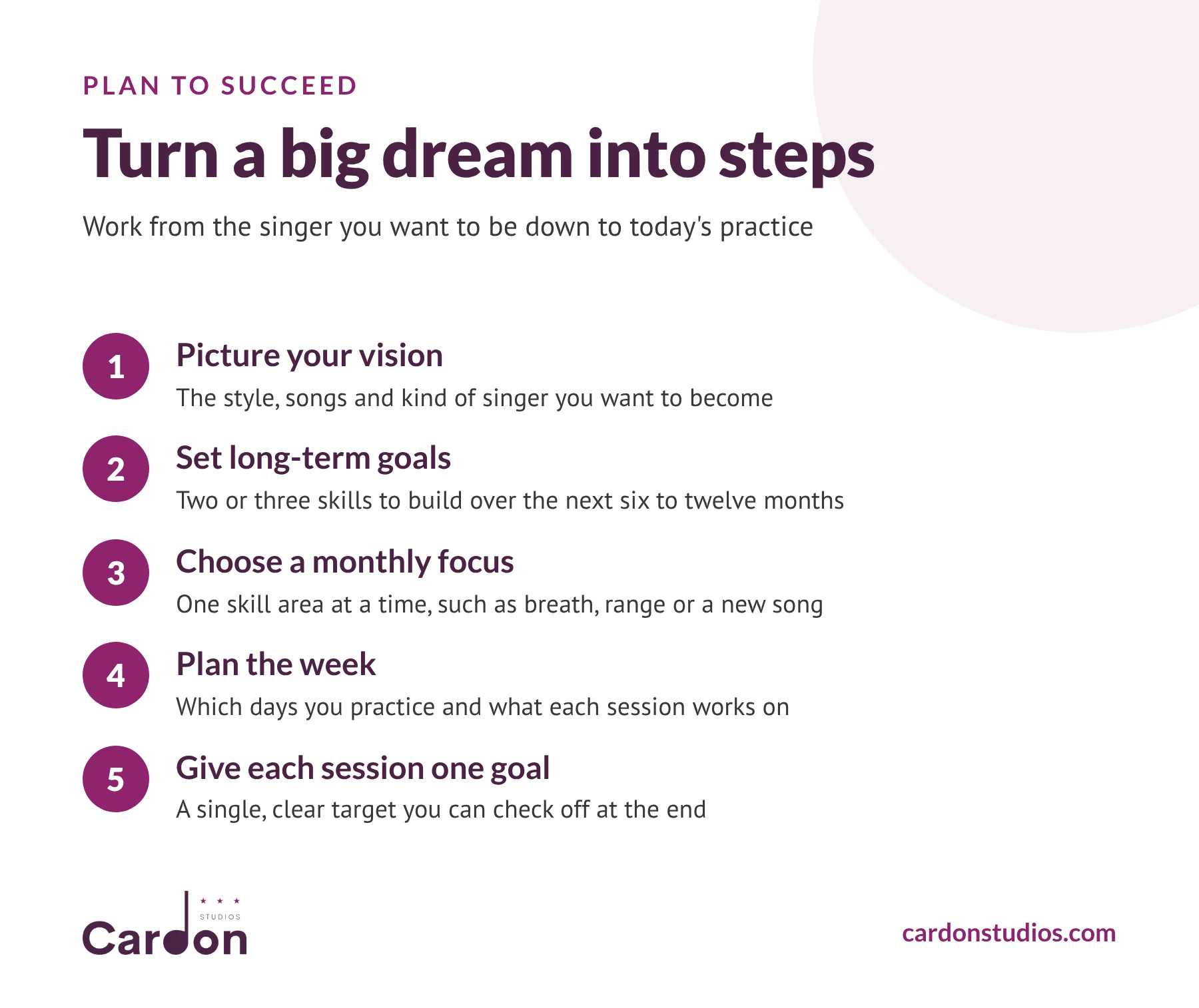
Long-term goals (six to twelve months)
Pick two or three skills from your vision list that would make the biggest difference. Keep them specific enough to recognize when you’ve reached them: “sing my audition song with steady breath from start to finish” works better than “be a better singer.”
A monthly focus
Choose one skill area to emphasize each month, such as breath, range, a new song or performance. You’ll still warm up and touch other skills, but most of your attention goes to this one area. Rotating your focus keeps practice fresh and lets you see real change in one area at a time.
A weekly plan
At the start of each week, decide which days you’ll practice and what each session will work on. Short, regular sessions on most days usually work better than one long session. Our guide to how to practice singing between voice lessons shows how to turn your plan into daily habits.
Set one goal for every practice session
Regardless of the timing of your weekly routine, setting a goal for each session is the most important habit of all. A session goal might be to decide exactly when and how to breathe in your new song. It might be to focus only on memorization and presentation. Or it might be to study the words of the song and look for places to bring a more nuanced interpretation or a more interesting vocal texture.
The best session goals are small and clear. You should be able to tell at the end of the session whether you reached it. Compare these:
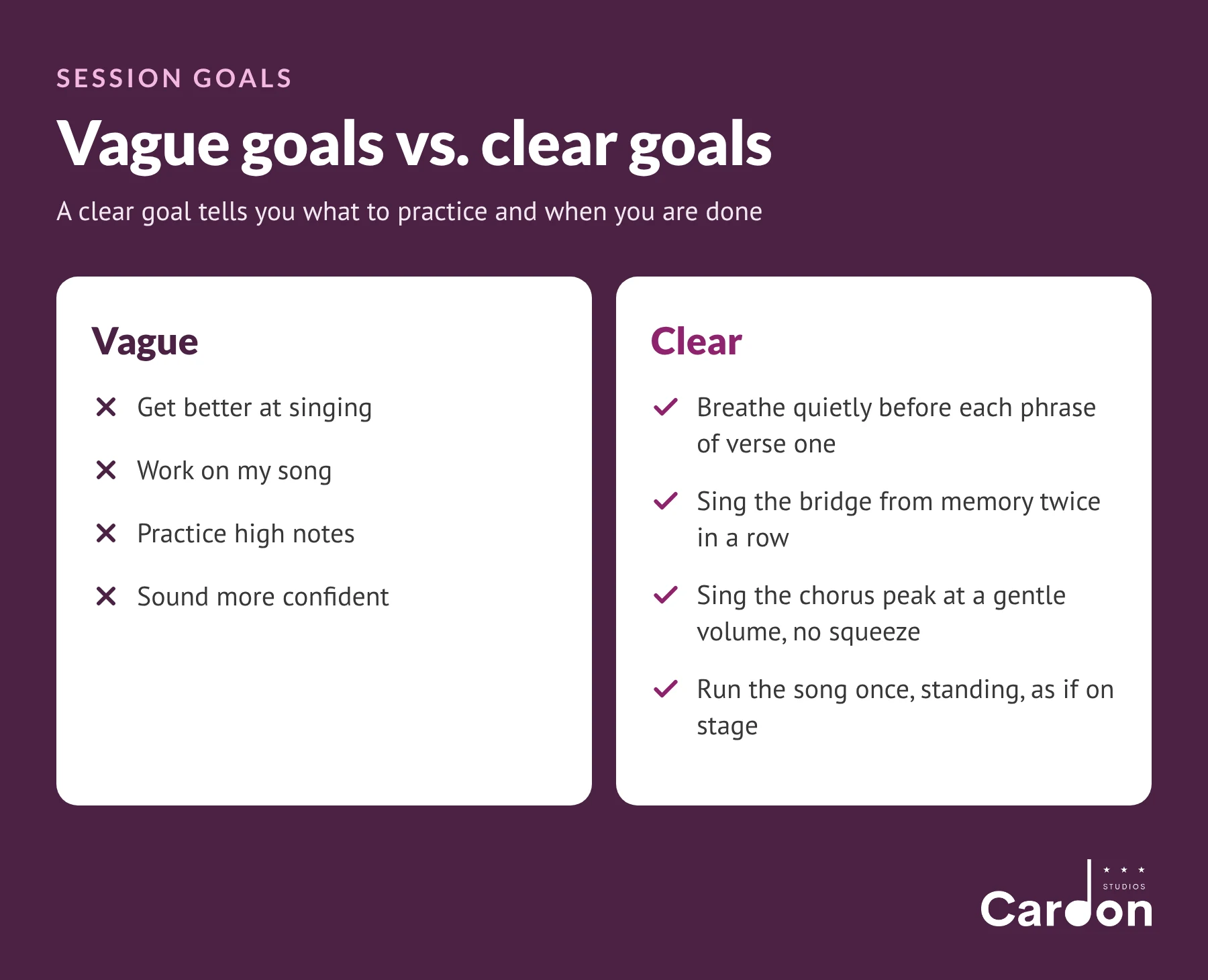
Practice goals keep you from getting distracted and going in circles. At the end of each session, you’ll feel successful, and you’ll have the clarity you need to set your goal for next time. Write each goal down before you start and check it off when you finish. If you didn’t reach it, that’s useful information too: break it into an even smaller step for tomorrow. For a simple way to stay focused during the session itself, read deliberate practice for singers.
Fit your plan to how you work best
Knowing your personality and learning style can help you design the best practice routine for you. There’s no single right schedule, so ask yourself a few honest questions:
- When are you most focused? Some singers think most clearly in the morning; others feel more awake and expressive in the evening.
- Do you work best in short bursts or long stretches? Many teachers find that frequent short sessions help most students improve fastest. But if switching tasks during your day is hard for you, fewer, longer sessions may work better. Whichever suits you as a person will be best for you as a singer.
- What keeps you coming back? A practice log, a friend to check in with, or a small reward after a week of sessions can all help. If getting started is the hardest part, our guide to beating practice procrastination has ideas.
Whatever you choose, protect your voice. Plan lighter days for rest, keep longer sessions broken up with breaks, and stop when your voice feels tired rather than pushing through.
Track your progress (and adjust the plan)
Make a list of the skills from your vision and start checking off your progress toward becoming the artist you want to be. Progress in singing is often gradual, so a written record helps you see change you might otherwise miss. Once a week, look back at your sessions and ask yourself these questions:
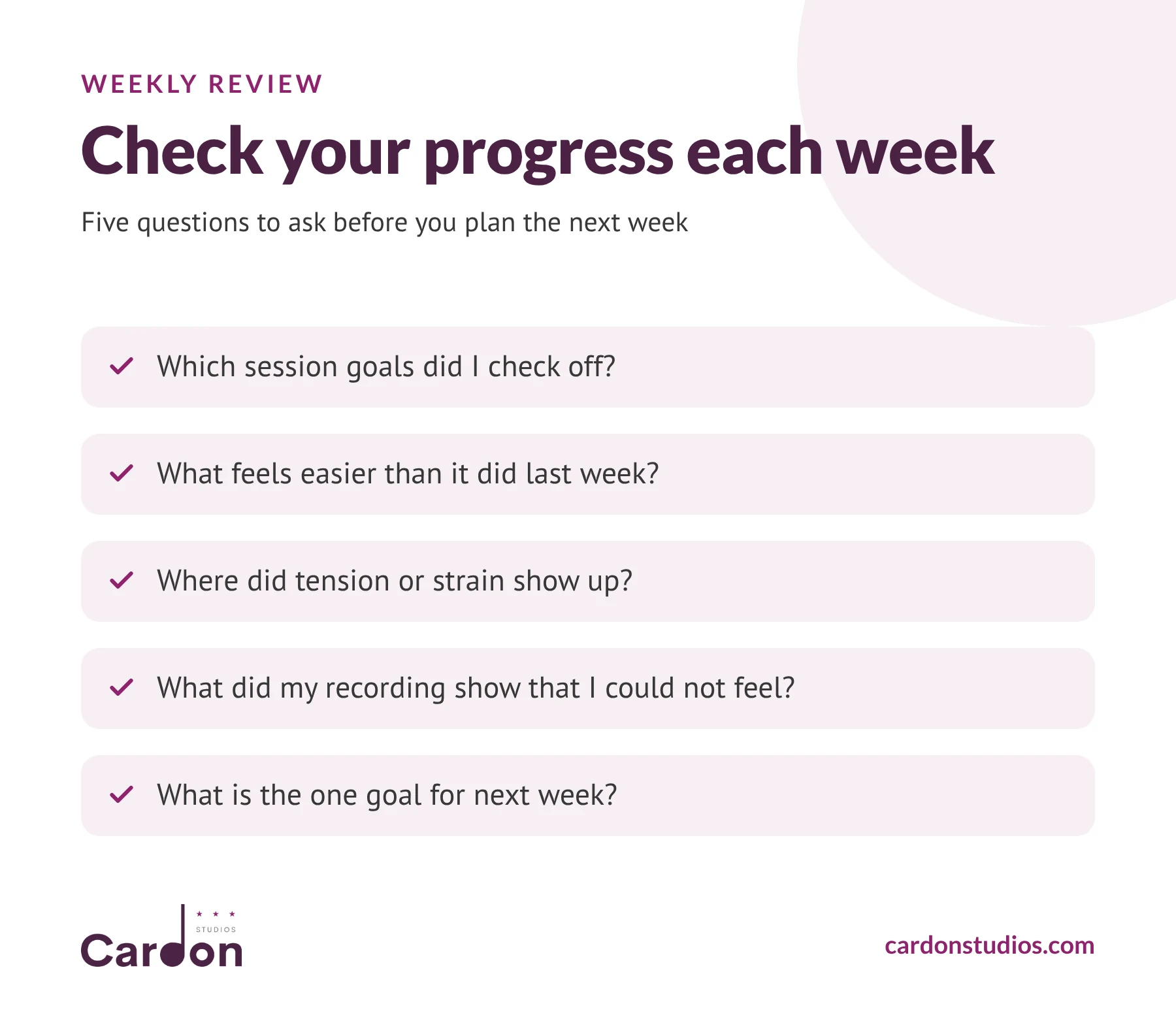
Recordings are one of the most useful tracking tools you have. Sing the same short passage at the start of each month and keep the recordings. Hearing them side by side shows growth that’s hard to notice day to day. Our guide on how to record yourself singing explains how to do it well.
Plans should change as you do. If a goal feels too easy, raise it. If you keep missing a goal, shrink it. If your vision shifts, say from pop to musical theater, rebuild the ladder from the top. Organization and diligence will bring your future successes closer: you simply need to take the next step.
A sample four-week singing plan
Here’s one way a newer singer might lay out the first month, with breath as the monthly focus and one song to apply it to. Adjust the songs, days and goals to fit your own voice and schedule.
| Week | Focus | Sample session goals |
|---|---|---|
| Week 1 | Find your breath | Practice a quiet, low inhale; sing one easy song noticing only where you breathe; mark breath spots in your music. |
| Week 2 | Steady air | Hiss on “sss” with an even stream; sing verse one keeping the air steady to the end of each phrase. |
| Week 3 | Apply it to the hard part | Work the longest phrase of your song in small chunks; sing it slowly three times in a row with an easy breath. |
| Week 4 | Put it together | Sing the whole song once, standing, as if on stage; record it and compare with a recording from week 1. |
At the end of the month, use your recording and your weekly notes to choose next month’s focus. Maybe your breath feels steadier but high notes feel tight, so range and coordination come next. Step by step, the plan keeps moving you toward the singer in your vision. To stay present and relaxed while you work through it, see mindfulness for singers.
Listen to your voice
A good plan should never hurt. If singing becomes painful, or your throat feels tight, scratchy or tired, stop and rest. The National Institute on Deafness and Other Communication Disorders advises drinking plenty of water, taking vocal naps through the day, and avoiding singing when your voice is hoarse or tired. It also recommends seeing a doctor if your voice has been hoarse for more than three weeks. For everyday care, see our guide to vocal health for singers.
From the studio
A teacher can help you assess where you are, plan your next steps and grow. In live, one-on-one online voice lessons, your teacher hears what you can’t, helps you set realistic goals and gives you exercises that target your weak spots. Between lessons, you can send a video for personalized feedback within 72 hours and rewatch your lesson recordings. Learn more about membership here.
Online voice lessons
Build your singing plan with a teacher
One monthly membership includes four private online voice lessons, one video coaching submission, the Learning Library, and member online events, with a teacher matched to your style, goals, age, and schedule.
Common questions about singing goals
What are good singing goals for beginners?
Start with the fundamentals: a quiet, steady breath, knowing your comfortable range, and moving smoothly between low and high notes. Then add one song you’d love to sing well. Keep each goal specific enough that you can tell when you’ve reached it.
What are the basics of singing I should learn first?
Most teachers start with breathing, posture, finding your range and voice type, and simple exercises that build coordination across your voice. These singing basics make every song you learn later easier and help you avoid habits that are hard to undo.
How long does it take to learn to sing?
It depends on your starting point, how often you practice and how focused that practice is. Many singers notice changes within a few weeks of regular practice, while skills like a wide, even range keep developing over months and years. A clear plan helps you see that progress.
How do I make a singing practice plan?
Write down your vision, choose two or three long-term skills, pick one focus for the month, then plan which days you’ll practice each week. Give every session one small goal, and review your progress weekly so you can adjust the plan.
Can anyone learn how to sing?
Most people can improve their singing with good instruction and steady, focused practice. Singers who struggle to match pitch can also make progress with patient work. Our guide on going from tone deaf to talented explains how.