


Voice training for actors builds the breath, resonance, and coordination that let your voice carry to the back of the house, survive weeks of rehearsals and a full run, and handle big emotional scenes without strain. Voice lessons help even if you never plan to sing, because speaking, shouting, crying, and singing on stage all use the same instrument.
This guide covers what voice training gives actors, how to play intense scenes safely, a set of vocal exercises for actors, a warm-up you can use before rehearsal or a show, and the habits that protect your voice through a run.
Key takeaways
- Voice training builds stamina for long rehearsal periods and runs of shows, and helps your voice carry without pushing.
- Screaming, yelling, and crying on stage can sound intense while your breath, not your throat, does the work.
- A short, consistent warm-up of body, breath, humming, slides, and diction prepares your voice for every rehearsal and performance.
- Hydration, voice rest, and marking protect your voice through a run; hoarseness that lasts more than three weeks is a reason to see a doctor.
Why voice training for actors matters
Voice lessons aren’t only for singers. They expand the range and flexibility of an actor’s voice and help you use it efficiently, which matters when you rehearse for weeks and then perform night after night. Your body is your instrument, and your voice is the part of it the audience relies on to follow the story.
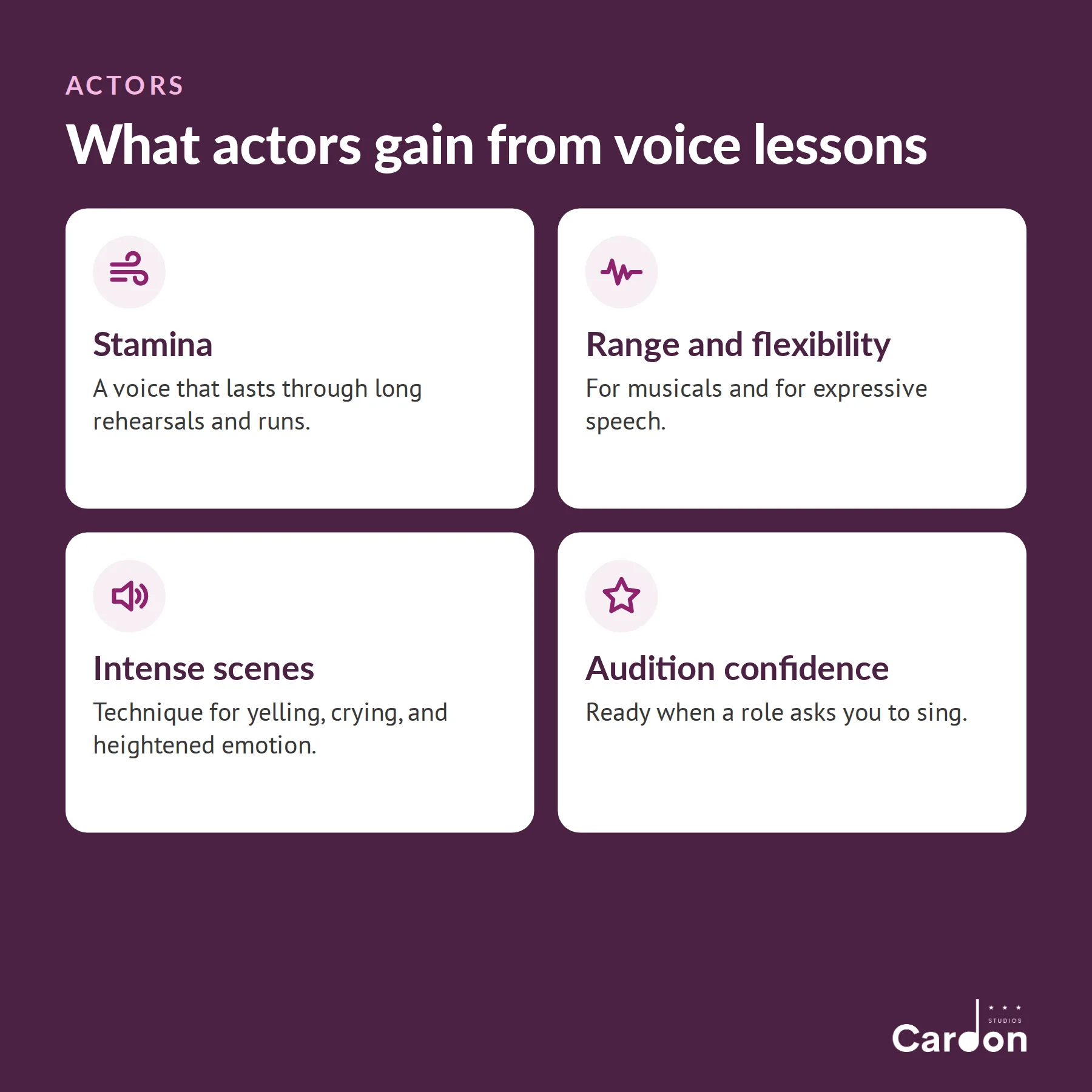
- Stamina. Efficient breathing and coordination help your voice last through long rehearsals, tech weeks, and runs with several shows in a row.
- Range and flexibility. A more flexible voice gives you more colors for characters: higher and lower pitches, brighter and darker tones, and more options for expressive speech.
- Intense scenes. Technique for yelling, screaming, and crying on stage without putting extra strain on your voice.
- Confidence. When a role asks you to sing, you’re ready rather than nervous about it.
Voice work also makes you easier to direct. When a director asks for “more urgency” or “pull it back,” a trained voice can change pitch, volume, pace, and tone on purpose instead of by accident, and can repeat the choice the next night.
Your speaking voice on stage
Even in non-musical roles, your speaking voice has to carry to the back of the house. Projection comes from breath and resonance rather than pushing, and a teacher can help you find a speaking pitch that feels natural and sustainable for the length of a run. These are the same skills singers build, which is why voice lessons translate so directly to acting.
Breath: the engine
Stage speech needs more breath than conversation, but not a huge gulp before every line. Let the breath drop low and wide, with your ribs and belly expanding, then let a steady stream of air carry the phrase. Plan breaths at the commas and full stops in your text, the way a singer marks breaths in a song. Our primer on how to breathe when singing covers the same mechanics.
Resonance: the amplifier
A voice carries because it resonates in the throat, mouth, and face, not because the throat squeezes harder. Humming on “mm” and noticing a buzz around your lips and nose is a simple way to feel resonance. Speaking with that same buzz gives you a brighter, clearer tone that reaches the audience at a comfortable effort. Our guide to vocal projection explains the difference between projection and volume.
Diction: the clarity
Clear, quick diction helps the audience catch every word without adding tension to your jaw or throat. Crisp consonants do more for clarity than extra volume. The lips, tip of the tongue, and soft palate do the work, while the jaw stays loose. If you notice your jaw or tongue tightening on long speeches, our guide to releasing tension has exercises that help.
How to scream, yell, and cry on stage without hurting your voice
Some of the most demanding moments for an actor’s voice are emotional ones: an argument, a scream of fear, a scene played through tears. Repeated over many rehearsals and performances, those moments can leave your voice tired or hoarse if you approach them with force alone. The National Institute on Deafness and Other Communication Disorders (NIDCD) lists screaming and other extremes of your range among the things to avoid when caring for your voice, so stage intensity needs a plan.
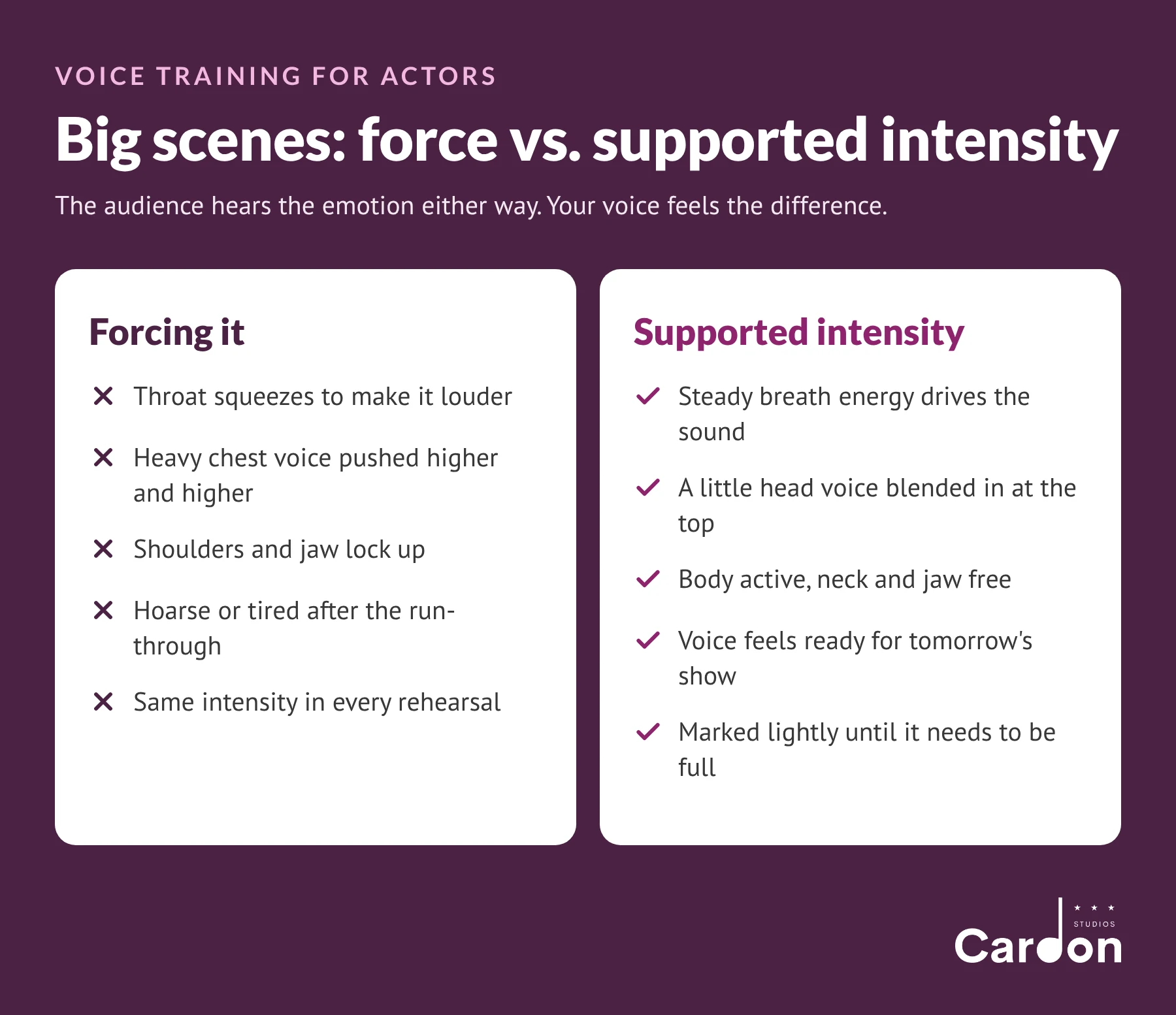
Voice lessons teach you to create the sound of intensity with breath and coordination rather than pressure in the throat. The audience hears the emotion either way; your voice feels the difference.
Work through a big moment in this order with your teacher or on your own:
- Find the line’s natural pitch. Speak the line calmly first, then notice where its highest point sits. Most strain comes from jumping much higher than your comfortable speaking range.
- Breathe for the whole phrase. Take a low breath before the line starts, and let your abdominal muscles stay active while you speak. The sound rides on the breath.
- Build volume from resonance. Try the line on a bright, forward “ay” or “eh” quality before full voice. Brightness reads as loud without the squeeze.
- Use the body, not the neck. Let the physical intensity show in your stance, hands, and face, while the neck, jaw, and shoulders stay as loose as you can manage.
- Shape the scream. A stage scream is often shorter than it seems. Start it with breath, keep it brief, and let your acting and the reaction of other characters sell the rest.
- Mark it in rehearsal. Once the moment is set, rehearse it at partial volume and save full intensity for the runs that need it.
Crying scenes bring their own challenge: real tears often tighten the throat and make breathing shallow. Keep the breath moving, let the sobs live in the ribs and belly rather than the throat, and rely on the text and your face to carry the feeling. Our guide to singing with emotion explains how to share a strong feeling while staying in control of your voice.
Chest voice, head voice, and heightened emotion
Singers spend a lot of time learning to bridge the gap between chest voice and head voice, their lower and upper registers. Actors benefit from the same work. In heightened emotional states like anger or fear, we tend to push a heavy chest voice higher and higher, and you may be asked to recreate that state in every performance.
A teacher can help you reach that heightened sound while bringing in a little more head voice at the top of your speaking range, and adjusting vowels slightly, so the moment reads as powerful without over-shouting. Our guides to finding your mix for higher voices and lower voices explain how chest and head voice work together.
Vocal exercises for actors
These vocal exercises for actors build the skills above. Start gently, stay in a comfortable range, and stop if anything hurts or your voice feels scratchy. Most actors use a few of them as a daily routine and the rest as targeted work for a particular role.
| Exercise | How to do it | What it builds |
|---|---|---|
| Hum and speak | Hum “mm” on a comfortable pitch until you feel a buzz at the lips, then open into “mm-one, mm-two, mm-three” in a speaking voice. Repeat 5 times. | Forward resonance in speech |
| Lip trill slides | Blow air through loose lips so they flutter, and slide from a low pitch to a medium-high one and back. Repeat 5 to 8 times. | Steady airflow, easy range |
| “Ng” sirens | Say “sing” and hold the “ng.” Glide slowly up and down like a siren, staying quiet. Repeat 5 times. | Smooth shifts between chest and head voice |
| Counting to the back row | Count from 1 to 10. Begin at conversational volume and grow a little louder with each number, keeping the same easy throat. Repeat 3 times. | Projection with breath, not push |
| Sustained “zzz” | On one breath, buzz a “zzz” at an even volume until the breath runs low, without squeezing at the end. Repeat 3 times. | Breath control for long lines |
| Consonant drills | Repeat “puh-tuh-kuh” 5 times slowly, then 5 times quickly, then a tongue twister such as “red leather, yellow leather” 5 times, crisply and quietly. | Clear, quick diction |
| Speaking-pitch check | Say “mm-hmm” as if agreeing with someone, then say a line from your script starting on that same pitch. Repeat with 3 lines. | A comfortable home pitch |
If an exercise feels hard on your throat, make it quieter and lower before trying it again. Recording yourself on your phone, then listening back, helps you hear whether your voice carries the way you think it does. Our guide to recording yourself has setup tips.
A vocal warm-up for actors before rehearsal or a show
Warm up before every rehearsal and show, even if you’re only speaking. A vocal warm-up for actors moves from body to breath to voice to text, so each step prepares the next. Keep it gentle: the goal is a ready voice, not a tired one.
- Release the body. Roll your shoulders, stretch your arms overhead, and let your jaw hang loosely. Our guide to posture and alignment explains why this matters.
- Wake up the breath. Breathe in low and wide, then hiss out slowly on “sss.” Repeat 4 times.
- Hum. Hum on a few comfortable pitches, feeling the buzz in your lips and face.
- Slide. Do lip trills or “ng” sirens from low to medium-high and back, 5 times each.
- Articulate. Run your consonant drills and one tongue twister, crisply and at moderate volume.
- Speak the text. Say a few lines from the show at performance energy, including the start of your biggest moment at partial volume.
On a musical, add a few sung scales and part of your hardest song after step 4. Our complete vocal warm-up routine has more exercises to choose from.
Musicals and singing auditions
Many actors eventually face a singing audition, whether for a musical, a play with songs, or a role that calls for a few bars on stage. Preparing a song with a teacher takes much of the fear out of it. You’ll choose material that suits your voice and the role, learn to act the song, and practice it until it feels reliable. Our guides to preparing for a musical theater audition and picking an audition song walk you through it.
Actors often bring strong acting instincts to a song and then lose them when they worry about the notes. Voice training closes that gap: once the technique is secure, your attention can go back to the character, the story, and the person you’re singing to. For the higher, brighter sounds many musicals ask for, our guide on how to belt safely is a good next step.
Protecting your voice through a run of shows
A few simple habits go a long way when you’re performing night after night. NIDCD notes that people whose jobs depend on their voices, such as singers and public speakers, make great demands on them, and recommends drinking plenty of water, resting your voice through the day, and avoiding talking in noisy places (Taking Care of Your Voice).
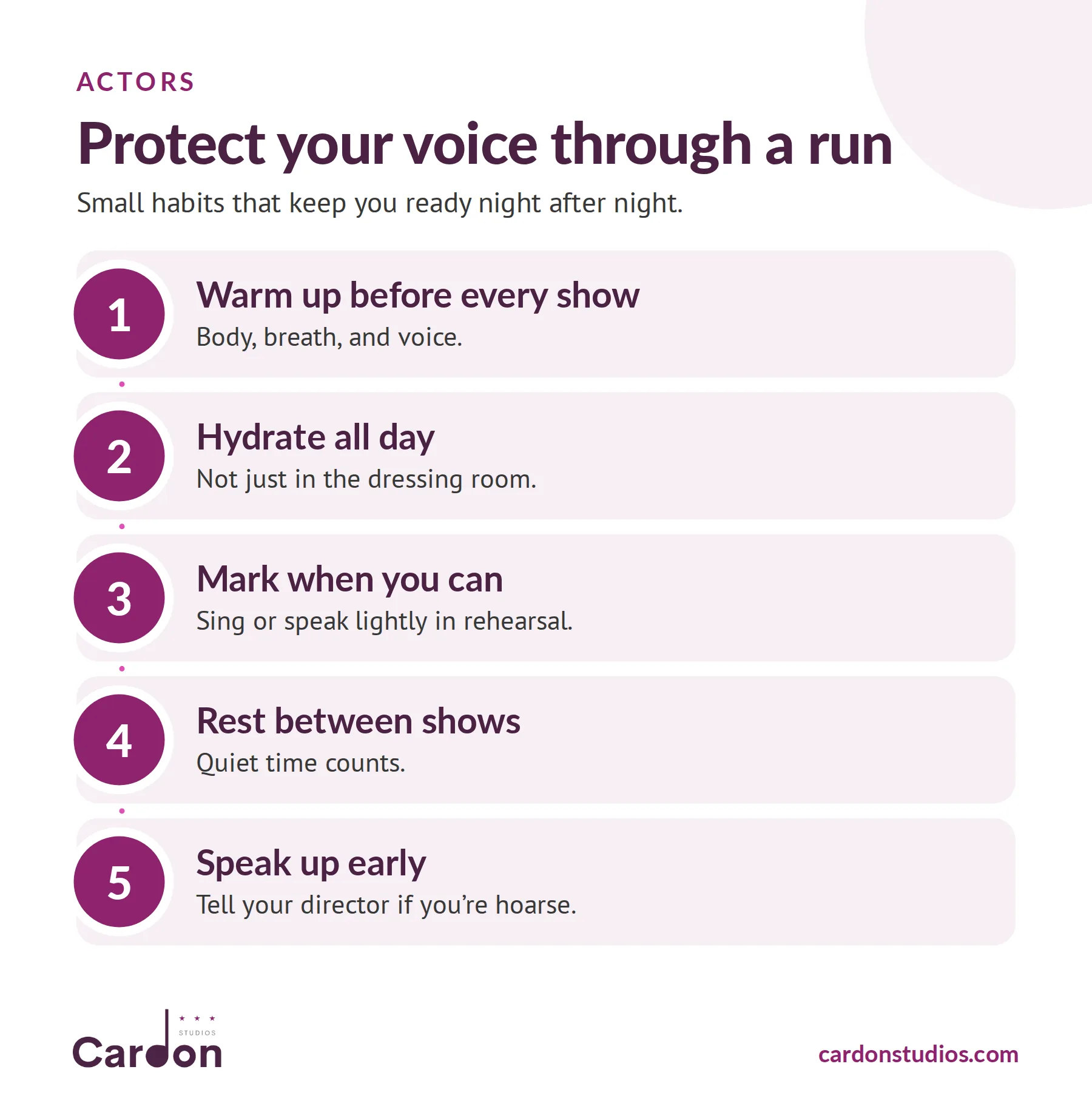
- Warm up before every show. Body, breath, and voice, even if you’re only speaking. Use the warm-up above or our guide to warming up.
- Hydrate all day. Keep water with you through rehearsals and performances, not just in the dressing room. If you drink caffeine, balance it with plenty of water.
- Mark when you can. In rehearsal, sing or speak lightly when full voice isn’t needed, and save your energy for the moments that count.
- Rest between shows. Quiet time and good sleep help your voice recover. Skip loud cast parties and noisy restaurants on show nights when you can.
- Speak up early. If you’re feeling hoarse, tell your director or stage manager, and see a doctor if it doesn’t improve with rest.
Listen to your voice
Stop if speaking or singing hurts, and rest your voice when it feels hoarse or tired. NIDCD notes that cheering, speaking loudly in noisy places, and talking too long without rest can cause temporary hoarseness, and recommends seeing a doctor if your voice has been hoarse for more than three weeks. For everyday care, see our guide to vocal health for singers.
What voice lessons for actors look like
Lessons for actors are built around what you need right now. You might work on breath and resonance for a demanding role, prepare an audition song, or rehearse a scene that asks a lot of your voice. Your teacher listens, demonstrates, and gives you exercises to practice between lessons, then helps you bring that work into your scripts and songs.
Many actors wonder whether they need a voice teacher or a vocal coach. A voice teacher focuses on technique: breath, range, registers, and vocal health. A coach focuses on preparing specific material, such as an audition song or a role. Our guide to the difference between a voice teacher and a vocal coach explains how the two work together.
Shopping for a performer this season? Our guides to gifts for actors and drama students and gifts for Broadway lovers include ideas for the actor in your life.
From the studio
At Cardon Studios, you’re matched with a teacher by your style, goals, age, and schedule, and you’re welcome to bring scripts, sides, and audition songs to your lessons. Between lessons, you can send a video of a scene or song and get a personalized response from your teacher within two business days.
Online voice lessons
Train your voice for the stage
One monthly membership includes four private online voice lessons, one video coaching submission, the Learning Library, and member online events, with a teacher matched to your style, goals, age, and schedule.
Common questions from actors
Do actors need voice lessons if they don’t sing?
They can help a great deal. Voice training for actors builds stamina, flexibility, projection, and technique for demanding scenes, all of which matter for spoken roles as well as musicals.
How can I scream on stage without hurting my voice?
Support the moment with your breath rather than throat pressure, keep the scream short, and let brightness and resonance make it sound loud. Warm up first, rehearse it at partial volume once it’s set, and stop if it hurts.
What are good vocal exercises for actors?
Humming into speech, lip trill slides, “ng” sirens, counting with growing volume, a sustained “zzz,” and consonant drills cover resonance, range, projection, breath, and diction. Start gently and stay in a comfortable range.
Should an actor work with a voice coach or a voice teacher?
A voice teacher builds technique, like breath, range, and healthy power, while a coach helps you prepare specific material. Many actors start with technique and add coaching before auditions or a demanding role.
What does it mean to speak from your diaphragm?
It usually means breathing low and letting steady breath energy support your voice, instead of pushing from the throat. Your ribs and belly expand as you inhale, and your abdominal muscles stay active as you speak.
Can voice lessons help me prepare for a singing audition?
Yes. A teacher can help you choose a song that suits you and the role, cut it well, and practice it until it feels reliable, so you can focus on acting the song on the day.