

Giving an effective performance takes many skills at once. You need reliable technique so your voice does what you intend, even under pressure. You need stage presence, stylistic effects that suit your genre (or clear language diction, in classical singing), rhythm, musical vocabulary, and the ability to work with other musicians. With so much to cover, the terms “voice teacher” and “vocal coach” can get confusing. Here’s the difference, and how to tell which one you need.
Key takeaways
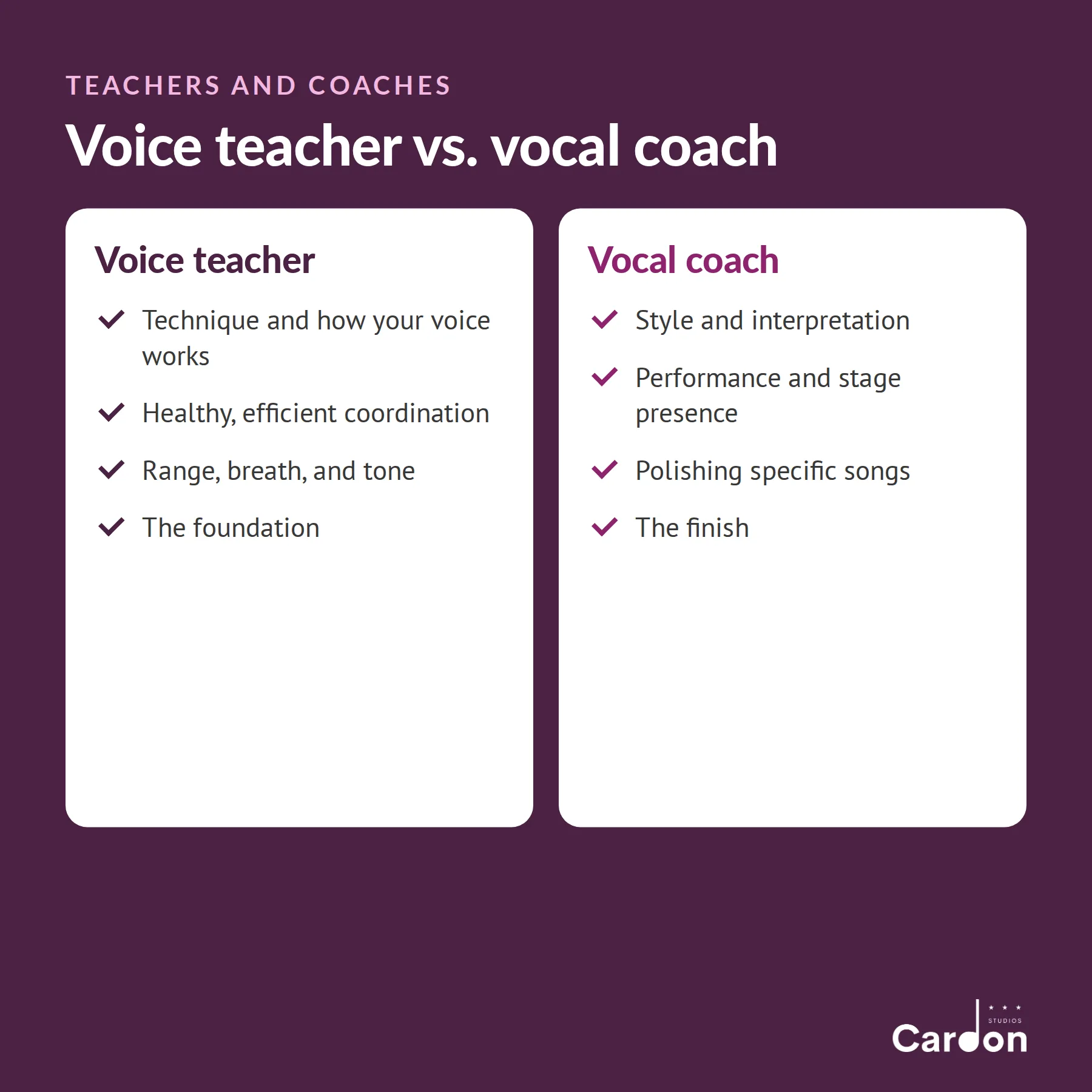
- A voice teacher focuses on technique: how your voice works and how to use it well.
- A vocal coach focuses on style, interpretation, and performance polish.
- Lessons lay the foundation; coaching adds the finish. Many singers need both.
- Ask about a teacher’s or coach’s background so you know what to expect.
What a voice teacher does
Traditionally, voice teachers are trained in vocal technique and, these days, in voice science too. They’re technicians who help you understand how your voice works and coordinate it to meet your goals: breath, range, tone, register transitions, and healthy, efficient singing.
Many voice teachers hold degrees in voice performance, which often means a classical background. A classical foundation can certainly help a pop or rock singer, but there are real stylistic differences between classical and contemporary singing. If you sing contemporary styles, look for a teacher with training and experience in contemporary commercial music, sometimes called CCM. Most people who call themselves voice teachers also do some coaching, but not all, so it’s worth asking.
What a vocal coach does
Vocal coaching is the second layer. Where lessons lay the foundation, coaching adds the polish. A coach gives you feedback on style, interpretation, and performance: how you shape a phrase, tell the story, use the stage, and make choices that suit the genre. Depending on the coach, they may also help with arranging or reworking songs you’ve written.
Coaches don’t necessarily work on technique, although in contemporary styles the line is blurring, and some coaches offer excellent technical training as well. Again, ask about their background so you know what to expect.
Which one do you need?
In the traditional model, singers need both, which is why many teachers also coach. As a rule of thumb:
- Choose a voice teacher if you’re building your foundation, want more range or control, feel strain when you sing, or want to understand your voice.
- Choose a coach if your technique is solid and you’re preparing specific songs, an audition, a recording, or a performance.
- Look for both in one person if you want steady technical growth and performance polish at the same time.
What each looks like in practice
Imagine you’re preparing an audition song with a high, sustained phrase near the end. A voice teacher might work on the breath and coordination behind that phrase, with exercises that make the move into your upper range smoother. A coach might work on the story of the song: where the character’s thought changes, how to build toward the climax, and how to make the ending land. Both are working on the same song, from different angles.
Or say your voice feels tired after every rehearsal. That’s a technique question, and a voice teacher is the right first call. If your technique feels solid but your performances feel flat, a coach can help you find more expression and connection.
Many singers move between the two over time: more technical work while building a foundation, then more coaching as performances, auditions, or recordings come up. A teacher who does both can shift the balance as your needs change, so you don’t have to start over with someone new.
Questions to ask before you start
- What training do you have, and in which styles?
- Do you focus on technique, style and performance, or both?
- How do you work with singers in my style?
- What support is there between sessions?
Our guide to choosing a voice teacher covers more of what to look for.
How video coaching works at Cardon Studios
At Cardon Studios, voice lessons are the core of the membership, and we put a strong emphasis on performing, so elements of coaching are part of your lessons. Each month also includes a video coaching submission, which gives you focused feedback between lessons.
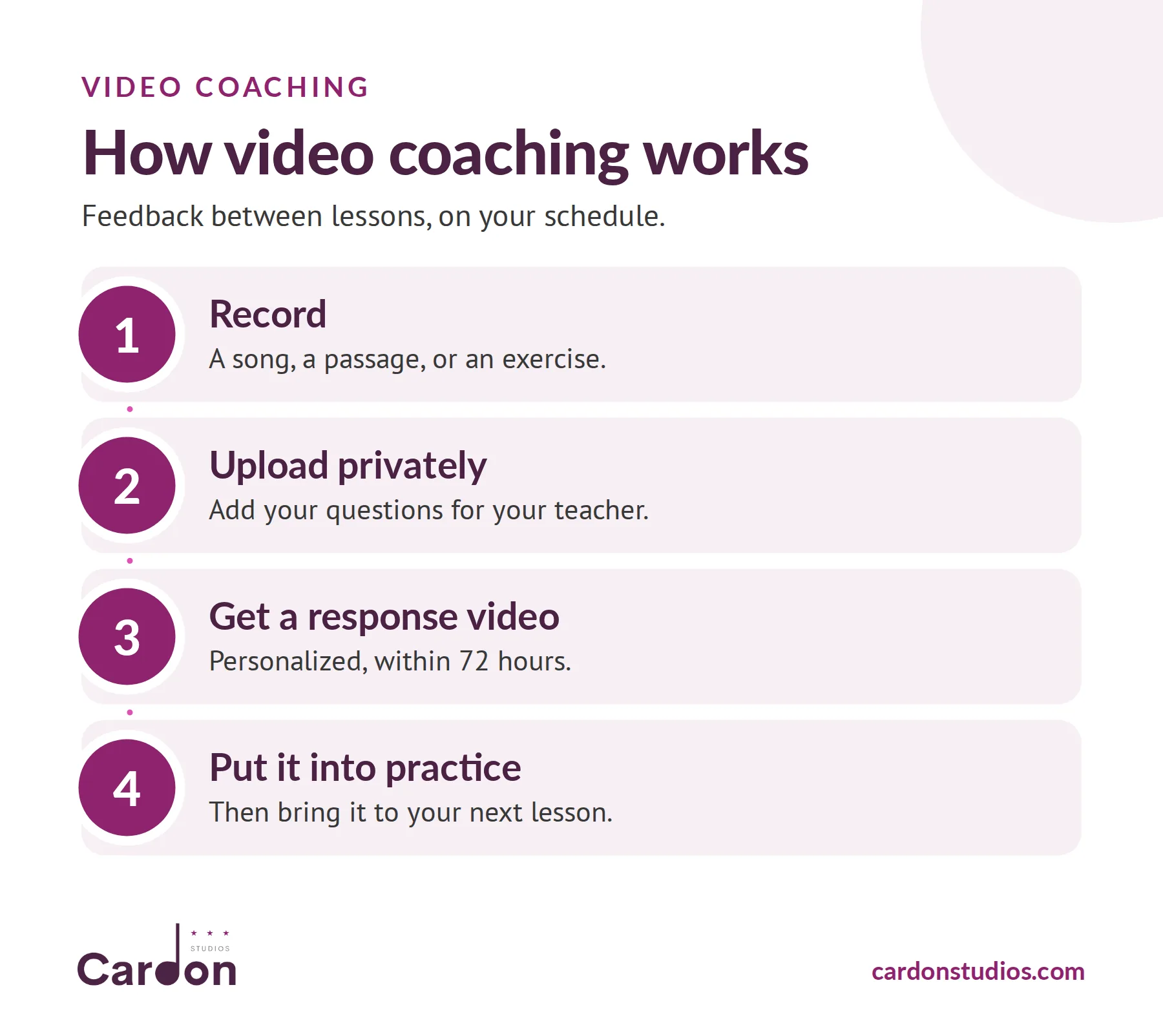
- Record. A song, a passage you’re stuck on, an audition cut, or an exercise.
- Upload privately. Add your questions for your teacher.
- Get a response video. Your teacher sends back a personalized response within 72 hours, often with demonstrations and a few clear priorities.
- Put it into practice. Then bring what you learned to your next lesson.
Video coaching is especially useful for audition pieces, recordings, technique checks, and questions of style and expression. Our guide to recording yourself singing will help you make a clear video.
From the studio
Every Cardon Studios teacher has been selected and trained by founder Kate Cardon, and each singer is matched with a teacher by style, goals, age, and schedule. Member online events, including open mics, group classes, and recorded showcases, give you places to try what you’ve polished.
Online voice lessons
Get lessons and coaching in one membership
One monthly membership includes four private online voice lessons, one video coaching submission, the Learning Library, and member online events, with a teacher matched to your style, goals, age, and schedule.
Common questions about teachers and coaches
What’s the difference between a voice teacher and a vocal coach?
A voice teacher focuses on technique and how your voice works. A vocal coach focuses on style, interpretation, and performance. Many professionals do both.
Do I need a voice teacher or a vocal coach?
If you’re building your foundation or feel strain when you sing, start with a voice teacher. If your technique is solid and you’re preparing specific songs or performances, a coach can add polish. Many singers benefit from both.
Can a voice teacher also coach?
Often, yes. Many teachers combine technical work with coaching on style and performance. Ask about their background and approach before you start.