


To balance singing with a day job, practice in short, focused sessions on most weekdays and save one longer session for the weekend. Use your commute and lunch break for listening and silent practice, plan your heaviest singing around the talking your job requires, and set goals that fit your busiest seasons at work.
Plenty of singers work a full-time job, and plenty of them keep improving. You don’t need hours a day or a flexible schedule. You need a realistic plan, a few habits that fit around work, and a way to protect your voice when your job asks a lot of it.
Key takeaways
- Short, focused sessions on most weekdays add up; save longer sessions for the weekend.
- Commutes and lunch breaks are good for listening and silent practice.
- Talking all day is vocal work too, so plan your heaviest singing around it.
- For weeknight gigs, prepare the next workday before you leave.
Start with an honest look at your week
Your job affects your practice in ways that go beyond hours. A physically demanding job can leave you exhausted by evening, and a mentally demanding one can make it hard to focus. Before you plan, ask yourself:
- How does work affect my energy and my attitude toward practice?
- Could I cut back on another activity to make room for singing?
- What distractions take time away from practice?
- Do I put off practice even when I have time?
- Does my practice routine need rethinking?
If your job leaves you anxious or low, be kind to yourself about it. Singing should add to your life, not become one more source of pressure.
Start small
When work is demanding, especially if you’re new to a job, give yourself time to adjust. Lower your expectations for a while, practice a little on most days, and build back up gradually. A small, steady habit beats an ambitious plan you abandon after a week. If an hour feels like too much, two shorter sessions often fit better.
Build a week that fits your job
Spread your practice across the week according to the time and energy you actually have.
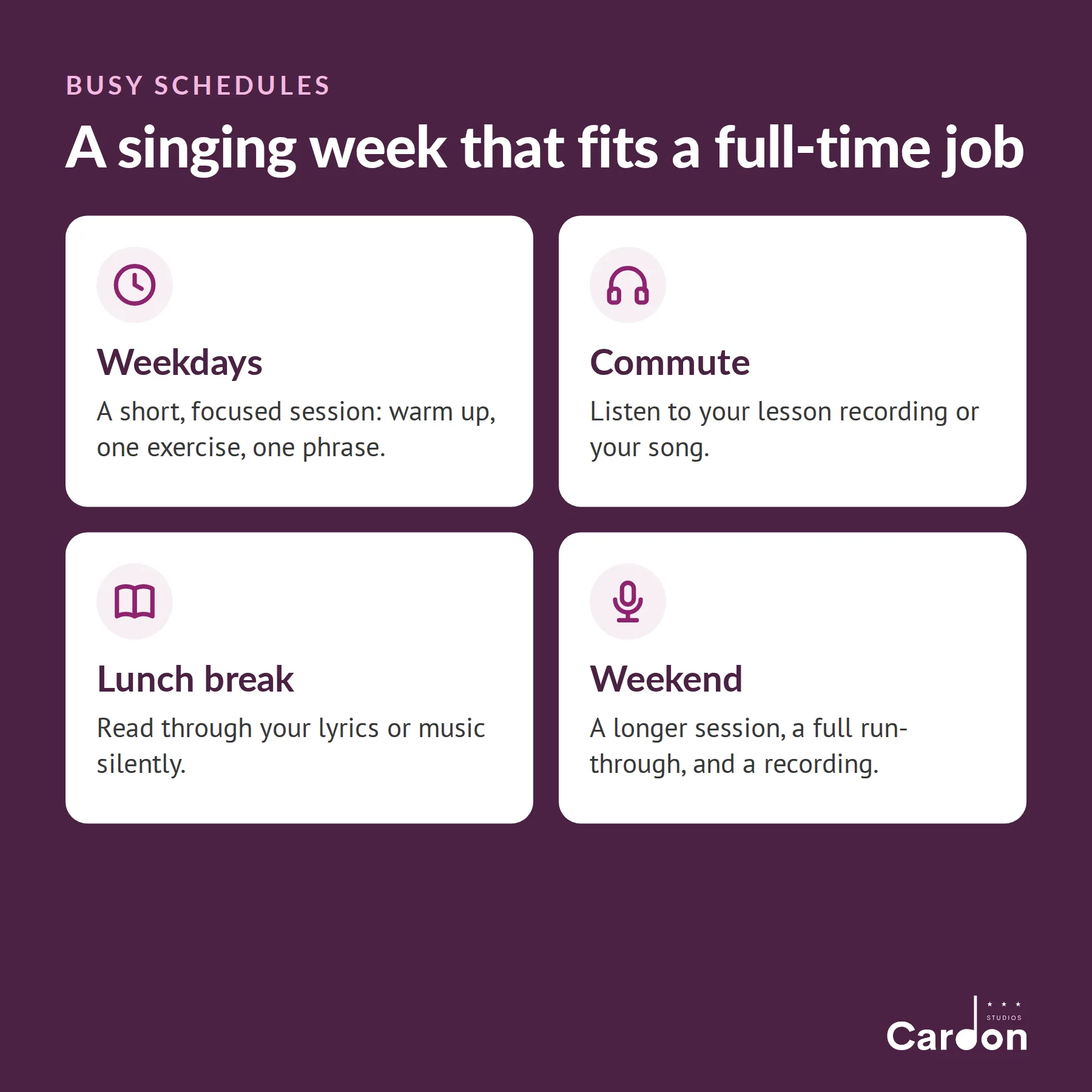
- Weekdays: a short, focused session. Warm up, revisit one exercise, and work one phrase. Our guide to practicing between lessons has a five-step plan.
- Commute: listen to your lesson recording or the song you’re learning. If you drive, singing along in the car counts too.
- Lunch break: read through your lyrics or music silently. Silent practice keeps your learning moving without using your voice; see our guide to deliberate practice.
- Weekend: a longer session with a full run-through, plus a recording so you can hear your progress. Here’s how to record yourself singing.
Keep your music, lyrics, or practice playlist where you’ll see them. A visible reminder makes it far easier to start.
Singing while working: protect your voice on workdays
If your job involves a lot of talking, such as teaching, sales, customer service, or back-to-back meetings, your voice is already working hard before you sing a note. Plan your heaviest singing for lighter talking days, keep water at your desk, and avoid raising your voice over background noise. On days with a lesson or performance, give your speaking voice a break where you can. Our guide to vocal health for singers has more everyday habits.
Singing tips for office and remote workers
If you work at a desk, in an office or at home, your voice may get little use during the day, and the first notes of the evening can feel stiff. A few habits help your voice and your schedule.
- Wake your voice gently. Before an evening session, start with humming, sirens or lip trills rather than going straight into a song. Our vocal warm-up routine walks you through it.
- Use the edges of your day. If you work from home, a short session at lunch or right after your last meeting often fits better than a late one. If you share walls, our tips for singing in an apartment keep the noise down.
- Undo the desk posture. Hours at a screen can leave your neck and shoulders tight. Stand up, roll your shoulders and stretch before you sing; see alignment for singers.
- Keep calls easy on your voice. Use a headset or microphone so you never need to raise your voice on a call, and drink water through the day. The National Institute on Deafness and Other Communication Disorders also suggests vocal naps: short breaks to rest your voice during the day.
Weeknight gigs and performances
Early bookings often land on weeknights, which means a late night before an early workday. If you can’t move the gig to a weekend, prepare as much as you can.
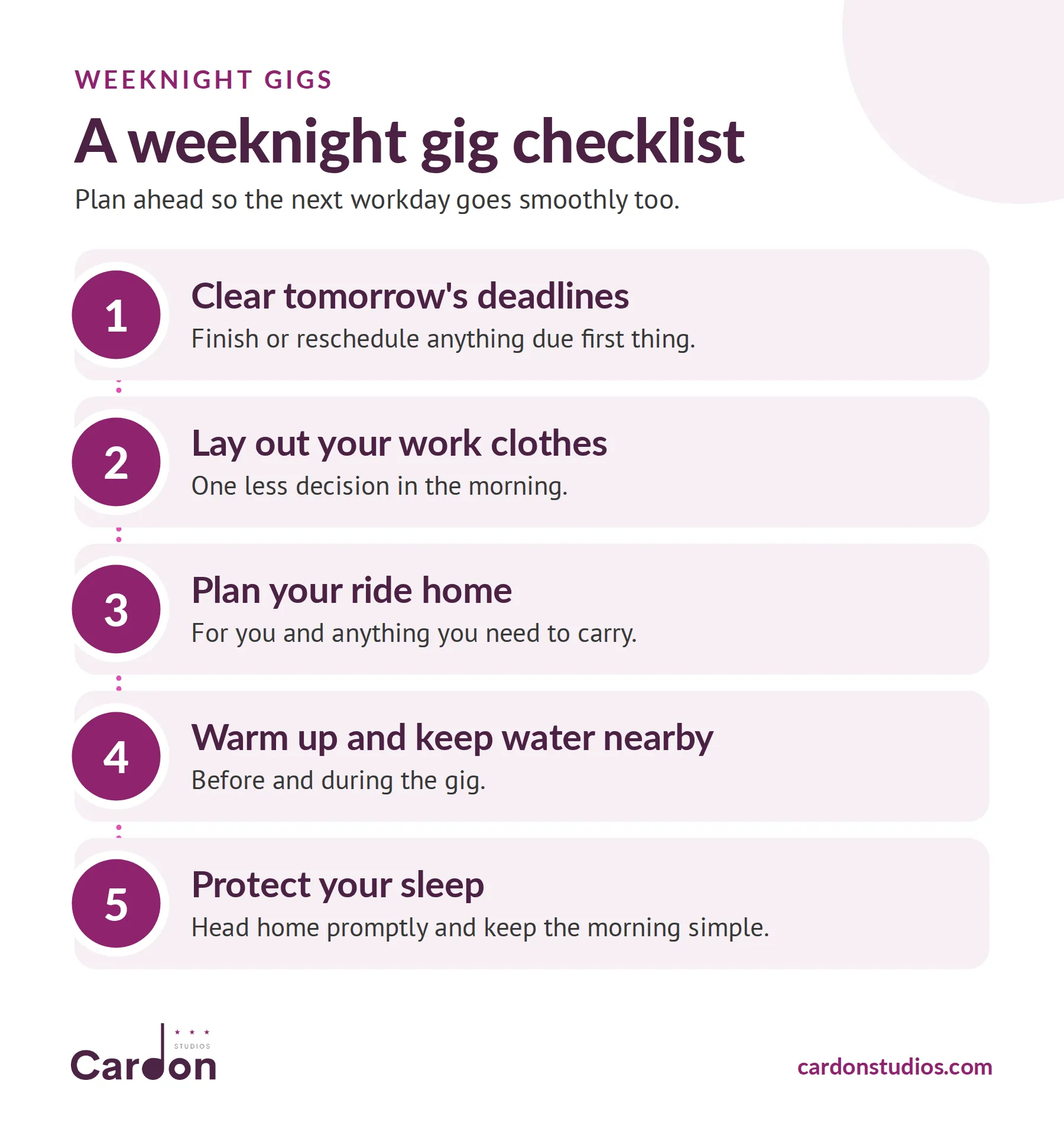
- Clear tomorrow’s deadlines. Finish or reschedule anything due first thing, so you’re not working late after the show.
- Lay out your work clothes and anything else you need for the morning.
- Plan your ride home, for you and any gear you need to carry.
- Warm up and keep water nearby, before and during the gig.
- Protect your sleep. Play with musicians you already know so load-out is quick, and keep the next morning simple.
Set goals that fit your season
Some seasons at work leave plenty of room for singing; others, like a busy quarter or a new role, leave very little. Rather than measuring yourself against your best month, set a goal that fits the season you’re in. During a heavy stretch, the goal might simply be to keep your voice moving with short sessions and your regular lessons. When work eases, raise the bar with a new song, an audition, or an open mic. Write your goal down where you’ll see it, and check in every few weeks so you know whether to push ahead or hold steady. Progress on a busy schedule is still progress.
Share the load and keep it separate
If you perform with a band or group, divide the work. A bandmate with a flexible schedule can handle promotion, and one with a car can move equipment. Keep your music money separate from your other savings and budget for costs in advance; a simple spreadsheet is enough. And think before you post: if you wouldn’t want your manager to see something, it isn’t worth the risk while your day job pays the bills.
The best day jobs for musicians who sing
The best day jobs for musicians aren’t defined by a job title. They’re the ones that leave you the time, energy and voice to keep singing. If you’re choosing a job, or wondering why your current one makes practice so hard, look at four things.
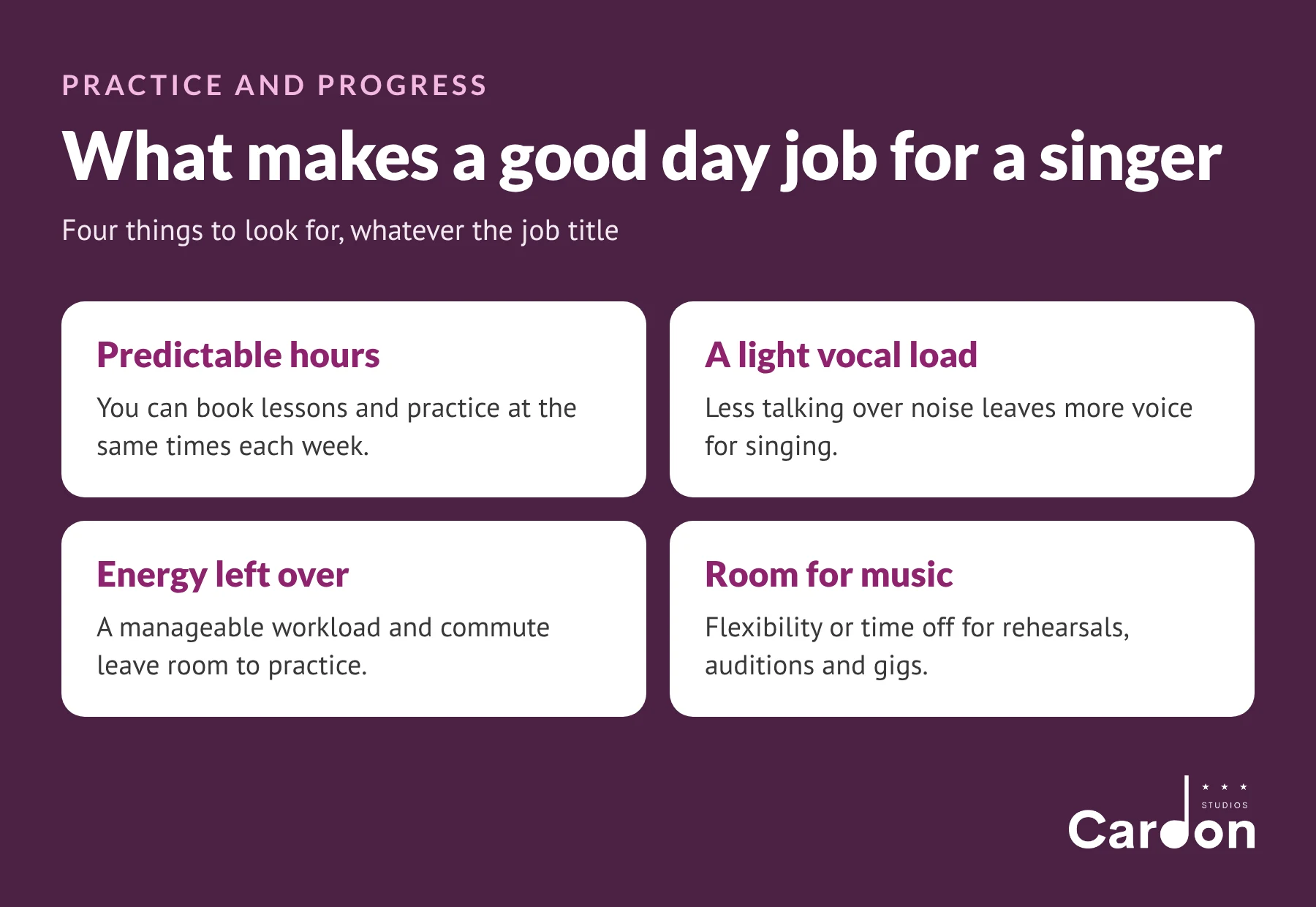
- Predictable or flexible hours. A regular schedule lets you book lessons and practice at the same times each week. Shift work can suit you just as well if you see your schedule far enough ahead to plan rehearsals and gigs.
- A light vocal load. Jobs where you talk all day, especially over noise, use up the voice you want for singing. Desk work, remote work and behind-the-scenes roles usually leave more in reserve. If your job is talk-heavy, the voice care habits above matter even more.
- Energy left over. A physically draining job or a long commute can leave little for evening practice. A job that ends at a predictable time, close to home, gives you a better chance of a real session after work.
- Room to say yes to music. Some singers choose part-time jobs, freelance work or roles with paid time off so they can take an audition, a rehearsal week or a weeknight gig. Before you trade income for flexibility, work out what your singing needs and budget for it.
Good day jobs for musicians can also sit close to music, such as arts administration or work at a theater or venue, which keeps you near performers and performances. None of these is right for everyone. A job that pays the bills reliably and leaves your evenings open often does more for your singing than a music-related job that drains you.
Lessons that fit a working schedule
Live online lessons remove the commute, which makes them easier to fit around work. At Cardon Studios, you schedule lessons yourself through your student account, and lessons are recorded so you can review them on your own time. When a busy week gets in the way of practice, you can send a video between lessons and get a personalized response within two business days.
From the studio
Every singer is matched with a teacher by style, goals, age, and schedule, so your lessons start from the time you actually have.
Online voice lessons
Keep singing, whatever your schedule
One monthly membership includes four private online voice lessons, one video coaching submission, the Learning Library, and member online events, with a teacher matched to your style, goals, age, and schedule.
Common questions about singing with a day job
How much should I practice singing if I work full time?
There’s no fixed number. Short, focused sessions on most days, plus a longer session on the weekend, work well for many working singers. Your teacher can suggest a plan that fits your voice and goals.
Can I practice singing on my lunch break?
Yes, even if you can’t sing out loud. Read through your lyrics or music silently, listen to your lesson recording, or hum gently if you have a private space.
Is it too late to start voice lessons as a working adult?
Not at all. Many singers start or return to lessons as adults. Read why it’s never too late.
What are the best day jobs for musicians?
Jobs with predictable or flexible hours, a light vocal load and energy left over at the end of the day. Desk work, remote work and part-time roles suit many singers, while talk-heavy jobs call for extra voice care.
How can I practice singing at home after work?
Keep it short and regular: warm up gently, work on one exercise and one phrase, then stop while your voice still feels fresh. Humming and lip trills are quiet enough for most homes, and a lesson recording gives each session a clear focus.