

Thinking about voice lessons but not sure what actually happens in one? Here’s what to expect: what a teacher gives you, how a typical lesson runs, what your first lesson looks like, and how to get the most out of every session.
Key takeaways
- A voice lesson combines a check-in, targeted exercises, song work, and a practice plan.
- Your first lesson is about getting to know your voice and your goals.
- Lessons give you structure; practice between lessons makes the change stick.
- Asking questions and reviewing your lessons speeds up your progress.
What a voice teacher gives you
- A knowledgeable resource to answer your singing questions.
- Personalized exercises to address weak spots, expand your range, and widen your palette of vocal colors.
- Explanations tailored to how you learn, grounded in how voices actually work.
- Song coaching that builds on your strengths and brings out your most compelling performances.
- Help with auditions and performance nerves.
- Vocal anatomy and music theory, if those interest you.
For many new singers, lessons are the missing link. You may have read plenty about technique, but having those ideas applied to your own voice and perception changes everything. Singing can feel abstract and overwhelming on your own; a good teacher untangles it and presents new ideas in manageable pieces when you’re ready for them.
Inside a typical lesson
Every lesson is built around you rather than a fixed curriculum, but most follow a similar shape.
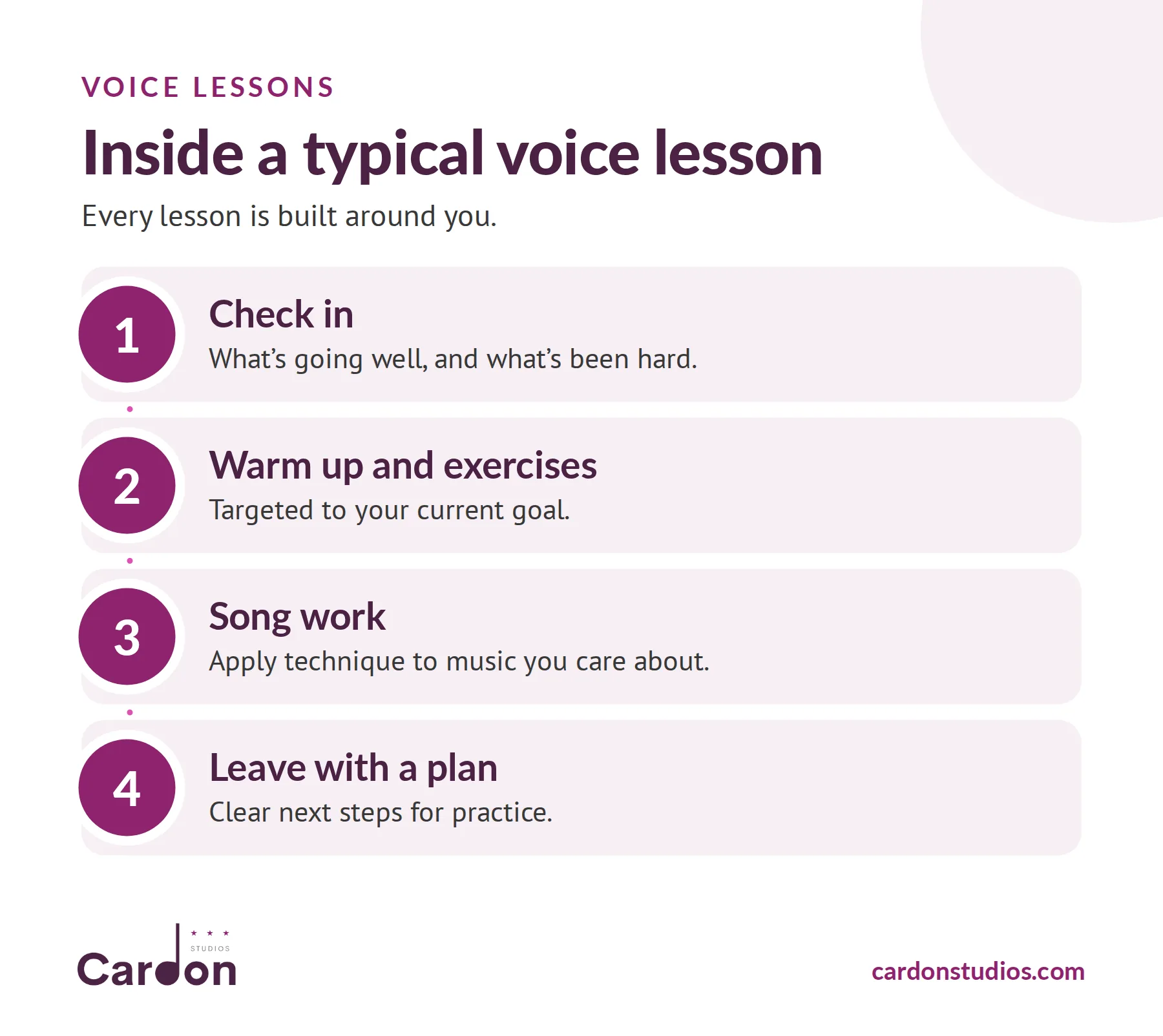
- Check in. What’s been going well since last time, and what’s been hard.
- Warm up and exercises. Targeted to the skill you’re working on, such as breath, range, or a smoother register change.
- Song work. Applying technique to music you care about, along with interpretation and style.
- Leave with a plan. Clear next steps for practice before your next lesson.
The balance between exercises and songs shifts with your needs. Before an audition, your lesson may focus almost entirely on your cut; when you’re building a new skill, it may lean toward technique.
Your first lesson
Your first lesson is about getting to know your voice and your goals. Your teacher will ask what you’d like to work on and what music you love, listen to you sing a little, and try some simple exercises to hear how your voice moves through its range. Then they’ll suggest a plan and a few things to practice. You don’t need to prepare anything special or have any experience. Just come ready to sing.
Taking lessons online? Our article on how online voice lessons work covers setup and what’s different.
What to bring to a lesson
- Water, so you can sip as you sing.
- Your music: the song you’re working on, or one you’d like to start.
- Questions from your week of practice, such as a phrase that kept catching you or an exercise that felt confusing.
- A way to remember what you learned, whether that’s a notebook or your lesson recording.
How long until you see progress?
Every singer is different, so there’s no fixed timeline. Many singers notice small changes within the first few weeks: a warmup that feels easier, a phrase that flows better, a note that settles. Bigger changes, like a smoother transition between registers or more reliable high notes, usually build over months of regular practice. Progress isn’t always a straight line, either. Plateaus are normal, and a teacher can help you find a way through them.
Taking lessons online
Live online lessons work much like lessons in a teacher’s studio: your teacher listens, watches how you breathe and move, demonstrates, and guides you in real time. You’ll need a computer, tablet, or phone with a camera and microphone, an internet connection, and a quiet place to sing. Online lessons also remove the commute, which makes it easier to keep a regular schedule.
Practice makes permanent
Voice lessons can feel like a revelation, but they aren’t a magic cure. Ultimately, you get out of lessons what you put in. You’ve probably heard “practice makes perfect.” We prefer “practice makes permanent.” Old habits can be changed, but it takes mindful, consistent repetition.
If you’ve sung a certain way for years, one lesson a week can’t overwrite that habit on its own, no matter how much freedom your teacher helps you find in the moment. Singers who practice regularly between lessons change much more quickly. Our guide to practicing between lessons gives you a simple session plan.
Getting the most from your lessons
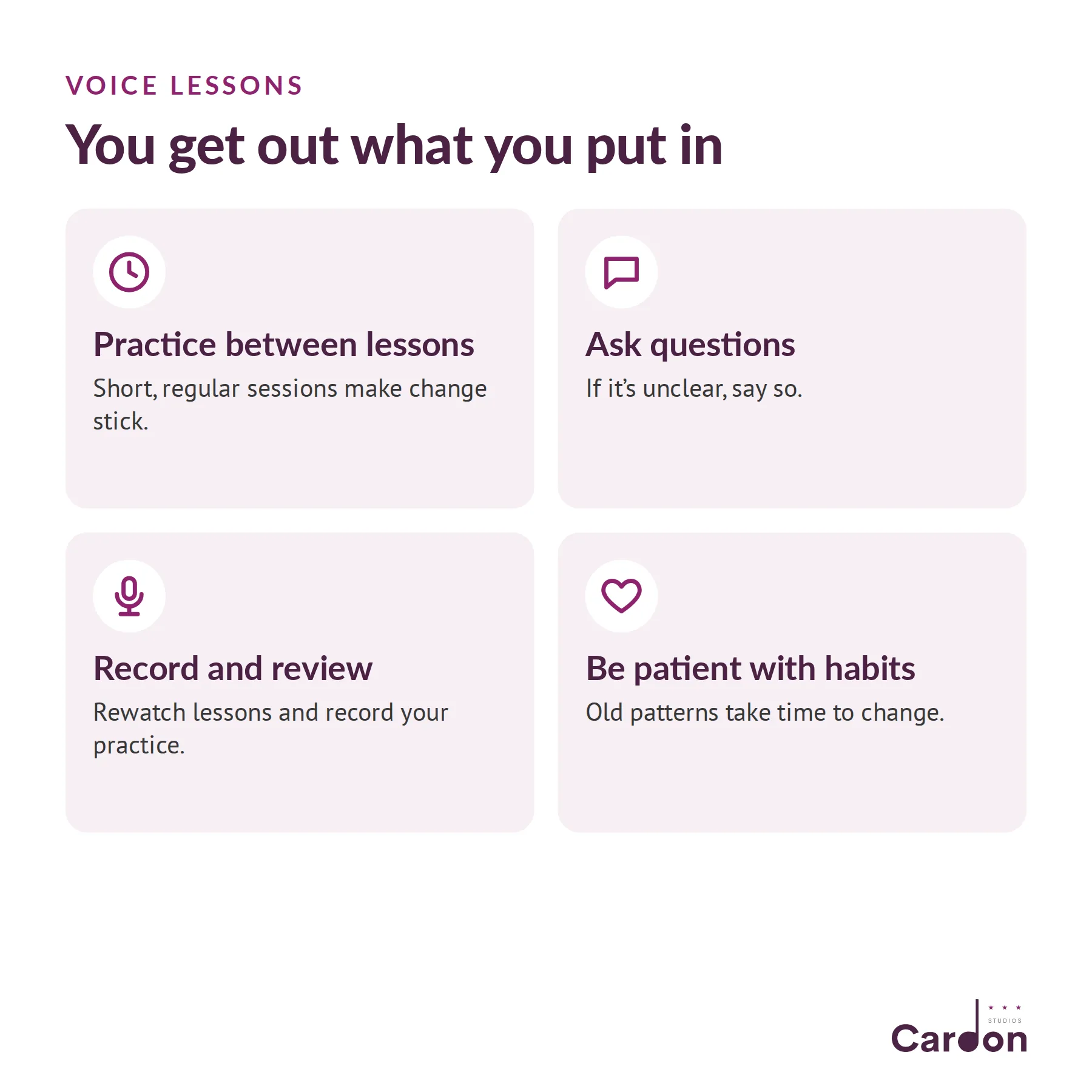
- Practice between lessons. Short, regular sessions make the change stick.
- Ask questions. If something is unclear, say so. Your teacher wants to know.
- Record and review. Rewatch your lessons and record your own practice to hear your progress.
- Be patient with habits. Old patterns take time to change, and progress isn’t always a straight line.
Above all, expect lessons to give you a reliable structure for progress. If you commit to the work, you’ll see results; you just need to hold up your end of the deal. Be brave and make the commitment to yourself and your music. It’s worth it.
From the studio
At Cardon Studios, lessons are live and one-on-one online, and each one is recorded so you can rewatch it while you practice. Between lessons, you can send a video when you get stuck and get a personalized response from your teacher within 72 hours.
Online voice lessons
See what a lesson can do
One monthly membership includes four private online voice lessons, one video coaching submission, the Learning Library, and member online events, with a teacher matched to your style, goals, age, and schedule.
Common questions about voice lessons
What happens in a first voice lesson?
Your teacher asks about your goals and the music you love, listens to you sing, and tries a few simple exercises. You’ll leave with a plan and something specific to practice.
Do I need experience before taking voice lessons?
No. Lessons start wherever you are, from complete beginner to experienced performer.
How much should I practice between lessons?
Short, focused sessions on most days work well for many singers. Your teacher can suggest a routine that fits your voice and goals.