


Exercise helps singers because your body is your instrument. Regular physical activity builds the stamina you need for long rehearsals and performances, supports the posture and body awareness that good singing depends on, and, according to the CDC, helps with mood, sleep and sharp thinking. The key is choosing activities that build flexibility and coordination rather than tension, and learning to move and sing at the same time.
Key takeaways
- Fitness gives you the stamina to sing well through long rehearsals, shows and gigs.
- Core, back and flexibility work support easy posture and alignment.
- Exercise also helps with mood, sleep and focus, all of which affect how you sing.
- Breathe through effort instead of holding your breath, and save hard workouts for after performances.
Why fitness matters for singers
It’s a great habit to spend time practicing, but don’t neglect the rest of your body. Unlike a violinist or a pianist, you can’t put your instrument back in its case. Your voice depends on your breath, your posture and your overall energy, so how you treat your body shows up in your sound.
Performing is physical, too. A musical might ask you to dance and sing at the same time; a gig might mean standing for hours under hot lights; a choir concert might include a long program on your feet. Staying active helps you give your best performance every time, from the first song to the last.
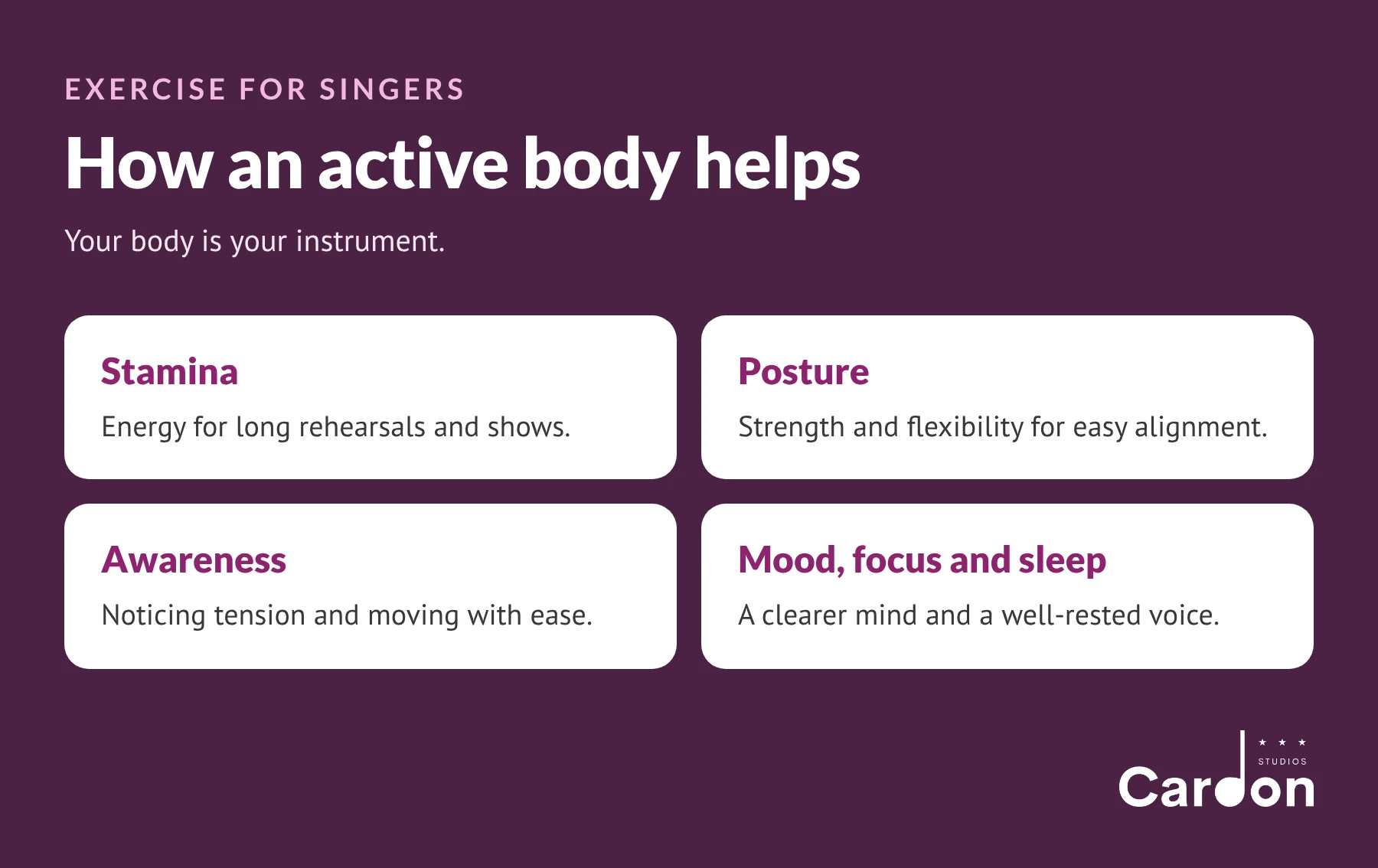
Five ways exercise helps you sing
1. Stamina for performing
Regular aerobic activity, such as brisk walking, cycling or dancing, builds the general stamina that long rehearsals and performances demand. When your body isn’t fighting fatigue, it’s easier to keep your singing steady and expressive late into a show.
2. Posture and alignment
Good singing posture is balanced and easy, not rigid. Strength in your core, back and legs, along with flexibility in your hips and shoulders, makes that balance easier to find and keep. According to the CDC, muscle-strengthening activities help you increase or maintain muscle mass and strength. Our guide to alignment covers what balanced singing posture looks like.
3. Body awareness and coordination
Singing is coordination: breath, voice and body working together. Activities that build awareness, such as yoga, Pilates or dance, help you notice tension and move with more ease. Our guide to releasing tension when singing explains how that awareness carries into your voice.
4. Mood, focus and sleep
The CDC notes that regular physical activity can help keep your thinking, learning and judgment skills sharp as you age, reduce short-term feelings of anxiety in adults, and help you sleep better. A clear mind helps you learn music, and good sleep is one of the simplest things you can do for a well-rested voice.
5. Confidence on stage
Feeling at home in your body makes it easier to stand tall, move freely and connect with an audience. Many singers find that regular movement helps them feel more grounded before a performance. If nerves are an issue, see conquering stage fright.
Exercise and breathing
It’s tempting to assume that running or swimming will automatically improve your breath control for singing. Fitness helps your overall stamina, but the breath coordination singers use, a low, steady, controlled release of air, is its own skill. Breathing hard after a sprint is very different from sustaining a long phrase. Pair your workouts with short, regular vocal practice; our guide to how to sing better covers the skills that build a better voice.
The best way to connect the two is to practice singing while you move. Try singing a song while walking around the room, or while doing gentle dance steps, and notice how your breath adapts. This is especially useful for musical theater. For the singing side of breath, read how to breathe when singing and what breath support really is; the second explains why tight, braced abs can work against you.
Exercise ideas for singers
| Activity | Why singers like it |
|---|---|
| Walking | Easy to fit in, builds stamina, and a good time to listen to your lesson recording or songs you’re learning |
| Yoga | Builds flexibility, balance and awareness of the breath and body |
| Pilates | Builds core strength and control, with an emphasis on precise movement |
| Dance | Builds stamina and coordination, and prepares you to sing while moving |
| Light strength training | Supports posture; focus on good form and steady breathing rather than heavy lifts |
| Cycling or swimming | Low-impact ways to build general fitness |
You don’t need to start lifting heavy weights or training for a marathon. Choose something you enjoy enough to keep doing, and build up gradually.
Yoga for singers: a gentle sequence before you sing
Yoga for singers works best as a short, gentle sequence that loosens the places singers tend to hold tension: the neck, shoulders, ribs, belly and jaw. You don’t need difficult poses. The goal is a balanced, easy body and a slow, low breath, so you arrive at your vocal warm-up ready to sing rather than tired.
Try this sequence on a mat or a carpeted floor. Move slowly, breathe through your nose, and stay well inside what feels comfortable. If a position pinches or hurts, skip it.
| Step | How to do it | What it does for your singing |
|---|---|---|
| 1. Mountain pose | Stand with your feet hip-width apart, knees soft and weight balanced between heels and toes. Take 5 slow breaths, letting your ribs widen as you inhale. | Finds the tall, balanced posture you sing in |
| 2. Neck and shoulder release | Roll your shoulders back slowly 5 times. Then let your head tip gently toward each shoulder and stay for 3 breaths on each side. | Eases tension around the throat and upper chest |
| 3. Cat-cow | On hands and knees, inhale as your belly drops and your gaze lifts; exhale as you round your back. Repeat 6 times. | Wakes up the spine and links movement to breath |
| 4. Child’s pose | Sit back toward your heels with your arms forward and your forehead resting down. Take 5 breaths into your lower back. | Helps you feel the breath expand into your back and sides |
| 5. Standing side stretch | Reach one arm overhead and lean gently to the other side for 3 breaths, then switch. | Opens the ribs so the inhale takes less effort |
| 6. Seated breathing | Sit tall. Inhale through your nose for 4 counts, then exhale on a soft “sss” for 8 counts. Repeat 4 times. | Bridges yoga breathing to the long, steady exhale singing needs |
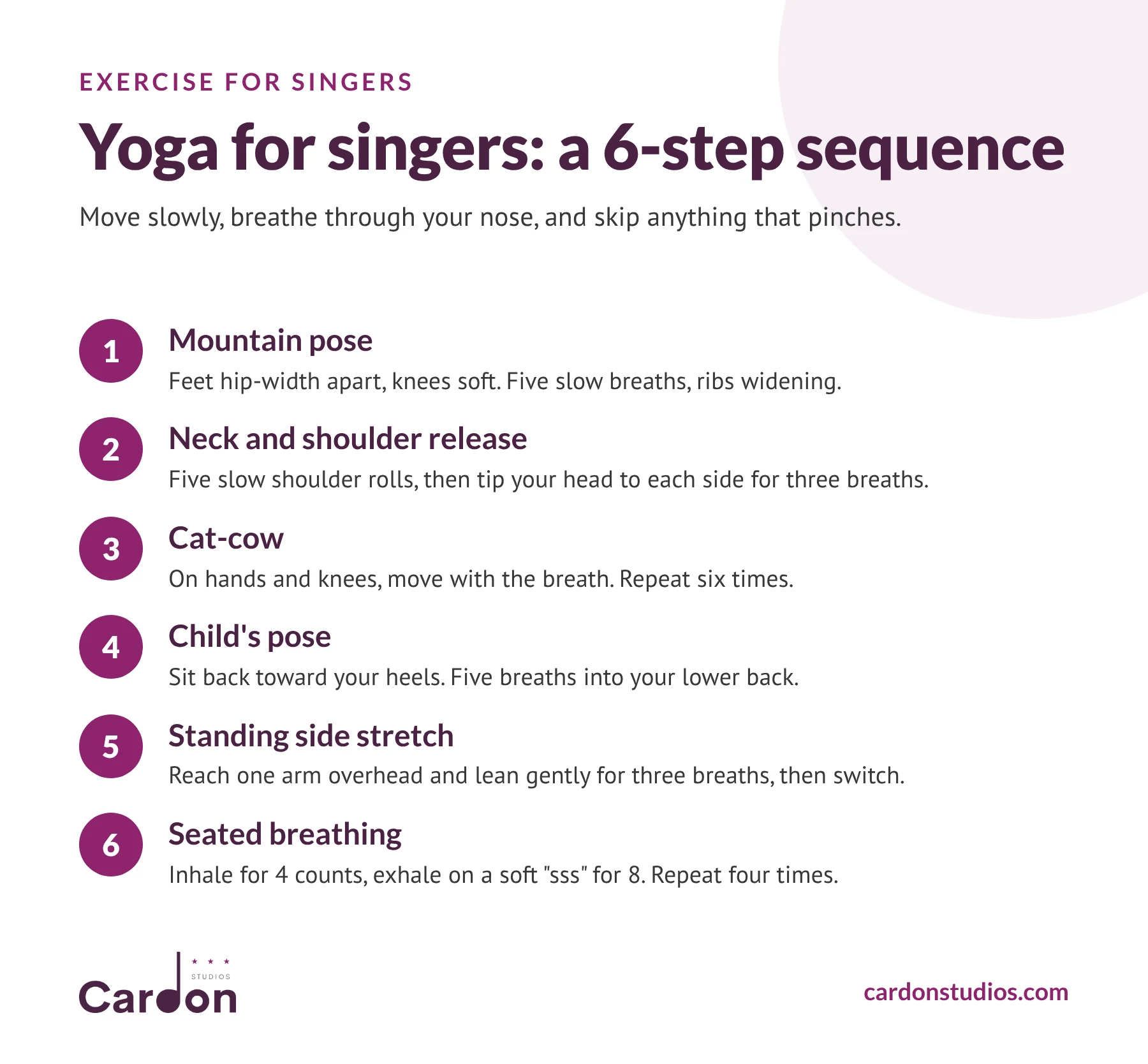
Yoga is a physical warm-up, not a vocal one, so go straight from the last step into lip trills, hums and gentle slides from our complete vocal warm-up. Slow, gentle styles suit singers best before singing; save hot or very vigorous classes for days when you won’t be singing much.
Over a few weeks, notice which step releases the most tension for you. Keep that one as a regular part of your practice routine between lessons, and use it again backstage, where a single slow side stretch or a few rounds of seated breathing can settle you before you go on.
Exercise on rehearsal and performance days
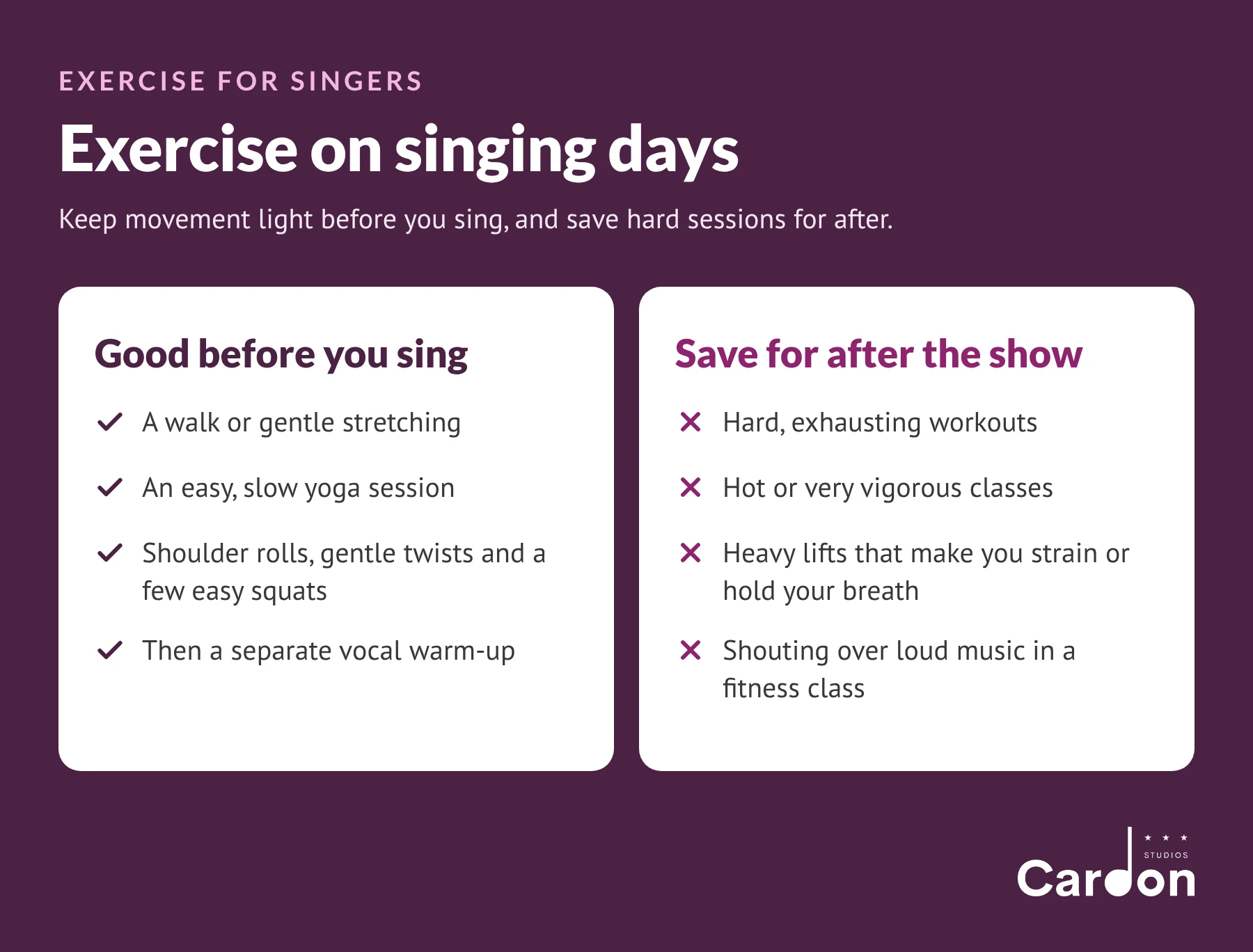
On days when you sing a lot, lighter movement usually serves you better than a hard workout. A walk, gentle stretching or an easy yoga session can help you feel loose and energized without leaving you tired before you sing.
Before you perform, a short physical warm-up, such as shoulder rolls, gentle twists and a few easy squats, helps wake up your body. Follow it with your vocal warm-up. After the performance, once your voice has had time to rest, is a better moment for a harder session.
If you’re in a show with heavy choreography, build singing while moving into your practice weeks before opening night. Practice each number at performance energy, so the combination feels familiar long before tech week. Our guide to preparing for a singing performance has more.
Smart habits for active singers
- Breathe through effort. Keep breathing during hard moves instead of holding your breath or grunting.
- Don’t shout in fitness classes. Cheering and yelling over loud music can tire your voice quickly.
- Stay hydrated. Drink water before, during and after exercise, especially on days you sing.
- Time it well. Save your hardest workouts for after a performance rather than right before it.
- Warm up your voice separately. A physical warm-up isn’t a vocal warm-up; do both. See our complete vocal warm-up.
- Rest and recover. Your body and voice both need recovery days.
Before you start
If you’re new to exercise or have a health condition, check with your doctor before starting a new program. The CDC suggests that adults who aren’t active work up gradually to 150 minutes a week of moderate-intensity activity. If singing or exercise ever leaves your voice hoarse for more than three weeks, the National Institute on Deafness and Other Communication Disorders recommends seeing a doctor.
From the studio
Your teacher can help you connect what your body is doing to what your voice is doing. In a live online lesson, they can spot posture and tension habits and suggest exercises that fit your style. Lessons are recorded so you can rewatch them, and between lessons you can send a video and get a personalized response within 72 hours.
Online voice lessons
Train your voice and your whole instrument
One monthly membership includes four private online voice lessons, one video coaching submission, the Learning Library, and member online events, with a teacher matched to your style, goals, age, and schedule.
Common questions about exercise for singers
Does exercise improve your singing?
It supports it. Exercise builds stamina, posture and body awareness, and helps with mood and sleep, all of which make singing easier. It doesn’t replace vocal training, but it gives your voice a stronger foundation.
What is the best exercise for singers?
The one you’ll keep doing. Many singers like a mix: walking or dance for stamina, yoga or Pilates for awareness and flexibility, and light strength work for posture.
Should singers do ab workouts?
Core work can support posture, but singing needs flexible abs, not braced ones. Balance strength work with flexibility, and keep your belly soft when you sing.
Is it OK to exercise before singing?
Light movement before singing can help you feel energized and loose. Save hard, exhausting workouts for after a performance, and always do a separate vocal warm-up.
Can lifting weights hurt your voice?
Straining, grunting or holding your breath during heavy lifts can put extra effort on your voice. Use good form, breathe steadily through the effort, and stop if your voice feels tired or sore.
How do you sing while dancing?
Learn the choreography until it’s automatic, then add the singing at half volume before going to full performance energy. Plan your breaths for moments when the movement eases, and run each number start to finish so your stamina builds with it.
Is it good to sing while exercising?
Gentle movement, such as singing while you walk, is a useful way to practice steady breath while your body is working. Avoid singing or shouting through hard workouts when you’re out of breath, because you’ll tend to push; keep it easy and stop if your voice feels tired.