

To sing country, start from your speaking voice and tell the story. Country singing uses a conversational, speech-like delivery, a bright, forward tone often called twang, and expressive touches such as slides, scoops and the quick register flip or “cry” in the voice. Vowels are shaped more like speech than classical singing, vibrato usually comes late or not at all, and the words always come first. Build those colors on top of healthy technique, and you’ll sound authentic without straining.
Key takeaways
- Country singing is storytelling first: conversational phrasing and clear words.
- Twang is a bright, forward tone that you can find with playful, bratty sounds.
- Slides, scoops and flips add character, but they work best when they’re light and easy.
- Healthy breath, mix and resonance keep country styles sustainable.
What makes country singing sound country
| Element | What it sounds like |
|---|---|
| Speech-like delivery | Phrasing that follows the natural rhythm and stress of spoken words |
| Twang | A bright, forward, buzzy tone that cuts through the band |
| Storytelling | Words that are clear and central, delivered like you mean every one |
| Slides and scoops | Approaching notes from below or gliding between them |
| The flip or cry | A quick break into a lighter register for emotion, like a catch in the voice |
| Late or little vibrato | Mostly straight tone, with vibrato sometimes blooming at the end of a note |
| Natural vowels | Vowels shaped more like speech, often including regional color |
Not every country singer uses all of these, and the style covers a wide range, from traditional to contemporary country-pop. Listen widely, and notice which elements you love.
How to sing country, step by step
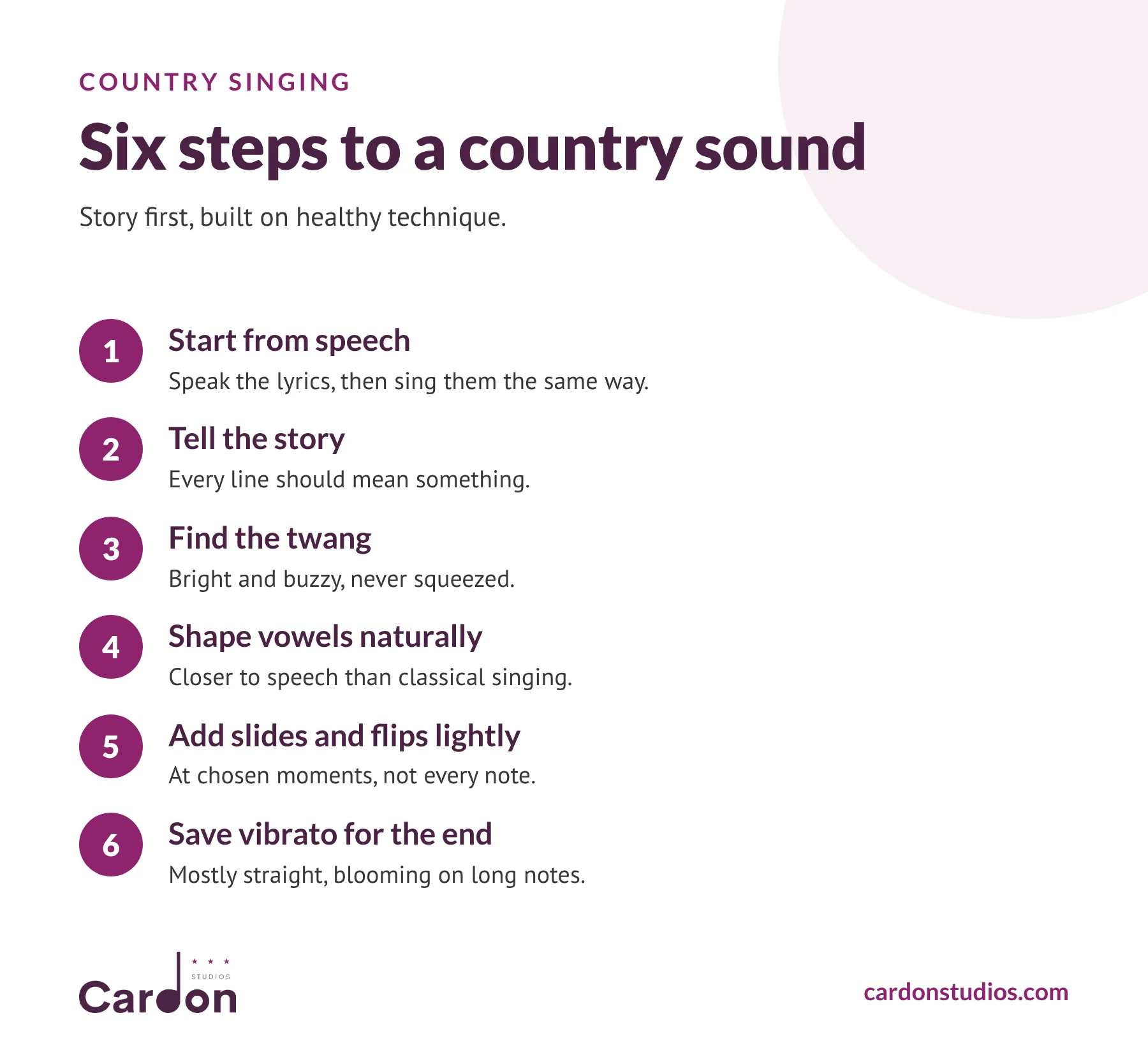
- Start from speech. Speak the words of the song in your natural voice, with the rhythm and emphasis you’d use in conversation. Then sing them with the same feeling.
- Tell the story. Decide who you’re singing to and what happened. Country audiences listen to the words, so every line should mean something.
- Find the twang. Twang is a bright, forward resonance. Exercises like the playful “nyeah” below help you find it without squeezing.
- Shape vowels naturally. Let vowels be closer to speech than to classical singing. If you have a regional accent, it can be part of your sound.
- Add slides and flips lightly. Use them for expression at key moments, not on every note.
- Save vibrato for the ends of notes. Sing mostly straight, and let vibrato bloom on longer held notes if it comes naturally. See our guide to vibrato.
Country singing exercises
Warm up first, keep the volume moderate, and stop if anything feels tight.
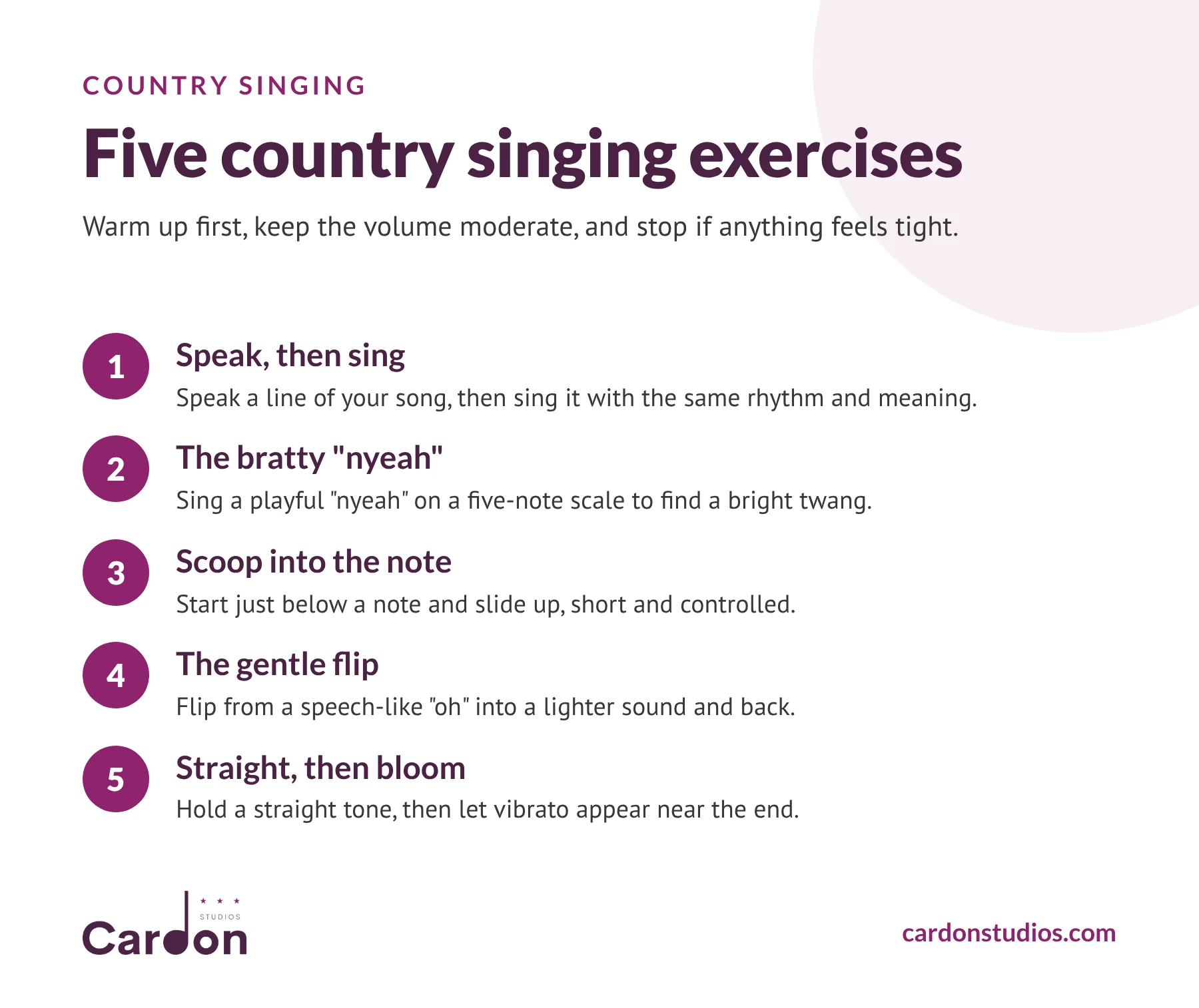
1. Speak, then sing
Speak a line of your song on a comfortable pitch, then sing it with the same rhythm and meaning. Repeat until the sung version feels as natural as the spoken one.
2. The bratty “nyeah”
Say “nyeah” like a playful, teasing kid, then sing it on a five-note scale. The bright, buzzy sound is close to country twang. Keep it light and fun; if it feels pinched, back off the intensity.
3. Scoop into the note
Sing a note by starting slightly below it and sliding up smoothly. Then try it on a word from your song. Keep the slide short and controlled, so you still land in tune. Our guide to how to sing in tune helps here.
4. The gentle flip
Sing “oh” on a comfortable note in your lower, speech-like sound, then flip quickly up into a lighter sound and back, like a small yodel. Keep both sides easy. This builds the “cry” used in many country songs.
5. Straight, then bloom
Sustain a note with a straight tone, then let it relax so vibrato appears near the end, if it comes naturally. This trains the late vibrato common in country.
Slides, scoops and flips
Ornaments give country singing its emotional color, but they’re most effective when they’re chosen, not automatic. Pick a few moments in each song, such as the hook, the emotional peak or the last line, and use your ornaments there.
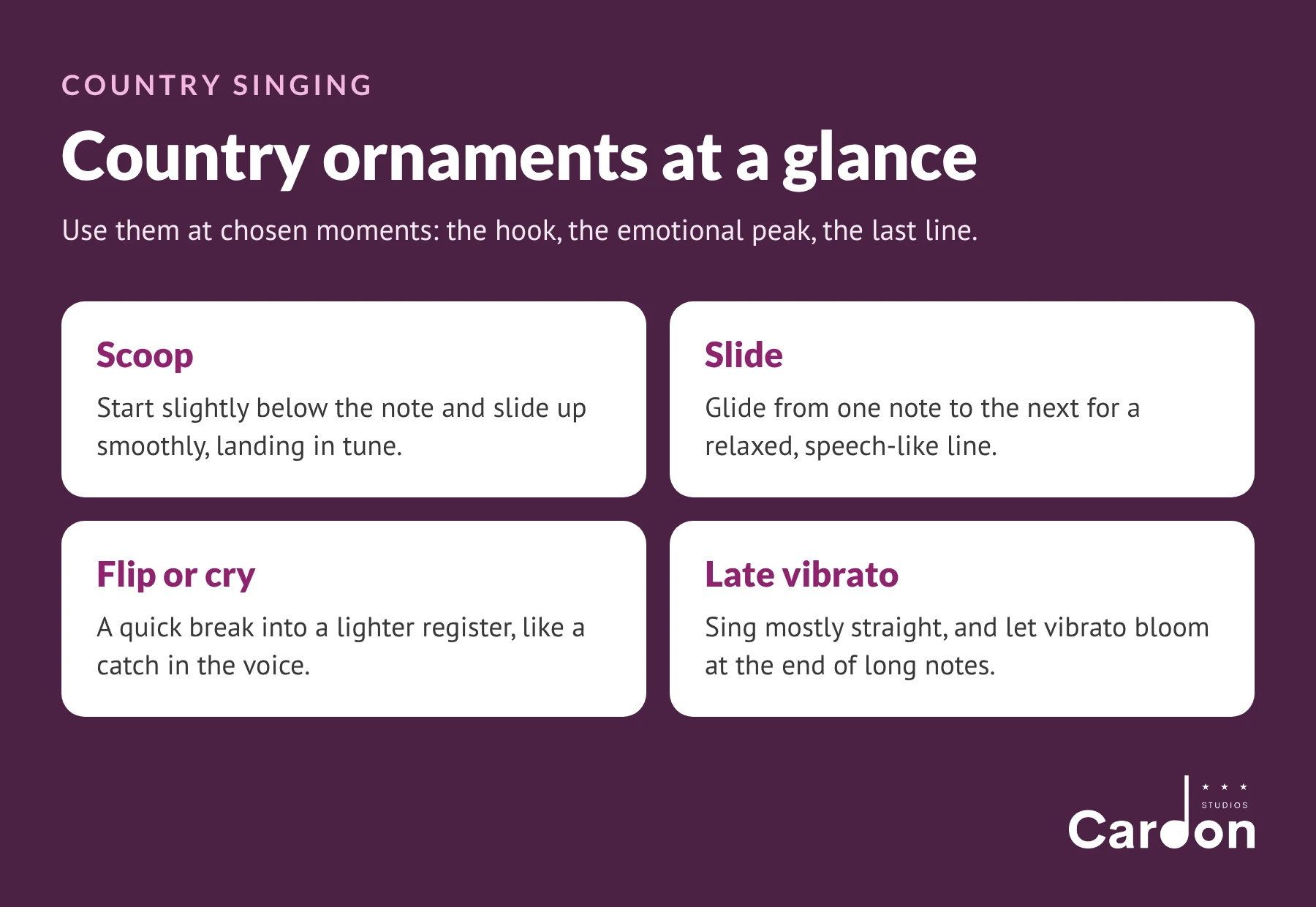
The flip or cry is a deliberate break between registers. Ironically, it depends on understanding those registers well, because it’s the same shift you smooth out the rest of the time. Our guides to voice cracking and vocal effects explain what’s happening at the break.
Choosing songs to start with
Start with songs that sit in the comfortable middle of your voice and tell a simple, clear story. Slower ballads are a good first step, because they give you time to shape each word and try a scoop or flip. Add up-tempo songs and bigger belted choruses as your coordination grows. Harmony singing is also a big part of country, so practice singing a part against the melody; our tips on holding your harmony part apply here too.
How to sing country songs: a one-week plan for a new song
Learning a country song well means learning the story before the style. This plan takes one song from first listen to a confident run-through in about a week of short daily sessions. Pick a song that sits in the comfortable middle of your voice, and keep every session easy.
| Day | Focus | What to do |
|---|---|---|
| 1 | The story | Read the words aloud like a monologue. Decide who you’re singing to, and mark the line that carries the most feeling. |
| 2 | Speech rhythm | Speak each line in rhythm with the recording, then sing it on a comfortable pitch with the same stresses. Keep important words strong and let small words stay light. |
| 3 | Melody and breath | Sing the melody on “nee” or a lip trill, then with the words. Mark breaths at the ends of thoughts, not in the middle of a phrase. |
| 4 | Twang | Add brightness one section at a time, starting with the chorus. If a phrase feels pinched, sing it again with less twang. |
| 5 | Ornaments | Choose three places for a scoop, slide or flip, such as the hook, the emotional peak and the last line. Sing everything else plainly. |
| 6 | Record and listen | Record a full run-through and listen with the words in front of you. Note one line where the story gets lost and one where your tone tightens. |
| 7 | Tell it | Sing the song start to finish for a friend or your phone camera, as if you’re telling them what happened. |
The order matters. When the words and their rhythm come first, twang and ornaments have something to serve, and they’re far less likely to sound put on. If a day’s goal feels hard, repeat that day before moving on rather than adding more style on top of a shaky base.
Day 6 is the one singers most often skip, and it’s often the most useful. Hearing yourself from the outside shows you whether a scoop lands in tune and whether the story comes through; our guide to the benefits of recording yourself explains how to listen back without being too hard on yourself. For ways to fit short daily sessions into a busy week, see how to practice between lessons.
Keeping country singing healthy
- Build your mix. Many country songs sit in the middle of the voice and climb to big, chesty high notes. A balanced mixed voice keeps that power sustainable; see finding your mix.
- Belt with care. Contemporary country often uses belting. Learn it step by step; see how to belt safely.
- Twang without squeezing. Twang should feel bright and buzzy, not tight. If your throat feels pinched, lighten up.
- Keep the breath steady. Conversational phrasing still needs low, steady breath. See how to breathe when singing.
- Rest after long gigs. Multiple sets in loud venues are tiring. Cool down with gentle humming, and rest your voice the next day if you can. See how to sing without straining.
Singing country with a microphone
Most country singing is amplified, which lets you use quieter, more intimate colors. Move closer to the mic for soft, conversational lines, and back off a little for big, belted moments, so the sound stays balanced. Let the sound system handle the volume, rather than pushing to be heard over the band. If you play gigs, our gig guide has more practical tips.
Listen to your voice
Country styles should feel expressive, not painful. If singing leaves you hoarse, rest. According to the National Institute on Deafness and Other Communication Disorders, see a doctor if your voice has been hoarse for more than three weeks.
From the studio
Cardon Studios teachers work with singers in many styles, including folk and country, and every singer is matched with a teacher by style, goals, age and schedule. In a live online lesson, your teacher can help you find an authentic sound that’s healthy too. Lessons are recorded so you can rewatch them, and between lessons you can send a video and get a personalized response within two business days.
Online voice lessons
Find your country sound
One monthly membership includes four private online voice lessons, one video coaching submission, the Learning Library, and member online events, with a teacher matched to your style, goals, age, and schedule.
Common questions about singing country
How do you get a country twang when singing?
Twang is a bright, forward resonance. Try a playful, bratty “nyeah” on a scale, then bring that brightness into your song. Keep it light; it should feel buzzy, not tight.
Do I need an accent to sing country?
No. Country vowels are closer to speech than classical vowels, and some singers use regional color, but the most important thing is a natural, conversational delivery that tells the story.
What is the “cry” in country singing?
It’s a quick, deliberate flip into a lighter register, like a catch or sob in the voice. It adds emotion when it’s used at chosen moments, and it works best when both sides of the flip are easy.
Is country singing bad for your voice?
No, as long as you build on healthy technique. Twang, belting and flips are all sustainable when they’re coordinated rather than forced. Rest after long gigs and stop if anything hurts.
Can a classical or musical theater singer learn country?
Yes. Many singers sing multiple styles. The main changes are more speech-like vowels, less vibrato and a brighter tone. See our article on singing multiple styles.
How do you become a country singer?
Start with healthy technique and a set of songs that suit your voice. Sing for people as often as you can, at school events, community shows or open mics, and record yourself to track your progress. Many country singers also learn to sing harmony and write their own songs, since both are central to the style.
What makes a country song easy to sing?
Look for a narrow range in your comfortable middle voice, a slow or moderate tempo, and phrases with room to breathe. Story ballads are usually easier than up-tempo songs with big belted choruses. Learn it with the one-week plan above.