


To sing without straining, use less force and more coordination: warm up first, breathe low and release the air steadily, lighten your sound as you go higher, keep your jaw, tongue and neck relaxed, and sing in a key that suits your voice. Strain usually comes from pushing, either more air, more volume or more weight than a note needs. If singing hurts, leaves you hoarse or makes your throat feel tight, that’s your signal to stop, rest and change how you’re approaching the sound.
Key takeaways
- Strain comes from pushing: too much air, volume or weight for the note.
- Singing should feel energized but easy. Pain, tightness and hoarseness are warning signs.
- Warm-ups, steady breath, lighter high notes and the right key prevent most strain.
- Gentle exercises such as straw singing and lip trills help you find efficient, easy singing.
Signs you’re straining
Healthy singing can be hard work, but it shouldn’t hurt. Effort that’s spread through your breath and body feels energized; strain feels concentrated in your throat. Watch for these signs:
- A tight, squeezed or scratchy feeling in your throat.
- Visible tension in your neck, or your chin lifting on high notes.
- A voice that tires quickly or feels sore after singing.
- Hoarseness, or a raspy or breathy tone that wasn’t there before.
- Losing your high notes, or cracking more as you sing longer.
- Needing to clear your throat or cough frequently while singing.
Any one of these is a reason to stop, rest and rethink how you’re singing that passage.
What causes vocal strain
Most strain comes from one of six causes, and each has a simple fix.
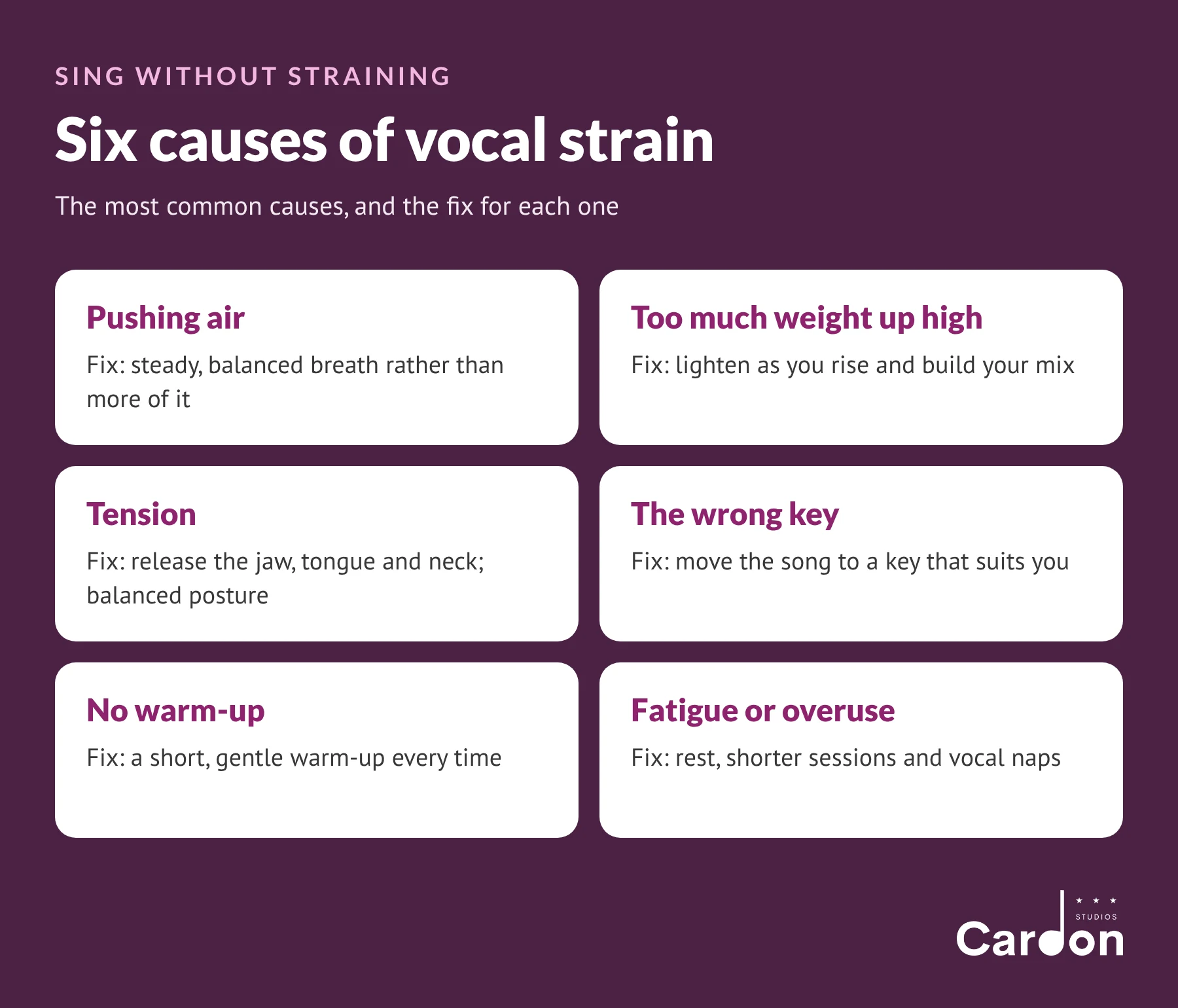
Everyday voice use matters too. The National Institute on Deafness and Other Communication Disorders notes that talking too loudly or too softly can both stress your voice, and recommends avoiding extremes such as screaming or whispering, resting your voice throughout the day, and not speaking or singing when your voice is hoarse or tired.
How to sing without straining
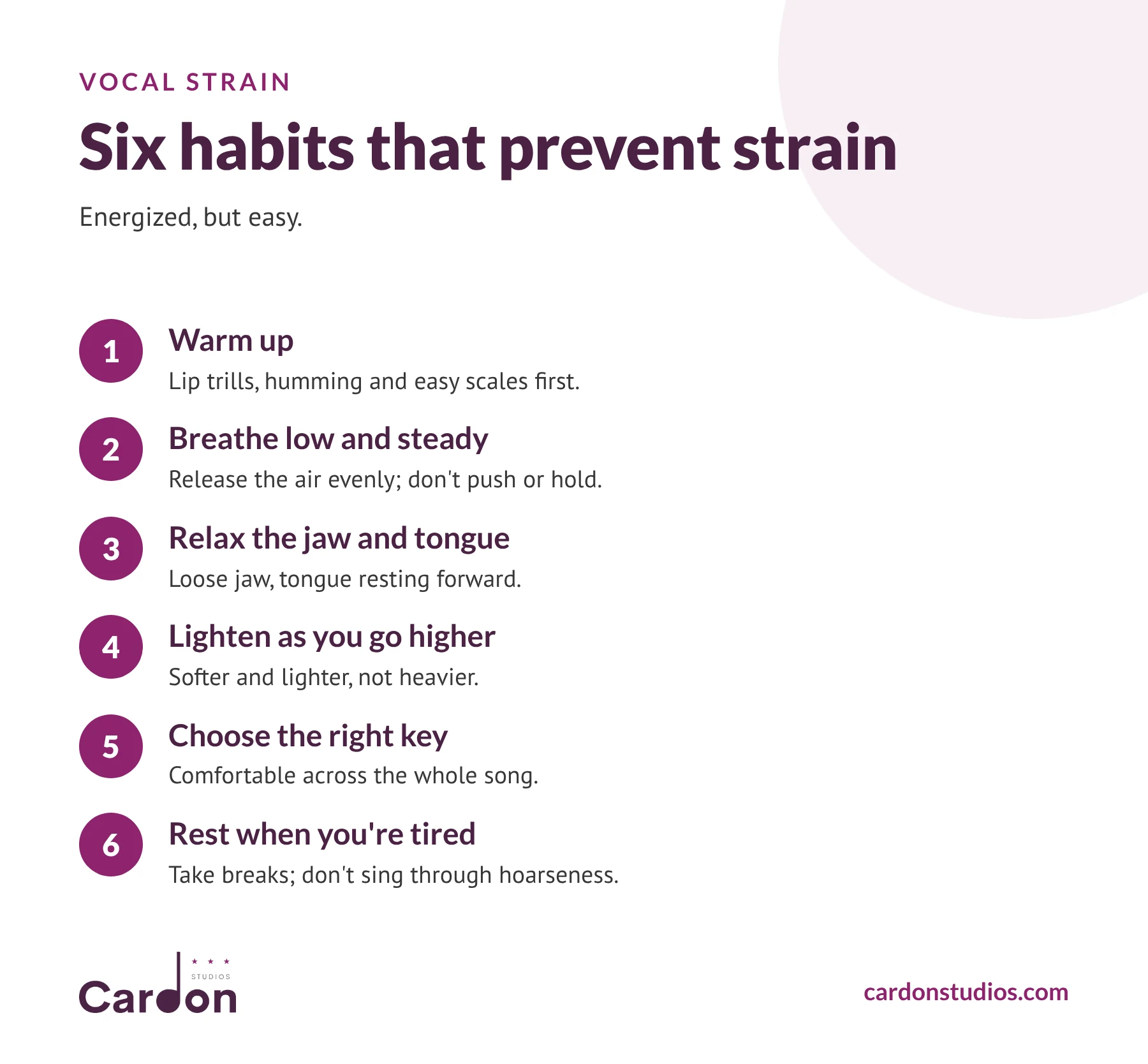
- Warm up. Start gently with lip trills, humming and easy scales before demanding songs. Try our vocal warm-up routine.
- Breathe low and steady. Let the breath drop in low and release it evenly, without pushing or holding. See how to breathe when singing.
- Relax the jaw and tongue. Let the jaw hang loosely and the tongue rest forward. See releasing tension when singing.
- Lighten as you go higher. Sing a little softer and lighter as you rise rather than pushing your lower sound up.
- Choose the right key. If the highest or lowest notes are a stretch, change the key. Your voice should feel comfortable across the whole song.
- Rest when you’re tired. Take breaks during long practice sessions and rehearsals, and don’t sing through hoarseness.
Exercises for easy singing
Semi-occluded exercises, which partly close the mouth at or near the lips, are some of the best tools for finding efficient singing. A 2021 review in the Journal of Singing describes them as raising pressure in the mouth, and recommends starting with medium resistance before moving to lower resistance, because very high resistance can make some singers squeeze.
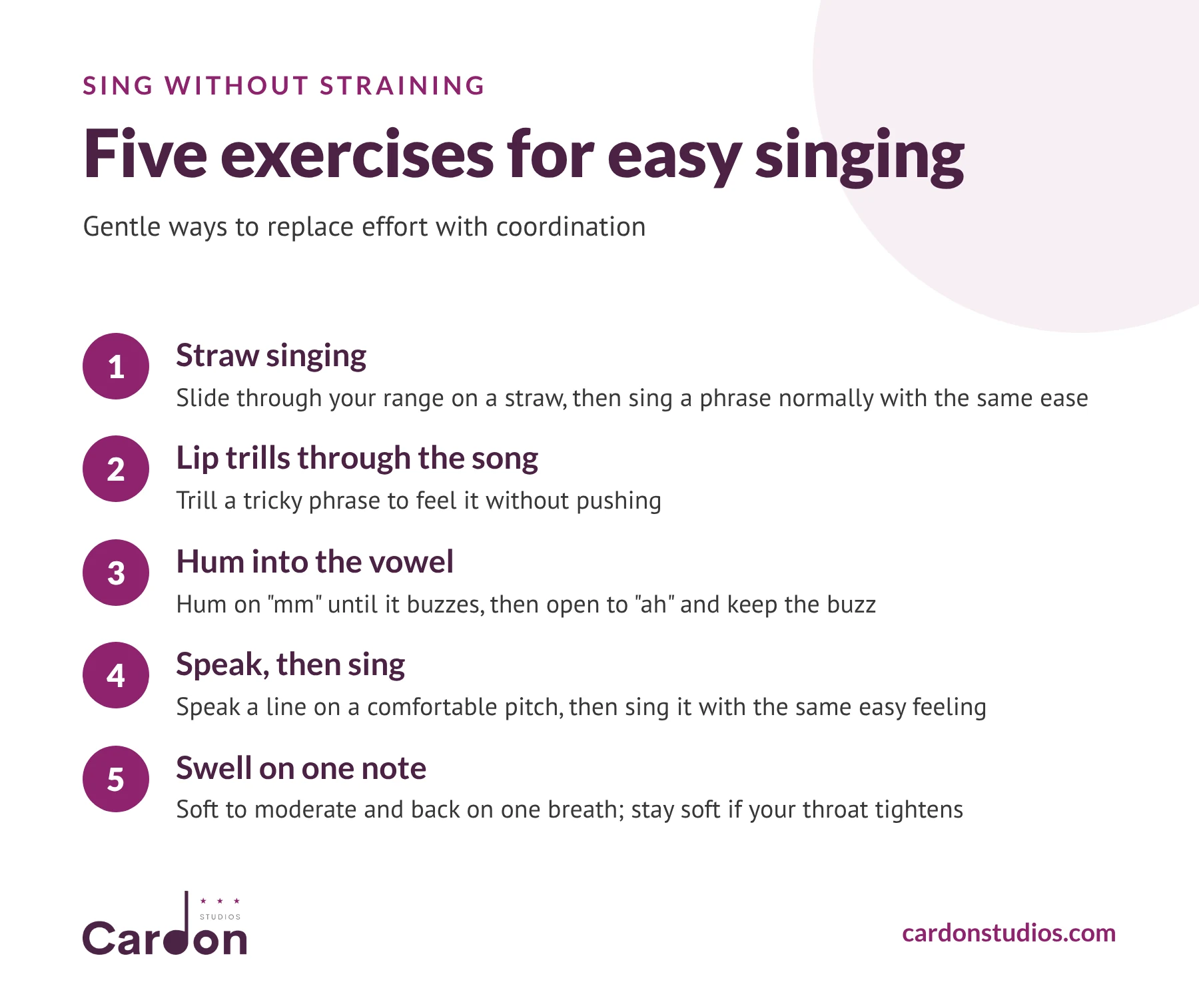
1. Straw singing
Sing through a drinking straw, sliding up and down your range and then singing a phrase of your song. The back pressure helps your voice work with less effort. Then sing the phrase normally and try to keep the same ease.
2. Lip trills through the song
Sing a tricky phrase on a lip trill. It’s hard to squeeze through a lip trill, so you feel what the phrase is like without pushing.
3. Hum into the vowel
Hum on “mm” until you feel a buzz around your lips and nose, then open to the vowel (mm-ah) without losing the buzz. This connects resonance to your open sound.
4. Speak, then sing
Speak a line of your song on a comfortable pitch, then sing it with the same easy, natural feeling. Many singers add effort when they switch from speaking to singing.
5. Swell on one note
Start a comfortable note softly, grow to a moderate volume, and fade back down on one breath. If your throat tightens as you get louder, stay at the softer level for now.
High and loud notes without strain
High and loud passages are where most strain happens. A few principles help:
- Resonance, not force. A clear, buzzy sound carries further than a pushed one. See how to sing louder without straining.
- Coordination for power. A balanced mixed voice lets you keep fullness higher; see our guides to finding your mix for higher and lower voices.
- Belt with care. If you sing contemporary styles, learn to belt step by step; see how to belt safely.
- Use the mic. When you’re amplified, let the sound system do the volume work.
How to sing high notes without straining: a five-step ladder
To sing high notes without straining, build up to them in layers: find the note with an easy slide first, then add the vowel, the words and, last of all, the volume. Work through these steps on the highest phrase of your song, and move to the next step only when the one before feels easy.
- Slide on a lip trill. Trill from a comfortable note in the middle of your range up to the high note and back down, five times. If the trill stops, you’re usually pushing too much air, so use less and try again.
- Sing the note on “oo” or “ee”. Narrow vowels are easier to keep light up high. Sing the high note on “oo” five times at a medium-soft volume, keeping your chin level and your jaw loose.
- Approach from above. Start one or two notes above the target on “oo”, then slide down onto it. Arriving from above helps you keep the lighter coordination instead of hauling your lower sound up.
- Add the real word, with a gentler vowel. Sing the actual word on the high note, letting a wide vowel such as “ah” shade slightly toward “uh”. This keeps your jaw from opening too far and usually makes the note easier to tune.
- Bring in the volume last. Sing the whole phrase at about two-thirds of your full volume. Add more only if your throat still feels easy; if you notice squeezing, go back one step.
Record yourself on the last step and listen for the signs of strain listed above. Recording yourself makes it easier to hear a pinched or pushed sound you can’t notice while singing. If notes near the top of your range still feel heavy, spend a week on singing in head voice, then come back to the ladder.
Keep the ladder short: three or four rounds at the end of your warm-up are plenty. Stop for the day if your voice starts to feel tired or sounds hoarse.
If you’ve already strained your voice
Rest is the first step. Speak less, avoid whispering and shouting, drink plenty of water, and give your voice time before singing again. When you return, start gently with humming and straw singing, keep sessions short, and notice what triggered the strain so you can change your approach.
When to see a doctor
According to the National Institute on Deafness and Other Communication Disorders, see a doctor if your voice has been hoarse for more than three weeks, especially if you haven’t had a cold or the flu. A laryngologist, an ear, nose and throat doctor who specializes in the voice, is the best specialist for singers. Our guide to vocal health for singers covers everyday care.
From the studio
Strain is often easier for someone else to hear and see. In a live online lesson, your teacher can spot where effort is creeping in and give you exercises to replace it with coordination. Lessons are recorded so you can rewatch them, and between lessons you can send a video and get a personalized response within two business days.
Online voice lessons
Learn to sing with ease
One monthly membership includes four private online voice lessons, one video coaching submission, the Learning Library, and member online events, with a teacher matched to your style, goals, age, and schedule.
Common questions about vocal strain
How do I know if I’m straining my voice?
Signs include a tight or scratchy throat, neck tension, a voice that tires quickly, hoarseness, and cracking more as you sing. Healthy singing should feel energized but easy.
How do I stop straining on high notes?
Lighten your sound as you rise, keep your chin level and your jaw loose, and steady your breath rather than pushing. Building a mixed voice helps you keep power without strain.
Is it normal for singing to hurt?
No. Singing can be tiring, but it shouldn’t hurt. If it does, stop, rest and look at how you’re singing. If hoarseness lasts more than three weeks, see a doctor.
Can straw singing help vocal strain?
Straw singing is one of the gentlest ways to find efficient singing, and many singers use it in warm-ups and cool-downs. It isn’t a treatment for injury; if your voice is hurt, rest and see a doctor.
What is vocal strain?
Vocal strain is what happens when you make sound with more force or tension than it needs, through pushing, squeezing or overuse. It usually shows up as a tight throat, a voice that tires quickly, soreness or hoarseness after singing or speaking. Rest and a gentler approach help; if hoarseness lasts more than three weeks, see a doctor.
How do I sing without hurting my throat?
Warm up gently, keep your breath steady instead of forced, sing in a key that suits you, and lighten your sound as you go higher. Singing should never hurt. If it does, stop and rest, and see a doctor if pain or hoarseness doesn’t go away.
How long should I rest a strained voice?
It depends on how strained it is. Rest until your voice feels normal again, then return gently. If hoarseness lasts more than three weeks, see a doctor.