

A voice major is a college student whose main area of study is singing, usually through a Bachelor of Music in vocal performance, a Bachelor of Arts in music, or a Bachelor of Fine Arts in musical theatre. The degree you choose decides how much of your schedule is music, which styles you study, and what you’re ready for after graduation. This guide compares the degrees, shows what a vocal performance major studies, explains auditions, and lists the questions to ask each school.
Key takeaways
- A Bachelor of Music is a professional degree: for performance majors, music normally makes up at least 65% of the courses.
- A Bachelor of Arts in music is a liberal arts degree, normally 30 to 45% music, with room for a minor or second major.
- Voice majors study diction and foreign languages along with theory, ear training and music history.
- Most programs admit voice majors by audition, and many ask for a recorded prescreening first.
What is a voice major?
Many passionate singers decide to continue their training at a college, university or conservatory. As a voice major, your weekly private voice lessons are the center of the degree. Around them you take classes in musicianship and performance and, depending on the program, academic subjects outside music.
The details vary more than most students expect. Two schools can offer degrees with the same name and very different requirements, and one school may offer several degrees in voice. Comparing programs side by side before you apply saves you from discovering the differences after you enroll.
Voice degrees compared: BA vs. BM vs. BFA
Some schools offer more than one degree for the same major, such as a BA in music and a BM in voice. The National Association of Schools of Music (NASM), which accredits many U.S. music programs, sets benchmarks for how much of each degree is music, based on a four-year, 120-credit program (NASM Handbook 2025-26). NASM calls these percentages benchmarks rather than exact rules, so always check each school’s own requirements.
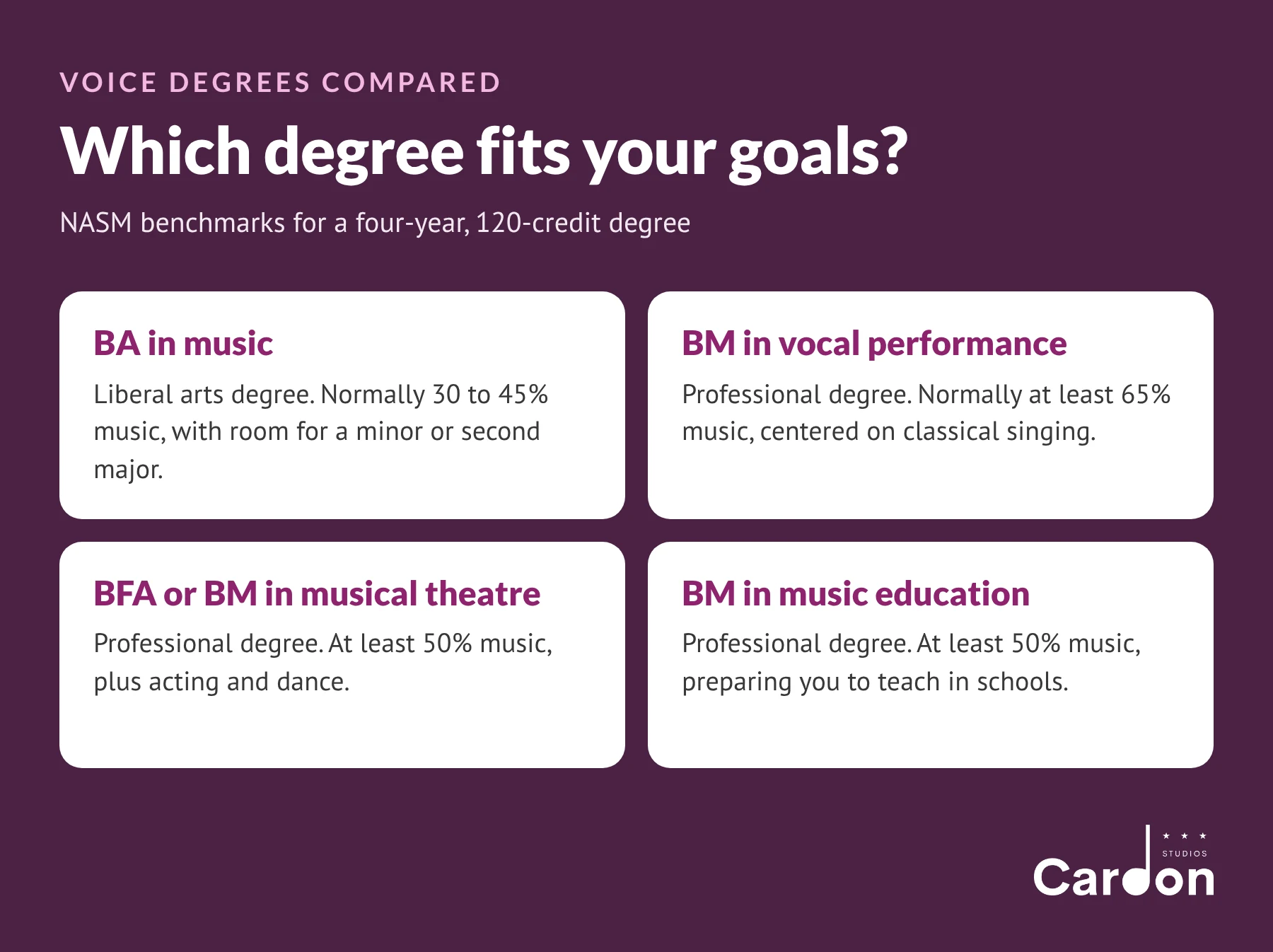
| Degree | Type | Music share (NASM) | A good fit if you |
|---|---|---|---|
| Bachelor of Arts (BA) in music | Liberal arts | Normally 30 to 45% | Want a broad education, a double major, or more time to decide |
| Bachelor of Music (BM) in vocal performance | Professional | Normally at least 65% | Want to focus on classical solo singing and graduate study |
| BFA or BM in musical theatre | Professional | At least 50%, plus acting and dance | Want to perform in musicals |
| BM in music education | Professional | At least 50% | Want to teach choir or general music in schools |
Bachelor of Arts in music
A BA in music is a wonderful degree, but depending on your career goals it may be less specialized than you want. Because more than half of the coursework is general studies, a BA can be a strong first step before more focused study in a graduate program, and it leaves room for a second major or a minor.
Bachelor of Music in vocal performance
A Bachelor of Music in vocal performance is the pathway with the most music coursework, including music theory, ear training and music history. Most BM voice programs are built around classical singing: art song, opera and oratorio.
Bachelor of Fine Arts
A BFA in musical theatre, and at some schools in jazz or contemporary voice, is another specialized pathway. Musical theatre programs combine singing with acting and dance, and their repertoire leans toward contemporary styles rather than classical.
Classical, contemporary, jazz or musical theatre
Voice programs usually center on one style, so match the program to the music you want to sing. Common areas of study include:
- Classical voice. Art song, opera and oratorio in several languages, the traditional focus of a BM in performance.
- Contemporary voice. Sometimes called CCM (contemporary commercial music): pop, rock, R&B, country and singer-songwriter styles, often with songwriting and recording.
- Jazz voice. Standards, improvisation, scat singing and small-group performance.
- Musical theatre voice. Legit, mix and belt singing combined with acting and dance.
- Study across styles. Some programs let you train in several styles, which suits singers who want a flexible career.
Not sure where your voice fits yet? Our guide to singing multiple styles explains how singers move between them, and voice types covers how teachers classify voices.
What a vocal performance major studies
A vocal performance major spends most of each week on music. Private lessons and studio classes build your technique, and the rest of the schedule builds the musicianship a professional singer needs. A typical Bachelor of Music in vocal performance includes:
- Private voice lessons every semester, usually with juries (end-of-term performances for the voice faculty) and one or more recitals.
- Music theory and ear training, often four semesters each, covering harmony, sight singing and dictation.
- Music history, from early music to today.
- Diction for singing in English, Italian, German and French, usually taught with the International Phonetic Alphabet (IPA).
- Foreign languages. NASM’s standards call the study of foreign languages and diction essential for voice performance majors.
- Ensembles and opera workshop, such as choirs and staged scenes.
- Piano skills, often checked with a keyboard proficiency requirement.
For example, Oberlin Conservatory’s Bachelor of Music in voice performance includes English, Italian, German and French diction courses, elementary Italian, German and French, four semesters each of aural skills and class piano, and a junior and a senior recital (Oberlin course requirements, 2024-25). If reading music is new to you, start now with our step-by-step sight singing guide.
Voice major auditions and prescreening
Most voice programs admit students by audition, in addition to the university’s academic application. Many ask for a recorded prescreening first and invite only some applicants to a live audition. Requirements differ by school, so read each one’s audition page carefully.
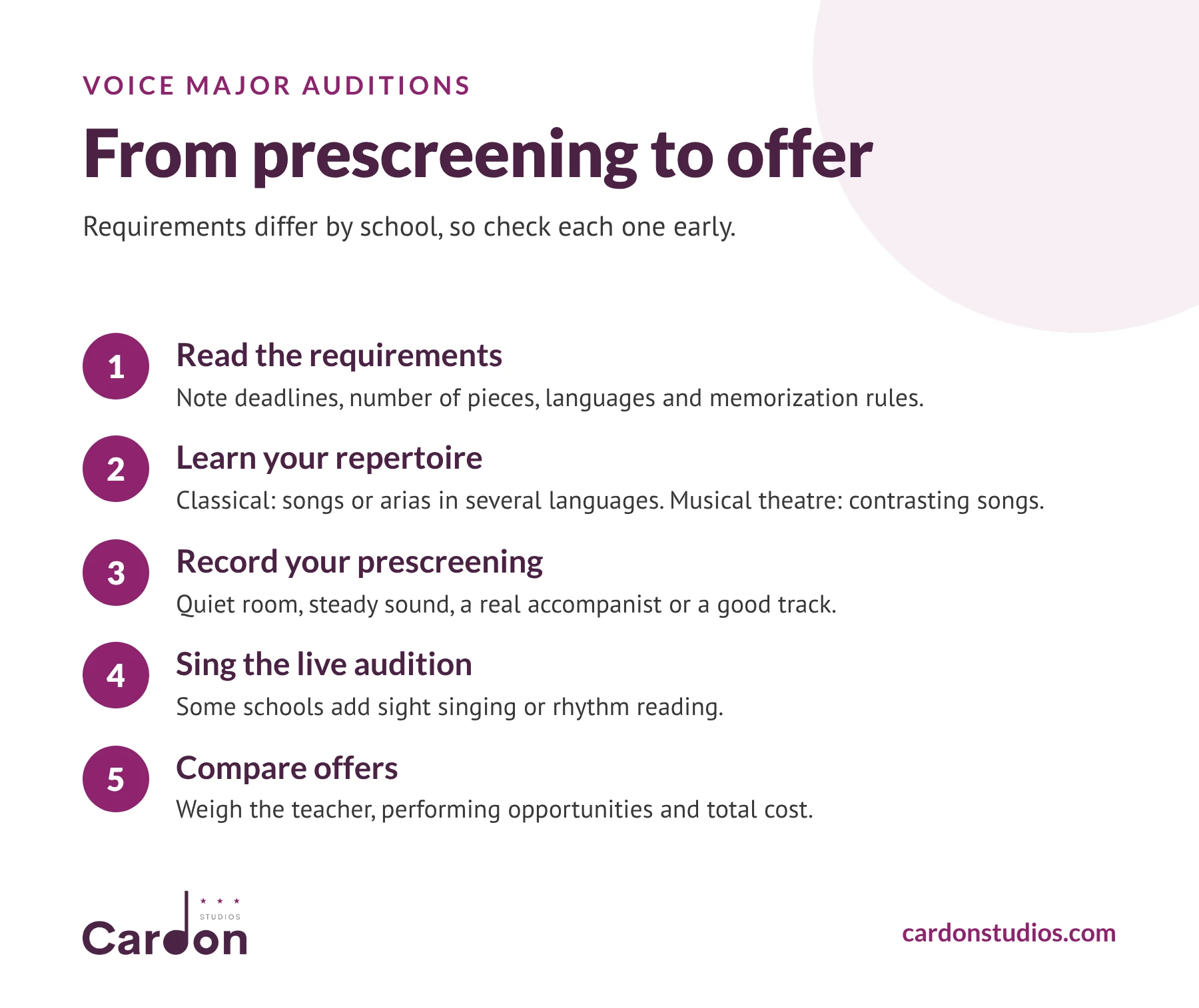
- Read each school’s requirements early. Note deadlines, the number of pieces, the languages, and whether you must sing from memory.
- Choose and learn your repertoire. Classical programs usually ask for art songs or arias in several languages. Musical theatre programs ask for contrasting songs and often a monologue and a dance call.
- Record your prescreening. Use a real accompanist or a good accompaniment track, a quiet room and steady sound.
- Prepare for the live audition. Some schools add a musicianship check, such as singing a melody at sight or reading rhythms.
- Compare offers. Weigh the teacher you would study with, performing opportunities and the total cost.
As one example, Northwestern University’s Bienen School of Music requires a video prescreening for its Bachelor of Music in voice and opera performance. Applicants sing four memorized selections, one each in Italian, in French or German, in English, and in a language of their choice, and musical theatre repertoire isn’t accepted (Bienen School audition requirements). Our guide to preparing for college voice auditions walks through audition day, and choosing an audition song helps musical theatre applicants.
How to choose colleges for singing: questions to ask
Once you know the degree and style you want, compare individual schools. Ask the admissions office, the voice faculty and current students these questions:
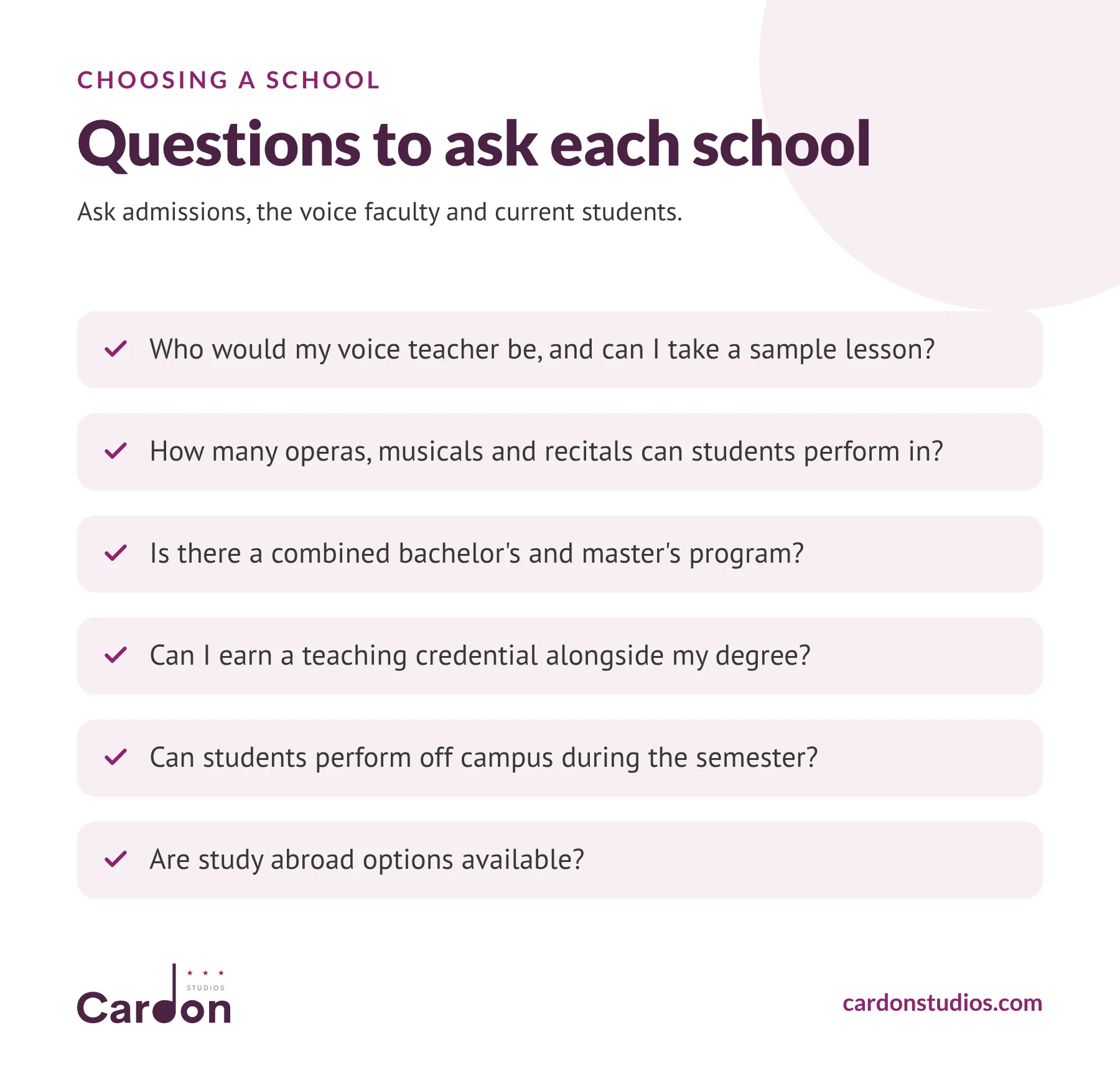
- Who would my voice teacher be? Ask whether you can take a sample lesson, and what performing credits and professional associations the voice faculty have.
- How many performance opportunities will I get? Ask about operas, musicals, recitals and ensembles, and whether first-year students are cast.
- Does the school offer a master’s degree as well? Some schools offer combined programs that let you finish a master’s degree sooner than starting one somewhere else.
- Can I earn a teaching credential at the same time? Some schools let you graduate with a teaching certification alongside your degree, while others require a separate music education degree.
- Are paid student positions available? Some colleges offer assistantships or other paid roles that provide income and strengthen your résumé.
- Is the school in a vibrant arts city? Hearing as much live music in as many styles as possible will make you a more well-rounded musician.
- Can students accept performing work off campus? Some schools limit outside performing during the semester.
- Are study abroad options available? A semester in London for musical theatre, or in Italy for voice performance, may be a great fit for some students.
Visit if you can, sit in on a studio class, and ask current voice majors what a typical week looks like.
Preparing to be a voice major: a high school plan
The strongest applicants start preparing well before senior year. This plan spreads the work out so audition season isn’t a scramble.
| When | Focus | What to do |
|---|---|---|
| 9th grade | Technique | Take regular voice lessons, join a choir, and start learning to read music. |
| 10th grade | Musicianship | Add piano basics and sight singing, and sing in recitals or solo festivals. |
| 11th grade | Research | List schools, compare degrees, and start songs in Italian, German and French with your teacher. |
| Summer before 12th | Repertoire | Choose and memorize your audition pieces, then record practice runs. |
| 12th grade, fall | Apply | Record prescreening videos, submit applications by each deadline, and schedule auditions. |
| 12th grade, winter | Audition | Sing your live auditions and compare offers. |
Record yourself regularly along the way. Our guide to recording yourself singing shows what to listen for, and how to practice singing gives you a daily routine to build on.
From the studio
Cardon Studios teachers are matched to each student’s style, goals, age and schedule, so a singer planning to major in voice can work on technique, audition repertoire and diction in private online lessons. Every lesson is recorded to rewatch, and the monthly video coaching submission is a useful way to get feedback on a prescreening recording before you send it. For audition-day tips, read our guide to preparing your college entrance auditions.
Online voice lessons
Prepare for your voice major auditions
One monthly membership includes four private online voice lessons, one video coaching submission, the Learning Library, and member online events, with a teacher matched to your style, goals, age, and schedule.
Common questions about majoring in voice
What is a voice major?
A voice major is a college student whose main area of study is singing. Most voice majors earn a Bachelor of Music in vocal performance, a Bachelor of Arts in music, or a BFA in musical theatre, with private voice lessons every semester.
What is the difference between a Bachelor of Music and a Bachelor of Arts?
A Bachelor of Music is a professional degree in which music normally makes up at least 65% of a performance major’s courses. A Bachelor of Arts in music is a liberal arts degree, normally 30 to 45% music, with more general studies.
What can you do with a vocal performance degree?
Graduates perform in opera, choirs, musicals and concerts, teach private voice, work in church music, or continue to graduate study. Many combine several of these. A vocal performance degree also builds discipline, stage presence and language skills that help in other careers.
Do you need to read music to be a voice major?
It helps a great deal. Music degrees include theory, ear training and sight singing, and some auditions include a musicianship check. If you don’t read music yet, start learning in high school.
Should I take voice lessons before applying?
Yes, if you can. Auditions usually ask for prepared, memorized pieces, often in several languages, and a teacher can help you choose repertoire, build technique and prepare your prescreening recording.