

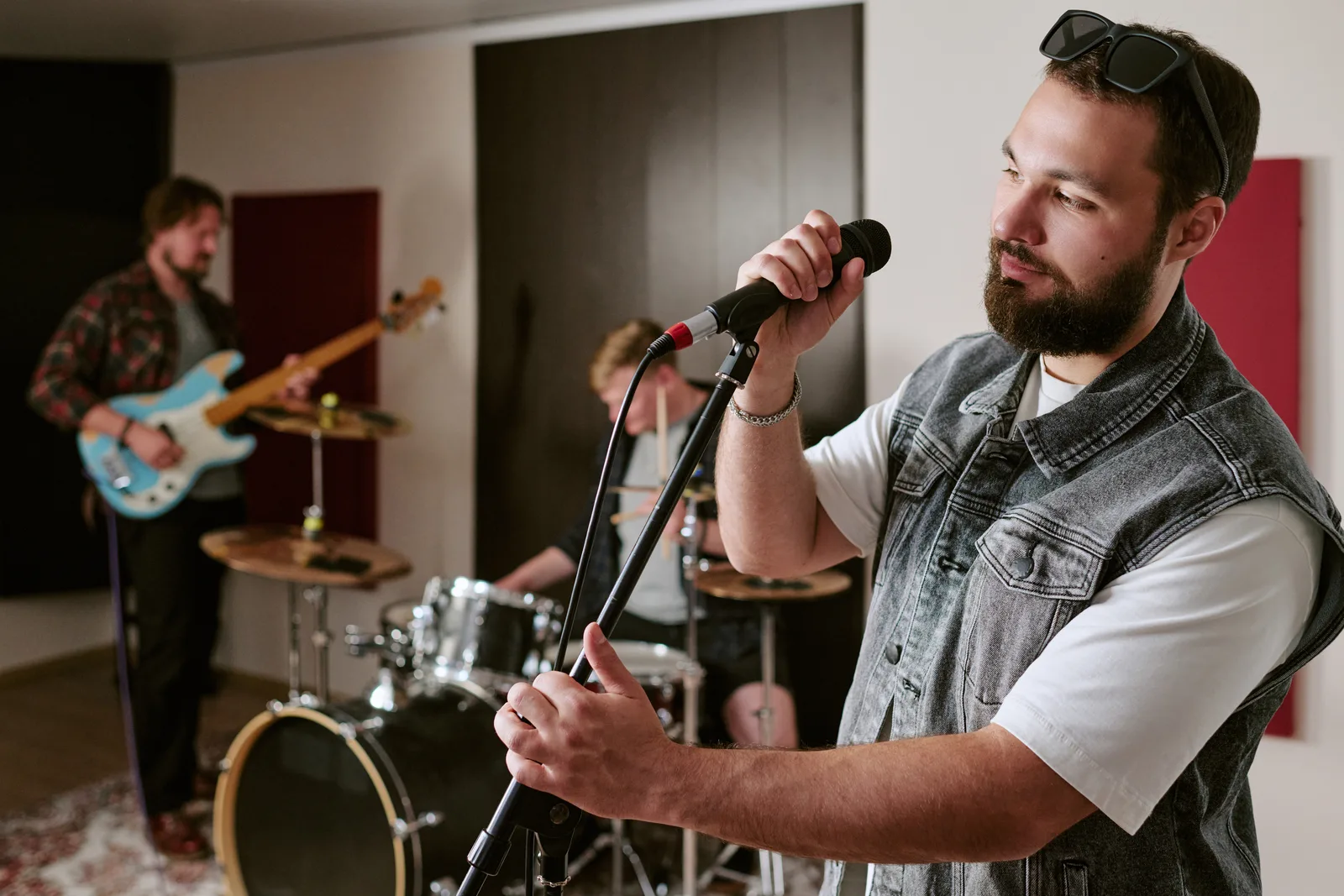
Musical collaboration is the skill of making music with other people: singing with a band, an accompanist, a duet partner or a group so that everyone sounds better together than apart. For singers, it comes down to three things: being prepared and easy to work with, listening and responding to the musicians around you, and communicating clearly about the music.
Musicians must learn to play well with others. From being pleasant and easy to work with, to reading musical cues and responding to them, a singer’s ability to collaborate, in life and in music, will hugely influence their success. This guide covers how to find people to make music with, how to be the bandmate everyone wants back, and how to create real musical moments together.
Key takeaways
- Professionalism and courtesy go a long way: singers who are prepared, agreeable and willing to compromise are the ones who get hired again.
- Great collaboration is mostly listening. Stay present in the music as it happens and respond to how your partners are shaping it.
- Clear communication about keys, form, tempos and cues prevents most rehearsal problems before they start.
- Respect yourself too: save your pushback for what truly matters, and never compromise your health or safety for a gig.
What music collaboration means for singers
Music collaboration covers every situation where you make music with someone else. It might be a rock or pop band, a jazz trio, an accompanist for a recital or audition, a duet partner, a worship team, a choir section, or a songwriting partner you trade ideas with. The settings differ, but the skills are the same: preparation, listening, flexibility and respect.
Singers have a special place in most groups. You usually carry the melody and the words, you often face the audience, and the band frequently follows your phrasing. That makes you a natural leader, and it also means your habits affect everyone. A singer who comes in late, changes the key without warning or ignores the band’s cues can throw off the whole song. A singer who knows the music and listens can make a good group sound great.
Collaboration also has the power to bring a piece to life in a way you can’t manage alone. When you trade ideas with other musicians, you hear the song from new angles, try sounds you wouldn’t have chosen yourself, and grow as an artist faster than you would practicing alone.
Be easy to work with: professionalism and courtesy
Like any other field, professionalism and courtesy go a long way in music. Behaving like a “diva” fools no one, except perhaps yourself. Those who are agreeable and willing to find suitable compromises, whether on the set list or a performance detail, are the most likely to be hired again. And bandmates who like and respect you, both as a person and as a musician, make it easier to create music in an organic and inspiring way.
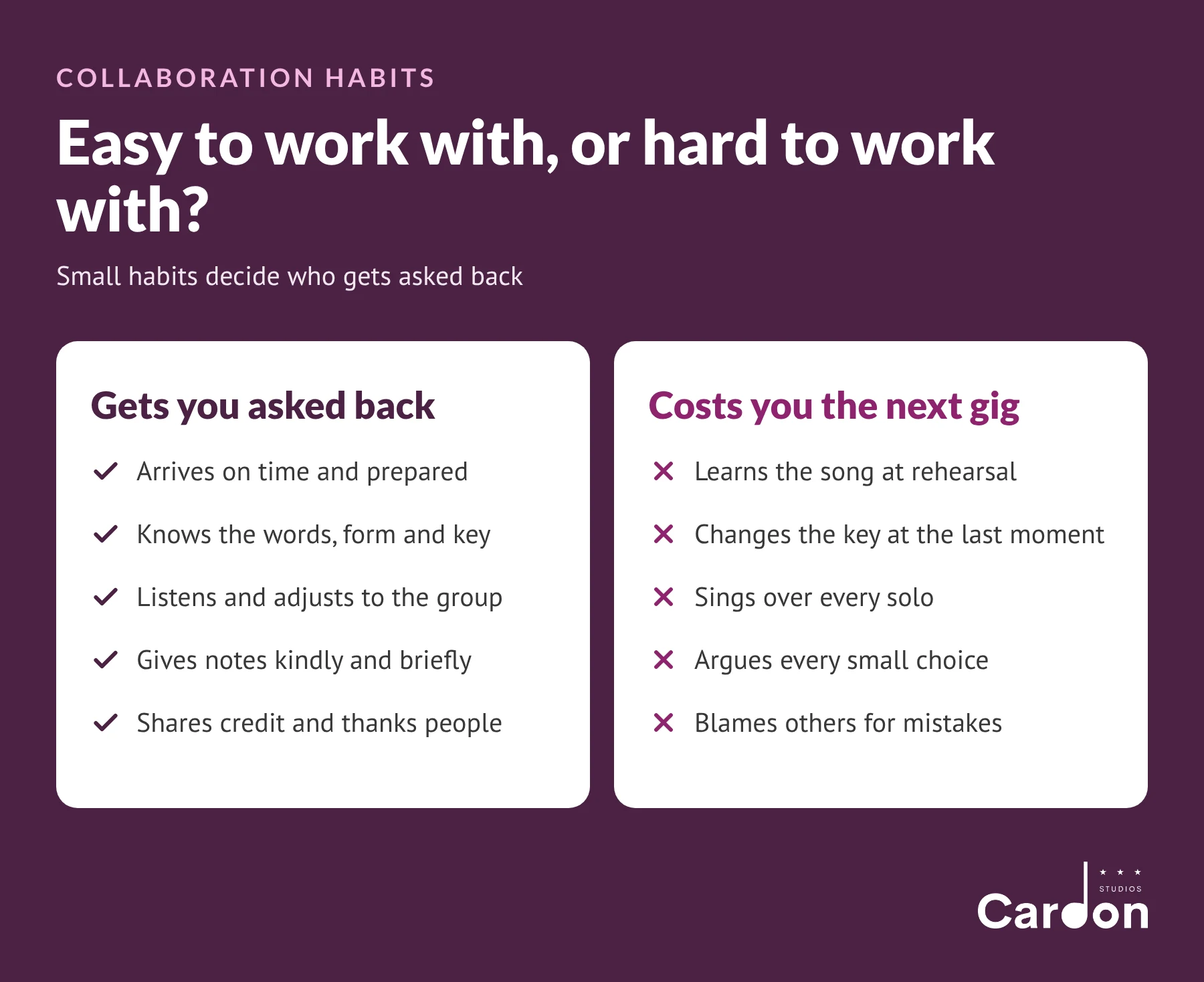
Being easy to work with is mostly a set of small, repeatable habits:
- Be on time and ready. Arrive warmed up, with your materials, so rehearsal starts when it’s supposed to.
- Know your part. Learn the words, melody, form and key before the first rehearsal. See our guide on how to memorize a song if this slows you down.
- Listen more than you talk. Hear a suggestion all the way through before you respond, and try it before you reject it.
- Give notes kindly. Keep feedback short and specific, focused on the music rather than the person.
- Share the credit. Thank your accompanist or band by name on stage, and let others shine during their solos.
None of these habits require extra talent. They are choices, and they add up. Over time, a reputation for being prepared and pleasant will bring you more opportunities than almost any single performance.
Know when to stand up for yourself
Being agreeable doesn’t mean saying yes to everything. Musicians also need self-respect, and there are times to stand up for yourself, especially over logistical challenges. Never compromise your health or safety for a gig. A stage without safe footing, a room so loud you can’t hear yourself, or a schedule that leaves your voice no chance to recover are all worth raising.
The key is to choose your battles. Don’t make it a habit to refuse inconvenient requests from your client or bandmates; save your pushback for the items that truly matter. A small change to the set order or an extra run-through usually costs you little and earns goodwill. When something does matter, raise it early, calmly and privately, explain why, and suggest a solution rather than just a complaint.
A few questions can help you decide whether to push back:
- Does this put my voice, hearing, health or safety at risk?
- Will it change the music in a way I can’t perform well?
- Is it a one-time inconvenience, or a pattern I need to address?
Listen to your voice
Loud rehearsals tempt singers to push. Ask for more of your voice in the monitors instead of singing louder, and stop if anything hurts. NIDCD notes that singing loudly and talking for too long without rest can cause temporary hoarseness, and recommends seeing a doctor if your voice has been hoarse for more than three weeks. Protect your ears as well: NIDCD lists playing in a band among activities that can lead to noise-induced hearing loss and recommends earplugs for loud activities. For everyday care, see our guide to vocal health for singers.
How to find musicians to collaborate with
If you’re a singer looking for a band or a partner, start where musicians already gather. Most lasting collaborations begin with people who have heard each other perform and enjoyed it.
- Open mics and jam nights. You’ll hear local players, they’ll hear you, and it’s easy to start a conversation afterward.
- Choirs, school and community groups. Ensembles are full of musicians who already know how to rehearse. Our guide to singing in a choir explains what to expect.
- Friends of friends. Let the musicians you know hear what you’re looking for. Many bands form through one introduction.
- Online communities. Local musician groups and music social platforms let you share a short recording and describe the style you want to sing.
When you reach out, be specific. Say what styles you sing, what you want to do (cover gigs, original songs, a duet project, recording), how often you can meet, and share a short clip of yourself singing live. A clear, friendly message makes it easy for the right people to say yes. When you’re ready to perform for an audience together, our gig guide for singers walks through the next steps.
Before you commit, have one relaxed session together. You’ll learn quickly whether your styles, schedules and goals fit, and whether you enjoy the time together, which matters as much as the music.
How to start a music collaboration
Once you’ve found someone to work with, a little structure at the start saves weeks of confusion later. Use these steps for a new band, a duet or a single project.
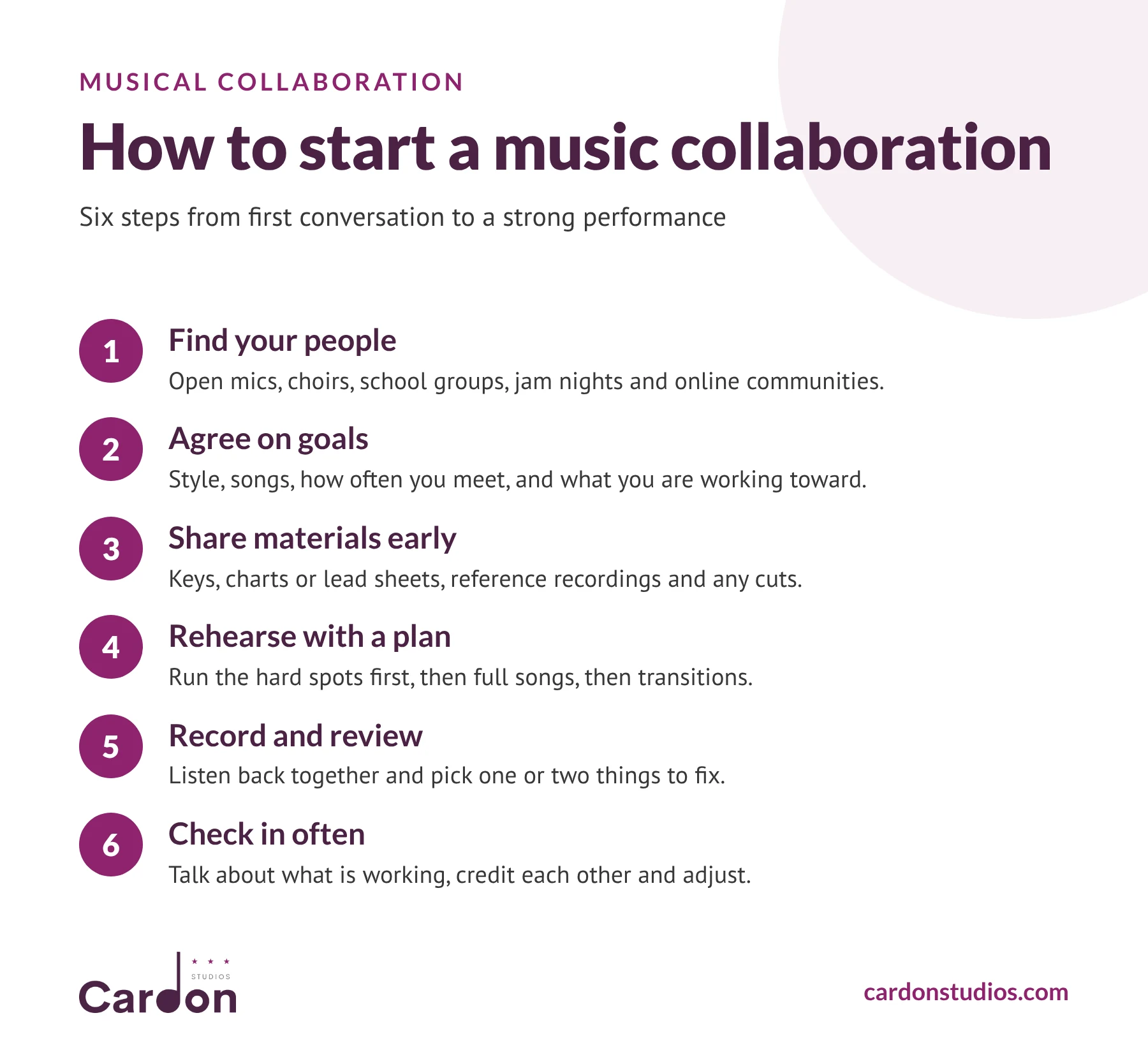
- Agree on goals. Talk about the style, the songs, how often you’ll meet and what you’re working toward, such as a first gig, a recording or simply enjoying music together.
- Choose keys that suit your voice. Work out the best key for each song before charts are written, so nobody has to relearn parts later.
- Share materials early. Send charts or lead sheets, a reference recording, and any cuts or changes to the form ahead of rehearsal.
- Decide who leads what. Agree who counts songs in, who calls changes on stage, and how decisions get made when you disagree.
- Talk about credit and money up front. For original songs and paid gigs, agree how writing credit and any pay will be shared before it becomes an issue.
Run rehearsals that work
Preparation is key. The rehearsal is for putting the parts together, not for learning your part. When every musician arrives knowing their music, the group can spend its time on blend, feel and transitions, the things you can only fix together.
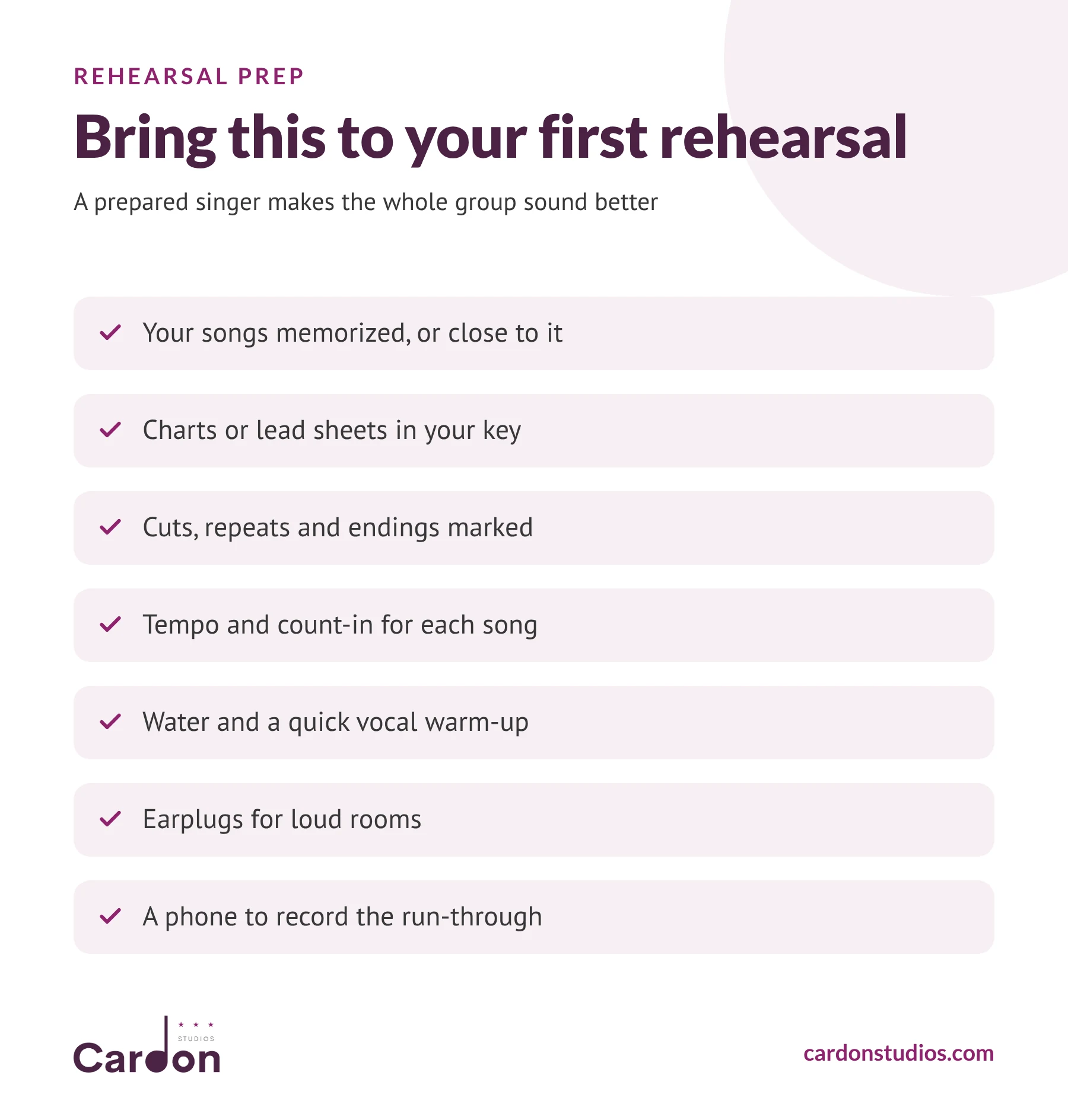
A simple rehearsal plan keeps everyone focused:
| Part of rehearsal | What to do | Why it helps |
|---|---|---|
| Warm up and set up | Warm up your voice before you arrive; check your mic and monitor levels. | You start singing well instead of pushing to be heard. |
| Hard spots first | Work tricky intros, key changes, harmonies and endings in small chunks. | Fresh attention goes where it’s needed most. |
| Full run-throughs | Play songs top to bottom without stopping. | Builds stamina and shows how the song flows. |
| Transitions | Practice song-to-song changes and what you’ll say between songs. | Smooth sets sound far more professional. |
| Record and review | Record one run-through and agree on one or two fixes for next time. | Everyone hears the same thing and progress is clear. |
Recording rehearsals is one of the fastest ways to improve as a group, because you hear the balance the audience hears rather than what you hear from inside the band. Our guide to the benefits of recording yourself explains how to listen back usefully.
Read and give musical cues
Much of live collaboration happens without words. Musicians signal each other constantly with nods, eye contact, breaths and gestures, and reading those cues is what lets a group stay together when something unexpected happens.
- Breathe visibly before you come in. A clear breath shows your accompanist or band exactly when you’re about to start a phrase.
- Use eye contact at key moments. Look at your partners before an entrance, a held note, a tempo change or an ending.
- Agree on simple signals. A raised hand for “one more time through the chorus,” a closed fist for the ending, or a nod to start the next section.
- Know the form. If you know how many times each section repeats, you can recover quickly when someone takes a wrong turn.
Understanding a little music theory makes cues much easier to follow, because you can talk with the band in their language: bars, keys, sections and tempos. Our guide to musicianship for singers covers the essentials.
Working with an accompanist
Accompanists, whether for a recital, an audition or a church service, are collaborators, not background. Bring clean, clearly marked music in the right key, with any cuts, repeats, breaths and tempo changes written in. Tell them your tempo by singing a line or two rather than just naming it. Then trust them: a good accompanist will follow your phrasing, and you can listen and respond to the way they shape the music too.
Interplay, contrast and staying present
In music, collaboration has the power to bring a piece to life. No matter what style you sing, musicians talk about interplay between parts, trading off the main melody, soloing or otherwise taking the lead, and about contrast in tempo, dynamics or phrasing. These conversations between parts are what make a performance feel alive rather than mechanical.
When you sing with someone else, focus on being present in the music as it is happening. If you stop worrying about yourself, or about what’s coming later in the song or the set, you give your musical instincts room to respond to the way your duet partner or bandmates are interpreting the music. Staying alert and flexible can be the key to creating musical moments that make an impact.
Try these ways of listening outward during a song:
- Match and contrast dynamics. If the band drops down for a verse, bring your voice down with them; when they build, ride the build together.
- Leave space. During an instrumental solo or fill, step back from the mic and let it breathe. Your next entrance will land harder.
- Answer phrases. When another musician plays a melodic idea, echo its shape or rhythm in your next line.
- Blend in harmonies. When you sing harmony with others, adjust your volume and vowel shapes to match the lead voice. Our guide to holding your harmony part shows how.
Trust your artistry and your preparation, and magic can happen. The work you do alone, learning the song and building your technique, is what lets you stop thinking and start listening once the music begins. If nerves get in the way of that, our guide to conquering stage fright can help, and our guide to preparing for a performance covers the days before a show.
Collaborating with musicians online
You don’t have to live near your collaborators. Many singers collaborate with musicians online by trading recorded parts: one person records a guide track, others record their parts over it, and someone combines them into a finished mix. It’s a great way to work on original songs or to keep a duo going when you live far apart.
A few habits keep online collaboration smooth:
- Agree on the key, tempo and song form before anyone records.
- Record to the same guide track or click so the parts line up.
- Use headphones while recording, so only your voice reaches the microphone.
- Name files clearly with the song, part and version, and keep them in one shared folder.
- Give and ask for feedback in writing, with timestamps, so everyone knows exactly which spot you mean.
Good sound at home helps everyone. Our guide to better audio for online singing covers microphone placement and room setup that also works for recording your parts.
If you’re interested in more chances to perform in real time, our Event Series is designed to help singers develop a keen awareness of performance elements and learn to stay flexible and in control in live performance.
From the studio
Collaboration gets easier when you trust your own voice. In live, one-on-one online voice lessons, your teacher can help you find the right keys for your songs, build the technique to blend or stand out as the music needs, and prepare for rehearsals and performances with other musicians. Between lessons, you can send a video for feedback within two business days, and member live online events, including open mics and group classes, give you a place to sing for and with others. Learn more about membership here.
Online voice lessons
Become the singer every band wants
One monthly membership includes four private online voice lessons, one video coaching submission, the Learning Library, and member online events, with a teacher matched to your style, goals, age, and schedule.
Common questions about musical collaboration
How do I find a band to sing with?
Go where musicians already gather: open mics, jam nights, choirs and community groups, and local musician groups online. When you reach out, share a short live clip, the styles you sing and how often you can rehearse. Try one relaxed session together before committing.
What should a singer looking for a band include in a post?
Say what styles you sing, what you want to do (covers, originals, gigs or recording), roughly where you are, and when you can rehearse. Add a short recording of yourself singing live, and keep the message friendly and specific.
How can I collaborate with musicians online?
Agree on the key, tempo and form, then record your parts to a shared guide track or click with headphones on. Name files clearly, keep them in one shared folder, and give feedback with timestamps so everyone knows which moment you mean.
How do I work well with an accompanist?
Bring clean music in your key with cuts, repeats and tempo changes marked. Show your tempo by singing a line, breathe visibly before you come in, and listen to how they shape the music, because a good accompanist follows and supports your phrasing.
What if a bandmate is hard to work with?
Talk privately and calmly, describe the specific problem and suggest a solution. Many issues come from unclear roles, so agreeing who leads what can help. If the pattern continues and it affects your health, safety or the music, it may be time to move on.
How do two singers sing a duet well?
Decide who sings which lines and where you harmonize, then match vowels, volume and phrasing in the shared parts. Make eye contact on entrances and endings, and listen to your partner rather than only to yourself.