


Chest voice is the lower part of your singing range, the register closest to the voice you speak with every day. It’s called chest voice because you can feel it vibrate in your chest, but the sound is made at your vocal folds like every other note you sing. A strong, free chest voice is the foundation for a healthy mix and belt, so it’s worth understanding and training well.
Key takeaways
- Chest voice is a register: a way your vocal folds vibrate, with thicker folds and more contact than in head voice.
- Every voice type has a chest voice, though where it sits in the range differs from singer to singer.
- Build it from your speaking voice, with steady breath and no pushing.
- Don’t drag a heavy chest sound too high. Let it lighten into a mix as you go up.
What is chest voice?
Chest voice is a vocal register: a particular way the vocal folds vibrate. In chest voice the folds are relatively thick and stay in contact for a larger part of each vibration, which gives the sound its full, speech-like quality. Voice scientists call it the first laryngeal mechanism, or M1.
Research backs up what singers feel. In a 2014 study published in The Journal of the Acoustical Society of America, singers’ vocal folds stayed in contact for a larger share of each cycle in chest voice than in falsetto at the same pitch, and the vibration was larger. The researchers link this to more of the folds’ mass moving together with the vocalis muscle, part of the thyroarytenoid muscle inside each fold. For a refresher on the parts involved, see how your voice works.
How chest voice feels and sounds
- It feels like speaking. If you say “hey” or “uh-huh” in a relaxed, energetic voice, you’re almost certainly in chest voice.
- You feel vibration low. Put a hand flat on your upper chest and speak or sing low: you’ll feel a buzz there. That sensation, not the sound source, gave the register its name.
- It sounds full and direct. Chest voice tends to be rich, strong and clear, and volume comes easily.
- It gets heavier as you go up. Carried too high without adjusting, it starts to feel tight and loud, and eventually cracks or flips into a lighter sound.
Chest voice vs. head voice
Chest voice and head voice are the two main registers most singers work with. Many singers also develop a mix that blends qualities of both.
| Chest voice | Head voice | |
|---|---|---|
| Feels like | Speaking; vibration in the chest | Lighter; vibration felt higher, in the face or head |
| Sounds | Full, direct, speech-like | Lighter, rounder, often softer |
| Vocal folds | Thicker, more contact in each vibration | Thinner and stretched, less contact |
| Where in the range | Lower and lower-middle | Upper-middle and upper |
| Heard in | Pop and rock verses, belting, low classical passages | Classical singing, soft high phrases, choral music |
Where chest voice sits in your range
Chest voice covers the lower part of every singer’s range, but where it ends depends on your voice and training. Lower voices generally have a longer, deeper chest range; higher voices often reach a register shift sooner.
The two registers also overlap. The same 2014 study found a band of pitches where singers could choose either chest or falsetto. That overlap is why you can sing the same note in two different ways, and why the shift between registers, sometimes called the passaggio or break, can be smoothed with practice. Our guide to voice types and vocal range explains how ranges differ.
How to find your chest voice
Your speaking voice is the quickest way in: these four steps turn it into a sung chest note.
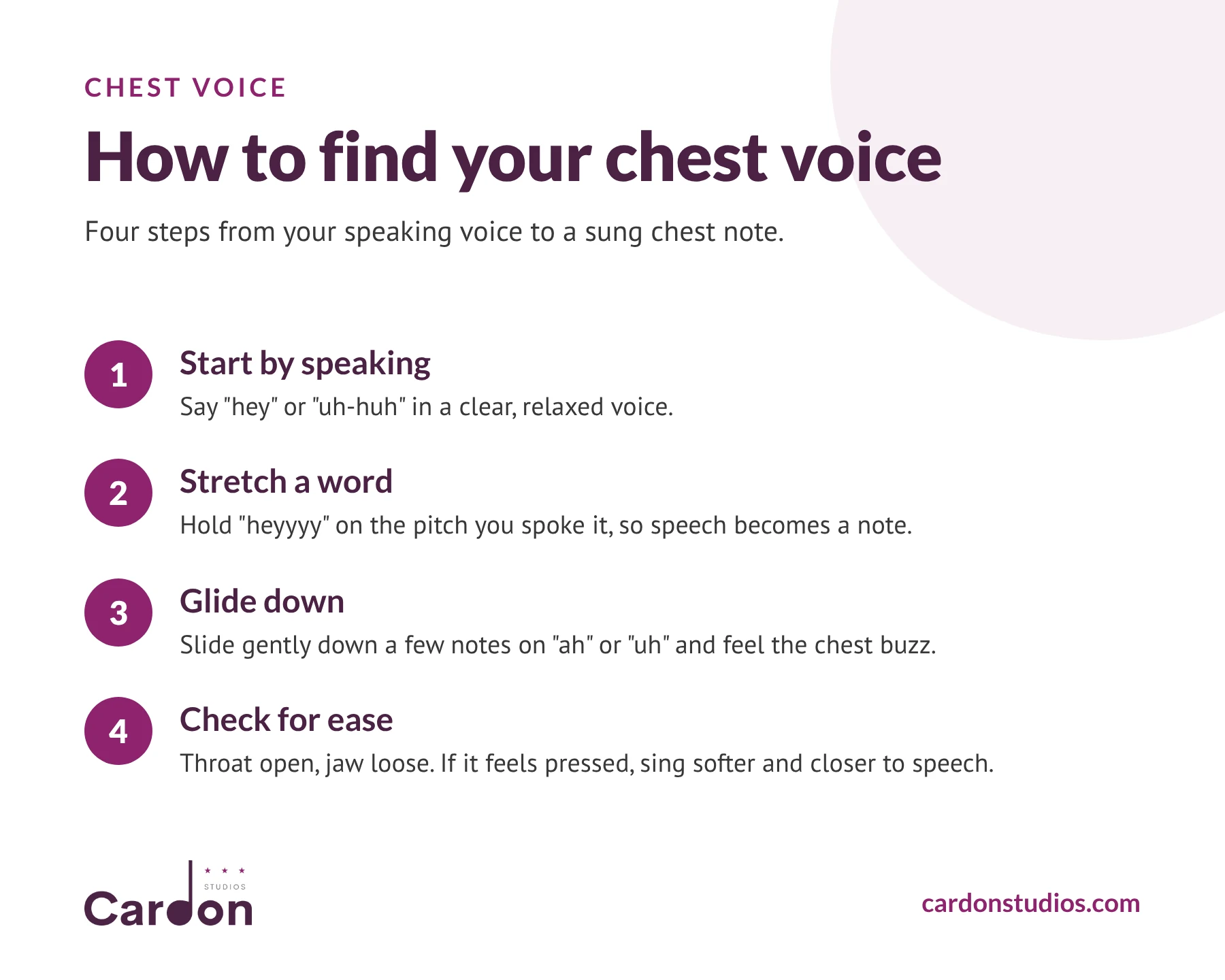
- Start by speaking. Say “hey,” “uh-huh” or a short sentence in a clear, relaxed voice, as if greeting a friend.
- Stretch a word. Say “heyyyy” and let the vowel hold on the pitch you spoke it, so speech turns into a sung note.
- Glide down. From that note, slide gently down a few notes on “ah” or “uh.” Notice the vibration in your chest.
- Check for ease. Your throat should feel open and your jaw loose. If it feels pressed or scratchy, sing softer and closer to your speaking pitch.
Chest voice exercises
Start in a comfortable middle-low part of your range at a moderate volume. Do each exercise for a few repetitions, rest, and stop if anything feels tight or hurts.
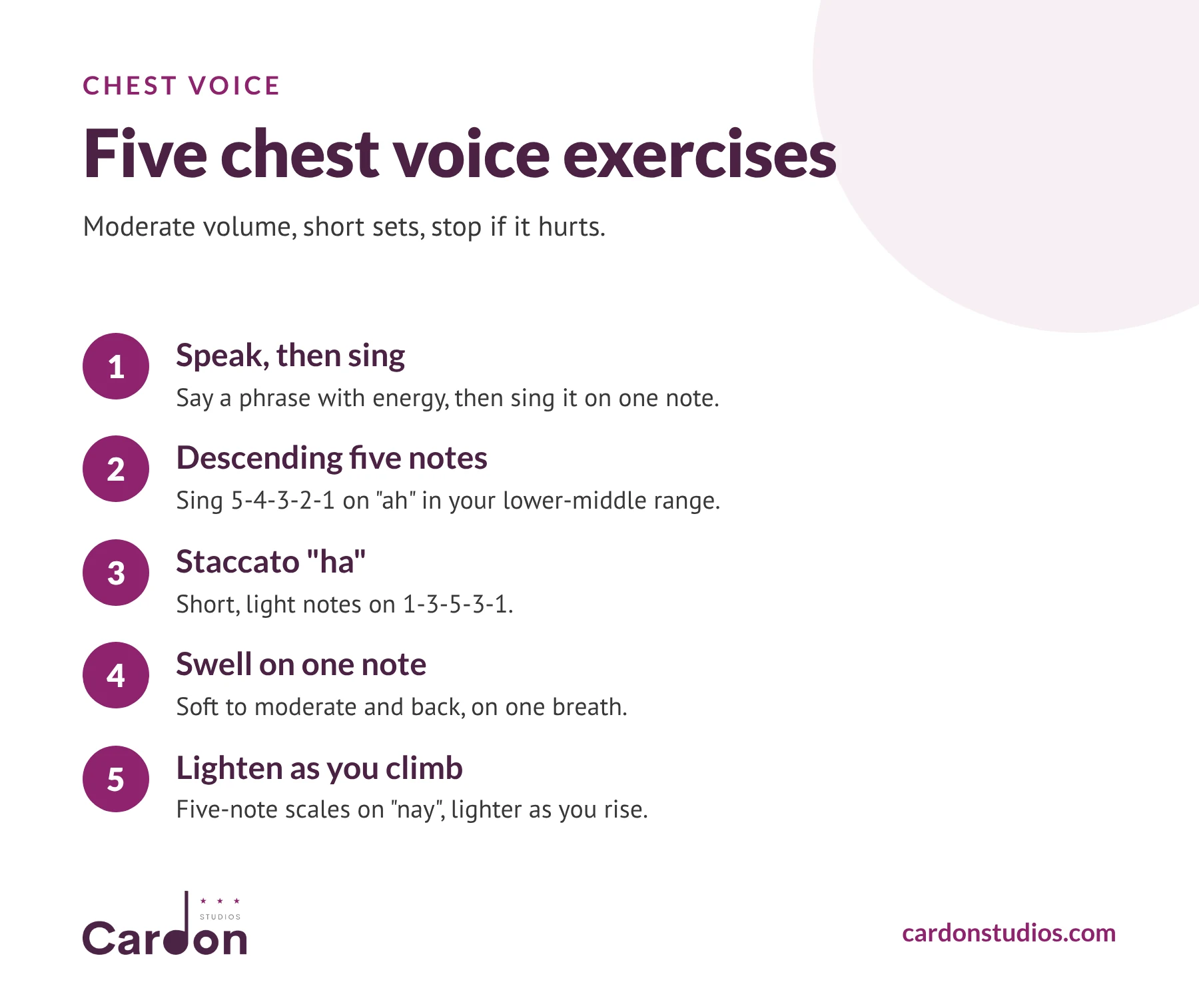
1. Speak, then sing
Speak a short phrase like “hey, how are you?” with energy, then sing it on one comfortable pitch with the same feeling. Go back and forth until the sung version feels as natural as speech.
2. Descending five-note scale
Sing “ah” or “uh” on five notes from the top down (5-4-3-2-1), starting in your lower-middle range. Descending patterns help your voice settle into chest without pushing. Move the pattern up or down a half step each time.
3. Staccato “ha”
Sing short, bouncy “ha” notes on the first, third and fifth notes of a scale (1-3-5-3-1). Keep each note clean and light at the start, with a small, steady puff of breath. This trains clear onsets without squeezing.
4. Swell on one note
On a comfortable chest note, start softly, grow gradually to a moderate volume, then fade back down, all on one breath. This builds control and shows you that a strong chest voice doesn’t need force.
5. Lighten as you climb
Sing a five-note scale up and down on “nay” and move it up by half steps. As you rise, let the sound get a little lighter instead of louder. When it starts to feel heavy, stop going higher; that’s where mix and head voice take over. Our guides to finding your mix for higher voices and lower voices pick up from here.
Always warm up before chest voice work, and keep your breath steady and engaged rather than pushed. Breathe: A Primer for Singers covers the basics.
Common chest voice mistakes
An easy chest voice and a pushed one can sit on the same notes. The difference is how they’re made, and how your voice feels afterward.
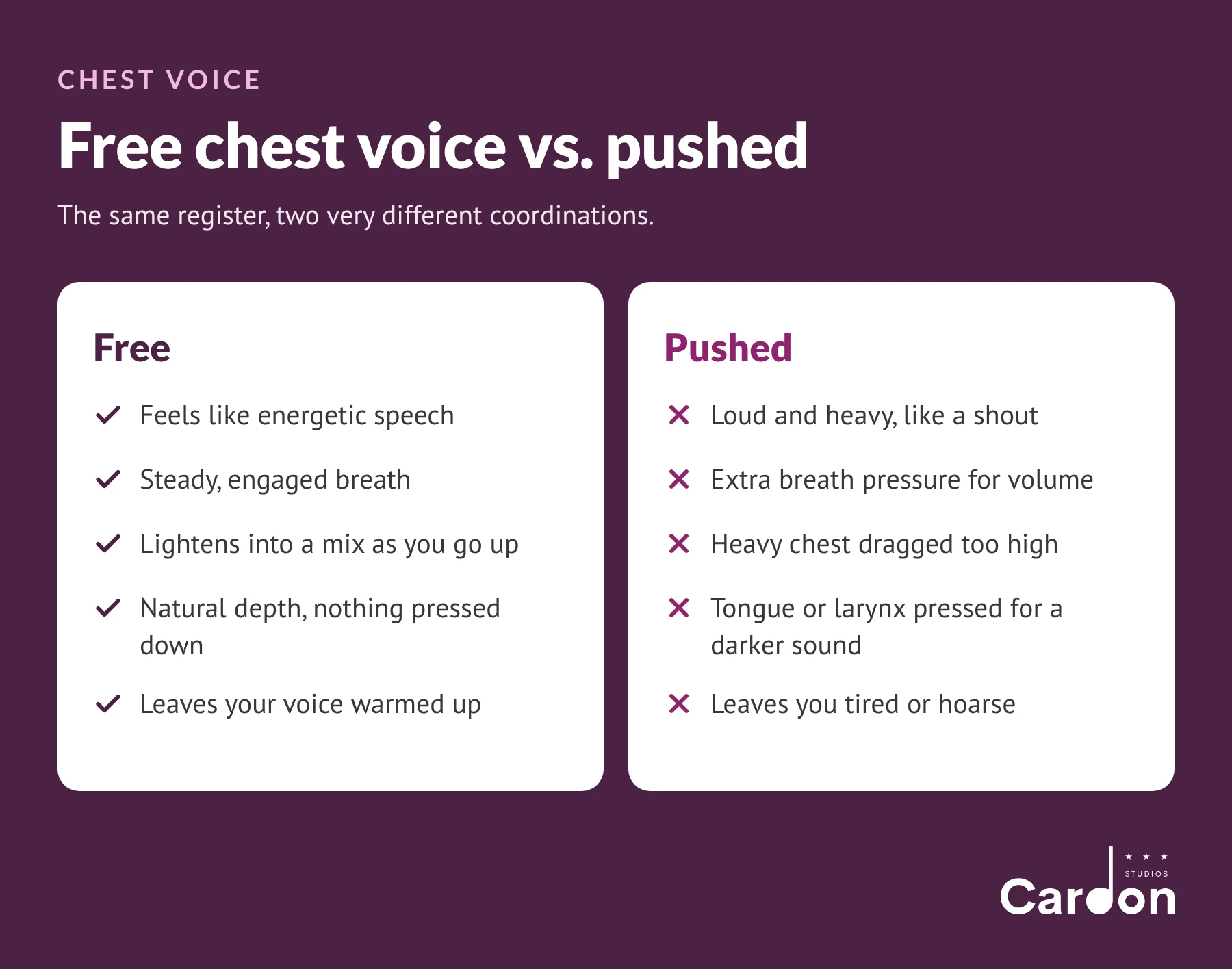
- Pulling chest too high. Carrying a heavy, loud chest sound up through your range is the most common cause of strain and cracking. Let it lighten.
- Pushing for volume. More breath pressure makes the sound harsher, not bigger. See projection for ways to carry without force.
- Faking depth. Pressing the tongue or larynx down to sound darker or older adds tension. Your natural chest voice is enough.
- Avoiding it entirely. Some singers, especially those trained mostly in head voice, avoid chest voice and end up with a weak, breathy low range. Gentle chest work balances the voice.
- Confusing chest voice with belting. Belting builds on chest voice but is its own coordination. Learn a healthy chest voice first; our guide to how to belt safely takes it from there.
Listen to your voice
Chest voice work should leave your voice feeling warmed up, not tired. Stop if you feel pain, scratchiness or tightness, or if you’re hoarse afterward. According to the National Institute on Deafness and Other Communication Disorders, see a doctor if your voice has been hoarse for more than three weeks. For everyday care, read our guide to vocal health for singers.
From the studio
Registers are easier to sort out with someone listening. In a live online lesson, your teacher can hear whether your chest voice is free or pushed, show you where it should start to lighten, and choose exercises for your voice type. Between lessons, you can send a video of a scale or song passage and get a personalized response within 72 hours.
Online voice lessons
Build a strong, easy chest voice
One monthly membership includes four private online voice lessons, one video coaching submission, the Learning Library, and member online events, with a teacher matched to your style, goals, age, and schedule.
Common questions about chest voice
Do all singers have a chest voice?
Yes. Every voice type has a chest register, including sopranos and tenors. Where it sits and how far it extends varies from singer to singer.
Is chest voice the same as belting?
No. Belting builds on chest voice, carrying its strong, speech-like quality higher with open vowels and a specific coordination. A healthy chest voice comes first.
How high can I sing in chest voice?
It depends on your voice and training. Rather than chasing a particular note, notice where chest voice starts to feel heavy or tight, and let it lighten into a mix there.
Why does my voice crack between chest and head voice?
A crack often happens when you carry too much weight from chest voice up to the point where the voice has to change registers. Lightening the sound as you go up, and practicing slides across the shift, usually makes it smoother.
Is singing in chest voice bad for you?
No. Chest voice is a normal, healthy part of singing. Problems come from pushing it too high or too loud, or from singing on a tired voice.
Is chest tone the same as chest voice?
Mostly, yes. Singers and directors often say “chest tone” for the full, speech-like quality of chest voice, or for a sound that keeps some of that quality as it rises into a mix. When a director asks for more chest tone, they usually want a fuller, more spoken sound, not more volume or pressure.
How do I increase my chest voice range?
Widen it gradually, from ease rather than force. Use the lighten-as-you-climb exercise above, and add a half step only when your current top note feels as easy as speech. Above the point where chest starts to feel heavy, a mixed voice lets you keep a speech-like sound higher, and head voice exercises keep the top of your range balanced.