


Belting is the bright, powerful, speech-like sound you hear in musical theater, pop, rock, R&B, and gospel. It can sound like the singer is giving it everything, but a healthy belt is a coordination, not a contest of force. Most singers can learn to belt, and the safest way in starts with something you already do every day: speaking with energy.
Key takeaways
- Belting is a bright, chest-dominant, speech-like way of singing, most often used in the middle and upper-middle of the range.
- A healthy belt feels like an energized call, not a yell. Your neck, jaw, and tongue stay free.
- Open, speech-like vowels and steady, moderate breath matter more than extra air or volume.
- Build it gradually in short sets, low to high, and stop if you feel strain or get hoarse.
What is belting?
Belting is a style of singing that carries the strong, bright quality of your speaking or calling voice up into your singing range. It’s often described as chest-dominant, because it keeps more of the heavier, speech-like vocal fold action that you use when you talk, rather than shifting into a lighter head voice as you go higher.
Voice research helps explain what’s happening. In a study of 12 trained female singers published in the Journal of Singing, the vocal folds stayed closed for a larger share of each vibration when the singers belted (an average of 52 to 59 percent) than when they sang the same high notes in head voice (34 to 39 percent). Voice scientist Ingo Titze has described how belters favor bright, open vowels, which help the throat amplify the sound in the way that gives belting its ring. You don’t need the science to belt well, but it points to two practical ideas: firm, efficient vocal fold contact and open, speech-like vowels.
If you’d like a refresher on the parts involved, read how your voice works.
Belting vs. yelling
From across the room, a belt and a yell can sound similar. From the inside, they feel very different. A belt is coordinated: the sound is strong because the voice is working efficiently, not because you’re forcing more air through it. A yell is driven by effort, and you usually feel it in your throat afterward.
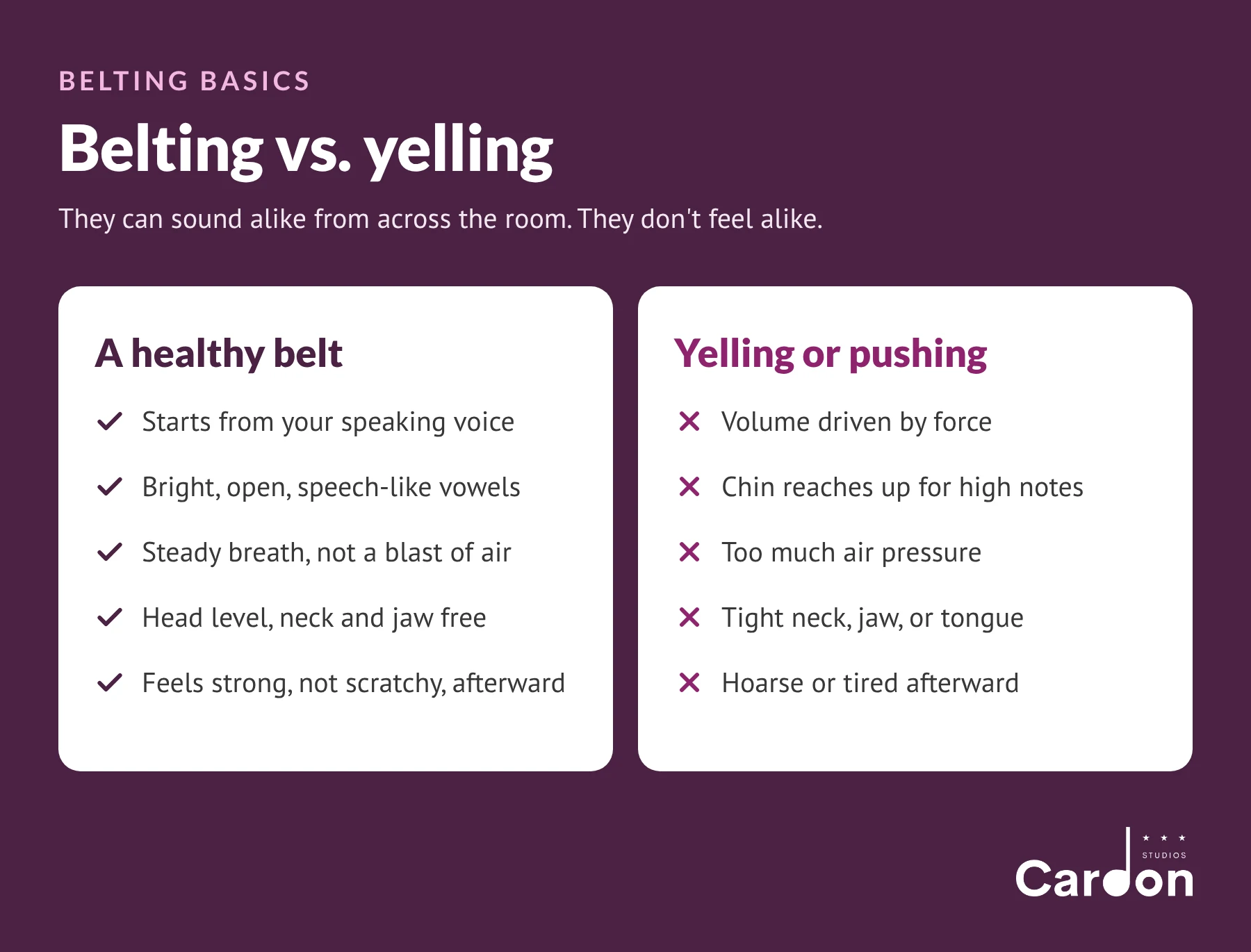
A useful test: after a few belted phrases, your voice should feel warmed up, not tired. If you feel scratchiness, tightness, or a lump in your throat, or your voice sounds rough, you were probably pushing.
Before you start
Belting asks more of your voice than easy, quiet singing, so set yourself up well:
- Warm up first. Spend a few minutes on gentle exercises such as humming and lip trills before you belt. Our guide to warming up your voice has a routine.
- Check your alignment. Stand tall with your head balanced over your shoulders, not jutting forward or tipped up. See singing posture and alignment.
- Know your breath support. Belting needs steady, engaged breath, not a big gulp of air. Read Breathe: A Primer for Singers and core coordination.
- Stay hydrated and rested. A tired or dry voice is not the place to learn a new coordination.
How to belt, step by step
Work through these steps over several practice sessions, not all at once. Keep each set short, rest between sets, and stay in a comfortable part of your range at first.
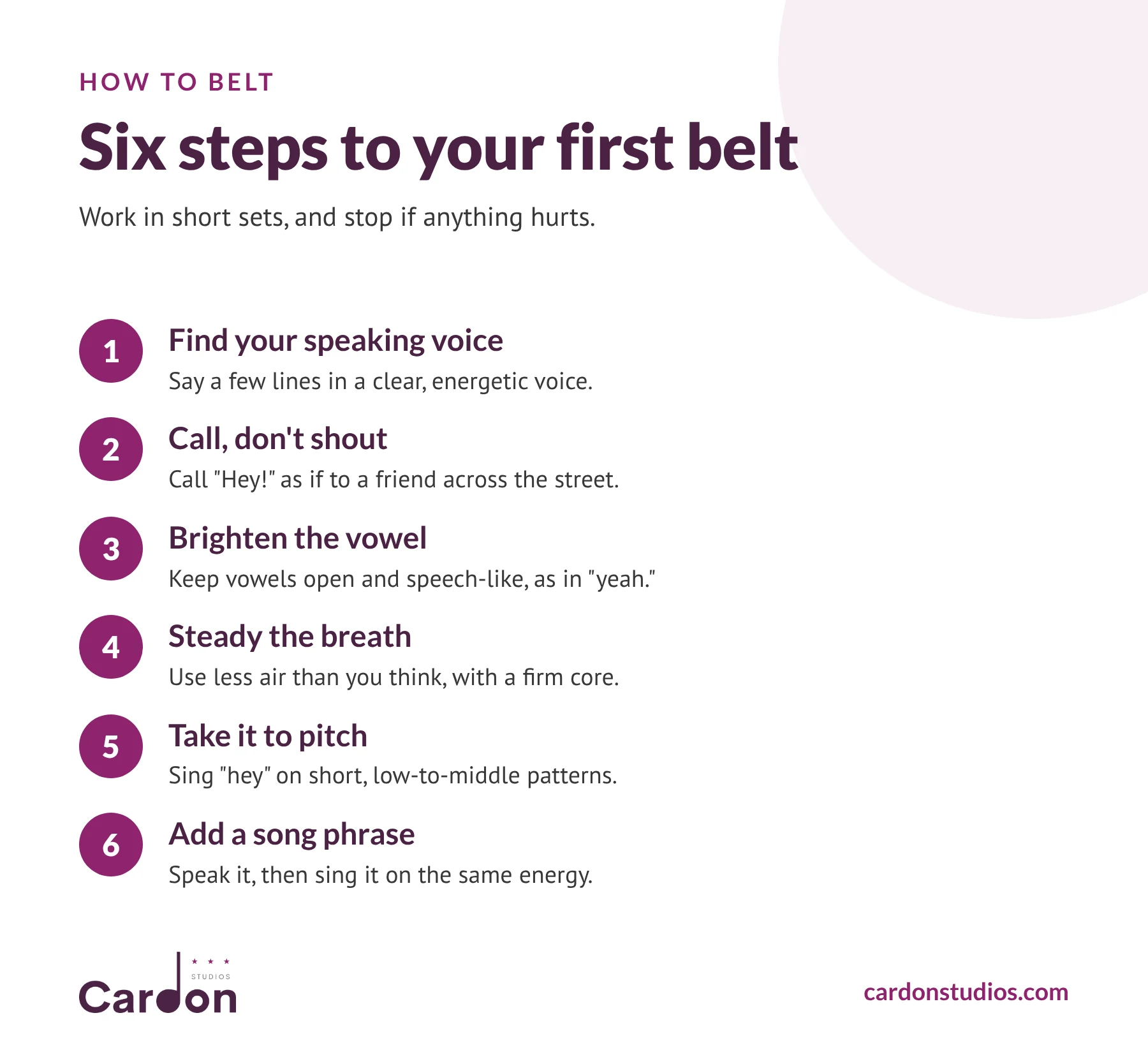
- Find your speaking voice. Read a few lines out loud in a clear, energetic voice, as if you’re telling a story to a group. Notice where it sits and how easy it feels. This is the foundation of your belt.
- Call, don’t shout. Call out “Hey!” as if you’re getting a friend’s attention across the street. A good call is bright and strong but doesn’t hurt. If it feels harsh, make it friendlier, not quieter.
- Brighten the vowel. Belting favors open, speech-like vowels: the “eh” in “hey,” the “a” in “yeah,” the “ah” in “hot.” Let your mouth open and your tongue stay relaxed and forward. Tall, round, classical vowels tend to pull you out of a belt.
- Steady the breath. Use less air than you think. Keep your ribs open and your core gently engaged so the breath is steady, then let the voice do the work. More air pressure usually means more strain, not more belt.
- Take it to pitch. Turn the call into singing on short patterns in the low and middle part of your range, such as “hey” on three or five notes up and back down. Keep the same speech-like quality on every note.
- Add a song phrase. Speak a phrase from a song you’re working on with energy, then sing it on the same energy and vowel shapes. Record yourself and listen back: does it sound like your voice, only bigger?
Belting exercises to practice
These exercises build the coordination behind a healthy belt. Start in a comfortable, middle part of your range, keep the volume moderate at first, and move up gradually only when each pattern feels easy.
1. Calls on “hey”
Call “Hey!” on a comfortable speaking pitch, then on slightly higher pitches. Keep it short and bright, and let the sound end cleanly rather than squeezing it off. This connects your belt to your natural calling voice.
2. Bratty “nyeh”
Say “nyeh” in a playful, slightly whiny voice, like a teasing kid. Then sing it on a five-note scale up and down. The bright, forward “twang” helps the sound carry without extra force, and many singers find it makes belting feel easier.
3. “Yeah” on a triad
Sing “yeah” on the first, third, and fifth notes of a scale and back down (1-3-5-3-1). Keep the vowel open, like the “a” in “cat,” and let your jaw drop a little on the top note instead of reaching up with your chin.
4. Speak, then sing
Choose one phrase from a song. Speak it with full energy and meaning, then immediately sing it, keeping the same energy, vowel shapes, and intent. Go back and forth until the sung version feels as natural as the spoken one.
5. Call and release
Belt a short phrase, then sing the same phrase lightly in head voice or a gentle mix. Moving between the two keeps your voice flexible and helps you notice the difference between a coordinated belt and pushing.
If you have a teacher, ask which exercises suit your voice right now. Not every exercise suits every singer, and the right one depends on how your voice is working today.
How to belt higher notes
Belting higher is where most singers run into trouble, usually by pushing harder or reaching up with the chin. A few principles help:
- Open the vowel as you go up. On higher notes, let the vowel open toward “ah” or “eh” with a slightly lower jaw. A closed vowel such as “ee” or “oo” is much harder to belt up high.
- Keep your head level. Lifting the chin to reach a note tightens the front of the neck. Keep looking forward and let the note come to you.
- Don’t add more air. Higher belted notes need steady support, not a bigger blast of breath.
- Know your current ceiling. Every voice has a point where a full belt stops being comfortable. Above that, a mix belt or a lighter mix is the healthier choice, and the ceiling often rises gradually with practice.
- Build up slowly. Extend your patterns by a half step at a time over days and weeks, not all in one session.
How high you can belt depends on your voice and your training. In the Journal of Singing study above, trained female singers belted as high as F5 (the F an octave and a fourth above middle C), but they had years of practice, and there’s no single target that applies to everyone. Lower voices belt in a lower range, and that is just as valid. Our guide to voice types and vocal range explains how ranges differ.
Belt, mix, and mix belt
These terms are used in different ways by different teachers, but here’s a practical way to think about them:
| Sound | What it’s like | Where you’ll hear it |
|---|---|---|
| Belt | Bright, strong, speech-like, chest-dominant | Big musical theater moments, pop and rock choruses, gospel |
| Mix belt | A belt-like sound with more of the lighter mechanism blended in, so it can go higher with less effort | Contemporary musical theater and pop, especially higher belted notes |
| Mix | A balanced blend of chest and head qualities, often lighter and more flexible | Ballads, legit musical theater, many pop verses |
| Head voice | A lighter, rounder sound in the upper range | Classical singing, soft high passages, choral music |
Many singers find belting easier once they have a reliable mix, because they can move between the two instead of carrying a heavy sound too high. Start with our guides to finding your mix for higher voices and lower voices.
Is belting bad for your voice?
Belting doesn’t have to hurt your voice. Many voice teachers consider a well-coordinated belt a healthy way to sing. Like any demanding physical skill, it can cause problems when it’s done with excess tension, for too long, or on a tired voice. Musical theater performers belt in eight shows a week on Broadway, and they rely on good technique, warmups, and rest to do it.
Listen to your voice
Stop and rest if belting causes pain, a scratchy or tight throat, or hoarseness afterward, or if you start losing notes you usually have. Short practice sets with rest in between are safer than long belting sessions. According to the National Institute on Deafness and Other Communication Disorders, you should see a doctor if your voice has been hoarse for more than three weeks. An otolaryngologist (ear, nose, and throat doctor) can examine your vocal folds. For everyday care, see our guide to vocal health for singers.
Common belting mistakes
- Pushing more air. Extra breath pressure makes the sound harsher and the throat tighter. Aim for steady and efficient.
- Reaching up with the chin. Keep your head level and your neck long, especially on high notes.
- Squeezing the throat or jaw. A belt should feel open. Gently check that your jaw, tongue, and neck aren’t gripping.
- Closing the vowels. Narrow vowels up high make belting harder. Open them toward speech.
- Belting cold or for too long. Warm up first, keep sets short, and give your voice rest between them.
- Belting everything. Great singers use belt as one color among many. Mix and head voice make the belted moments stand out.
From the studio
Belting is much easier to learn with someone listening. In a live online lesson, your teacher can hear whether a sound is coordinated or pushed and adjust your exercises on the spot, starting from your speaking voice and building up at a pace that suits you. Between lessons, you can send a video of a belted phrase or an audition cut for a personalized response from your teacher within 72 hours.
Online voice lessons
Build a strong, healthy belt with a teacher
One monthly membership includes four private online voice lessons, one video coaching submission, the Learning Library, and member online events, with a teacher matched to your style, goals, age, and schedule.
Common questions about belting
Can anyone learn to belt?
Most singers can learn to belt in some part of their range, whatever their voice type. It’s a coordination you build gradually, starting from your speaking voice, rather than a gift you either have or don’t.
Is belting bad for your voice?
Not when it’s coordinated and you give your voice enough rest. Belting with excess tension, on a tired voice, or for long stretches can lead to strain. Stop if it hurts or leaves you hoarse, and see a doctor if hoarseness lasts more than three weeks.
How long does it take to learn to belt?
It varies a great deal. Some singers find a basic belt in their first few sessions; building a reliable belt higher in the range usually takes steady practice over months. Short, regular practice works better than long, occasional sessions.
What’s the difference between belting and mixing?
A belt is bright, strong, and chest-dominant, like an energized call. A mix blends chest and head qualities for a lighter, more flexible sound. A mix belt sits between them, keeping a belt-like quality with less weight so it can go higher more easily.
Can men and lower voices belt?
Yes. Belting isn’t limited to any voice type. Lower voices belt in a lower range, and the same principles apply: start from the speaking voice, keep vowels open, and avoid pushing.
Can I learn to belt in online voice lessons?
Yes. Lessons are live and one-on-one over Zoom, so your teacher hears your voice in real time and can adjust exercises as you go. You’ll need a computer, tablet, or phone with a camera and microphone, an internet connection, and a quiet place to sing.