


Lip trills are a warm-up where you blow air through loose, closed lips so they flutter, then add your voice to make a gentle “brrr” on a pitch. Singers use them because the buzzing lips create a little back pressure that helps the voice start easily, with steady air and less effort. Here’s how to do lip trills, which exercises to start with, and what to try if your lips just won’t trill.
Key takeaways
- A lip trill is a voiced flutter of the lips, sometimes called lip bubbles or a lip roll.
- Partly closing the lips creates back pressure, which many teachers use to help the voice work efficiently.
- Keep lip trills soft to medium in volume, with a loose jaw and steady, unforced air.
- If your lips won’t trill, support your cheeks with your fingertips, or use a tongue trill, a hum or a straw instead.
What are lip trills?
A lip trill is exactly what it sounds like: your lips flutter, or trill, while you sing. You make it by blowing a steady stream of air through relaxed, gently closed lips, the way a child imitates a motorboat or a horse. Once the lips are buzzing, you add your voice, so the flutter carries a pitch. Singers and teachers also call it a lip bubble, a lip roll or a lip buzz.
Lip trills belong to a family of exercises called semi-occluded vocal tract exercises, or SOVT exercises. “Semi-occluded” means partly closed: the opening of your mouth is made smaller than it is on an open vowel. Humming, tongue trills, buzzy consonants such as “v” and “z,” and singing through a straw are in the same family. A 2021 review of the research in the Journal of Singing sets out what these exercises do and how teachers can use them.
You’ll find lip trills near the start of most warm-ups, including our complete vocal warm-up routine. This guide goes deeper into the exercise itself: how to make it work, how to use it through your range, and how to fix it when it won’t cooperate.
Why lip trills help
When your lips are partly closed and fluttering, the air leaving your mouth meets resistance. That raises the air pressure inside your mouth and throat, above the vocal folds. Voice scientist Ingo Titze, using a computer model of the voice, described how a semi-occluded vocal tract raises the pressure above and between the vocal folds, which can make the voice more efficient and more economic. In plain terms, the voice can produce sound with less effort and less force on the vocal folds.
In practice, singers notice a few things when they trill:
- An easy start. The trill gives you a gentle way to begin singing before you ask your voice for open vowels or volume.
- Steady breath. The lips only keep fluttering if the airflow stays even, so the trill tells you right away when your breath wobbles or runs out. Our primer on breathing for singing explains why steady breath matters.
- Smoother register changes. Sliding through your range on a trill can make the shift from chest voice into head voice feel less abrupt.
- Less pushing. It’s hard to shout on a lip trill, which makes it a useful reset after a demanding rehearsal.
Research on lip trills is still limited, so it’s worth being modest about the claims. One small study in the Journal of Voice found a tendency toward lighter vocal fold contact during a lip trill, with a more pronounced change in untrained singers. The 2021 review notes that at high intensity, lip trills can have the opposite effect. The practical message is simple: lip trills work best soft to medium in volume.
How to do lip trills, step by step
If you’ve never done a lip trill, start without your voice. Once the lips flutter easily on air alone, adding sound is a small step.
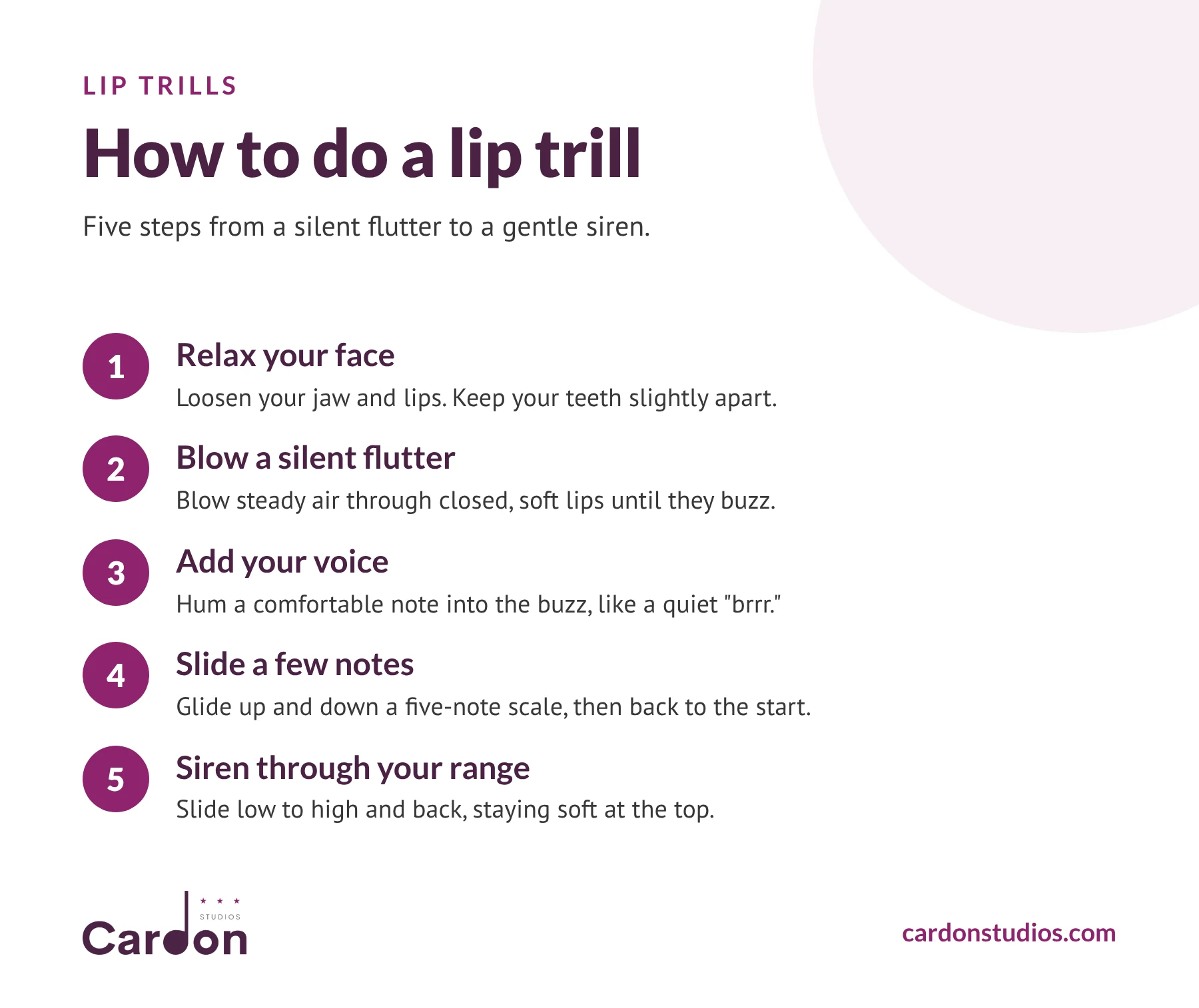
- Relax your face. Let your jaw hang loose with your teeth slightly apart. Your lips should rest together softly, not pressed.
- Blow a silent flutter. Take an easy breath and blow a steady stream of air through your lips until they buzz. Aim for a long, even flutter rather than a short burst.
- Add your voice. Keep the flutter going and hum a comfortable note into it, low in your speaking range. It should sound like a quiet “brrr” with a pitch.
- Slide a few notes. Glide up five notes of a scale and back down, keeping the buzz steady from start to finish.
- Siren through your range. Slide from low to high and back, like a gentle siren, getting lighter as you go up. Stay where it feels easy.
A good lip trill feels like a tickle at the lips and a gentle buzz around your nose and cheekbones. Your throat should feel calm. If you feel effort in your neck, make the sound softer before you try to go higher.
Lip trill exercises to practice
Once the basic trill feels easy, these exercises take it through your range. Start each one in the middle of your voice, move up or down by a half step at a time, and stop before anything feels strained. Repeat each pattern three to five times.
1. Five-note scale
Trill up and down the first five notes of a major scale (1-2-3-4-5-4-3-2-1) on one breath. Start around your comfortable speaking pitch and move up by half steps. This is the classic first lip trill exercise and a good test of steady air.
2. Octave slide
Trill a smooth slide from a comfortable low note up an octave and back down (1-8-1). Don’t stop on the top note; let it turn around like a ball tossed in the air. Slides help you connect the bottom and top of your voice without a bump.
3. Siren
Slide from the bottom of your range to the top and back on one breath, as smoothly as you can. The trill makes sirens easier because it keeps the volume down. If the trill stalls near the top, lighten up rather than blowing harder.
4. Arpeggio
Trill an arpeggio, the first, third, fifth and eighth notes of a scale and back down (1-3-5-8-5-3-1). The jumps ask your breath to stay steady while the pitch changes quickly, which is good preparation for melodies with leaps.
5. Trill a phrase, then sing it
Choose a short phrase from a song you’re learning. Trill the melody first, then sing it straight away with the words, keeping the same ease and steady air. This carries the feeling of the trill into real singing, and it’s a useful way to work on a tricky high passage.
Recording these exercises on your phone can help you hear whether the trill stays even. Our guide to recording yourself singing explains a simple setup.
Can’t do lip trills? Try these fixes
Many singers can’t trill at first, and it has nothing to do with talent. Lip trills depend on how relaxed your lips and cheeks are, how steady your air is, and even how moist your lips are. Most people get there with one of these fixes.
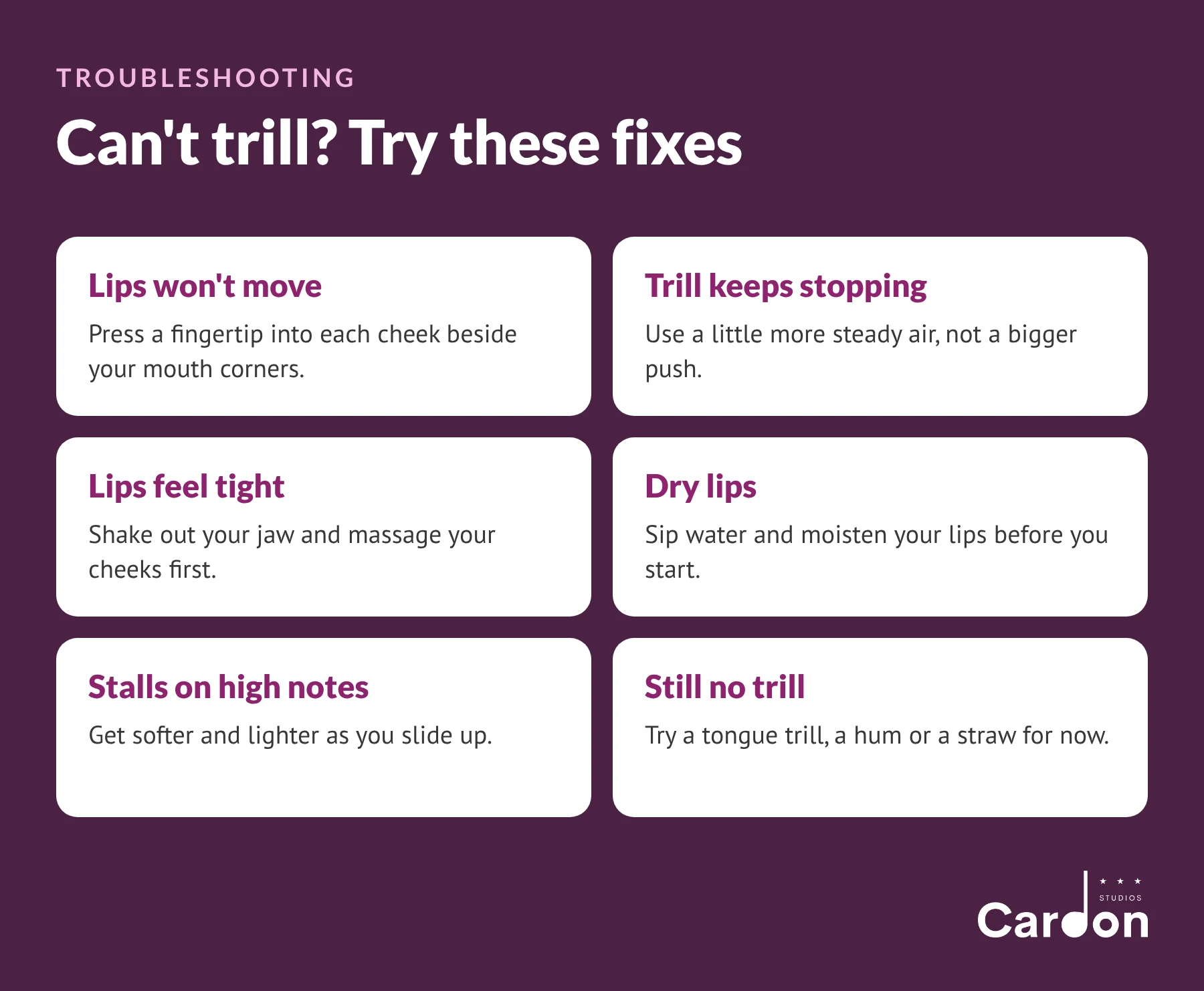
| Problem | Likely cause | Try this |
|---|---|---|
| The lips won’t flutter at all | Cheeks too loose or lips pressed too firmly | Place a fingertip in each cheek just beside the corners of your mouth and press gently inward and up, then blow. |
| The trill starts, then stops | Airflow is uneven or too weak | Use a little more steady air, like blowing out a long, slow candle, not a bigger push. |
| It only works without voice | The voice comes in too loud or too high | Add your voice very quietly on a low, comfortable note, then slide from there. |
| The trill stalls on high notes | Too much volume or a lifted chin | Get softer as you go up and keep your head level. Stop where it stalls and build up slowly. |
| Lips feel dry or stuck | Dry lips or a dry room | Sip some water and moisten your lips before you start. |
| Still no luck | Some faces take longer | Use a tongue trill, a hum or singing through a straw for now. They’re in the same family and give a similar effect. |
Keep each attempt short and relaxed. If you find yourself straining to make the lips move, stop, shake out your jaw and shoulders, and come back to it later in the practice session.
A short lip trill warm-up
Lip trills make a good first step in a lip trill warm-up before practice, rehearsal or a lesson. This short sequence takes a few rounds of each pattern and works for most voices. Move on to vowels and the rest of your practice routine afterward.
| Step | What to do | Rounds |
|---|---|---|
| 1. Silent flutter | Blow air through loose lips with no voice, until the flutter is long and even | 3 |
| 2. Hum into the trill | Add a quiet, low note and hold it for a slow count of five | 3 |
| 3. Five-note scales | Trill 1-2-3-4-5-4-3-2-1, moving up by half steps through your middle range | 5 to 8 keys |
| 4. Octave slides | Trill 1-8-1, staying light at the top | 4 to 6 keys |
| 5. Sirens | Trill from low to high and back on one breath | 3 |
| 6. Trill to vowel | Trill a five-note scale, then sing it again on “oo” with the same ease | 3 keys |
If you sing in a choir, you can use the same patterns with your group. Our vocal warm-ups for choir show how to fit them into a rehearsal.
Common lip trill mistakes
Lip trills are simple, but a few habits can make them less useful. Most come from trying too hard.
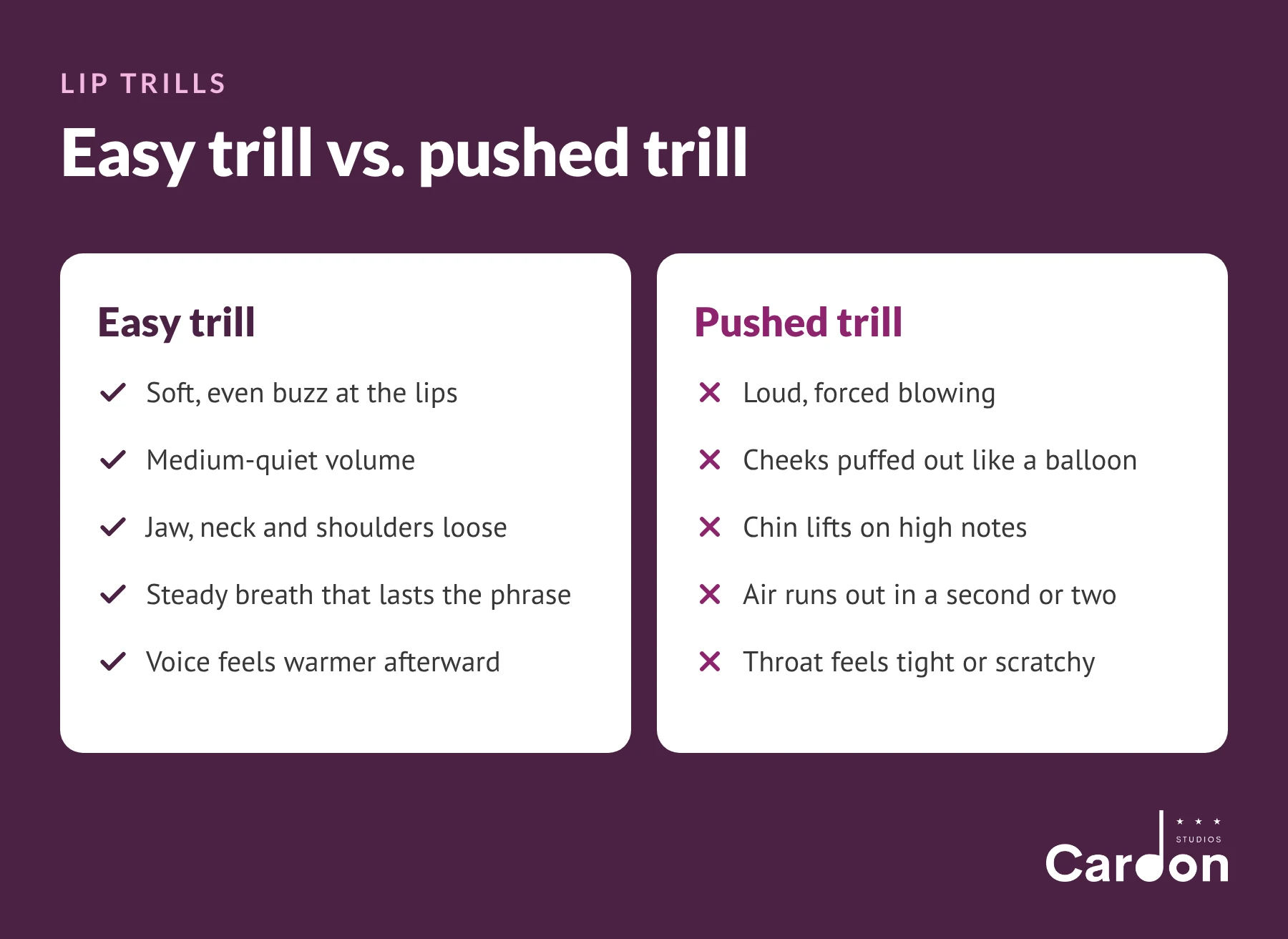
- Blowing too hard. More air doesn’t make a better trill. It makes the sound louder and can tighten the throat. Use just enough air to keep the lips moving.
- Trilling loudly. Keep it soft to medium. The research above suggests that loud lip trills may work against you.
- Puffing the cheeks. A little cheek movement is normal, but balloon cheeks usually mean too much air pressure. Support the cheeks with your fingertips if they puff.
- Reaching up with the chin. On high notes, keep your head level and your neck long, just as you would when singing words.
- Stopping at the trill. The point is to carry the easy feeling into your singing. Follow each trill pattern with the same pattern on a vowel or a song phrase.
Listen to your voice
Lip trills should feel easy. Stop and rest if they cause pain, a scratchy or tight throat, or hoarseness afterward. According to the National Institute on Deafness and Other Communication Disorders, you should see a doctor if your voice has been hoarse for more than three weeks. An otolaryngologist (ear, nose, and throat doctor) can examine your vocal folds. For everyday care, see our guide to vocal health for singers.
From the studio
Lip trills are one of the first exercises many teachers use, and a teacher can quickly hear whether yours is easy or pushed. In a live online lesson, your teacher can watch and listen as you trill, suggest a fix if your lips won’t cooperate, and choose patterns that suit your voice right now. Between lessons, you can send a video of your warm-up for a personalized response from your teacher within 72 hours.
Online voice lessons
Warm up smarter with a teacher
One monthly membership includes four private online voice lessons, one video coaching submission, the Learning Library, and member online events, with a teacher matched to your style, goals, age, and schedule.
Common questions about lip trills
Are lip bubbles the same as lip trills?
Yes. Lip bubbles, lip rolls, lip buzzes and lip trills are different names for the same exercise: a voiced flutter of loose, closed lips. Teachers use the names interchangeably.
How long should I do lip trills?
A few rounds of each pattern is plenty in a warm-up. Stop while the trill still feels easy, then move on to vowels and songs. Short, regular practice works better than one long session of trills.
Are tongue trills a good substitute?
Yes. A tongue trill, the rolled “r” of Spanish or Italian, partly closes the mouth in a similar way, so it gives a similar effect. Humming and singing through a straw are other good options if lip trills don’t work for you.
Do lip trills help with high notes?
They can help you approach high notes more easily, because the trill keeps the volume down and the air steady while you slide up. They won’t add range on their own, but many singers find the top of their voice feels lighter after a few trilled sirens.
Why do my lips tickle or itch after lip trills?
That buzzing, tingly feeling is normal. It comes from the lips vibrating quickly, and it fades within a few seconds. If your lips feel sore or dry, moisten them and take a break.
Can I learn lip trills in online voice lessons?
Yes. Lessons are live and one-on-one over Zoom, so your teacher can see and hear your trill in real time. You’ll need a computer, tablet, or phone with a camera and microphone, an internet connection, and a quiet place to sing.