


Vibrato is a regular, gentle wavering in the pitch and loudness of a sustained note that gives a singing voice warmth and richness. In typical vibrato, the pitch moves about a semitone above and below the note, four to seven times per second. Healthy vibrato usually isn’t something you add on purpose. It tends to appear on its own when your voice is relaxed, well supported and balanced, which is why the best way to develop it is to release tension rather than to force a wobble.
Key takeaways
- Vibrato is a natural, regular pulse in pitch and volume on sustained notes.
- Typical vibrato moves about a semitone either side of the note, four to seven times a second.
- It usually emerges on its own when tension is released and breath is steady.
- A wobble that’s too slow or a flutter that’s too fast usually points to imbalance, not a lack of talent.
What is vibrato?
When you sustain a note with vibrato, the pitch doesn’t stay perfectly still. It moves slightly above and below the target note in a regular, repeating pattern, and the loudness pulses with it. Listeners hear the center of that movement as the pitch, and the movement itself as warmth and life in the tone.
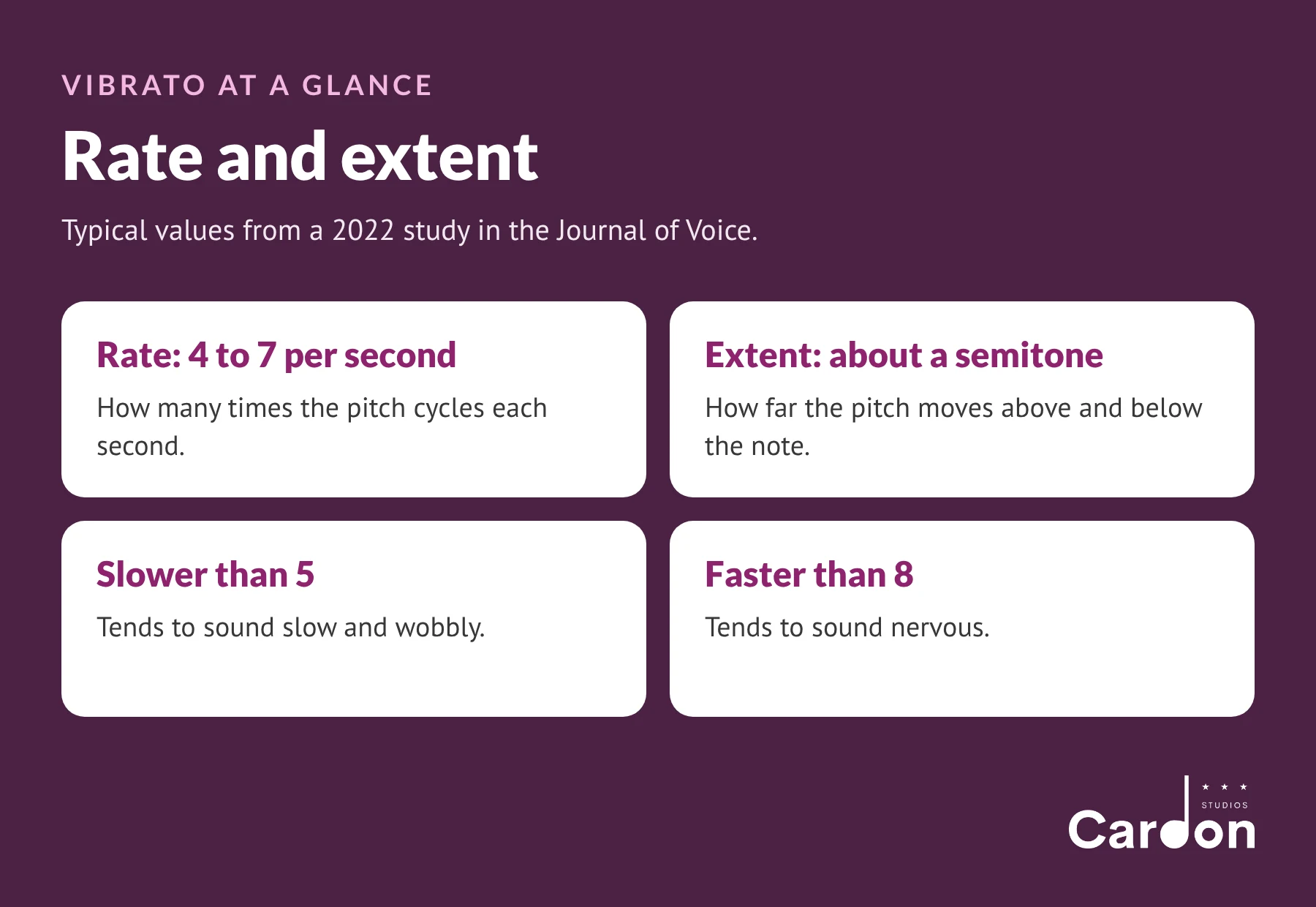
Researchers describe vibrato with two measures: its rate, how many times the pitch cycles each second, and its extent, how far the pitch moves. According to a 2022 study in the Journal of Voice, typical vibrato moves about a semitone above and below the average pitch, at a rate of about four to seven cycles per second. The same paper notes that vibrato slower than about five cycles a second tends to sound unacceptably slow, and faster than about eight sounds nervous.
Why vibrato happens
Scientists don’t fully understand the exact mechanism of vibrato, but a leading explanation involves the muscles that adjust the length of your vocal folds. The Journal of Voice paper describes a model in which the muscles that lengthen the folds and the muscles inside the folds activate in alternation, a reflex-like back-and-forth that keeps the pitch gently oscillating.
What matters for singers is the practical consequence. That oscillation seems to need a voice that’s balanced and able to move. When the throat, jaw or tongue tightens, or the breath is held, vibrato tends to disappear or become uneven. When the voice is relaxed and well supported, it often shows up without any effort.
Is vibrato natural, or can you learn it?
For many singers, vibrato is natural: it appears once technique is balanced, often gradually over months of good practice. Some singers have it from the start; others sing with a straighter tone at first and develop vibrato as tension releases and breath support improves.
That’s why chasing vibrato directly can backfire. Shaking your jaw, pulsing your stomach or wobbling your larynx creates an imitation that sounds and feels effortful. The healthier route is to work on the conditions that let vibrato emerge, then let it happen.
How to find your vibrato
Practice these gently, in the comfortable middle of your range, at a moderate volume.
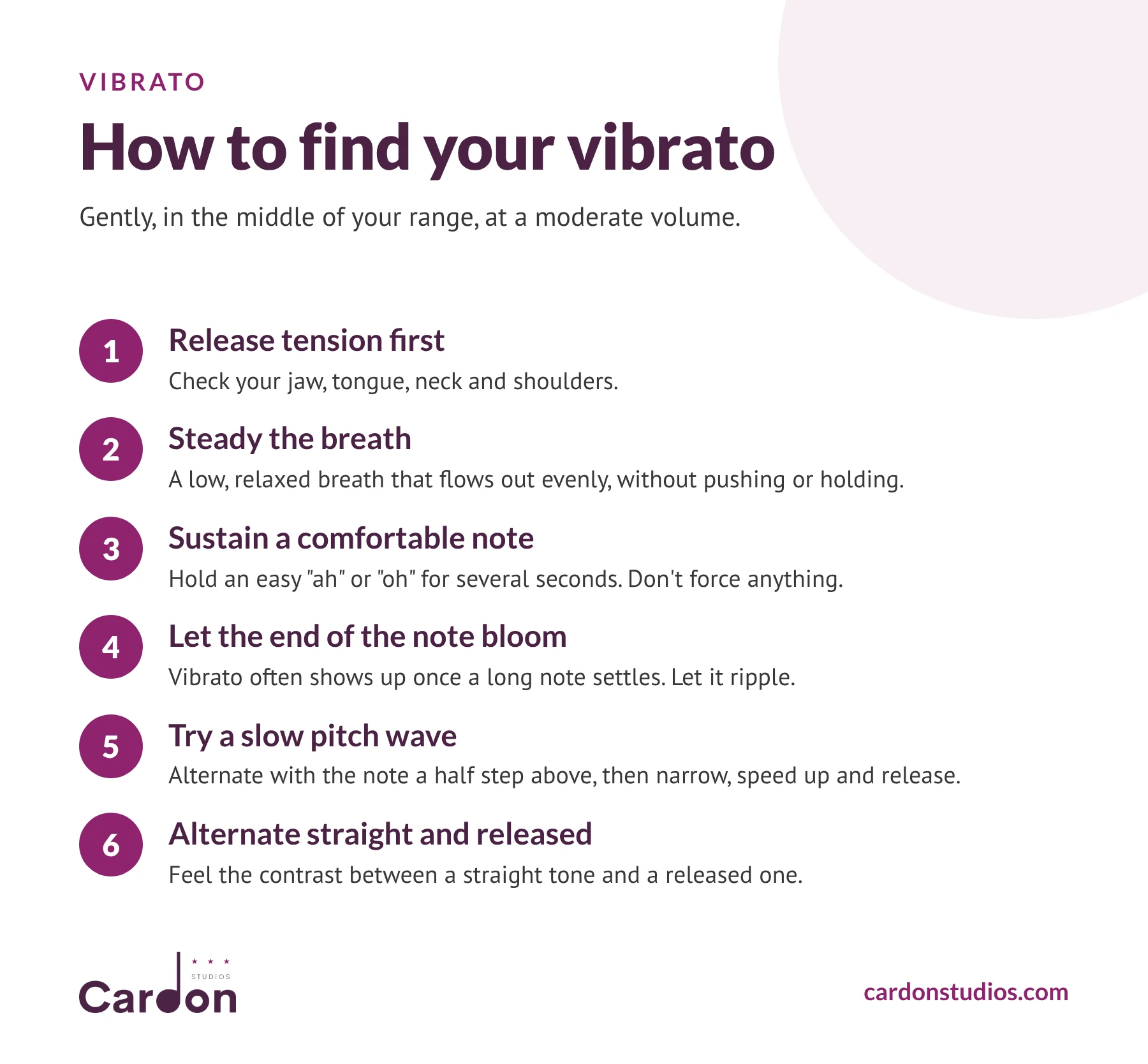
- Release tension first. Check your jaw, tongue, neck and shoulders. Our guide to releasing tension when singing has exercises that help.
- Steady the breath. Take a low, relaxed breath and let it flow out evenly, without pushing or holding. See how to breathe when singing.
- Sustain a comfortable note. Sing “ah” or “oh” on an easy pitch and hold it for several seconds. Don’t try to make anything happen; just keep it easy.
- Let the end of the note bloom. Many singers first notice vibrato toward the end of a long note, once the sound has settled. Let it ripple rather than holding it still.
- Try a slow pitch wave. Slowly alternate between your note and the note a half step above, like a gentle trill. Gradually speed it up and narrow it, then release into a sustained tone and see whether a natural pulse remains.
- Alternate straight and released. Sing a note with a deliberately straight tone, then release it. Feeling the contrast helps you understand what “letting go” feels like.
Record yourself as you experiment. Vibrato often sounds different from the inside, and a recording tells you whether it’s even and natural. See how to record yourself singing.
How to do vibrato when singing: a four-week practice plan
If you’re wondering how to do vibrato when singing, the practical answer is to build the conditions for it in stages. This plan spreads the steps above over four weeks. Practice on most days, keep every exercise in a comfortable range at a moderate volume, and stop if anything feels tight or sore.
- Week 1: release and sustain. Start each session with a few gentle lip trills and sighs from high to low. Then sing five long notes on “ah,” each on a different comfortable pitch, holding each for a slow count of eight. The only goal is an easy, steady tone with no squeezing.
- Week 2: the slow pitch wave. Set a metronome to 60. On “ah,” alternate between your note and the half step above it, two changes per click, for four clicks, then release into a sustained note. Repeat three to five times, then try three changes per click.
- Week 3: speed up and narrow. Move to four changes per click, then make the alternation smaller, so it feels more like a gentle pulse than two separate notes. After each set, sustain the note and listen for an even ripple that keeps going on its own.
- Week 4: take it into music. Choose a slow song you know well and find two or three long notes. Sing each one straight for a moment, then release it and let it bloom. Record the phrase and compare it with a recording from week 1.
Vibrato rarely arrives on a schedule, so treat the weeks as a guide, not a deadline. If the pulse sounds slow and wide, sing lighter; if it sounds fast and tight, go back to the release work from week 1. Short, regular sessions work better than long ones, and our guide to how to practice singing shows how to fit them into your week.
Common vibrato problems
Most vibrato problems point to an imbalance in the voice rather than a lack of talent, and each one has something specific to try.
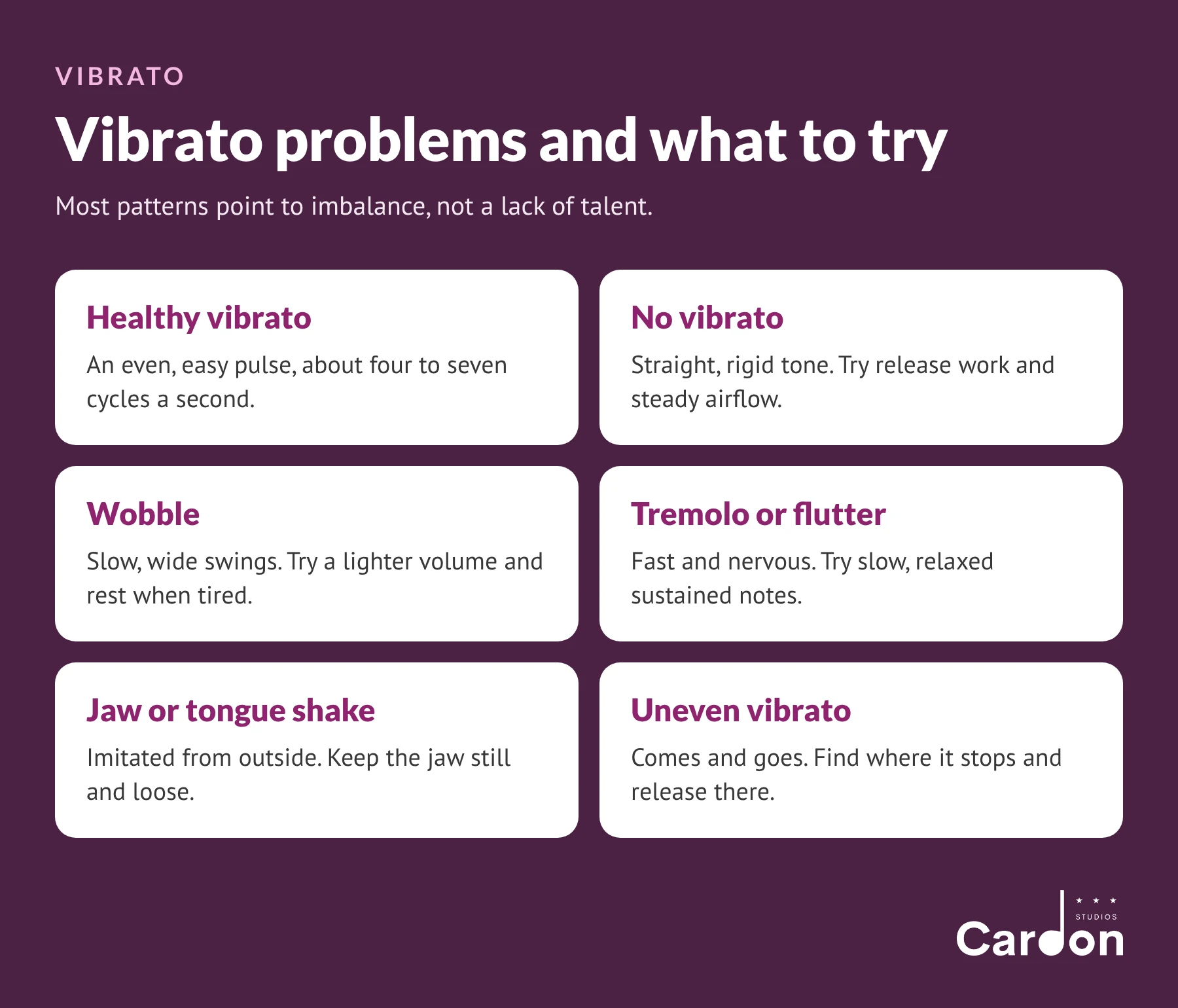
| Problem | What it sounds like | Often linked to | Try |
|---|---|---|---|
| No vibrato | A straight, sometimes rigid tone | Holding the breath or tension in the throat, jaw or tongue | Release work, steady airflow and longer, easier notes |
| Wobble | Slow, wide swings in pitch | Pushing too much weight or breath pressure, or fatigue | Lighter volume, balanced breath and rest when tired |
| Tremolo or flutter | Fast, narrow, nervous-sounding vibrato | Tension, often in the throat or tongue, or nerves | Slow, relaxed sustained notes and calming breaths |
| Jaw or tongue vibrato | A visible shake in the jaw or tongue | Imitating vibrato from outside the voice | Keep the jaw still and loose, and let the pulse come from a relaxed voice |
| Uneven vibrato | Vibrato on some notes but not others | Tension creeping in on certain pitches or vowels | Find where it stops, and release tension there |
If a wobble or tremolo has become a habit, it’s well worth working with a teacher. These patterns are usually fixable, but they’re hard to diagnose from the inside.
Vibrato and straight tone across styles
How much vibrato you use is partly a style choice. Classical and opera singers usually sing with vibrato through most sustained notes. Musical theater singers often start a note straight and let vibrato bloom at the end, a pattern you’ll also hear in many pop, R&B and country singers. Choirs often ask for a straighter tone to help voices blend; see our choir singing tips.
The goal is choice. A healthy singer can sing a straight tone, let vibrato emerge, or shift between the two as the music asks, without the straight tone becoming locked or the vibrato becoming forced. For more on stylistic choices, see our guide to vocal effects.
Listen to your voice
Vibrato work should feel easy. If singing causes pain, or your voice stays hoarse, rest it. According to the National Institute on Deafness and Other Communication Disorders, see a doctor if your voice has been hoarse for more than three weeks.
From the studio
Vibrato is one of the most common things singers ask about, and one of the hardest to judge on your own. In a live online lesson, your teacher can hear what’s helping or blocking your vibrato and give you exercises for your voice. Lessons are recorded so you can rewatch them, and between lessons you can send a video and get a personalized response within 72 hours.
Online voice lessons
Let your natural vibrato come through
One monthly membership includes four private online voice lessons, one video coaching submission, the Learning Library, and member online events, with a teacher matched to your style, goals, age, and schedule.
Common questions about vibrato
What is vibrato in singing?
A regular, gentle wavering in the pitch and loudness of a sustained note. In typical vibrato, the pitch moves about a semitone above and below the note, four to seven times per second.
Can everyone sing with vibrato?
Most singers can develop vibrato. It usually appears once tension is released and breath is steady, though for some singers it takes time to emerge.
Why don’t I have vibrato?
Often because of tension or a held breath. Work on releasing your jaw, tongue and neck, keep the airflow steady, and sustain easy notes in the middle of your range.
Is it bad to sing without vibrato?
No. A straight tone is a valid stylistic choice, common in choirs, early music and many contemporary styles. The key is that it stays relaxed rather than locked.
How do I fix a wobbly vibrato?
A slow, wide wobble is often linked to too much weight or breath pressure, or to fatigue. Sing lighter, balance your breath and rest when you’re tired. A teacher can help you find the cause.
What are the best singing vibrato exercises?
Start with exercises that release tension and steady the breath: lip trills, sighs from high to low and long, easy notes on “ah.” Then add the slow pitch wave, alternating between a note and the half step above, gradually speeding it up and narrowing it before you release into a sustained tone. Keep every exercise gentle, and stop if anything hurts.
How long does it take to develop vibrato?
There’s no set timeline. For many singers, vibrato emerges gradually as tension releases and breath becomes steadier, sometimes over months of balanced practice. Regular, relaxed practice matters more than long sessions, and a teacher can spot what’s holding it back.