

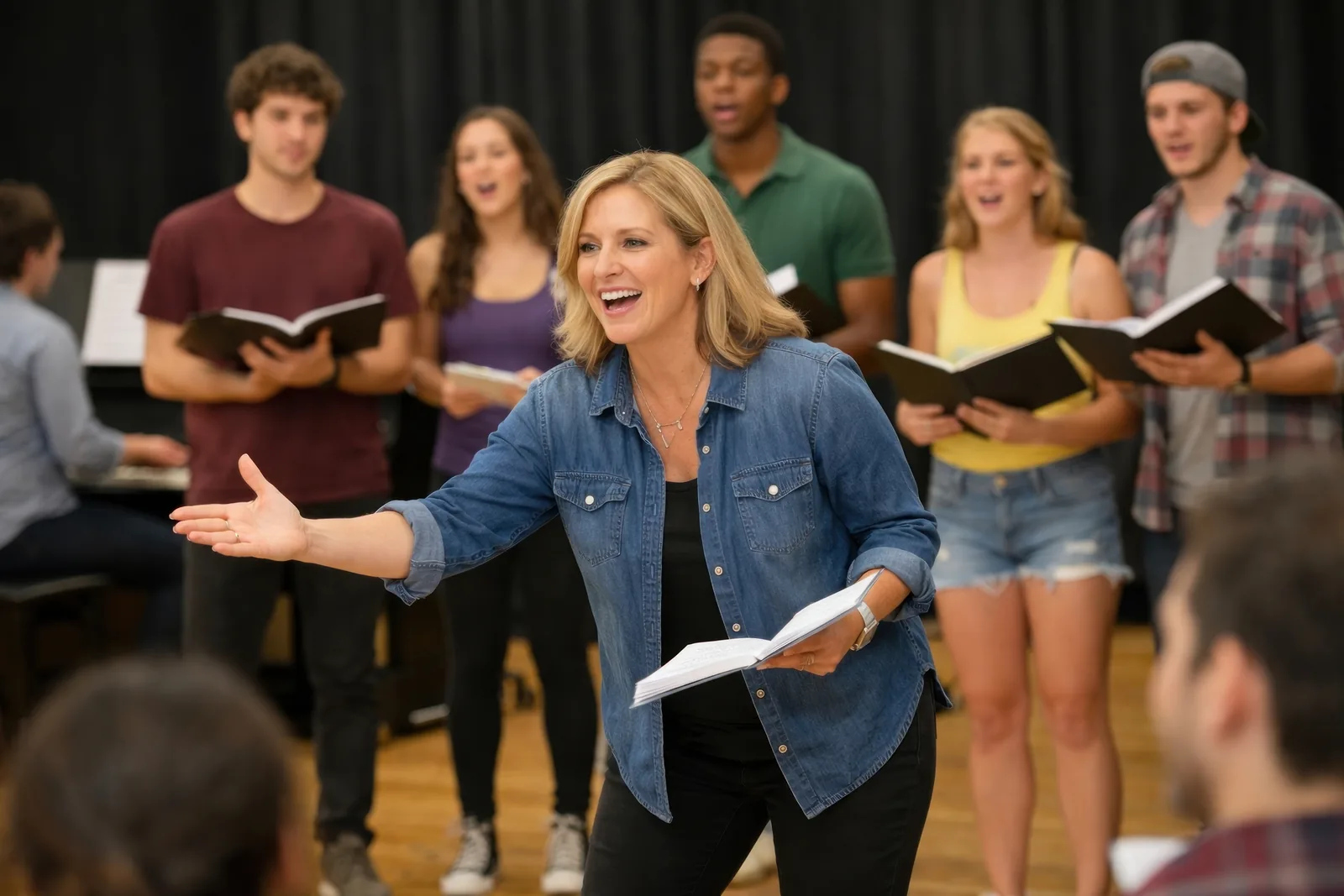
A good choir warm-up does three jobs in about ten minutes: it gets each singer’s body and voice ready, it gets the group listening to each other, and it prepares the specific skills the day’s music needs. This guide gives you a complete vocal warm-up sequence for choir, step by step, plus fun choir warm-ups that keep rehearsals lively. It works for directors leading a group and for singers warming up on their own before rehearsal.
Key takeaways
- Warm up in order: body, breath, gentle sound, range, diction, then listening and tuning.
- Start quiet and low-effort. Volume and high notes come last, once voices are moving freely.
- End with an ensemble exercise, so the group is tuned to each other before the first piece.
- Pick one warm-up that targets a challenge in today’s music.
Why choirs warm up
Singers arrive at rehearsal from school, work or a long drive, often after hours of talking or silence. A warm-up moves the voice gently from speaking to singing, settles breathing, and wakes up the ear. For a choir, it does something more: it turns a room of individual voices into an ensemble that listens, matches vowels and tunes together. A rehearsal that starts with a good warm-up usually sounds better in the first piece than one that starts cold.
A 10-minute vocal warm-up for choir
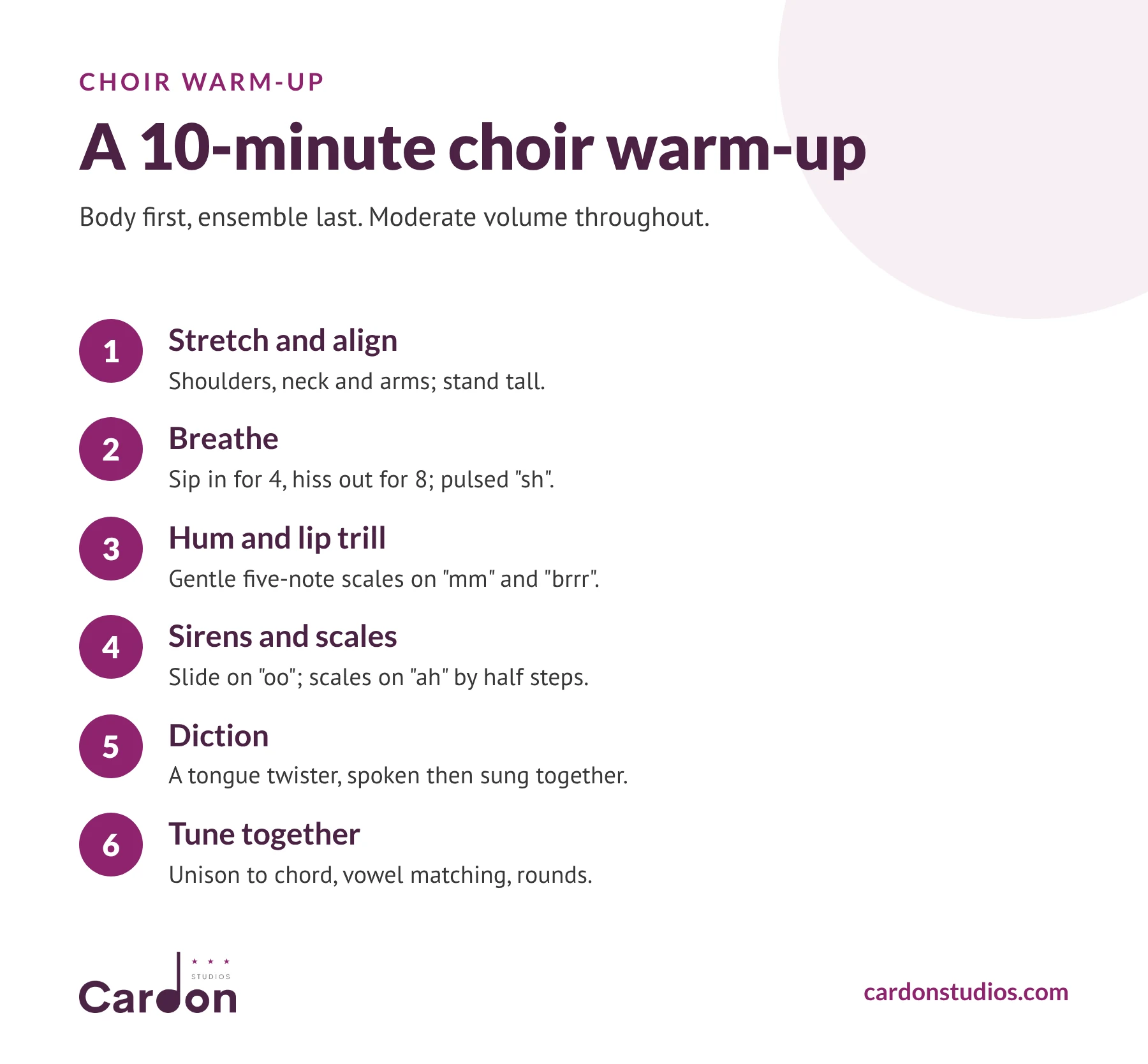
This sequence moves from the body to the ensemble. Each step takes one to two minutes. Lead it at a comfortable pitch for the lowest and highest sections, and move patterns up and down by half steps.
Step 1 and 2: body and breath
Stretch and align (1 minute)
Roll the shoulders back and down, gently tilt the head side to side, and shake out the arms. Then stand tall with feet hip-width apart, knees soft and the head balanced over the shoulders. For more on posture, see singing posture and alignment.
Breathe (2 minutes)
- Sip and hiss. Breathe in slowly through the nose for four counts, then hiss out on “sss” for eight counts, keeping the ribs open. Extend the hiss to 12 or 16 counts over time.
- Pulsed “sh.” On a steady beat, pulse “sh, sh, sh, sh” four times, then rest. This wakes up the abdominal muscles that support the breath.
Our primer on breathing for singers explains why steady, engaged breath matters.
Step 3 and 4: voice and range
Hum and lip trill (2 minutes)
Hum a gentle five-note scale up and down (1-2-3-4-5-4-3-2-1) on “mm,” feeling a buzz around the lips and nose. Then repeat on a lip trill (a relaxed “brrr” with loose lips). Both get the voice moving with very little effort.
Sirens and scales (2 minutes)
Slide smoothly from low to high and back on “oo” or a lip trill, like a gentle siren, staying light at the top. Then sing a scale on “ah” or “nee,” starting mid-range and moving up and down by half steps. Let sopranos and tenors drop out as patterns get high for their part, and basses and altos as they get low.
Step 5: diction
Choirs are understood through consonants. Spend a minute on a tongue twister spoken, then sung on one pitch, crisp and together: try “red leather, yellow leather,” “unique New York,” or “the lips, the teeth, the tip of the tongue.” Speed up only as long as the whole group stays together. Finish with a quick “puh-tuh-kuh” pattern for agile consonants.
Step 6: listening and tuning
End the warm-up with an exercise the group can only do well by listening to each other.
- Unison to chord. Everyone sings one pitch on “oo.” On a signal, each section moves to its note of a major chord. Hold it, listen, and adjust until it rings.
- Vowel matching. Sing one pitch on “ee,” “eh,” “ah,” “oh,” “oo,” matching the shape of each vowel across the room.
- Scale in parts. Sing a major scale as a round or in canon, so each section holds its line against another. This is excellent preparation for holding a harmony part.
Fun choir warm-ups
Energy matters, especially with young singers or at the end of a long day. These warm-ups build real skills while keeping the room engaged.
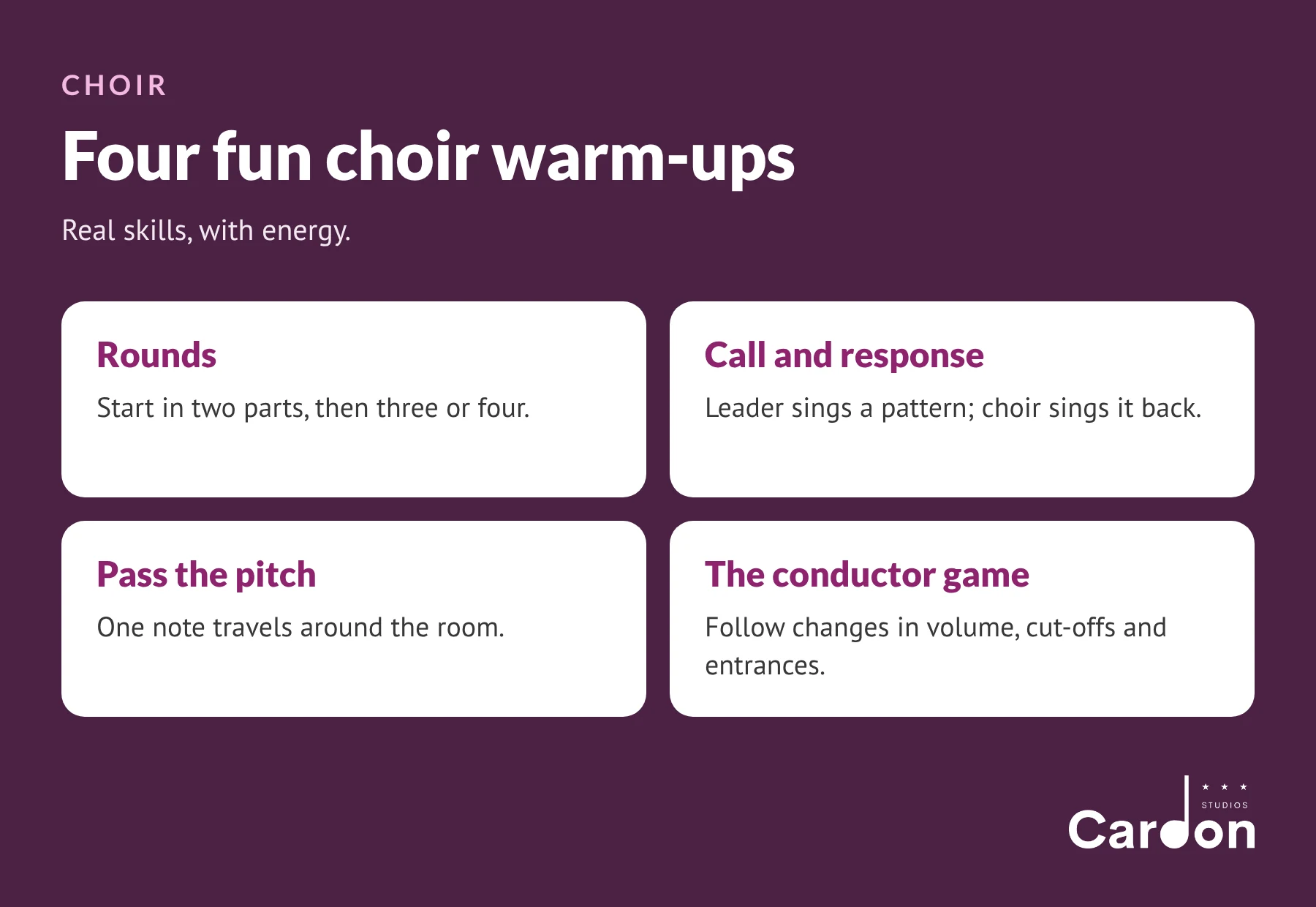
- Rounds. Traditional rounds such as “Row, Row, Row Your Boat” or “Frère Jacques” build independence and listening. Start in two parts, then three or four.
- Call and response. The leader sings a short pattern (a rhythm, a scale fragment or a solfège phrase) and the choir sings it back. Make the patterns gradually harder.
- Pass the pitch. One singer starts a note; the next matches it, and it travels around the room. It’s a quick, friendly ear-training exercise.
- The conductor game. The leader conducts a held “ah” with changes in volume, cut-offs and entrances. Singers must watch closely, which carries straight into rehearsal.
Warm-ups matched to today’s music
The general routine gets voices ready. One targeted exercise, built from the hardest spot in the day’s music, gets the choir ready for that piece. Pick the challenge, then choose a warm-up that isolates it.
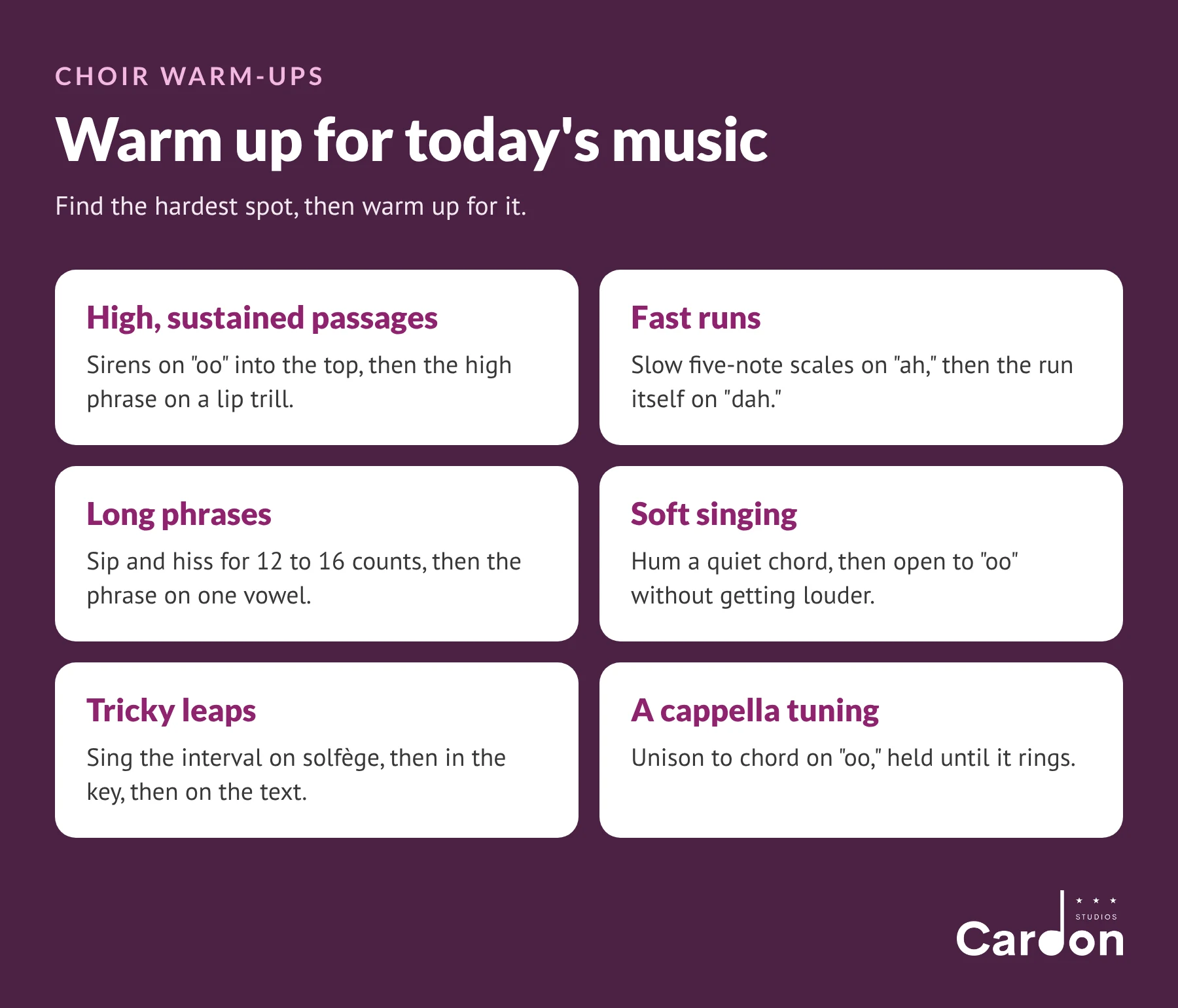
The table below adds one more case, music with lots of text, and gives each exercise in a little more detail.
| If the music has… | Try this warm-up |
|---|---|
| High, sustained passages | Sirens on “oo” into the top of the range, then the passage’s highest phrase on a lip trill before singing it on words. |
| Fast runs or melismas | Five-note scales on “ah” at a slow tempo, speeding up only while every note stays clear; then the run itself on “dah.” |
| Long phrases | Sip and hiss for 12 to 16 counts, then sing the phrase on a single vowel, breathing only where it’s marked. |
| Soft, controlled singing | Hum a held chord quietly, then open to “oo” without getting louder. Soft singing needs steady breath, not less of it. |
| Tricky leaps | Sing the interval on solfège from do, then in the passage’s key, then on the text. |
| A cappella tuning | Unison to chord on “oo,” held until it rings, then the opening chord of the piece the same way. |
| Lots of text | Speak the hardest line in rhythm, crisp and together, before singing it. |
Before a performance, shorten the routine to a few minutes of gentle hums, sirens and one tuning exercise. The goal is a fresh, ready voice, not a tired one.
Tips for directors and singers
- Warm up for today’s music. If the piece has a tricky leap, a fast passage or a long phrase, build one warm-up around it.
- Keep the volume moderate. Warm-ups are not the place for full-voice high notes.
- Mind the ranges. Move patterns so that no section is stuck singing too high or too low for long.
- Add sight singing. A short solfège pattern from the day’s music builds reading skills. See our guide to sight singing for choir singers.
- Singers: warm up before you arrive. A few minutes of humming and lip trills in the car or at home means you start rehearsal ready. Our guide to warming up your voice has a solo routine.
- Change it up. Rotate exercises every few weeks so warm-ups stay focused rather than automatic.
For more on singing well in a group, read Singing in a Choir: Voice Tips for Choral Singers. If your voice often feels tired after rehearsal, our guide to vocal health for singers can help.
From the studio
Group warm-ups prepare a choir; private lessons prepare your own voice. In a live online lesson, your teacher can work on your part in the choir music, your range and your blend, and help you build a warm-up that fits your voice. Between lessons, you can send a video of a passage from your choir music and get a personalized response within 72 hours.
Online voice lessons
Walk into rehearsal ready to sing
One monthly membership includes four private online voice lessons, one video coaching submission, the Learning Library, and member online events, with a teacher matched to your style, goals, age, and schedule.
Common questions about choir warm-ups
How long should a choir warm-up be?
About 10 to 15 minutes works for most rehearsals. Shorter is fine before a performance if singers have already warmed up on their own; longer helps early in the day or with young voices.
What should a choir warm up with first?
Start with the body and breath: a gentle stretch, good posture and a few breathing exercises. Then move to quiet sounds like humming and lip trills before scales and range work.
What are good warm-ups for a young choir?
Short, playful exercises work best: call and response, simple rounds, sirens on “oo” and the conductor game. Keep ranges moderate and change activities often.
Should singers warm up before choir rehearsal?
Yes. A few minutes of humming, lip trills and gentle scales before rehearsal means your voice is ready from the first note, and the group warm-up can focus on blend and tuning.
How do warm-ups help a choir sing in tune?
Exercises like unison to chord, vowel matching and rounds train singers to listen to each other and adjust. Ending each warm-up with one of them tunes the group before the first piece.
What are good choir warm-up songs?
Short traditional rounds and canons are the classic choice, because they warm up the voice and train part singing at the same time. Choose one everyone can learn by ear quickly, keep it in a comfortable middle range, and sing it on a neutral vowel like “loo” first so singers listen to the line before adding words. Rounds are also a gentle first step toward holding your own harmony part.
What vocal exercises are best for choir?
The most useful are humming and lip trills to start the voice gently, sirens and five-note scales for range, a tongue twister for diction, and vowel matching or unison to chord for blend. Together they cover the six steps of the routine above. For more on blend and listening within your section, see our voice tips for choral singers.