


Vocal fatigue is the tired, effortful feeling your voice gets after heavy use: singing or speaking takes more work, your range shrinks, and your throat may feel achy or sore. It usually eases with rest, which is one of its defining signs. This guide explains the symptoms and causes of vocal fatigue, what a sore throat after singing can mean, how to rest your voice, and when to see a doctor.
Key takeaways
- Vocal fatigue shows up as a voice that tires quickly, needs more effort, or feels uncomfortable after use, and it usually improves with rest.
- Long or loud voice use, singing while sick, poor sleep, dry air and pushing past your comfortable range are common causes.
- Vocal rest means using your voice less and more gently for a while. Whispering is not a rest, because it can stress the voice too.
- Hoarseness that lasts more than three weeks, pain, or a sudden loss of voice needs a doctor, not more rest at home.
What is vocal fatigue?
Vocal fatigue is a change in how your voice feels and works after you’ve used it, usually a lot or in a demanding way. Researchers describe it as a symptom you notice that affects how well you can do a vocal task, and it differs from person to person. In a 2020 consensus paper in the Journal of Speech, Language, and Hearing Research, a group of voice scientists defined it as a combination of self-perceived symptoms and, sometimes, a measurable drop in vocal performance.
That second part matters for singers. Fatigue isn’t only a feeling. You might notice that the top of your range has gone missing, that soft high notes won’t start cleanly, or that you have to push to be heard. The same paper points out that fatigue can follow high vocal demand, high vocal effort, or both.
Voice clinicians use a questionnaire called the Vocal Fatigue Index to identify it. When the researchers who built it analyzed patients’ answers, the complaints fell into three groups: a tired voice that people start to avoid using, physical discomfort when using the voice, and symptoms that improve with rest. Those three groups are a useful way to think about your own voice.
Vocal fatigue is common in people who use their voices for long stretches. The National Institute on Deafness and Other Communication Disorders (NIDCD) lists singers alongside teachers and other heavy voice users as people who put great demands on their voices, which puts them at risk for voice problems. If you’d like to understand the parts involved, read how your voice works.
Vocal fatigue symptoms
Vocal fatigue symptoms tend to build during a long day of voice use and ease after a good night’s sleep and a quiet day. Watch for these signs.
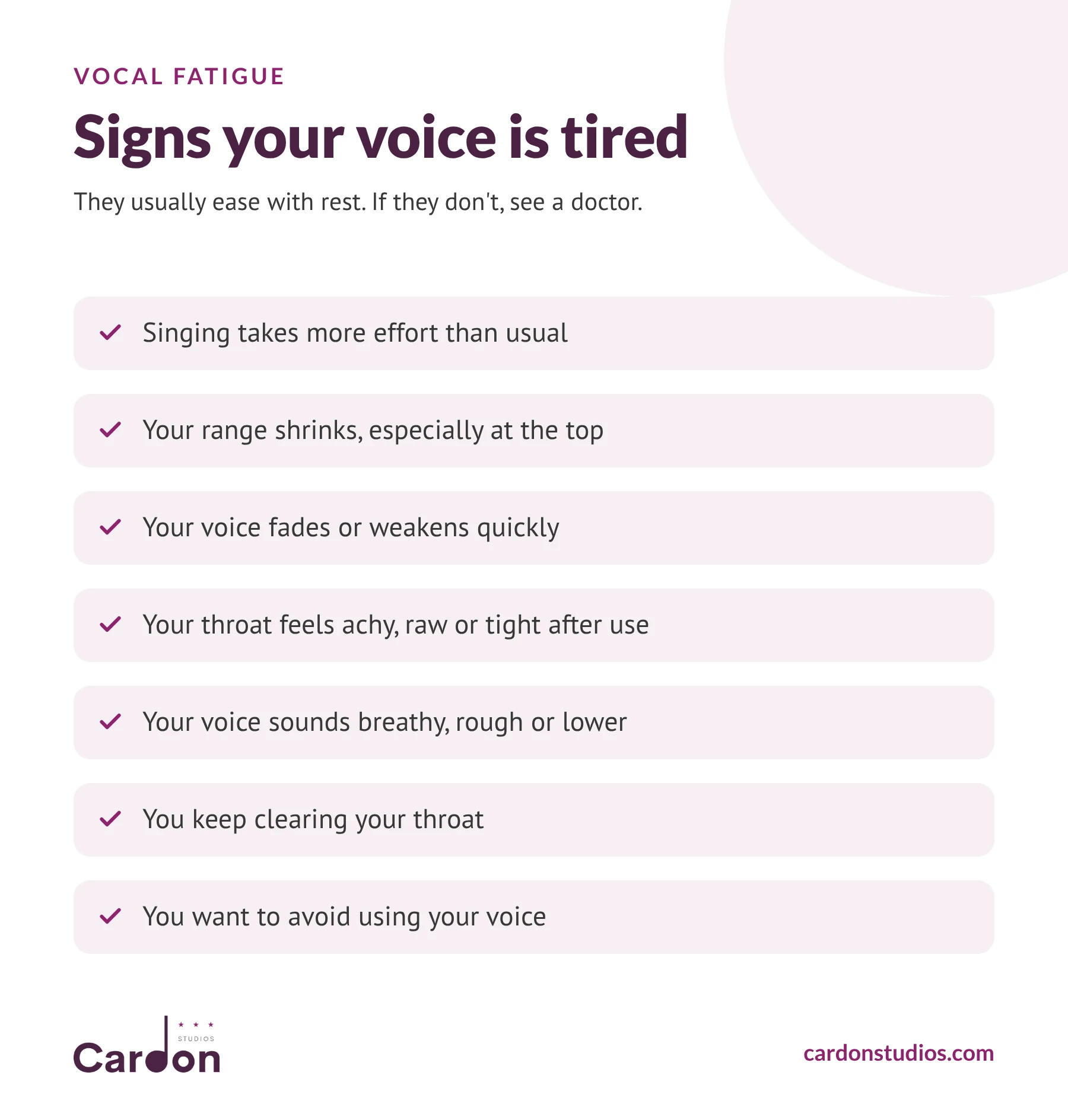
- Singing takes more effort. Phrases that felt easy now need a push, and you feel like you’re working harder for the same sound.
- Your range shrinks. NIDCD lists losing the ability to hit some high notes as a sign that your voice may not be healthy.
- Your voice tires quickly. It starts well, then fades or sounds weaker after a short time.
- Your throat feels achy, raw or tight. The discomfort comes from using your voice, not from swallowing.
- The sound changes. Your voice sounds breathy, rough or lower than usual, or it cracks where it normally doesn’t.
- You keep clearing your throat. Repeated throat clearing is another warning sign on NIDCD’s list.
- You want to stop talking. Avoiding your voice because it feels like work is one of the main patterns the Vocal Fatigue Index looks for.
The key question is whether the symptoms get better with rest. Fatigue that clears after a quieter day or two is a message to adjust how you use your voice. Symptoms that hang on, or that come with pain, are a reason to see a doctor (see when to see a doctor).
What causes vocal fatigue
Most vocal fatigue comes from asking more of your voice than it’s ready for, for longer than it’s ready for. The usual culprits are easy to spot once you know them.
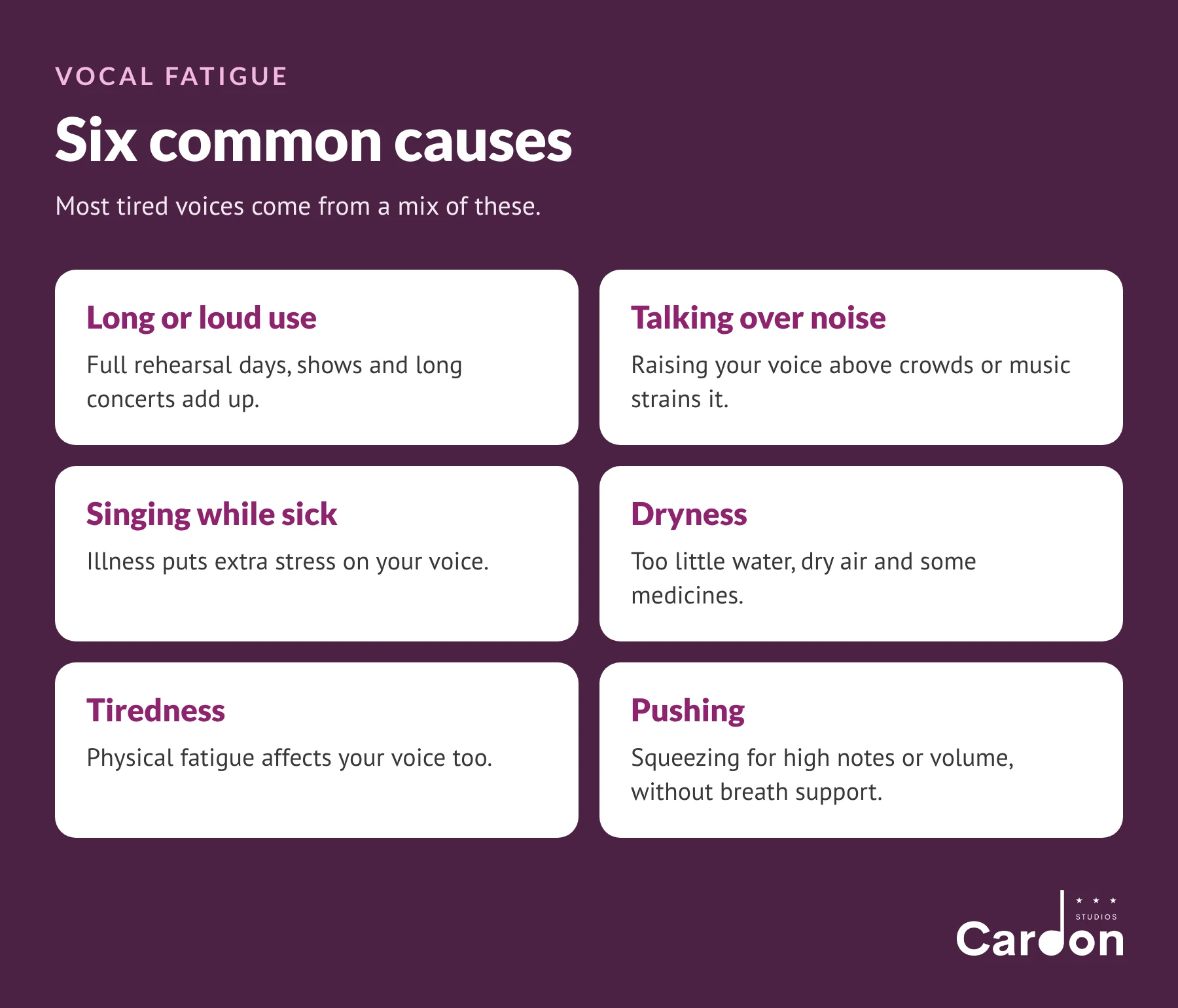
- Long or loud voice use. A full day of rehearsal, a show, a long choir concert, or teaching and then singing all add up. NIDCD advises against overusing your voice and against singing when your voice is already hoarse or tired.
- Talking over noise. Speaking above crowds, music or traffic strains the voice, according to NIDCD.
- Singing while sick. Colds and other illnesses put extra stress on the voice, so NIDCD recommends resting it when you’re unwell.
- Dryness. Not drinking enough water, dry winter air, and some cold and allergy medicines can dry out the vocal folds.
- Tiredness. NIDCD notes that physical fatigue has a negative effect on the voice. A short night before a long rehearsal is a common recipe for a tired voice.
- Technique under pressure. Squeezing for high notes, pushing for volume, or singing without good breath support makes the throat do work it shouldn’t. Our guide to singing without straining covers the most common habits.
Often it’s a combination. A singer with a cold who sleeps badly and then shouts over a noisy room is far more likely to end the day tired than one who has only a long rehearsal to get through.
Sore throat after singing: what it means and what to do
A sore throat after singing is usually your voice telling you it has been overworked. If your throat hurts after singing but you otherwise feel well, the most likely cause is too much singing, too loud or too high, or singing with tension. It should ease within a day or so of lighter use.
Pay attention to where and how it hurts. An ache or tightness around the throat and neck after a long session often points to muscle tension. Pain when you swallow, along with a fever or other cold symptoms, points to an illness rather than your singing. NIDCD advises seeing a doctor if you have pain when speaking or swallowing that doesn’t go away.
When your throat is sore from singing, try this:
- Stop singing for the day. Finish the session early, even if you planned more. Pushing through a sore throat is how fatigue turns into a bigger problem.
- Speak less and more gently. Use a relaxed, medium-volume speaking voice, and skip noisy places where you’d have to raise it.
- Drink water through the evening. NIDCD recommends staying well hydrated, and balancing any caffeine or alcohol with plenty of water.
- Breathe moist air. A humidifier helps in dry weather. NIDCD suggests about 30 percent humidity at home.
- Sleep. A good night’s rest is one of the best things you can do for a tired voice.
- Test gently the next day. Hum a few easy glides. If it feels normal, return to singing gradually. If it still hurts, give it more rest, and see a doctor if the soreness or hoarseness continues.
Vocal rest: how to rest your voice
Vocal rest means giving your voice a break from heavy use so the tissues and muscles can recover. For most tired voices, that means relative rest: using your voice less, more softly and more efficiently, rather than going completely silent.
NIDCD suggests taking vocal naps, short periods of quiet spread through the day. On a heavy day, that might mean staying silent on a break between rehearsals, texting instead of calling, or listening more than you talk at lunch.
| Type of rest | What it means | When it’s used |
|---|---|---|
| Vocal naps | Short quiet breaks through the day | Every heavy voice day, as prevention |
| Relative voice rest | Less talking and singing, at a gentle, medium volume | After a long rehearsal or when your voice feels tired |
| Complete voice rest | No speaking or singing at all | Only when a doctor advises it, for example after a vocal fold injury |
Two cautions. First, whispering is not a way to rest your voice. NIDCD lists whispering, along with screaming, as an extreme that can stress the voice. Use a soft, easy speaking voice instead. Second, complete silence is a medical instruction, not a home remedy. The American Academy of Otolaryngology–Head and Neck Surgery describes complete voice rest as part of the care for a vocal fold hemorrhage, which needs an exam by an ear, nose and throat specialist.
How long vocal rest takes depends on how tired your voice is and why. Mild fatigue after one long day often clears with an evening and a night of quiet. Fatigue that keeps coming back means something about your voice use or technique needs to change, and rest alone won’t fix it.
A plan for a tired voice after a heavy singing day
This plan is for ordinary vocal fatigue: a voice that feels tired and a little rough after heavy use but has no pain, no lasting hoarseness and no sudden loss of voice. If you have any of those, skip the plan and talk to a doctor.
| When | What to do | What to notice |
|---|---|---|
| The evening after | Stop singing, speak gently and little, drink water, and get a full night’s sleep. | Whether your speaking voice feels easier by bedtime |
| The next morning | Hum a few soft glides and a couple of easy lip trills. Keep your speaking voice relaxed and avoid noisy places. | Whether high notes start cleanly at a soft volume |
| Day two | If the glides feel normal, do a short, gentle warm-up and sing easy songs in the middle of your range. | Any return of effort, tightness or roughness |
| Day three | Build back toward your usual practice, adding range and volume gradually. | Whether your voice stays comfortable for a full session |
| After that | If symptoms keep returning, change the habits that tired your voice, and see a doctor if hoarseness lasts more than three weeks. | Patterns: which days and activities tire your voice |
Gentle semi-occluded exercises such as humming, lip trills and straw phonation are good first sounds when you come back, because they let the voice work with less effort. Stop any exercise that hurts.
How to prevent vocal fatigue
You can’t avoid every tired voice, but you can make fatigue much less frequent. These habits come straight from how fatigue happens.
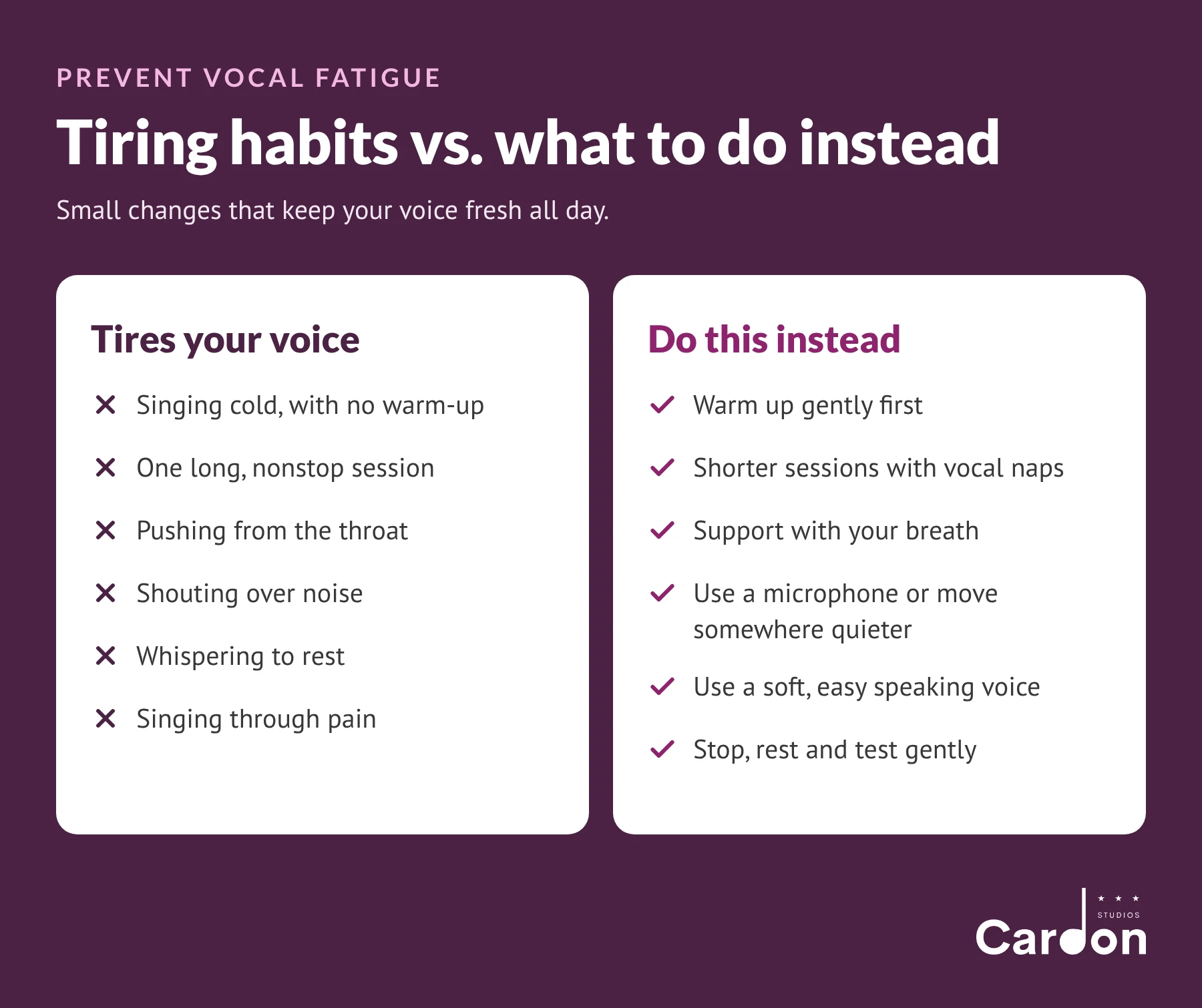
- Warm up before you sing. A short routine prepares your breath and voice for the work ahead. Our vocal warm-up routine has a quick version for busy days.
- Plan your voice day. If you have a show in the evening, keep the afternoon quiet. Spread practice into shorter sessions rather than one long one.
- Support with breath, not throat. NIDCD stresses that talking or singing from the throat without breath support puts strain on the voice. Our guide on how to breathe when singing walks you through it.
- Use a microphone when you can. NIDCD suggests amplification in places where you’d otherwise have to raise your voice for long periods.
- Stay hydrated and rested. Water, humid air and sleep all help your voice cope with a heavy day.
- Stop before it hurts. End a session while your voice still feels good. Fatigue often creeps in near the end of a long session, so plan your hardest singing earlier.
For everyday care beyond fatigue, see our guide to vocal health for singers.
When vocal fatigue needs a doctor
Vocal fatigue that clears with rest is common. Some symptoms are not ordinary fatigue, though, and need a medical exam. According to the NIDCD, see a doctor if:
- Your voice has been hoarse for more than three weeks, especially if you haven’t had a cold or the flu.
- You have pain when speaking or swallowing.
- You lose your voice completely for more than a few days.
- You cough up blood, have trouble swallowing or breathing, or feel a lump in your neck.
NIDCD also notes that losing your voice suddenly during strenuous use, such as yelling, may be a sign of a vocal fold hemorrhage, which needs total voice rest and prompt medical care. The specialist for voice problems is an otolaryngologist, also called an ear, nose and throat (ENT) doctor, who may refer you to a speech-language pathologist to help you change how you use your voice.
Listen to your voice
This article offers general guidance, not medical advice. Stop singing if you feel pain, and rest if your voice is hoarse or tired. According to the National Institute on Deafness and Other Communication Disorders, you should see a doctor if your voice has been hoarse for more than three weeks. For everyday care, see our guide to vocal health for singers.
From the studio
A voice that tires easily often has a technique habit behind it, and a teacher can spot it. In a live online lesson, your teacher can listen for pushing, squeezing or shallow breathing, adjust your warm-ups, and help you plan practice around rehearsals and performances. Between lessons, you can send a video of your singing for a personalized response from your teacher within two business days.
Online voice lessons
Build a voice that lasts all day
One monthly membership includes four private online voice lessons, one video coaching submission, the Learning Library, and member online events, with a teacher matched to your style, goals, age, and schedule.
Common questions about vocal fatigue
How long does vocal fatigue last?
Mild vocal fatigue after a single heavy day often eases after a night’s sleep and a quieter day or two. If it keeps coming back, or your voice stays hoarse for more than three weeks, see a doctor rather than waiting it out.
Is it OK to sing with a sore throat?
It’s best not to. NIDCD advises against singing when your voice is hoarse or tired, and resting your voice when you’re sick. Give it a day of light use, then test it gently with easy humming before you sing again.
Does whispering rest your voice?
No. Whispering can stress the voice too. If you need to talk while your voice is tired, use a soft, relaxed speaking voice at a comfortable pitch, and keep it brief.
What are the symptoms of vocal fatigue?
Common vocal fatigue symptoms include a voice that needs more effort, a smaller range, a voice that tires or fades quickly, an achy or tight throat after use, and a rough or breathy sound. These usually improve with rest.
Is vocal fatigue the same as vocal strain?
They’re closely related. Strain describes pushing or squeezing while you sing, and fatigue is how your voice feels and works after heavy or strained use. Reducing strain is one of the best ways to prevent fatigue.
Can online voice lessons help with vocal fatigue?
A teacher can help with the technique and practice habits behind a tired voice, but lessons don’t replace a doctor’s care for a voice problem. Lessons are live and one-on-one over Zoom, so your teacher can hear exactly how your voice is working.