


The best audition songs for baritones sit in the middle of the male range, show a warm, connected sound, and fit the style of the show and the type of role you want. Strong options include “This Is the Moment” from Jekyll & Hyde, “When Words Fail” from Shrek The Musical, “Luck Be a Lady” from Guys and Dolls and “If I Were a Rich Man” from Fiddler on the Roof. Below are musical theater audition song ideas for baritones, grouped by type, each with the show, the writers, the character and the role range the licensor publishes, plus tips for choosing and preparing yours.
Key takeaways
- Choose a song that shows your best range, not your highest note.
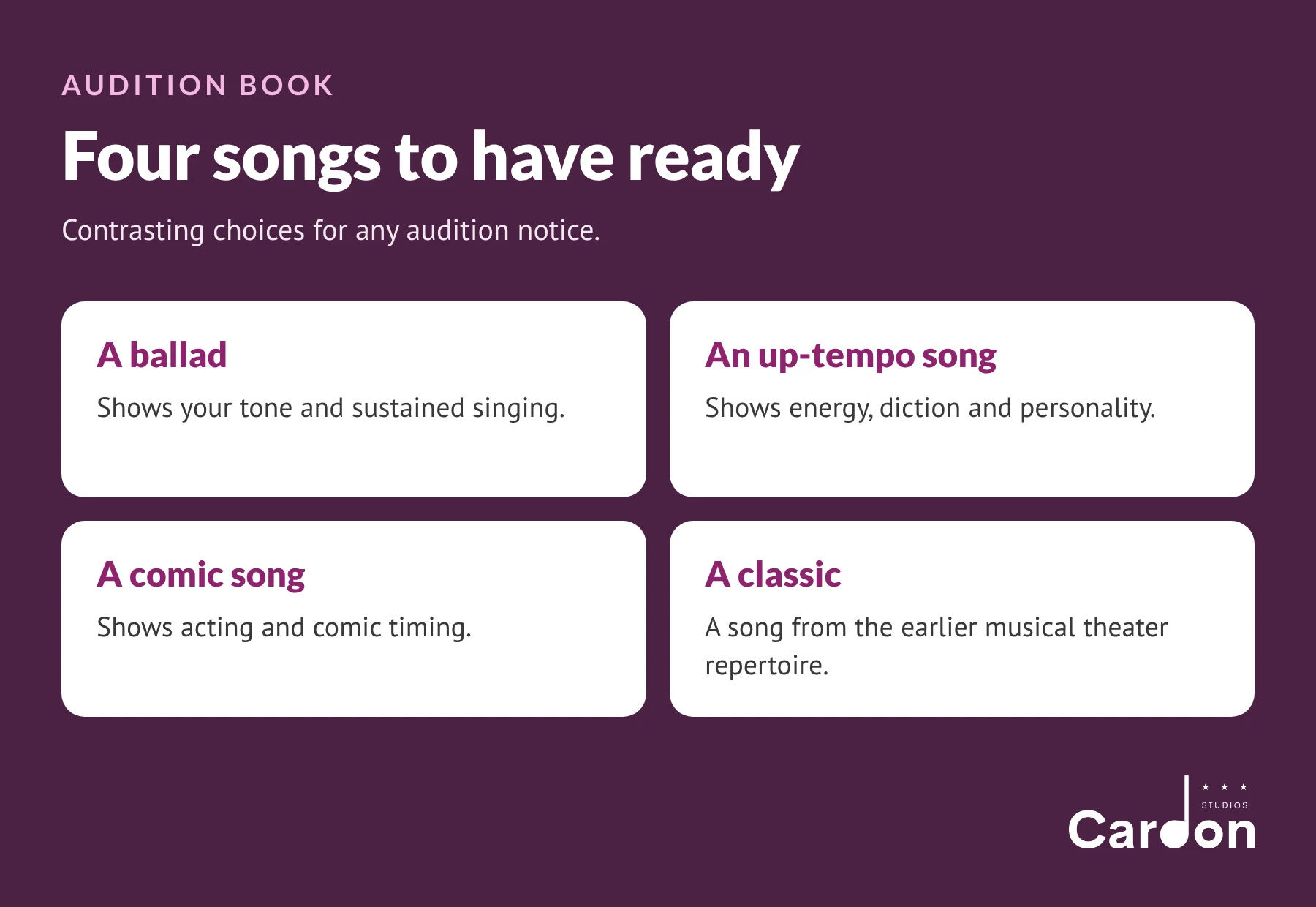
- Have a ballad, an up-tempo song and a comic song ready for different auditions.
- Match the style of the show and the type of role you’re auditioning for.
- Check each song’s range against your own, and bring music in the key you sing.
What makes a good baritone audition song
Baritone is the middle male voice, between tenor and bass. Baritones usually have a warm, full middle range and a top that can ring when it’s well coordinated, but feels heavy if it’s pushed. A good audition song keeps you mostly in the part of your voice that sounds best, with a high point you can hit easily on a good day and a bad one.
Not sure you’re a baritone? Our guide to voice types and vocal range helps you find out. Many singers sit between types, so compare each song’s range with your own rather than relying on the label.
The songs below come from musicals licensed by Music Theatre International. For each one, we’ve listed the show, its songwriters, the character who sings it, and the full role range MTI publishes in its character breakdowns, using the system in which C4 is middle C. A role’s range covers the whole part, so a single song may sit in a narrower band. Listen to each song in full and check the sheet music before you choose.
Ballads for baritones
| Song | Show and writers | Character | Role range |
|---|---|---|---|
| “This Is the Moment” | Jekyll & Hyde (Frank Wildhorn and Leslie Bricusse) | Jekyll | Bb2 to A4 |
| “When Words Fail” | Shrek The Musical (Jeanine Tesori and David Lindsay-Abaire) | Shrek | A2 to G#4 |
“This Is the Moment” is a big, building power ballad that suits a high baritone with a confident top; it’s also very well known, so make sure you can truly own it. “When Words Fail” is gentler and funnier, a touching song about a character who can’t find the right words, and it shows warmth and acting. Our main audition song guide also suggests “If I Can’t Love Her” from Beauty and the Beast and “How I Am” from Little Women.
Up-tempo and character songs
| Song | Show and writers | Character | Role range |
|---|---|---|---|
| “Luck Be a Lady” | Guys and Dolls (Frank Loesser) | Sky Masterson | B2 to Eb4 |
| “If I Were a Rich Man” | Fiddler on the Roof (Jerry Bock and Sheldon Harnick) | Tevye | Ab2 to F4 |
| “Grand Knowing You” | She Loves Me (Jerry Bock and Sheldon Harnick) | Steven Kodaly | B2 to A4 |
“Luck Be a Lady” is a classic, swaggering golden-age number for a leading man, and it sits comfortably for many lower baritones. “If I Were a Rich Man” is a character song that rewards storytelling and comic timing, and it suits older character roles. “Grand Knowing You” is a smooth, sly showcase for a charming rogue.
Comic songs
| Song | Show and writers | Character | Role range |
|---|---|---|---|
| “Dentist!” | Little Shop of Horrors (Alan Menken and Howard Ashman) | Orin | G2 to G4 |
| “I Am Aldolpho” | The Drowsy Chaperone (Lisa Lambert and Greg Morrison) | Aldolpho | A#2 to G4 |
“Dentist!” is a rock-and-roll villain song for a big, comic personality. “I Am Aldolpho” is a gloriously over-the-top character song for a self-proclaimed ladies’ man, perfect for showing comic commitment. Comic songs are great for character roles, but they still need clean, healthy singing underneath the comedy. “Marian the Librarian” from The Music Man, in our main guide, is another option with a charming, persuasive edge.
Song details come from MTI’s published character breakdowns and the shows’ song lists.
How to choose your song
Run each song you’re considering through these six checks before you commit to it.
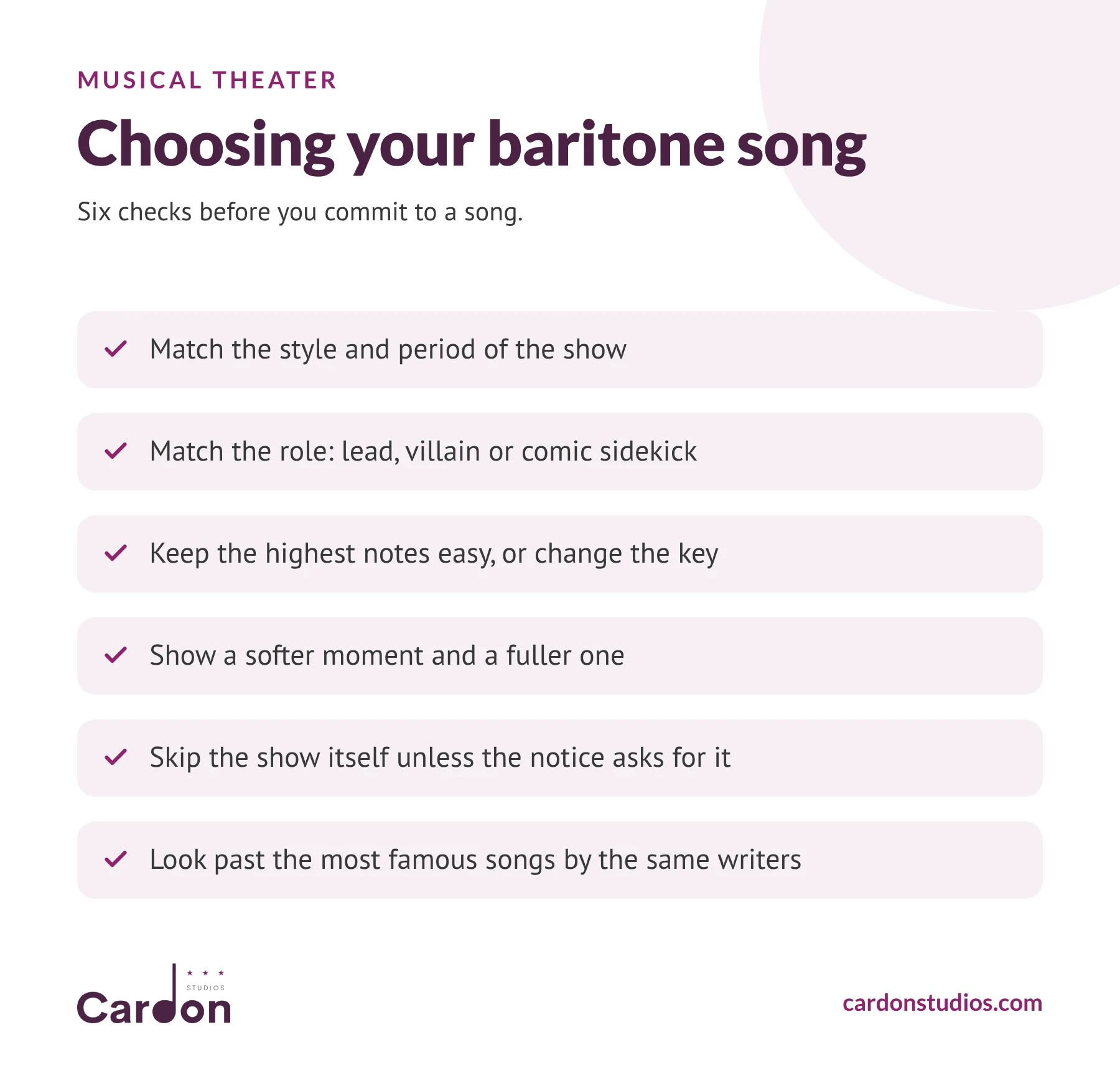
- Match the show’s style. Choose a golden-age song for a classic musical, and a contemporary song for a recent one, ideally by the same writers or from the same period.
- Match the role. A romantic lead, a villain and a comic sidekick each call for a different kind of song.
- Know your top. If a song’s highest notes are a stretch, choose another one, or another key. High baritones and singers between tenor and baritone have more options at the top; lower baritones may prefer songs that sit lower.
- Show more than one color. Choose a cut with at least one softer moment and one fuller moment, so the panel hears the range of your sound, not just its volume.
- Skip the show itself unless the audition notice asks for material from it.
- Look past the most famous songs. A strong, less familiar song by the same writers often makes a fresher impression.
If your top feels heavy or your voice cracks as you go higher, our guide to finding your mix for lower voices shows how to keep power without pushing.
Baritone musical theater songs matched to the audition: a worked example
The same list of baritone musical theater songs can serve very different auditions. Here’s how the checks above play out for three typical audition notices, using songs from the tables on this page.
| Audition notice | A good fit from this page | Why it works |
|---|---|---|
| A classic golden-age musical, leading-man roles | “Luck Be a Lady” | It matches the period and style, and its swagger and clear story show you can carry a leading role. |
| A recent musical, a warm or awkward hero | “When Words Fail” | A contemporary song that shows warmth, gentle humor and acting, not just volume. |
| A comedy with character roles | “I Am Aldolpho” or “Dentist!” | Big comic commitment on top of solid singing, which is what character roles call for. |
Three more steps turn a good fit into a strong audition. First, sing your cut through on a day you feel fresh and on a day you feel tired. If the highest note only works on the good day, choose a lower key or another song.
Second, read the character breakdown for the role you want and compare its range with your song’s. The panel should hear you in the part of your voice that role uses most. Third, prepare a contrasting second song, so that if you bring a ballad, you also have an up-tempo or comic song ready in case the panel asks for something different.
Record your cut and listen back a few days before the audition; our guide to recording yourself shows what to listen for. If nerves tend to tighten your top notes, our tips for conquering stage fright help you stay loose in the room.
Preparing your audition
Good preparation covers both the music you hand the accompanist and the story you tell.
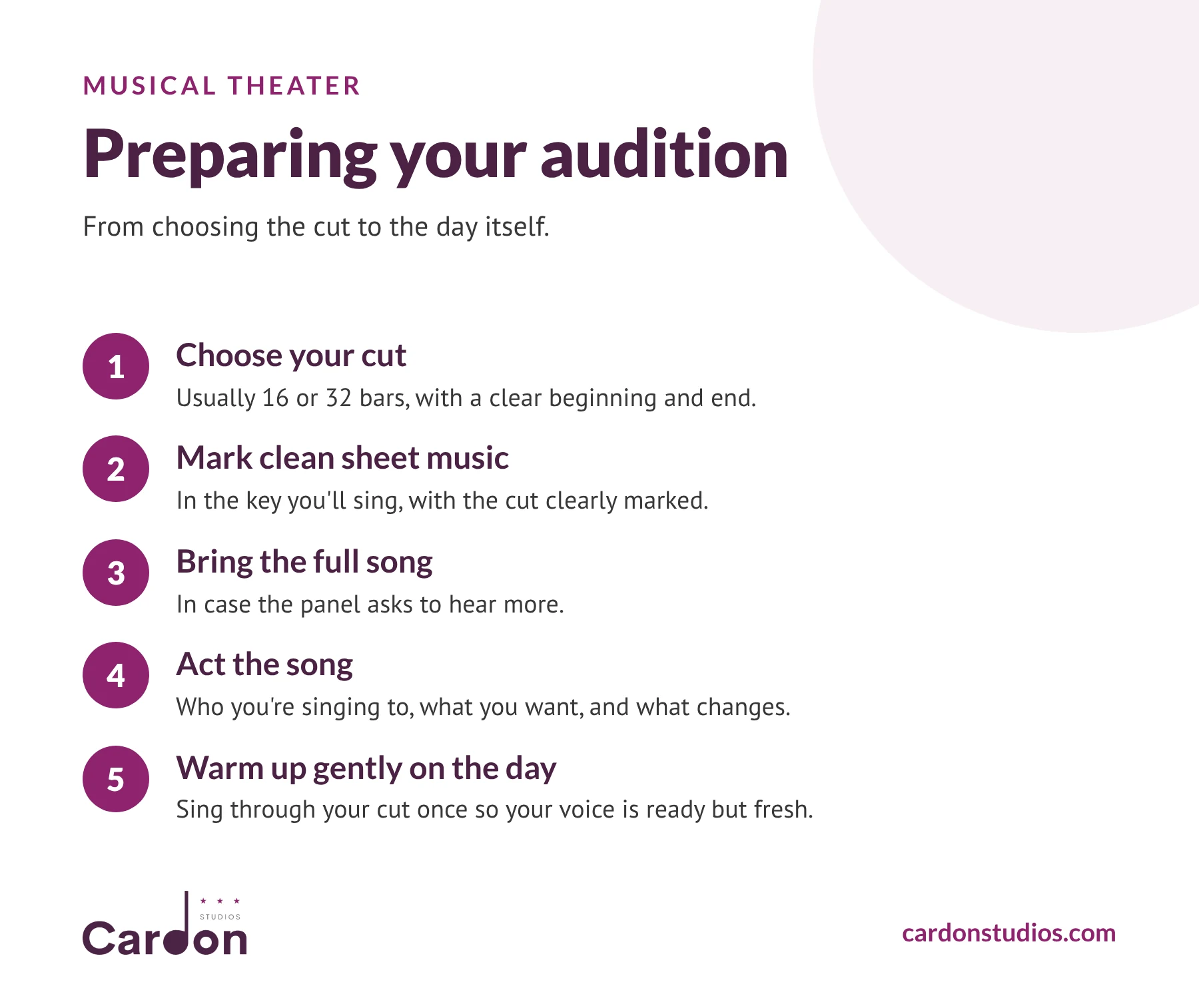
Most auditions ask for a short cut, usually 16 or 32 bars. Choose a section with a clear beginning and end that shows your voice and your character, and mark it clearly in clean sheet music in the key you’ll sing. Bring the full song too, in case the panel asks for more. Our audition song guide covers cutting your song and preparing your music, and our guide to community theater and school musical auditions walks you through the day.
Act the song, too. Decide who you’re singing to, what you want, and what changes by the end of the cut. A baritone who tells a clear story with an easy, connected sound is far more memorable than one who simply sings the notes loudly.
On the day, warm up gently and sing through your cut once before you leave, so your voice is ready but fresh. Our vocal warm-up routine includes a short version for performance days.
From the studio
Choosing and polishing an audition song is easier with an expert ear. In a live online lesson, your teacher can help you find songs that suit your voice and the roles you want, set a strong cut, and coach the acting. Between lessons, you can send a video of your audition song and get a personalized response within 72 hours.
Online voice lessons
Find the audition songs that fit your voice
One monthly membership includes four private online voice lessons, one video coaching submission, the Learning Library, and member online events, with a teacher matched to your style, goals, age, and schedule.
Common questions about baritone audition songs
What is a good audition song for a baritone?
One that sits mostly in your strongest range, fits the show’s style and the role you want, and lets you act the story. Options include “This Is the Moment,” “When Words Fail,” “Luck Be a Lady” and “If I Were a Rich Man.”
What’s the difference between a baritone and a tenor song?
Tenor songs usually sit higher and climb to higher climaxes, while baritone songs sit more in the middle of the male range. Many singers between the two can sing both; compare the song’s range with your own.
Can I sing a baritone song in a different key?
Usually, yes, as long as you bring clearly marked sheet music printed in your key. Don’t ask the accompanist to transpose at sight.
Should I sing a famous song at my audition?
You can, if you sing it exceptionally well. But very familiar songs are heard often, so a strong, less familiar song by the same writers can help you stand out.
How many audition songs should a baritone have ready?
At least two or three contrasting songs: a ballad, an up-tempo or character song, and a comic song. Add a classic and a contemporary option as your book grows.
What does a baritone voice sound like?
A baritone voice sounds warm and full in the middle of the male range, between the brighter tenor and the deeper bass. Its top can ring when it’s well coordinated. Our guide to voice types helps you tell which you are.
What are the best songs for baritones to practice?
Songs that sit mostly in your comfortable middle range, with a highest note you can reach easily. Start with gentler ballads, then add up-tempo and comic songs as your top grows more secure. A song is only right for you if it feels easy on an ordinary day.