

If your child sings in the car, in the school choir, or in their room with the door closed, you may be wondering whether voice lessons would help. Private lessons can give a young singer something rehearsals rarely can: time that’s entirely about their own voice. This guide covers when a young singer is ready, what lessons involve, how online lessons work, and how you can support them at home.
Key takeaways
- Readiness is about interest more than talent; Cardon Studios teaches singers ages 10 and up.
- Lessons combine healthy technique, songs your child cares about, musicianship, and performing.
- Changing voices are normal, and a good teacher adjusts as the voice develops.
- Parents help most by making practice easy, not by supervising it.
Is my child ready for voice lessons?
Readiness is less about talent than about interest. Good signs include:
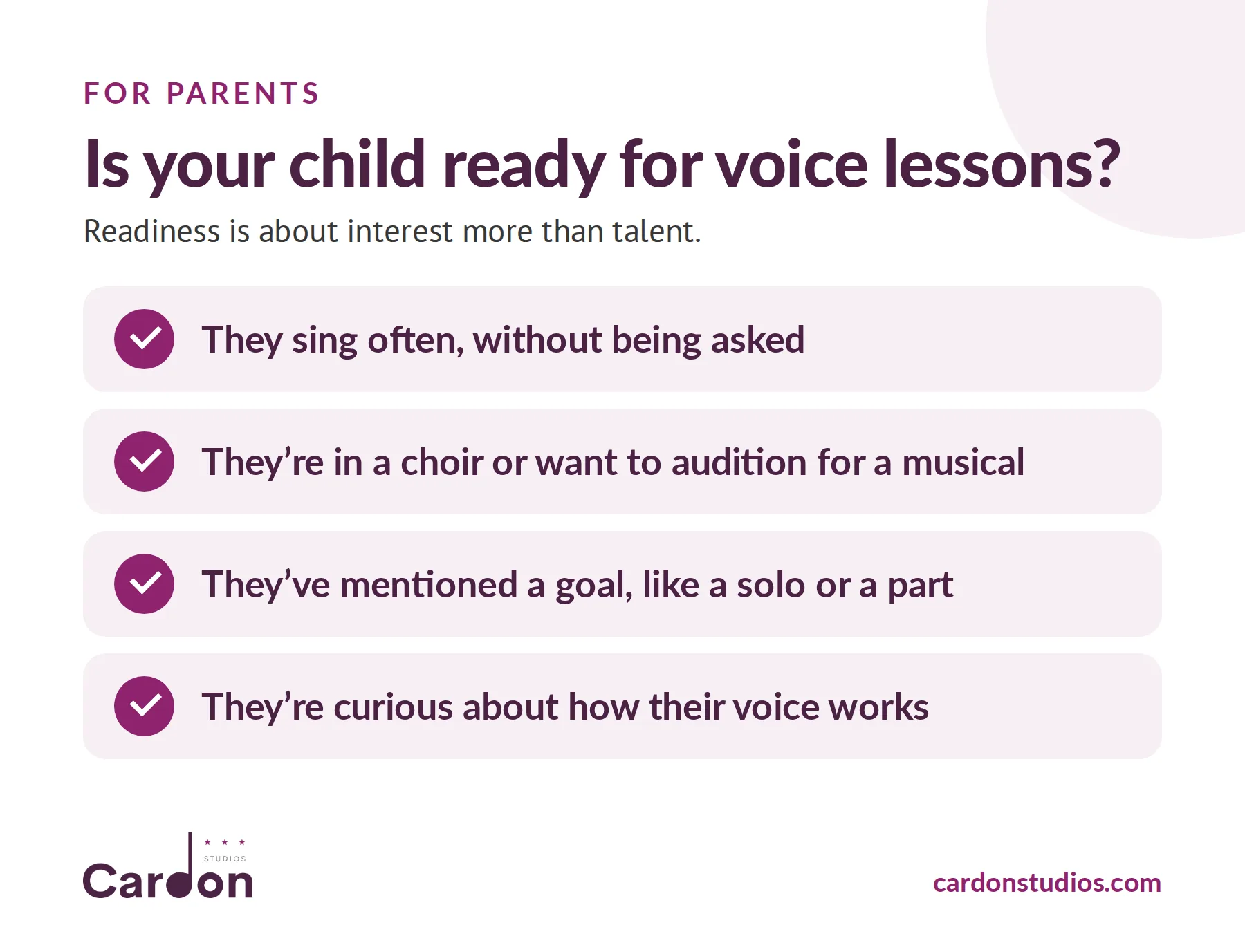
- They sing often on their own, without being asked.
- They’re in a school or community choir, or they want to audition for a musical.
- They’ve mentioned a goal: a solo, a part in the show, a song they want to sing well.
- They’re curious about how their voice works, or frustrated that it doesn’t do what they want yet.
Cardon Studios works with singers ages 10 and up. At that age most young singers can focus for a full lesson, practice a little on their own, and start to understand how their voice works.
What lessons cover for young singers
Every lesson is built around the singer in front of the teacher, not a fixed curriculum. For young singers, lessons usually combine:
- Healthy technique: breathing, posture, and comfortable coordination across their range, so singing feels easy rather than strained.
- Songs they care about: music from the school musical, a choir piece, or something they love from their own playlist.
- Musicianship: matching pitch, rhythm, reading their part, and learning songs more quickly.
- Performing: telling the story of a song, managing nerves, and building confidence.
What voice lessons can build
Beyond singing itself, regular lessons give young singers a chance to develop skills they use everywhere: the confidence to perform in front of others, the focus to work on something a little at a time, the listening skills that come with matching pitch and rhythm, and a healthy, comfortable way to use their voice. Just as important, they give your child a place to enjoy music on their own terms, alongside choir, school, and everything else.
What a first lesson looks like
In a first lesson, the teacher gets to know your singer: what music they love, what they’d like to be able to do, and where their voice is today. They’ll listen to your child sing a little and try some simple exercises, then suggest a plan and a few things to practice. Many young singers are nervous at first; teachers expect that and keep the first lesson relaxed and encouraging.
Changing voices are normal
During the preteen and teenage years, voices change, sometimes quickly. It’s common for a young singer’s range, tone, or control to shift for a while, for singers of any gender. A good teacher expects this and adjusts exercises and song choices as the voice develops, so your singer keeps making progress and doesn’t feel discouraged. If your child has ongoing hoarseness or pain when singing, check in with your doctor.
How online lessons work for kids and teens
At Cardon Studios, lessons are live and one-on-one over Zoom. Your singer is matched with a teacher by style, goals, age, and schedule, and can ask to work with a different teacher if the fit isn’t right. For singers under 18, a parent or guardian creates the account and pays for the membership.
Each month includes four private online voice lessons, one video coaching submission with a personalized response from the teacher within 72 hours, the Learning Library of warmups and exercises for practice between lessons, and member online events such as open mic nights, group classes, and recorded showcases. Lesson recordings are available in the student account, so your singer can rewatch what they worked on.
Online lessons fit around school, rehearsals, and activities without a drive across town. All you need is a computer, tablet, or phone with a camera and microphone, an internet connection, and a quiet place to sing.
How to support practice at home
Parents make a big difference, mostly by making practice easy rather than by supervising it.
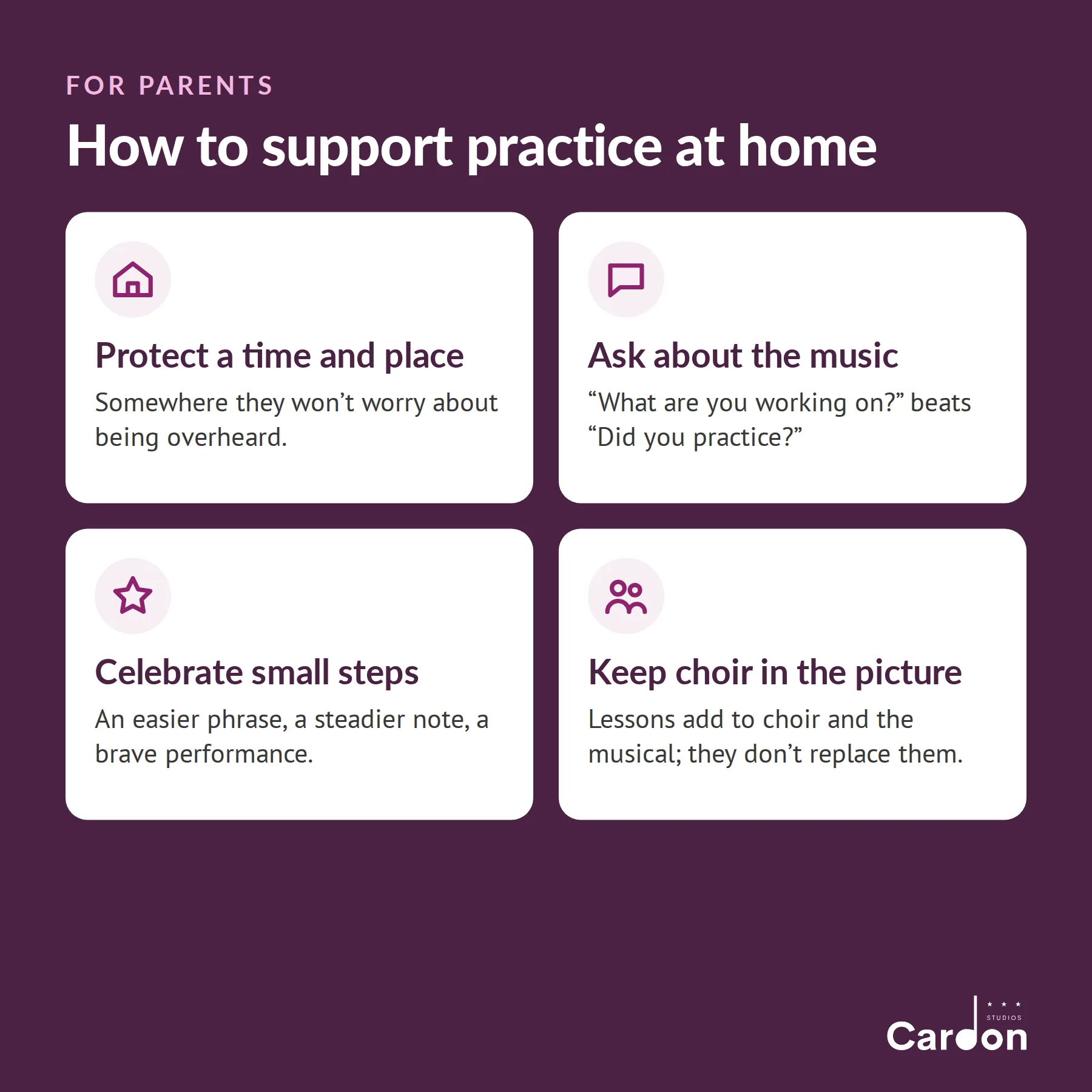
- Protect a regular time and a place where your singer can practice without worrying about being overheard.
- Ask about the music, not the minutes. “What are you working on this week?” lands better than “Did you practice?”
- Celebrate small steps: a phrase that’s easier, a note that’s steadier, a performance they were brave enough to try.
- Keep choir and the school musical in the picture. Lessons add to those experiences; they don’t replace them.
For more, read our article on why students quit music and how parents can help.
Choosing a voice teacher: questions to ask
- What training and teaching experience does the teacher have?
- Do they work with singers my child’s age and in the styles my child enjoys?
- How do they approach young and changing voices?
- What happens between lessons: is there support for practice?
- How do scheduling, billing, and cancellation work?
From the studio
Cardon Studios teachers have advanced musical training, performing experience, and training in voice science. Founder Kate Cardon taught music in K–12 classrooms before founding the studio in 2010; classroom and ensemble teaching showed her how much a singer can grow with individual attention, and how rarely there is time for it in a rehearsal. Today she selects and trains the studio’s teachers and matches each singer with the right one. You can meet the teachers here.
Online voice lessons
Give your singer time that’s all about their voice
One monthly membership includes four private online voice lessons, one video coaching submission, the Learning Library, and member online events, with a teacher matched to your singer’s style, goals, age, and schedule.
Common questions from parents
What’s the youngest age you teach?
Cardon Studios works with singers ages 10 and up.
Can I sit in on my child’s lessons?
Yes. Parents and guardians are welcome to attend lessons. Sitting in on the first one is a good way to see how your singer and their teacher work together.
Will lessons conflict with what my child’s choir director teaches?
They shouldn’t. Lessons are designed to support ensemble singing by building your child’s individual technique and confidence, and your singer can bring choir music to lessons to work through the parts they find difficult.
How much do lessons cost?
Membership is $295 per month, billed monthly, and includes four private online voice lessons, one video coaching submission, the Learning Library, and member online events. You can pause or cancel from the student account with 15 days’ notice before your next billing date.